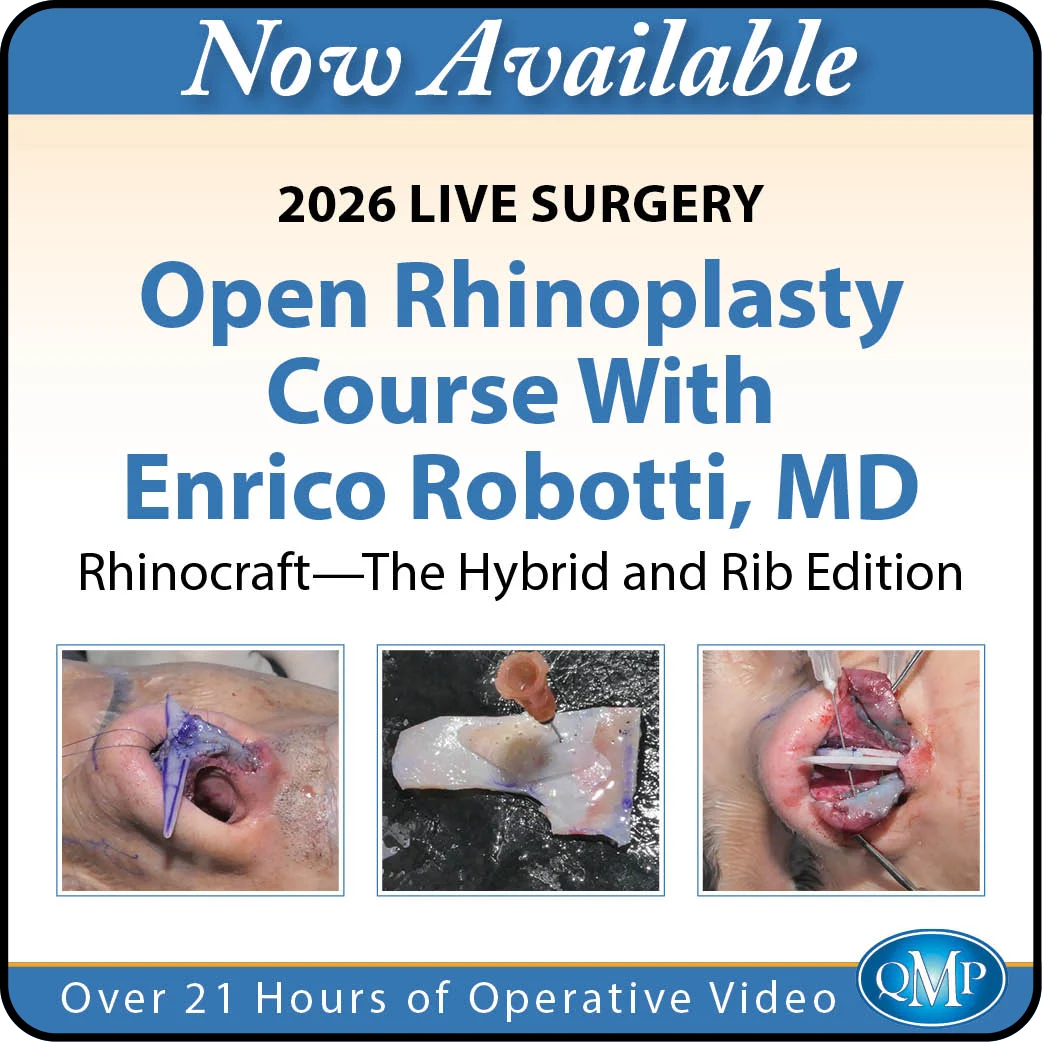
QMP 2026 Live Surgery Open Rhinoplasty Course With Enrico Robotti, MD Rhinocraft-The Hybrid and Rib Edition


$35.00
Watch Enrico Robotti, MD perform three primary and three revision rhinoplasty cases in more than 21 hours of operative video. Rhinocraft: The Hybrid and Rib Edition combines preservation and structural techniques with septal reconstruction, tip management, and rib cartilage grafting for advanced surgical study.
Delivery Information: This Product is shared via google drive download link. Please use your correct Gmail address at checkout.
Please note: there are no CME points or certificate associated with this course.
Samples for Courses Can be found here: Free Samples Here!
Enrico Robotti, MD demonstrates primary and revision open rhinoplasty through six detailed operative cases in QMP’s Rhinocraft: The Hybrid and Rib Edition. The first three cases combine preservation and structural techniques according to nasal anatomy, while the revision cases address altered support, deformity, and functional problems using reconstructive approaches that include rib cartilage. The demonstrations cover dorsal modification, septal work, tip support, osteoplasty, and graft selection, showing how individual maneuvers fit the overall operation. With more than 21 hours of operative video, this advanced surgical series offers plastic and facial plastic surgeons a case-based study of hybrid rhinoplasty and complex secondary reconstruction.
Topics:
6 Cases With Over 21 Hours of Operative Video:
- Case 1 – Primary Rhinoplasty in a 47-year-old Female Patient With Multiple Asymmetries of the Dorsum, Contour Irregularities, Extreme Bulbosity of the Tip, Hump, Excessive Tip Projection, and Functional Issues: Direct columella shortening, modified dorsal split, osteoplasty, high strip dorsal reduction, cartilaginous push down, septoplasty, septal fusion sling, medial crural transection overlap, full lateral crural transposition, multiple dome-refining sutures, columellar strut, and mini alar contour grafts.
- Case 2 – Primary Rhinoplasty in a 27-year-old Female Patient With Dorsal Hump, Excess Volume, and Wide Tip: Modified dorsal split, osteoplasty, sublaminar septal dissection, high strip dorsal reduction with inclusion of a portion of bony cap, three-point compartmentalization, septal extension graft, fusion sling, slide under of LLCs, lateral crural steal, dome-defining sutures, and alar wedges.
- Case 3 – Primary Rhinoplasty in a 34-year-old Female Patient With Thin Skin, Dorsal Hump, Droopy Tip, and Deviated Septum: Modified dorsal split, osteoplasty, sublaminar septal dissection, high strip full let down, three-point compartmentalization, double septal extension graft, fusion sling, turn under of LLCs, lateral crural steal, dome-defining sutures, diced cartilage, and alar wedges.
- Case 4 – Secondary Rhinoplasty in a 22-year-old Male Patient With Thin Skin, Severe Tip Deformity, Open Roof, Saddling of the Dorsum, Pollybeak, and Severe Functional Issues: Burr osteoplasty and piezoelectric selective osteotomies, full rib L-strut reconstruction, multiple tip grafts, perichondrium grafts, and SPLF graft to dorsum.
- Case 5 – Tertiary Rhinoplasty in a 33-year-old Female Patient With Tip Overprojection and Severe Overrotation, Alar Retraction, and Saddling of the Dorsum: Septum lengthening with composite graft of perforated PPE and septal cartilage, full L-strut reconstruction with rib extended spreaders and rib vertical element fixated to the spine, full tip reconstruction by extended and transposed lateral crural struts, interpositional grafts, perichondrium grafts to tip, and SPLF graft to the dorsum.
- Case 6 – Status Post Septoplasty in a 41-year-old Male Patient With Tip Drop, Axis Deviation, and Severe Functional Issues: Osteoplasty, Cottle septoplasty, full L-strut reconstruction with laminated rib grafts, modified dorsal split and spare roof type B dorsal reduction, septal extension graft, and multiple tip sutures.
Publisher: Quality Medical Publishing (QMP). Edition: 2026. The original QMP product is offered in HD streaming format; this independently delivered file package does not include a QMP streaming account. Operative recordings do not provide hands-on training, credentialing, or independent procedural competency. Appropriate surgical residency or fellowship training, supervised experience, anatomical knowledge, institutional credentialing, and patient-specific judgment remain necessary.
Related products
Plastic Surgery
Plastic Surgery
AMWC 19th Aesthetic & Anti-Aging Medicine World Congress 2021
Plastic Surgery
Osteocom Sutures, Materials, Instruments and Techniques – Korkurd Demirel, Burak Cankaya
Plastic Surgery
Plastic Surgery
Plastic Surgery