QMP Primary and Revision Rhinoplasty and Nasal Reconstruction, Volumes 1-3 2026


$60.00
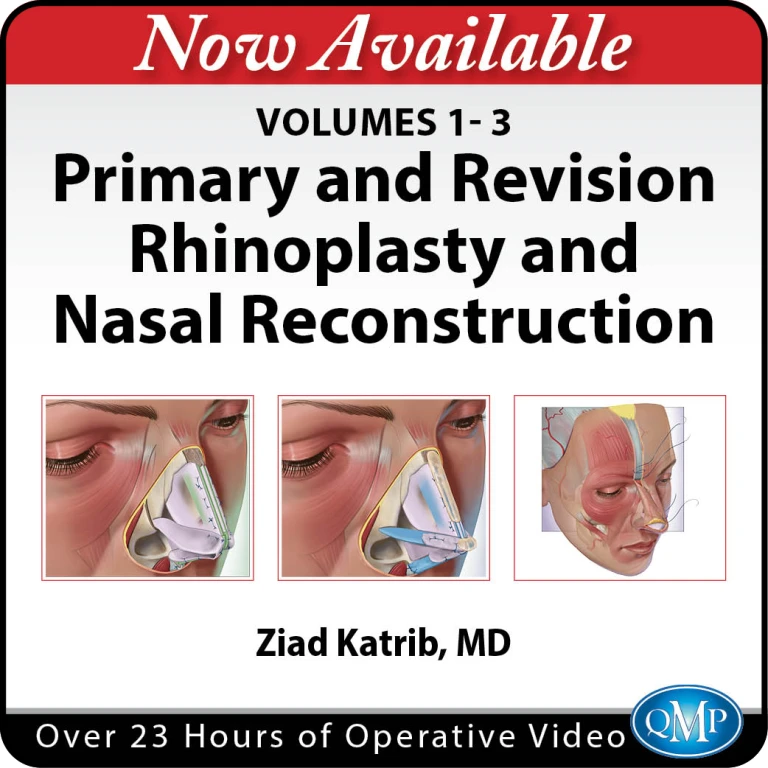
A three-volume operative video series with Ziad Katrib, MD, covering primary and revision rhinoplasty and staged forehead-flap reconstruction. The package lists 10 surgical cases and more than 23 hours of HD video, with English subtitles and audio. The complete case-by-case contents appear below.
Delivery Information: This Product is shared via google drive download link. Please use your correct Gmail address at checkout.
Please note: there are no CME points or certificate associated with this course.
Samples for Courses Can be found here: Free Samples Here!
Ziad Katrib, MD, demonstrates primary rhinoplasty, revision surgery, and forehead-flap nasal reconstruction in this three-volume QMP operative series. Ten surgical cases move from dorsal hump reduction, septoplasty, and tip refinement to rebuilding severely compromised nasal support and reconstructing complex defects. The case descriptions explain the grafts, structural decisions, and staged techniques shown in each operation, including rib cartilage harvest, septal reconstruction, and two-, three-, and four-stage forehead flaps. Released in September 2026, the collection is intended for surgeons and trainees studying the relationship between nasal form, airway function, and durable structural support.
Package
Three complete volumes; 10 surgical cases; 23+ hours of HD operative video, with English subtitles and audio.
Volume 1 – Primary Rhinoplasty: A Structural Approach to Natural and Functional Results
4 Cases | Over 8 Hours of Operative Video
Volume 1 – Video Contents
Volume 1 – Series Introduction
Introduction to the principles, surgical philosophy, and structural approach demonstrated throughout the primary rhinoplasty volume.
Case 1 – 23-year-old Female Patient With Crooked Wide Dorsum, Very Large Dorsal Hump, Deviated Septum, and Bulbous Tip
This case demonstrates:
- Component reduction of a large dorsal hump
- Osteotomies
- Nasal bone suture fixation
- Septoplasty
- Removal of a large septal spur
- Midvault reconstruction
- Donor rib spreader grafts
- Folded septal caudal septal extension graft
- Ethmoid splint
- Depressor septi nasi
- PRF membrane camouflage
- Primary tip suture-only techniques for refinement of a bulbous tip
Case 2 – 30-year-old Female Patient With Facial and Nasal Asymmetry, Large Dorsal Hump, Thin Skin, Deviated Septum, and Plunging Nasal Tip (Tension Nose)
Operative techniques demonstrated include:
- Component dorsal hump reduction
- Nasal bone osteotomies
- Full septoplasty
- Donor rib spreader graft reconstruction
- Folded septal caudal septal extension graft
- Ethmoid splinting
- Lateral crural steal
- Medial crural overlap
- Cranial tip suturing
- PRF membrane application for camouflage purposes
Case 3 – 36-year-old Female Patient With Wide Nasal Bones, Dorsal Hump, Low Radix, Extremely Wide Bulbous Tip, and Deviated Septum
This operative case includes:
- Dorsal hump reduction
- Precise osteotomies
- Narrowing of the wide bony pyramid
- Septoplasty
- Donor rib spreader graft placement
- Folded septal caudal septal extension graft
- Primary tip sutures
- Lateral crural steal
- Medial crural overlap
- Radix graft
- Intraoperative Kenalog solution application
Case 4 – 36-year-old Female Patient With Subtotal Septal Perforation, Severe Cocaine Nose Deformity, and Saddle Nose
A particularly complex structural reconstruction demonstrating:
- Correction of extreme saddle-nose deformity
- Harvesting of seventh, eighth and ninth ribs
- Preservation of perichondrium
- Reconstruction of the absent caudal septum
- Ninth rib graft reconstruction
- Release of nasal vestibular skin
- Eighth rib graft placement
- Fixation to nasal bones
- Primary tip suturing
- Diced rectus fascia application
Volume 2 – Revision Rhinoplasty: A Systematic Approach to Consistent Results
3 Cases | Over 9 Hours of Operative Video
Volume 2 – Video Contents
Volume 2 – Series Introduction
An introduction to Dr. Katrib’s systematic principles and operative approach to revision rhinoplasty.
Case 1 – 42-year-old Female Patient With Saddle Nose, Severe Columellar and Nostril Asymmetry, Small Pollybeak Deformity, and Wide Flat Tip
This case demonstrates:
- Seventh and ninth rib harvesting
- Perichondrium-preserving techniques
- Rectus fascia harvest
- Free perichondrium
- Full septoplasty
- Ninth rib septal extension graft
- Raised spreader grafts
- Saddle-nose correction
- Complete tip reconstruction
- Native lateral crural hinges
- Refined lateral crural replacement grafts
- Bridge and tip camouflage
- Management of supratip scarring
- Supratip control suturing
Case 2 – 54-year-old Female Patient With Short Nose, Crooked Nasal Bones, Overrotation of the Tip, Flat Retracted Columella (Previous Tongue in Groove), and Low Upper Dorsum
Techniques include:
- Seventh and ninth rib harvesting
- Rectus fascia
- Free perichondrium
- Asymmetric osteotomies
- Unilateral extended spreader grafting
- Ninth rib septal extension graft
- Extended spreader grafts
- Lateral crural strut grafts
- Tip reconstruction
- External valve reconstruction
- Upper dorsal augmentation
- Perichondrium
- Ultra-diced fascia and cartilage
Case 3 – 55-year-old Female Patient With Wide Nasal Bones, Extreme Saddle Nose, Severe Overrotation of the Nasal Tip, and Flat Retracted Columella
This advanced revision case demonstrates:
- Eighth and ninth rib harvesting
- Rectus fascia
- Free perichondrium
- Large bony pyramid movement
- Power tools and hand saw techniques
- Reconstruction of absent caudal and dorsal septum
- Raised and notched spreader grafts
- Ninth rib septal replacement graft
- Fixation to the nasal spine
- Maximal nasal tip derotation
- Total tip reconstruction
- Lateral crural hinges
- Lateral crural replacement grafts
- Tip, bridge and midvault camouflage techniques
Volume 3 – Forehead Flap Nasal Reconstruction: Principles & Practice
3 Cases | Over 6 Hours of Operative Video
Volume 3 – Video Contents
Volume 3 – Series Introduction
Introduction to forehead-flap nasal reconstruction principles and staged reconstructive planning.
Case 1 – Three-Stage Full-Thickness Paramedian Forehead Flap
73-year-old female patient with subtotal, large skin and soft-tissue defect of the tip, dorsum and soft triangles following resection of invasive nasal melanoma.
Stage 1
Demonstrates:
- Re-creation of the nasal defect
- Rib cartilage
- Strong tip support
- Columellar strut graft
- Primary tip suture techniques
- Rib tip grafting
- Alar rim grafting
- Full-thickness forehead flap
Stage 2
Demonstrates:
- Re-elevation of the forehead flap
- Thinning of the substructure
- Improvement of tip definition
- Tacking sutures
- Strategies to minimize fluid accumulation
Stage 3
Demonstrates:
- Pedicle management
- Medial eyebrow management
- Further flap thinning
- Final flap inset
- Tacking sutures
- Scar-tissue minimization strategies
Case 2 – Four-Stage Full-Thickness Folded Paramedian Forehead Flap
63-year-old female patient with a subtotal large skin and soft-tissue defect involving the tip and lower dorsum, together with a full-thickness defect of the left nasal ala.
Stage 1
- Re-creation of nasal defect
- Rib structural reconstruction
- Columellar strut graft
- Left alar rib batten graft
- Folded full-thickness forehead flap
- Reconstruction of internal nasal lining
- Management of forehead defect using wound matrix dressing
Stage 2
- Re-elevation of forehead flap
- Replacement of straight rib batten graft
- Convex ear cartilage batten graft
- Flap thinning
- Tacking sutures
Stage 3
- Pedicle management
- Medial eyebrow management
- Additional flap thinning
- Flap inset
- Tacking sutures
- Nostril retainers for preservation of nostril shape and size
Stage 4
- Re-creation of the left alar crease
- Nasal contour refinement
- Further nasal sidewall debulking
- Tacking sutures
- Final shape refinement
Case 3 – Two-Stage Forehead Flap for Nasal Tip Subunit Reconstruction
63-year-old female patient undergoing reconstruction of a nasal tip defect involving more than 50% of the nasal tip.
Stage 1
- Nasal tip subunit principle
- Excision of nasal tip subunit
- Primary tip suturing
- Improvement of tip definition
- Thin two-stage forehead flap
- Complete replacement of tip subunit
- Primary tacking sutures
Stage 2
- Pedicle management
- Medial eyebrow management
- Thinning of superior portion of flap
- Final reconstruction
- Tacking sutures
File scope: This purchase covers the educational files offered by MedicalAmboss. It does not include event registration, live attendance, publisher-platform access, accounts, memberships, apps, or publisher-hosted extras.
Related products


Dermatology



Dermatology