
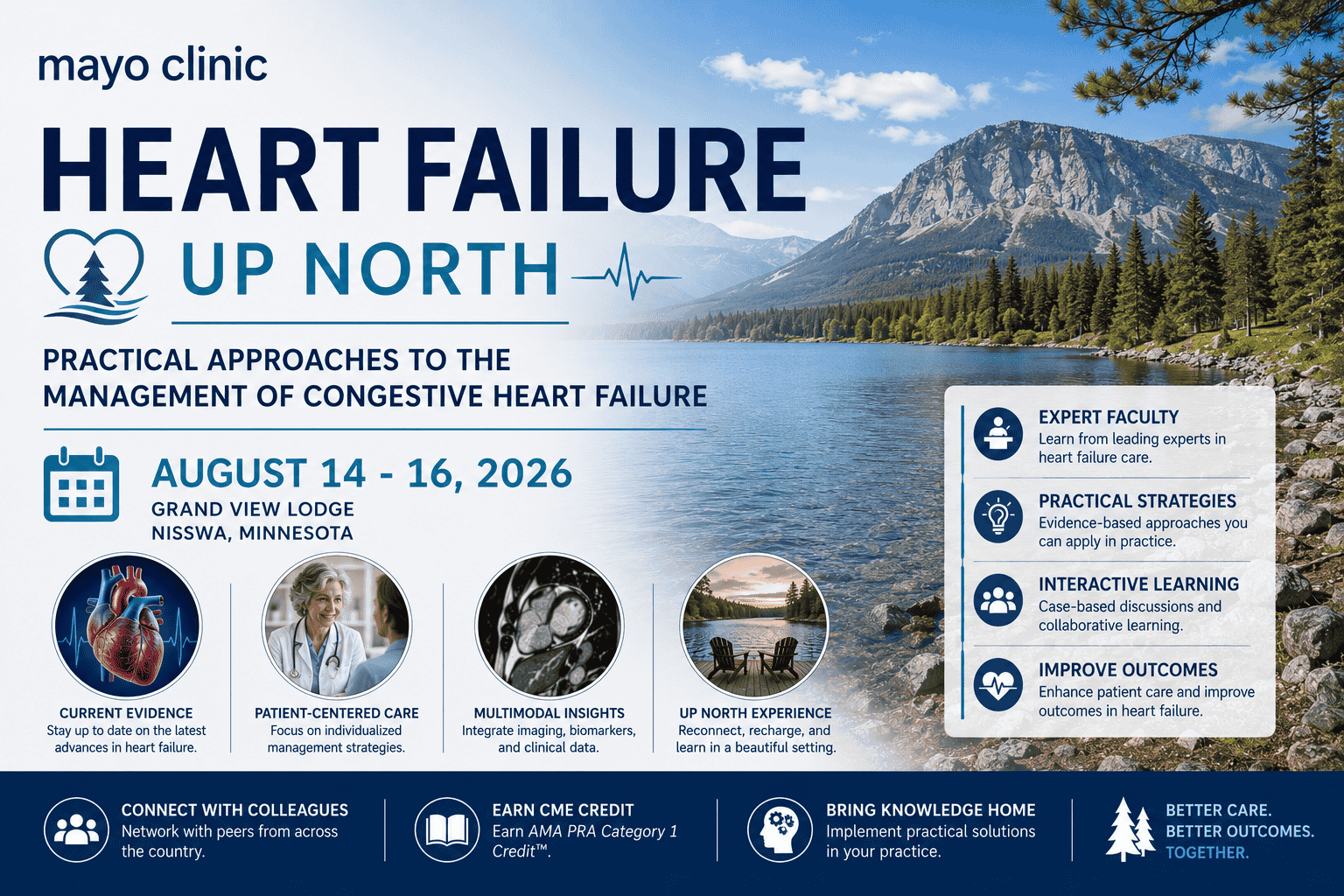
Mayo Clinic Heart Failure Up North Practical Approaches to the Management of Congestive Heart Failure August 14 – 16, 2026

$300.00
This Product is shared via google drive download link, So please share your correct Gmail id while placing the order .Please note that there are no CME points or certificate associated with this course Samples for Courses Can be found here : Free Samples Here!
Mayo Clinic Heart Failure Up North 2026
Practical Approaches to the Management of Congestive Heart Failure
August 14–16, 2026 | Grand View Lodge, Nisswa, Minnesota
Improve your practical approach to the diagnosis and management of heart failure with Mayo Clinic Heart Failure Up North: Practical Approaches to the Management of Congestive Heart Failure 2026.
This Mayo Clinic cardiovascular education program was held August 14–16, 2026, at Grand View Lodge in Nisswa, Minnesota.
Designed around the realities of heart failure encountered in everyday clinical practice, the 2.5-day course is primarily case based, supported by focused lectures covering core heart failure management, emerging therapies, hospital readmission, and advanced heart failure.
The curriculum emphasizes practical clinical decision-making across the heart failure spectrum, including:
- Recognition of the clinical syndrome of heart failure
- Identification of patients at risk
- Diagnostic evaluation
- Cardiovascular testing
- Pharmacologic treatment
- Non-pharmacologic management
- Emerging and novel therapies
- Hospitalized heart failure
- Prevention of hospital readmission
- Advanced heart failure
- Appropriate referral for advanced therapies
- Multidisciplinary heart failure care
Course Details
- Course: Heart Failure Up North: Practical Approaches to the Management of Congestive Heart Failure
- Provider: Mayo Clinic
- Year: 2026
- Dates: August 14–16, 2026
- Duration: 2.5 Days
- Venue: Grand View Lodge
- Location: Nisswa, Minnesota, USA
- Format of Original Activity: In-Person or Livestream
- Primary Specialty: Cardiology
- Major Focus: Heart Failure
- Original Activity: Up to 15.25 Credit Hours
- Language: English
Course Overview
Heart failure is not a single disease but a complex clinical syndrome resulting from structural or functional cardiac abnormalities.
Patients may present at very different stages, from:
Risk Factors → Early Cardiac Dysfunction → Symptomatic Heart Failure → Recurrent Hospitalization → Advanced Heart Failure
The Mayo Clinic Heart Failure Up North course focuses on the decisions clinicians make throughout this continuum.
Rather than concentrating primarily on theoretical cardiovascular science, the program is designed around practical questions encountered in daily practice:
- Does this patient have heart failure?
- Which patients are at increased risk?
- What diagnostic testing is required?
- How should therapy be initiated and optimized?
- What non-pharmacologic interventions are useful?
- How should patients be monitored?
- How can hospital readmissions be reduced?
- When should emerging therapies be considered?
- When has disease progressed to advanced heart failure?
- When should the patient be referred to an advanced heart failure center?
Learning Objectives
Upon conclusion of the original Mayo Clinic program, participants should be better able to:
- Recognize the clinical syndrome of heart failure.
- Identify patients at increased risk for heart failure.
- Describe diagnostic testing essential for diagnosis and management.
- Apply appropriate pharmacologic management strategies.
- Apply appropriate non-pharmacologic strategies.
- Manage patients across the spectrum of heart failure.
- Recognize when advanced heart failure evaluation is needed.
- Determine when referral for advanced heart failure therapies is indicated.
- Evaluate the evolving role of novel therapies in heart failure treatment.
Recognizing Heart Failure
The first challenge in heart failure management is establishing the correct diagnosis.
Patients may present with symptoms such as:
- Dyspnea
- Exercise intolerance
- Fatigue
- Orthopnea
- Paroxysmal nocturnal dyspnea
- Peripheral edema
- Weight gain
- Reduced functional capacity
These symptoms are not specific to heart failure, making an organized diagnostic approach important.
Identifying Patients at Risk
The course emphasizes recognizing not only established heart failure but also patients at risk.
Important clinical factors can include:
- Hypertension
- Coronary artery disease
- Previous myocardial infarction
- Diabetes
- Obesity
- Valvular heart disease
- Cardiomyopathy
- Arrhythmias
- Kidney disease
- Other cardiovascular risk factors
Early recognition of risk can support preventive treatment and closer clinical follow-up.
Diagnostic Evaluation of Heart Failure
Heart failure diagnosis requires integration of:
History + Physical Examination + Laboratory Testing + Cardiac Imaging + Clinical Context
No single test should be interpreted in isolation.
Clinical Assessment
Evaluation may include:
- Symptom history
- Functional limitation
- Previous cardiovascular disease
- Medication history
- Volume status
- Blood pressure
- Heart rate
- Physical examination
- Comorbidities
These findings help establish both diagnosis and severity.
Cardiac Imaging
Cardiac imaging plays an important role in determining:
- Ventricular function
- Cardiac structure
- Valve disease
- Chamber enlargement
- Potential underlying causes
Echocardiography is commonly central to the initial evaluation, while additional imaging may be appropriate depending on the clinical question.
Heart Failure Across the Spectrum
Heart failure can occur across different phenotypes and clinical stages.
A practical management strategy requires attention to:
- Ventricular function
- Symptoms
- Congestion
- Comorbidities
- Etiology
- Previous hospitalization
- Response to therapy
The goal is individualized treatment rather than applying the same management strategy to every patient.
Pharmacologic Management
One of the key Mayo Clinic learning objectives is applying appropriate pharmacologic strategies across the spectrum of heart failure.
Medication management requires clinicians to consider:
- Heart failure phenotype
- Blood pressure
- Renal function
- Electrolytes
- Volume status
- Comorbidities
- Drug tolerance
- Previous therapy
Optimizing Medical Therapy
Successful heart failure treatment involves more than prescribing a medication once.
Patients may require:
Start Therapy → Assess Tolerance → Titrate → Monitor → Reassess Symptoms and Risk
This longitudinal approach is particularly important in a chronic condition such as heart failure.
Medication Safety
Clinical follow-up may include monitoring of:
- Blood pressure
- Renal function
- Electrolytes
- Weight
- Symptoms
- Adverse effects
- Treatment adherence
The therapeutic plan should be adjusted according to patient response and clinical status.
Non-Pharmacologic Management
The Mayo Clinic objectives specifically include non-pharmacologic strategies.
Heart failure care can involve attention to:
- Patient education
- Daily symptom monitoring
- Weight monitoring
- Diet
- Physical activity when appropriate
- Medication adherence
- Management of cardiovascular risk factors
- Comorbidity management
- Recognition of worsening symptoms
Patient Education
Effective heart failure management depends heavily on patient participation.
Patients should understand:
- Their diagnosis
- Their medications
- Warning symptoms
- Follow-up requirements
- When to contact their healthcare team
Education can support earlier recognition of decompensation and better long-term management.
Novel Therapies in Heart Failure
An important 2026 course objective is to:
Evaluate the role of novel therapies in the treatment of heart failure.
Modern heart failure care continues to evolve through:
- New pharmacologic approaches
- New monitoring strategies
- Device-based therapy
- Structural heart interventions
- Advanced heart failure therapies
The clinical challenge is determining which innovations are appropriate for which patients.
Evidence-Based Adoption of New Therapies
A new therapy should be evaluated according to:
- Patient population studied
- Clinical indication
- Expected benefit
- Safety
- Contraindications
- Practical implementation
- Interaction with existing therapy
The goal is not simply to use newer treatment but to select evidence-based therapy for the appropriate patient.
Hospitalized Heart Failure
Hospitalization represents an important transition point in the natural history of heart failure.
Clinical management requires attention to:
- Reason for decompensation
- Congestion
- Hemodynamics
- Medication changes
- Comorbid illness
- Discharge planning
- Early follow-up
Preventing Heart Failure Readmissions
Hospital readmission is specifically highlighted by Mayo Clinic as one of the major themes of the course.
Reducing preventable readmission requires attention to the entire transition from inpatient to outpatient care.
A useful pathway is:
Stabilize → Identify Trigger → Optimize Treatment → Educate → Reconcile Medications → Arrange Follow-Up → Monitor
Causes of Recurrent Decompensation
Clinicians should evaluate potential contributors such as:
- Disease progression
- Inadequate therapy
- Medication adherence
- Dietary factors
- Arrhythmia
- Ischemia
- Infection
- Renal dysfunction
- Other comorbid illness
Understanding why a patient deteriorated can help guide future prevention.
Transition of Care
Effective transition from hospital to home may require coordination among:
- Cardiologists
- Primary care physicians
- Heart failure specialists
- Nurse practitioners
- Physician assistants
- Pharmacists
- Nursing teams
- Patients and caregivers
Heart failure is therefore an important example of multidisciplinary chronic disease management.
Advanced Heart Failure
The course specifically addresses advanced heart failure and when patients should be referred for more specialized evaluation.
Potential warning signs can include:
- Progressive symptoms despite therapy
- Recurrent hospitalization
- Increasing intolerance of standard treatment
- Progressive end-organ dysfunction
- Worsening functional capacity
- Persistent congestion
- Increasing treatment complexity
When to Refer
An important learning objective is determining:
When Is Standard Heart Failure Care No Longer Enough?
Timely referral can allow appropriate evaluation before severe clinical deterioration limits therapeutic options.
Advanced Heart Failure Therapies
Advanced heart failure programs may evaluate selected patients for therapies beyond conventional medical treatment.
The course objective focuses on helping clinicians recognize when referral for advanced therapy evaluation is appropriate rather than expecting every primary care clinician to manage advanced therapies independently.
Multidisciplinary Heart Failure Care
Patients with heart failure frequently have additional conditions such as:
- Kidney disease
- Diabetes
- Hypertension
- Coronary disease
- Obesity
- Arrhythmias
- Pulmonary disease
- Frailty
Optimal care may therefore involve multiple specialties.
Heart Failure in Primary Care
Primary care clinicians have an important role in:
- Identifying risk
- Recognizing new symptoms
- Coordinating diagnostic testing
- Managing comorbidities
- Supporting medication adherence
- Monitoring clinical status
- Recognizing deterioration
- Coordinating referral
This makes the Mayo Clinic program relevant beyond dedicated heart failure specialists.
Case-Based Education
The original Mayo Clinic course is described as primarily case based.
Case-based learning allows clinicians to work through questions such as:
What Is the Diagnosis? → What Testing Is Required? → What Treatment Should Be Started? → What Should Be Monitored? → Is Referral Needed?
This approach makes the content particularly applicable to everyday clinical practice.
Major Topics Covered
- Heart Failure
- Congestive Heart Failure
- CHF
- Heart Failure Diagnosis
- Heart Failure Risk Assessment
- Cardiovascular Testing
- Cardiac Imaging
- Heart Failure Pharmacotherapy
- Guideline-Based Heart Failure Care
- Non-Pharmacologic Heart Failure Management
- Novel Heart Failure Therapies
- Hospitalized Heart Failure
- Heart Failure Readmission
- Transition of Care
- Advanced Heart Failure
- Advanced Heart Failure Referral
- Heart Failure Monitoring
- Multidisciplinary Heart Failure Care
- Primary Care Cardiology
- Case-Based Cardiology
Who Should Take This Course?
The official Mayo Clinic program is intended for clinicians caring for patients with heart failure, particularly:
- Primary Care Physicians
- Cardiologists
- Heart Failure Clinicians
- Nurse Practitioners
- Physician Assistants / Associates
It is also relevant for:
- Internal Medicine Physicians
- Cardiology Fellows
- Internal Medicine Residents
- Hospitalists
- Cardiovascular Nurses
- Healthcare professionals involved in longitudinal heart failure management
Why This Course Is Useful
Mayo Clinic Heart Failure Up North 2026 is designed around the real-world decisions clinicians face when managing congestive heart failure.
The program helps learners review:
- Recognition of heart failure
- Heart failure risk
- Diagnostic testing
- Medical management
- Non-pharmacologic treatment
- Emerging therapies
- Hospital management
- Readmission prevention
- Advanced heart failure
- Referral decisions
The overall learning pathway is:
Recognize → Diagnose → Classify → Treat → Optimize → Monitor → Prevent Readmission → Refer When Advanced
Original Mayo Clinic Accreditation
The original 2026 Mayo Clinic activity offered up to:
- 15.25 AMA PRA Category 1 Credits™
- 15.25 ABIM MOC Points
- 15.25 ABS MOC Points
- 15.25 AAPA Credits
- 15.25 Nursing Credits
for eligible participants completing the official Mayo Clinic activity requirements.
Important Independent Product Notice
These credits belong to participation in the official Mayo Clinic educational activity.
An independently supplied recording or digital product should not be advertised as including Mayo Clinic CME, MOC, AAPA, Nursing credits, or a Mayo Clinic certificate unless official participation and credit eligibility are specifically included.
Product Information
- Product: Mayo Clinic Heart Failure Up North: Practical Approaches to the Management of Congestive Heart Failure 2026
- Provider: Mayo Clinic
- Dates: August 14–16, 2026
- Venue: Grand View Lodge
- Location: Nisswa, Minnesota
- Original Format: In-Person or Livestream
- Primary Specialty: Cardiology
- Focus: Heart Failure
- Original Activity: 15.25 Credit Hours
4. Short Description
Mayo Clinic Heart Failure Up North 2026 – Practical Approaches to the Management of Congestive Heart Failure provides a primarily case-based update on heart failure encountered in daily clinical practice.
The program focuses on heart failure recognition, risk assessment, essential diagnostic testing, pharmacologic and non-pharmacologic management, novel therapies, hospitalized heart failure, readmission prevention, and identification of patients who should be referred for advanced heart failure therapies.
+ Topics:
FRIDAY, AUGUST 14, 2026
Welcome
HEART FAILURE ASSESSMENT AND MANAGEMENT
Is This (Congestive) Heart Failure? Making the Clinical Diagnosis
Outpatient Heart Failure Medical Management: What Do the Guidelines Say
CLINICAL CASE VIGNETTES
Care for Patient Presenting with HFrEF
Care for Patient Presenting with HFpEF
Outpatient Social Determinants of Health (SDOH) Challenges
TOOLS FOR HEART FAILURE ASSESSMENT
The Role of Imaging in Heart Failure
Hemodynamics and Role of Right Heart Cath Assessment in Heart Failure
Right Heart Failure
Role of Genetic Testing in Heart Failure
OPTIMIZATION OF HEART FAILURE PATIENTS
Beyond the 4 Pillars
Titration / Patient Compliance
Daily Summary: 4 Things to Know
Cardiac Amyloid: What Every Cardiac Provider Needs to Know
SATURDAY, AUGUST 15, 2026
Congenital Heart Disease and Heart Failure
OPTIMIZATION AND RISK FACTOR MODIFICATIONS IN HEART FAILURE
Stage A/B Heart Failure
Hypertension and Risk Factor Management in the Heart Failure Patient
GLP1: What Do I Need To Know
Cardio-Obstetrics in Heart Failure
Pulmonary Hypertension
STRUCTURAL DISEASE IN HEART FAILURE
Valve Disease Assessment
Valve Disease Management in Practice for Heart Failure
Cardiac Amyloid: Cardiac MRI and Nuclear Imaging
Hypertrophic Cardiomyopathy
CLINICAL CASE VIGNETTES
Mitral Valve Repair (Clip) – HF Patient
ACHD / Aortopathy
Daily Summary: 4 Things to Know
SUNDAY, AUGUST 16, 2026
Early Bird: ECG Review
HEART RHYTHM AND INTERVENTIONS IN HEART FAILURE
Rate vs. Rhythm Control: Management of Atrial Arrhythmias in Heart Failure
Common Dysrhythmias in Patients with Heart Failure
Novel ICD and Pacing Strategies in Heart Failure
CLINICAL CASE VIGNETTES
In-Patient Heart Failure Patient
Advanced Heart Failure in the Cardiac Critical Care Unit
Patients that Benefit from ICD/CRT Therapy
Sudden Cardiac Death
HOSPITALIZED PATIENT AND HEART FAILURE
Cardiorenal Syndrome and Heart Failure
Mechanical Circulatory Support and Cardiac Transplant
Is This Advanced Heart Failure: When to Refer for LVAD/Transplant
Closing Comments & Daily Summary: 4 Things to Know
Related products

Internal Medicine

Internal Medicine

Internal Medicine
Anesthesiology & pain medicine
Critical Care Symposium: Mastering ED Mechanical Ventilation

Cardiology

Medical Accounts

Critical Care - Emergency medicine

Critical Care - Emergency medicine