
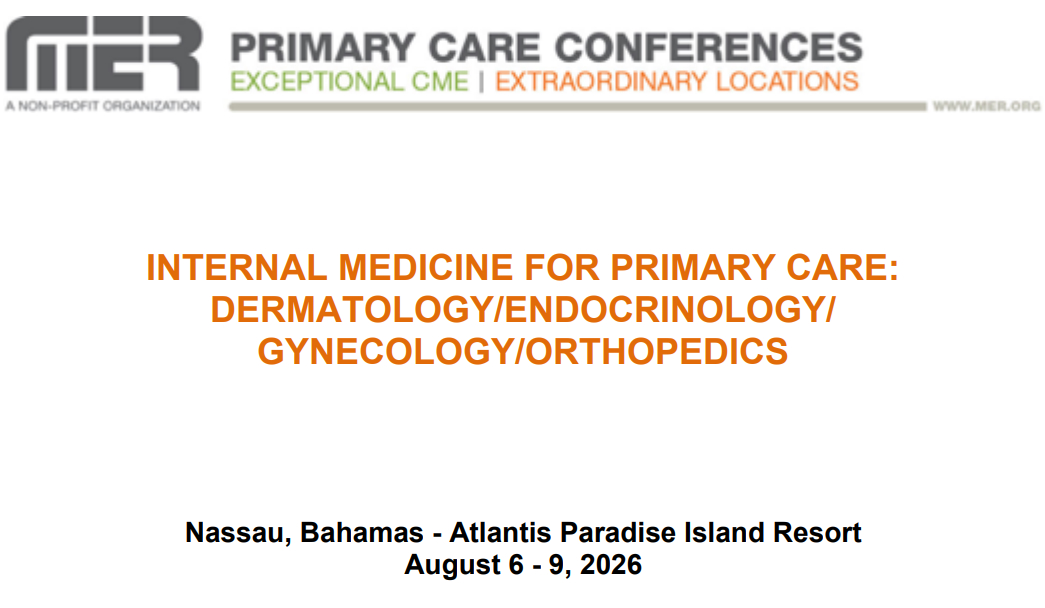
MER Primary Care Conferences Internal Medicine for Primary Care Derm Endo Gyn Ortho Aug 06-09, 2026


$130.00
MER Primary Care Derm Endo Gyn Ortho 2026 covers dermatology, endocrinology, women’s health and common orthopedic problems.
Delivery Information: This Product is shared via google drive download link. Please use your correct Gmail address at checkout.
Please note: there are no CME points or certificate associated with this course.
Samples for Courses Can be found here: Free Samples Here!
MedicalAmboss File Scope: This listing summarizes the official educational program for reference. Provider registration, live participation, streaming access, CME or MOC credit, certificates, apps, accounts, and post-course access are not represented as included unless they are explicitly present in the listed store files. MedicalAmboss.
MER Primary Care Derm Endo Gyn Ortho 2026
Dermatology • Endocrinology • Gynecology • Orthopedics
August 6–9, 2026 | Nassau, Bahamas
Review practical, evidence-based updates across four high-frequency areas of outpatient medicine with MER Internal Medicine for Primary Care: Dermatology/Endocrinology/Gynecology/Orthopedics 2026.
Organized by Medical Education Resources (MER), the original live conference was held August 6–9, 2026, at the Atlantis Paradise Island Resort in Nassau, Bahamas.
The four-day program was designed for office-based primary care clinicians and other healthcare professionals seeking clinically relevant updates in:
- Dermatology
- Endocrinology
- Gynecology and Women’s Health
- Orthopedics and Musculoskeletal Medicine
The curriculum emphasizes common conditions encountered in everyday primary care, including diabetes, osteoporosis, thyroid abnormalities, dermatitis, papulosquamous disorders, skin tumors, skin cancer detection, abnormal uterine bleeding, HPV and abnormal Pap smears, menopause, contraception, shoulder and upper-extremity injuries, knee evaluation, and foot and ankle pain syndromes.
Course Details
- Course: Internal Medicine for Primary Care: Derm/Endo/Gyn/Ortho
- Provider: Medical Education Resources – MER
- Year: 2026
- Original Conference Dates: August 6–9, 2026
- Duration: 4 Days
- Venue: Atlantis Paradise Island Resort
- Location: Nassau, Bahamas
- Primary Audience: Office-Based Primary Care Providers
- Main Specialties: Dermatology, Endocrinology, Gynecology, Orthopedics
- Official MER Listing: 16 Credit Hours
- Primary Clinical Focus: Evidence-Based Primary Care Updates
Who Was the Original Program Designed For?
MER describes the target audience as:
Office-based primary care providers and other health professionals seeking updates in primary care medicine.
The content is therefore especially relevant to:
- Primary Care Physicians
- Internists
- Family Medicine Physicians
- Nurse Practitioners
- Physician Assistants
- Dermatologists
- Endocrinologists
- Gynecologists
- Orthopedic Clinicians
- Other clinicians managing common outpatient conditions
The program should primarily be marketed as a multidisciplinary primary care course, rather than four separate specialty-board-review programs.
Learning Objectives
After reviewing the program, learners should be better able to:
Gynecology
- Assess and manage abnormal uterine bleeding.
- Describe management strategies for abnormal Pap smears and HPV.
- Discuss the menopausal transition and the risks and benefits of available treatment options.
- Apply patient-centered counseling approaches to complex contraceptive decisions.
Endocrinology
- Develop patient-specific treatment plans for type 2 diabetes.
- Diagnose and tailor treatment strategies for type 1 and type 2 diabetes.
- Identify the risks and benefits of bisphosphonate therapy in osteoporosis.
- Recognize the clinical implications of abnormal thyroid function.
Dermatology
- Differentiate atopic, irritant contact, allergic contact, and nummular dermatitis.
- Apply diagnostic principles to common papulosquamous disorders.
- Differentiate benign from malignant skin tumors.
- Recognize precancerous and cancerous skin lesions.
- Apply appropriate office-based approaches to common dermatologic presentations.
Orthopedics
- Diagnose and treat common shoulder injuries.
- Evaluate wrist, hand, and finger disorders.
- Describe the anatomy and function of the knee joint.
- Recognize chronic injuries and pain syndromes affecting the foot and ankle.
ENDOCRINOLOGY
Type 1 & Type 2 Diabetes
Diabetes management remains one of the most common responsibilities in primary care.
The MER curriculum emphasizes practical strategies for:
- Recognizing type 1 and type 2 diabetes
- Individualizing treatment
- Developing patient-specific management plans
- Applying contemporary therapeutic approaches
The goal is not simply glucose reduction but individualized management based on patient characteristics and disease type.
Patient-Specific Diabetes Management
Treatment decisions may need to account for:
- Glycemic status
- Comorbid disease
- Hypoglycemia risk
- Weight
- Cardiovascular and renal considerations
- Medication tolerance
- Patient preference
A useful clinical framework is:
Diagnose → Assess Risk → Select Therapy → Monitor → Individualize
Osteoporosis
The endocrine curriculum also addresses osteoporosis and the appropriate role of bisphosphonate therapy.
Topics include:
- Osteoporosis recognition
- Fracture risk
- Treatment selection
- Benefits of bisphosphonates
- Potential risks and adverse effects
Bisphosphonate Therapy
Bisphosphonates are important medications in osteoporosis management, but treatment decisions require consideration of both:
Fracture-Reduction Benefit
and:
Potential Treatment Risks
The course helps primary care clinicians approach these decisions more systematically.
Thyroid Function
Abnormal thyroid tests are frequently encountered in primary care.
The program emphasizes recognition of the clinical significance and risks associated with abnormal thyroid function.
Evaluation should integrate:
- Symptoms
- Thyroid function tests
- Clinical context
- Appropriate follow-up
DERMATOLOGY
Dermatitis
A major dermatology objective is differentiation among common eczematous disorders.
These include:
- Atopic dermatitis
- Irritant contact dermatitis
- Allergic contact dermatitis
- Nummular dermatitis
Because these disorders can overlap clinically, accurate classification helps guide management.
Atopic vs. Contact Dermatitis
The clinician should consider:
- Distribution
- Exposure history
- Chronicity
- Morphology
- Associated atopy
- Occupational or environmental triggers
The objective is to move from:
“Itchy rash”
toward:
Specific Clinical Pattern → Likely Etiology → Appropriate Management
Papulosquamous Disorders
MER also includes diagnostic principles and treatment options for conditions presenting with red, raised, or scaly lesions.
Primary care clinicians must recognize when a common inflammatory dermatosis can be treated in the office and when specialist evaluation may be appropriate.
Skin Tumors
The dermatology curriculum addresses differentiation between:
- Benign skin lesions
- Precancerous lesions
- Malignant skin tumors
This is particularly useful in primary care because suspicious lesions are frequently identified during routine examinations.
Skin Cancer Detection
Clinicians should be able to recognize concerning features that may warrant:
- Further assessment
- Biopsy
- Dermatology referral
Early recognition remains central to effective skin-cancer care.
Office Dermatology
The program also emphasizes practical office-based management rather than dermatology theory alone.
This supports primary care clinicians who routinely encounter:
- Rashes
- Skin lesions
- Pigmented lesions
- Possible skin cancer
- Common inflammatory disease
GYNECOLOGY & WOMEN’S HEALTH
Abnormal Uterine Bleeding
The gynecology curriculum includes assessment and management of abnormal uterine bleeding – AUB.
A structured evaluation may consider:
- Patient age
- Menstrual pattern
- Pregnancy possibility
- Medications
- Structural causes
- Endocrine factors
- Severity of bleeding
The goal is to determine which patients can be managed in primary care and which require additional gynecologic evaluation.
Abnormal Pap Smears & HPV
The program reviews contemporary management concepts involving:
- Abnormal cervical cytology
- HPV
- Follow-up
- Risk-based clinical decision-making
Primary care clinicians play an important role in cervical cancer prevention and appropriate follow-up.
HPV
Human papillomavirus is central to modern cervical screening strategies.
The clinical challenge is not merely identifying HPV but determining the appropriate next step according to the patient’s findings and risk.
Menopausal Transition
MER reviews:
- Menopausal symptoms
- Menopausal transition
- Available treatments
- Risks and benefits
- Patient counseling
Treatment decisions should be individualized.
Menopause Treatment Decisions
Management may involve discussion of:
- Symptom burden
- Patient preferences
- Contraindications
- Risks
- Potential benefits
- Nonhormonal alternatives
The objective is informed shared decision-making.
Contraceptive Counseling
The course emphasizes approaches to complex contraceptive decisions.
A patient-centered consultation should consider:
- Effectiveness
- Medical history
- Patient preferences
- Risks
- Benefits
- Adherence
- Reproductive goals
Complex Contraceptive Decisions
Some patients require more individualized counseling because of:
- Comorbid conditions
- Medication use
- Thrombotic risk
- Other clinical considerations
The course aims to improve confidence in navigating these situations.
ORTHOPEDICS & MUSCULOSKELETAL MEDICINE
Musculoskeletal complaints are among the most frequent problems seen in primary care.
The MER orthopedic curriculum focuses on practical evaluation of:
- Shoulder
- Wrist
- Hand
- Fingers
- Knee
- Foot
- Ankle
Shoulder Injuries
The program reviews diagnosis and treatment of common shoulder disorders.
Important assessment components include:
- History
- Mechanism of injury
- Range of motion
- Strength
- Focused physical examination
- Appropriate imaging when necessary
Common Shoulder Problems
Primary care clinicians frequently encounter conditions involving:
- Rotator cuff
- Impingement
- Adhesive capsulitis
- Bursitis
- Tendon-related pain
- Acromioclavicular joint disease
The objective is efficient differentiation and appropriate management.
Wrist, Hand & Finger Disorders
The curriculum also reviews common conditions affecting the upper extremity.
These may include clinical presentations involving:
- Wrist pain
- Hand pain
- Finger symptoms
- Overuse injuries
- Entrapment syndromes
- Tendon disorders
- Degenerative disease
Focused Upper-Extremity Examination
A structured assessment can include:
Location → Mechanism → Motion → Strength → Neurovascular Status → Focused Tests → Imaging if Indicated
The Knee
MER includes an overview of knee anatomy and function.
Understanding the major structures helps clinicians evaluate:
- Acute injury
- Sports-related problems
- Degenerative complaints
- Mechanical symptoms
Knee Assessment
Evaluation may involve:
- Mechanism
- Swelling
- Stability
- Range of motion
- Meniscal symptoms
- Ligament examination
- Imaging decisions
Foot & Ankle
Chronic foot and ankle pain is another common primary care problem.
The program helps clinicians recognize chronic injuries and pain syndromes involving these regions.
Primary Care Musculoskeletal Triage
One of the most important skills is deciding whether a patient requires:
- Conservative management
- Physical therapy
- Imaging
- Injection or office treatment
- Orthopedic referral
- Urgent evaluation
Four-Specialty Primary Care Integration
The value of this MER conference comes from covering multiple common outpatient domains in one program:
Dermatology
Rash + Lesion Recognition + Skin Cancer
Endocrinology
Diabetes + Osteoporosis + Thyroid
Gynecology
AUB + HPV/Pap + Menopause + Contraception
Orthopedics
Shoulder + Hand/Wrist + Knee + Foot/Ankle
This makes the course particularly useful for clinicians who need broad updates rather than a narrow subspecialty review.
Major Topics Covered
- Primary Care Medicine
- Internal Medicine
- Dermatology
- Endocrinology
- Gynecology
- Women’s Health
- Orthopedics
- Musculoskeletal Medicine
- Type 1 Diabetes
- Type 2 Diabetes
- Diabetes Management
- Osteoporosis
- Bisphosphonates
- Thyroid Function
- Atopic Dermatitis
- Contact Dermatitis
- Nummular Dermatitis
- Papulosquamous Disorders
- Skin Tumors
- Skin Cancer
- Precancerous Skin Lesions
- Abnormal Uterine Bleeding
- Pap Smears
- HPV
- Cervical Screening
- Menopause
- Menopausal Transition
- Contraception
- Shoulder Injuries
- Wrist Disorders
- Hand Disorders
- Finger Disorders
- Knee Anatomy
- Knee Injuries
- Foot Pain
- Ankle Pain
- Sports Injuries
Who Should Take This Course?
The course is best suited for:
- Primary Care Physicians
- Internists
- Family Medicine Physicians
- Nurse Practitioners
- Physician Assistants
- Dermatologists seeking primary-care-oriented updates
- Endocrinologists
- Gynecologists
- Orthopedic Clinicians
- Healthcare professionals involved in outpatient medicine
The strongest primary audience remains:
Primary Care + Internal Medicine + Family Medicine
because MER specifically designed the conference around common office-based primary care problems.
Why This Course Is Useful
MER Internal Medicine for Primary Care: Derm/Endo/Gyn/Ortho 2026 provides an efficient multidisciplinary review of conditions that frequently appear in everyday outpatient practice.
Learners can update their approach to:
Endocrine Disease
- Diabetes
- Osteoporosis
- Thyroid abnormalities
Dermatologic Problems
- Dermatitis
- Papulosquamous disease
- Skin tumors
- Skin cancer recognition
Women’s Health
- Abnormal uterine bleeding
- HPV
- Abnormal Pap smears
- Menopause
- Contraception
Musculoskeletal Complaints
- Shoulder injuries
- Wrist/hand/finger disorders
- Knee assessment
- Foot and ankle pain
The overall clinical pathway is:
Recognize → Differentiate → Evaluate → Treat → Refer When Appropriate
Original MER Credit Information
The official MER conference is listed as:
16 Credit Hours
These credits apply to eligible participation in the original MER educational activity and fulfillment of the provider’s applicable requirements.
An independently distributed MedicalAmboss package should not automatically be represented as providing:
- MER CME Credit
- MER Certificate
- ANCC Pharmacotherapeutic Contact Hours
unless the purchase includes official MER participation and credit-claiming eligibility.
Product Summary
- Product: MER Internal Medicine for Primary Care: Derm/Endo/Gyn/Ortho
- Provider: Medical Education Resources – MER
- Year: 2026
- Conference Dates: August 6–9, 2026
- Venue: Atlantis Paradise Island Resort
- Location: Nassau, Bahamas
- Duration: 4 Days
- Original MER Listing: 16 Credit Hours
- Primary Specialty: Internal Medicine / Primary Care
- Subspecialties: Dermatology, Endocrinology, Gynecology, Orthopedics
4. Short Description
MER Internal Medicine for Primary Care: Derm/Endo/Gyn/Ortho 2026 provides practical updates across four high-frequency areas of outpatient medicine.
Topics include type 1 and type 2 diabetes, osteoporosis and bisphosphonate therapy, abnormal thyroid function, dermatitis, papulosquamous disorders, benign and malignant skin lesions, skin cancer detection, abnormal uterine bleeding, abnormal Pap smears and HPV, menopause, contraceptive counseling, shoulder injuries, wrist/hand/finger disorders, knee evaluation, and chronic foot and ankle pain.
Topics
Thursday, August 6, 2026
-
Abnormal Uterine Bleeding (Gynecology): Overview of normal/abnormal menstrual physiology/profile; Menstrual disturbances; Ovulatory and anovulatory uterine bleeding; Other menstrual abnormalities; Diagnosis and appropriate treatment options.
-
Abnormal Pap Smears and High Risk HPV (Gynecology): Current recommendations for cervical cancer screening; Incorporating the ASCCP consensus guidelines for management of cytologic cervical abnormalities (including ASCUS, LGSIL, HGSIL and atypical glandular cells) into your practice; Algorithm for the appropriate use of HPV testing; History of HPV and effectiveness of its use; Recommendations for missed doses; Storage and administration of HPV vaccines.
-
Menopause Transition and Hormone Replacement Therapy (Gynecology): Symptoms of menopause, including hot flashes, night sweats, and atrophy; Menopause syndromes, including osteoporosis, breast cancer, cardiac disease, and colon cancer; Estrogen analogs; Counseling patients in options and alternatives to hormone therapy; Designer estrogens; SERMs; HRTs; Discussion of risks and benefits, especially in breast cancer and CHD.
-
Osteoporosis (Endocrinology): Review the epidemiology and pathophysiology of osteoporosis along with interpretation of DEXA scans and FRAX risk assessment; up-to-date therapeutic options.
-
Metabolic Bone Disease (Endocrinology): Disorders of bone strength caused by abnormalities of minerals, vitamin D, bone mass and structure; The role of calcium and phosphorus; Osteomalacia, Paget’s disease and parathyroid disorders.
Friday, August 7, 2026
-
Disorders of Calcium Metabolism (Endocrinology): Review of calcium homeostasis; causes of hypercalcemia; diagnosis and treatment.
-
Obesity Management (Endocrinology): Diagnosis; etiology; complications; use of appetite suppressant medications; lifestyle modifications; when surgery should be performed.
-
Contraception: A Primary Care Review of Best Practice (Gynecology): Coverage of the effectiveness, side effects and non-contraceptive benefits of available contraceptive options in the U.S.; Discussion of contraceptive counseling that is patient-centric including communicating without coercion; Management strategies for medically complex contraceptive decisions (patients with a history of VTE, breast cancer, hypertension).
-
Dermatitis (Dermatology): Overview of the causes and forms of skin irritants; Contact, atopic, irritant, nummular, seborrheic and exfoliative; Treatment of blistering, oozing, crusting and flaking; Diagnostic principles and management strategies.
-
Papulosquamous Diseases (Dermatology): Diagnostic principles of skin lesions consisting of red or purple papules; Psoriasis, lichen planus, pityriasis rosea, lupus erythematosus; Discussion of how to tell one scaly rash from another.
Saturday, August 8, 2026
-
Benign Skin Tumors (Dermatology): Proper diagnosis and treatment of common benign tumors; Biopsies and histopathologic examination; Nevi, seborrheic keratosis keloids, hemangiomas and miscellaneous tumors; When to refer.
-
Premalignant and Malignant Skin Tumors (Dermatology): Recognition of precursors of malignancies; Excisional and punch biopsies; Actinic keratosis, Bowen’s disease, squamous cell carcinoma, basal cell carcinoma, melanoma and other selected tumors; Risk reduction education.
-
The Shoulder: Anatomy, Common Injuries, and Exam Techniques (Orthopedics): Rotator cuff syndrome; impingement, frozen shoulder; subacromial bursitis; bicipital tendonitis; A-C joint disease.
-
Wrist, Hand, and Fingers (Orthopedics): Carpal tunnel, CMC arthritis thumb, ganglion cyst, trigger finger, de Quervains disease.
Sunday, August 9, 2026
-
The Knee: Anatomy, Common Injuries, and Exam Techniques (Orthopedics): ACL, meniscus, MRI; common sports injuries; osteoarthritis and hyaluronan; bursitis: prepatellar, pesanserine; baker’s cyst; joint injection/X-ray interpretation; pediatrics.
-
Ankle and Foot (Orthopedics): This presentation will address a series of common acute and chronic injuries and pain syndromes to the foot and ankle as they would present in the primary care setting. The focus will be on developing a working differential diagnosis based on the historical mechanism of injury and exam findings.
Related products
Endocrine and Nutrition
Harvard Fifty-Ninth Annual Update Obstetrics and Gynecology 2023
Endocrine and Nutrition
Comprehensive Care for Persons with Diabetes 2022: A Certificate Program

Endocrine and Nutrition
Internal Medicine
Cardiology
Nephrology / Urology
Endocrine and Nutrition

Endocrine and Nutrition
Harvard The Blackburn Course in Obesity Medicine Treating Obesity 2023