
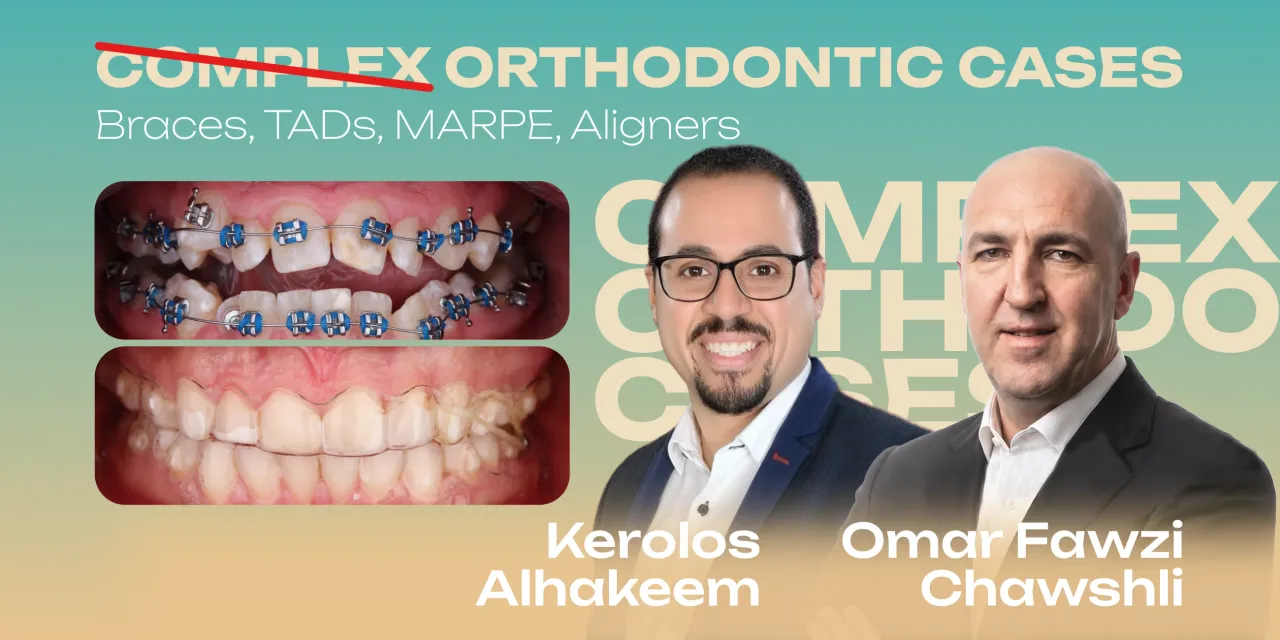
OHI-S Complex Orthodontic Cases. Braces, TADs, MARPE, Aligners
$60.00
This Product is shared via google drive download link, So please share your correct Gmail id while placing the order .Please note that there are no CME points or certificate associated with this course Samples for Courses Can be found here : Free Samples Here!
OHI-S Complex Orthodontic Cases
Braces, TADs, MARPE & Aligners
5 Lessons + 2 Free | 6 Hours 13 Minutes | Advanced Orthodontic Biomechanics
Develop a structured, biomechanics-driven approach to challenging malocclusions with OHI-S Complex Orthodontic Cases: Braces, TADs, MARPE, Aligners.
Presented by Kerolos Alhakeem and Omar Fawzi Chawshli, this advanced orthodontic course goes beyond simple tooth alignment to address the three-dimensional challenges that determine the success of complex treatment:
- Space management
- Anteroposterior control
- Vertical control
- Skeletal anchorage
- Clear aligner biomechanics
- Maxillary expansion
- Digital orthodontics
- Open-bite correction
- Deep-bite correction
- Gummy-smile management
- Occlusal-plane control
The course integrates conventional fixed appliances with modern tools including:
- Temporary Anchorage Devices – TADs
- Palatal miniscrews
- MARPE
- Clear aligners
- Buttons and elastics
- Sectional mechanics
- CBCT
- CAD/CAM
- 3D-printed surgical guides
Rather than teaching each appliance as an isolated technique, the program focuses on clinical decision-making, force systems, anchorage design, and case-specific biomechanics.
The core treatment philosophy can be summarized as:
Diagnose the Problem → Identify the Spatial Dimension → Define the Biomechanical Objective → Select Anchorage → Design the Force System → Execute and Reassess
Course Details
- Course: Complex Orthodontic Cases. Braces, TADs, MARPE, Aligners
- Provider: OHI-S
- Faculty: Kerolos Alhakeem, Omar Fawzi Chawshli
- Official Structure: 5 Lessons + 2 Free Lessons
- Total Lesson Presentations: 7
- Official Duration: 6 Hours 13 Minutes
- Language: English
- Official OHI-S CE: 5.25 CE Credits
- Primary Specialty: Orthodontics
- Level: Advanced
- Main Focus: Complex Orthodontic Biomechanics
- Core Modalities: Braces + TADs + MARPE + Aligners
- Additional Focus: Digital Orthodontics & Skeletal Anchorage
Course Overview
Complex orthodontic cases rarely involve a problem in only one dimension.
A patient may simultaneously present with:
- Crowding
- Protrusion
- Skeletal discrepancy
- Deep bite or open bite
- Altered facial proportions
- Missing teeth
- Asymmetry
- Occlusal-plane cant
- Maxillary transverse deficiency
- Periodontal limitations
Treatment therefore requires more than simply choosing between braces and aligners.
The clinician must determine:
- Where space should come from
- Which teeth should move
- Which teeth should remain stable
- Whether skeletal anchorage is required
- How sagittal mechanics will affect the vertical dimension
- Whether transverse skeletal expansion is necessary
- Whether aligners alone can generate the required movement
Three-Dimensional Orthodontic Control
The course can be understood through three major dimensions:
Sagittal
- Class II
- Class III
- Protrusion
- Retraction
- Distalization
- Space closure
Vertical
- Open bite
- Deep bite
- Gummy smile
- Incisor intrusion/extrusion
- Molar intrusion
- Occlusal-plane canting
Transverse
- Maxillary deficiency
- Crossbite
- Skeletal expansion
- MARPE
- Palatal anchorage
Complex treatment often requires simultaneous control of all three.
LESSON 1
Orthodontic Space Management and Extraction Decision
Faculty: Kerolos Alhakeem
This introductory clinical lesson establishes the logic behind space management and extraction decisions.
Topics include:
- Orthodontic camouflage
- Anteroposterior problems
- Space management
- Extraction vs. non-extraction treatment
- Changes in extraction trends
- Evidence-based orthodontic decision-making
- Facial aesthetics
- Soft-tissue-centered treatment planning
- Clinical case methodology
- Proclined anterior teeth
- Anterior open bite
Extraction vs. Non-Extraction
One of the central questions in orthodontics is:
Should Space Be Created Without Extractions—or Should Teeth Be Extracted?
The decision should not be based on a universal philosophy.
It requires consideration of:
- Crowding
- Incisor inclination
- Facial profile
- Lip position
- Skeletal relationships
- Periodontal limits
- Stability
- Treatment objectives
Soft-Tissue-Centered Planning
Orthodontic treatment can alter:
- Lip support
- Facial convexity
- Incisor display
- Smile appearance
Therefore, space-management decisions should not be based on dental casts alone.
The course emphasizes:
Dental Diagnosis + Facial Diagnosis + Soft-Tissue Objectives
Evidence-Based Decision-Making
The program addresses historical changes in orthodontic extraction patterns and encourages clinicians to evaluate treatment choices according to:
- Clinical evidence
- Facial goals
- Biological limits
- Individual patient anatomy
rather than rigid extraction or non-extraction philosophies.
LESSON 2
The Anteroposterior Dimension in Complex Orthodontic Case Management
Faculty: Kerolos Alhakeem
Duration: Approximately 1 Hour 30 Minutes
This major module explores sagittal correction and anchorage management.
Topics include:
- Orthodontic camouflage
- Space management
- Extraction vs. non-extraction
- Drawbridge effect
- Missing teeth
- Space opening vs. closure
- Gingival tissue evaluation
- Black-triangle prevention
- Growing patients
- Overjet management
- Severe incisor proclination
- Molar distalization
- TAD-supported distalization
- Palatal anchorage
- Unilateral distalization
- Transposed canines
Anteroposterior Control
Sagittal correction requires control over:
- Incisors
- Canines
- Molars
- Anchorage units
- Profile
The clinician must decide whether correction should occur through:
- Retraction
- Protraction
- Distalization
- Mesialization
- Extraction
- Growth modification
- Skeletal anchorage
Molar Distalization with TADs
Temporary Anchorage Devices can provide skeletal anchorage for selected distalization strategies.
The course includes clinical cases involving:
- Maxillary molar distalization
- Unilateral distalization
- Palatal anchorage
The biomechanical goal is to generate the desired dental movement while controlling undesirable reciprocal effects.
Missing Teeth & Space Management
The program reviews cases involving:
- Missing upper canines
- Missing lateral incisors
- Missing central incisors
The key decision may become:
Close the Space
versus:
Open and Preserve Space for Future Restoration
This requires interdisciplinary consideration of:
- Facial aesthetics
- Tooth proportions
- Periodontal tissues
- Prosthetic options
- Long-term stability
Black Triangles
Interdental papilla loss can create esthetic concerns following orthodontic movement.
The curriculum includes recognition and prevention of black triangles, emphasizing that tooth position, root relationships, contact position, and periodontal architecture must all be considered.
Growing Patients
Growth changes treatment possibilities.
The program addresses:
- Growth prediction
- Interceptive treatment
- Overjet correction
- Soft-tissue effects
The treatment plan should account for both current malocclusion and expected craniofacial development.
LESSON 3
The Vertical Dimension in Complex Orthodontic Case Management
Faculty: Kerolos Alhakeem
Duration: Approximately 1 Hour 6 Minutes
Vertical control is one of the most extensive topics in the program.
Topics include:
- Vertical diagnosis
- Anterior vertical control
- Posterior vertical control
- Skeletal vertical control
- Incisor intrusion
- Incisor extrusion
- Molar intrusion
- Molar extrusion
- Mandibular rotation
- Gummy smile
- Curve of Spee
- Open bite
- Deep bite
- TAD mechanics
- Occlusal-plane canting
The Three Domains of Vertical Control
The course organizes vertical biomechanics into three broad domains:
Anterior
Management of:
- Incisors
- Overbite
- Incisor display
Posterior
Management of:
- Molars
- Posterior vertical dimension
Skeletal
Management of the rotational effects that dental movement can have on the mandible and facial height.
True vs. Relative Vertical Correction
A key biomechanical distinction is between:
True Intrusion / Extrusion
and:
Relative Vertical Change Produced by Other Tooth Movements
Understanding the difference is essential when interpreting apparent bite correction.
Gummy Smile Diagnosis
The curriculum provides a systematic framework for gummy-smile evaluation.
Assessment may include:
- Gingival display
- Upper lip length
- Lip mobility
- Incisor dimensions
- Periodontal probing
- Incisor position
- Skeletal relationships
A gummy smile is not a single diagnosis and therefore should not automatically receive a single treatment protocol.
TAD-Supported Vertical Control
Clinical cases include TAD-supported management of:
- Anterior open bite
- Posterior intrusion
- Over-erupted molars
- Gummy smile
- Occlusal-plane canting
Open Bite
Open bite may involve combinations of:
- Dental factors
- Skeletal factors
- Tongue habits
- Posterior eruption
- Incisor position
Effective correction depends on identifying the underlying mechanism.
Deep Bite
Deep-bite treatment may require:
- Incisor intrusion
- Posterior extrusion
- Curve-of-Spee correction
- Anchorage management
The correct strategy depends on facial and dental diagnosis.
LESSON 4
Hybrid Aligner Mechanics in Orthodontic Treatment
Faculty: Kerolos Alhakeem
Duration: Approximately 58 Minutes
This module examines how clear aligners generate force and when hybrid mechanics can improve control.
Topics include:
- Aligner force delivery
- Clear aligners vs. fixed appliances
- Open vs. closed systems
- Attachments
- Tracking
- Engagement
- Force vectors
- Buccolingual tipping
- Thermoplastic materials
- Movement predictability
- Software overcorrection
- Buttons
- Elastics
- Class II
- Class III
- High-angle cases
- Rotation
- Hybrid derotation
How Aligners Move Teeth
Successful aligner treatment requires understanding:
- Force
- Moment
- Contact surface
- Attachment design
- Material properties
- Staging
Digital simulation alone does not guarantee biological movement.
Tracking & Engagement
An aligner can only deliver its intended force effectively when it maintains appropriate engagement with the teeth.
Loss of tracking can alter:
- Force delivery
- Movement accuracy
- Treatment sequencing
What Aligners Can and Cannot Predictably Achieve
The course emphasizes that different movements have different levels of predictability.
Complex treatment therefore requires recognizing when to add:
- Attachments
- Elastics
- Buttons
- Sectional fixed appliances
- TADs
Hybrid Aligner Mechanics
Hybrid mechanics combine clear aligners with adjunctive components.
Examples include:
Aligner + Elastic
Aligner + Button
Aligner + Sectional NiTi
Aligner + TAD
The aim is to use each system for movements it can perform most effectively.
Class II & Class III with Aligners
Case discussions address anchorage control for:
- Bilateral Class II
- Unilateral Class II with midline discrepancy
- Class III / reverse overjet
Advanced Derotation
The program includes hybrid approaches using:
- Minitubes
- Sectional NiTi wires
for rotational movements that may be difficult to achieve predictably with aligners alone.
LESSON 5
Digital Workflow for Palatal Miniscrew Appliances and MARPE
Faculty: Kerolos Alhakeem
Duration: Approximately 46 Minutes
Official CE: 0.75 Credit
This is one of the strongest digital-orthodontic modules in the course.
Topics include:
- Digital orthodontic workflow
- Palatal miniscrews
- MARPE
- Maxillary expansion
- Facial skeletal anatomy
- Midpalatal suture maturation
- Bone-borne expansion
- Tooth-bone-borne expansion
- TAD-First vs. TAD-Last
- Monocortical vs. bicortical anchorage
- Palatal safe zones
- CBCT
- Cephalometric data
- Segmentation
- Virtual TAD placement
- CAD/CAM
- 3D-printed surgical guides
MARPE
MARPE stands for:
Miniscrew-Assisted Rapid Palatal Expansion
It combines expansion mechanics with skeletal anchorage to influence the maxillary complex more directly than conventional tooth-borne expansion.
MARPE Classification
The course reviews different appliance designs including:
- Bone-borne
- Tooth-bone-borne systems
Their biomechanical behavior differs depending on anchorage configuration.
Midpalatal Suture Maturation
Chronological age alone does not completely define skeletal expansion potential.
The course addresses assessment of:
- Midpalatal suture maturation
- Facial skeletal anatomy
- Clinical examination
as part of treatment selection.
TAD-First vs. TAD-Last
Digital appliance fabrication can follow different sequences.
The curriculum compares:
- TAD-First
- TAD-Last
approaches to miniscrew-supported appliance design.
Monocortical vs. Bicortical Anchorage
Palatal TAD stability can be influenced by cortical engagement.
The course discusses biomechanical differences between:
- Monocortical
- Bicortical
skeletal anchorage.
CBCT-Based Digital Planning
The digital workflow includes:
CBCT → Segmentation → Anatomical Evaluation → Virtual TAD Placement → Appliance Design
This allows planning to account for individual palatal anatomy before insertion.
3D-Printed Surgical Guides
The curriculum specifically includes:
- CAD/CAM planning
- 3D-printed guide design
- Guided palatal miniscrew placement
The objective is to transfer the virtual plan to the clinical environment.
LESSON 6
Open Bite Treatment: Etiology, Mechanics, and Evidence-Based Strategies
Faculty: Omar Fawzi Chawshli
Duration: Approximately 13 Minutes
Free Clinical Video
This focused session reviews:
- Skeletal vs. dental open bite
- Evidence-based correction
- Habit-breaking appliances
- Molar intrusion
- TAD-supported intrusion
- Buccal vs. palatal TAD configurations
- Transpalatal arches
- Lingual arches
- Posterior bite turbos
- Clinical cases
Open-Bite Etiology
Open bite should first be classified according to its cause.
A useful distinction is:
Dental Open Bite
versus:
Skeletal Open Bite
because the appropriate mechanics may differ substantially.
Molar Intrusion
Posterior intrusion may contribute to:
- Bite closure
- Mandibular autorotation
- Changes in lower facial height
in appropriately selected cases.
LESSON 7
Vertical Plane Malocclusion: Diagnosis and Management
Faculty: Omar Fawzi Chawshli
Duration: Approximately 1 Hour 23 Minutes
Official CE: 1.25 Credits
The final major module provides a comprehensive review of:
- Open bite
- Deep bite
- Gummy smile
- Incisor extrusion
- Incisor intrusion
- Molar intrusion
- TAD biomechanics
- V-bends
- Extrusion arches
- Vertical elastics
- Bite raisers
- Space closure
- Reverse Curve of Spee
- Segmental intrusion
- Burstone intrusion principles
- Occlusal-plane canting
- IZC screws
Open Bite Correction
Available mechanics may include combinations of:
- Habit control
- Incisor extrusion
- Molar intrusion
- TADs
- Elastics
- Space closure
- Fixed appliances
The appropriate choice depends on diagnosis.
Incisor Extrusion
The curriculum discusses techniques involving:
- V-bends
- Extrusion arches
- Vertical elastics
for selected cases where anterior extrusion is desirable.
Deep Bite Correction
Deep bite can arise from combinations of:
- Incisor position
- Posterior eruption
- Skeletal morphology
Treatment may involve:
- Relative extrusion
- True intrusion
- Bite plates
- Bite turbos
- Elastics
- TADs
True Incisor Intrusion
The course includes advanced mechanics such as:
- Anterior TADs
- Segmental intrusion arches
- Utility intrusion arches
- Burstone principles
Reverse Curve of Spee
Reverse Curve of Spee mechanics can influence:
- Incisor position
- Posterior vertical effects
- Arch leveling
The resulting force system should be interpreted carefully rather than using the archwire mechanically without understanding its side effects.
Gummy Smile
Gummy-smile treatment is integrated into vertical diagnosis.
The program reviews cases involving combinations of:
- Incisor position
- Lip characteristics
- Skeletal vertical excess
- Deep bite
- Open-bite mechanics
Total-Arch Vertical Control
Advanced cases may use combinations of:
Anterior TADs + Posterior TADs
to control multiple vertical components simultaneously.
Occlusal Plane Canting
The curriculum includes diagnosis and correction of occlusal-plane cant.
Treatment requires asymmetric mechanics designed around the location and cause of the cant.
Infrazygomatic Crest – IZC Screws
The final module includes a Class III case using Infrazygomatic Crest screws during en-masse retraction.
This illustrates the broader role of extra-alveolar skeletal anchorage in complex orthodontic biomechanics.
BRACES + TADs + ALIGNERS
One of the strongest features of this course is that it does not promote a single appliance philosophy.
Instead, it asks:
Which Tool Best Produces the Required Movement?
Braces
Useful for comprehensive fixed-appliance mechanics and precise control.
Aligners
Useful for digitally staged tooth movement and selected esthetic treatment.
TADs
Useful when additional anchorage or directional control is required.
MARPE
Useful in selected transverse skeletal problems.
A complex case may therefore require a hybrid combination.
TADs in Complex Orthodontics
Temporary Anchorage Devices appear throughout the curriculum for:
- Molar distalization
- Incisor intrusion
- Posterior intrusion
- Gummy-smile management
- Open-bite correction
- Occlusal-plane correction
- MARPE
- Class III mechanics
Digital Orthodontics
The digital component includes:
- CBCT
- Cephalometric information
- Anatomical segmentation
- Virtual TAD placement
- CAD/CAM
- 3D-printed surgical guides
- Digital aligner planning
This allows the digital workflow to connect diagnosis directly with appliance design.
Complex Case Decision-Making
A useful framework derived from the curriculum is:
1. Diagnose the malocclusion
↓
2. Identify sagittal, vertical and transverse components
↓
3. Evaluate facial and periodontal limitations
↓
4. Determine space requirements
↓
5. Select anchorage
↓
6. Choose braces, aligners, TADs, MARPE or hybrid mechanics
↓
7. Design force vectors and sequence movements
↓
8. Monitor biological response and modify when necessary
Major Topics Covered
- Complex Orthodontic Cases
- Orthodontic Biomechanics
- Braces
- Temporary Anchorage Devices
- TADs
- Orthodontic Miniscrews
- MARPE
- Skeletal Anchorage
- Clear Aligners
- Hybrid Aligner Mechanics
- Space Management
- Extraction vs. Non-Extraction
- Orthodontic Camouflage
- Class II Malocclusion
- Class III Malocclusion
- Molar Distalization
- Palatal Anchorage
- Open Bite
- Deep Bite
- Gummy Smile
- Vertical Control
- Incisor Intrusion
- Molar Intrusion
- Occlusal Plane Canting
- Digital Orthodontics
- CBCT
- CAD/CAM
- 3D Surgical Guides
- Palatal Miniscrews
- Maxillary Expansion
- Midpalatal Suture
- IZC Screws
Who Should Take This Course?
The strongest target audience is:
- Orthodontists
- Orthodontic Residents
- Dental Practitioners with advanced orthodontic training
- General Dentists providing orthodontic treatment within their training and scope
The program may also be relevant to clinicians collaborating in complex interdisciplinary cases, including:
- Oral and Maxillofacial Surgeons
- Periodontists
- Restorative Dentists
- Prosthodontists
However, these groups should be treated as secondary interdisciplinary audiences.
The course itself is fundamentally an:
Advanced Orthodontics Course
rather than an oral-surgery or restorative-dentistry course.
Educational Safety Note
This program includes advanced topics involving:
- TAD placement
- MARPE
- Skeletal anchorage
- CBCT planning
- Guided miniscrew placement
- Complex orthodontic biomechanics
Recorded education can help clinicians understand diagnosis, case selection, mechanics, and workflows, but it does not replace:
- Formal orthodontic training
- Hands-on instruction
- Supervised clinical experience
- Appropriate imaging interpretation training
- Surgical competency where required
Original OHI-S CE Information
The official OHI-S course is listed for:
5.25 CE Credits
The official structure is:
5 Lessons + 2 Free Clinical Lessons
for a platform-listed total of:
6 Hours 13 Minutes
Official OHI-S CE eligibility applies to participants meeting the requirements of the original OHI-S activity.
An independently distributed MedicalAmboss course package should not automatically be marketed as including official OHI-S CE credit or certificate unless that eligibility is specifically included.
Product Summary
- Product: Complex Orthodontic Cases. Braces, TADs, MARPE, Aligners
- Provider: OHI-S
- Faculty: Kerolos Alhakeem & Omar Fawzi Chawshli
- Structure: 5 Lessons + 2 Free
- Total Presentations: 7
- Official Duration: 6h 13min
- Language: English
- Official OHI-S CE: 5.25 Credits
- Primary Specialty: Orthodontics
- Level: Advanced
- Core Modalities: Braces, TADs, MARPE & Clear Aligners
4. Short Description
OHI-S Complex Orthodontic Cases: Braces, TADs, MARPE, Aligners is an advanced 6h 13min orthodontic course presented by Kerolos Alhakeem and Omar Fawzi Chawshli.
The program covers space management, extraction vs. non-extraction decisions, sagittal and vertical control, Class II and Class III biomechanics, TAD-supported distalization and intrusion, gummy-smile diagnosis, open and deep bite, hybrid aligner mechanics, palatal miniscrews, MARPE, CBCT-based digital planning, CAD/CAM surgical guides, and complex case management.
Topics
Lesson 1. Orthodontic Space Management and Extraction Decision
-
Orthodontic camouflage and anteroposterior problems: definitions and space management
-
Strategies for space management in the dental arch
-
The extraction vs. non-extraction dilemma
-
Statistics on extraction therapy and reasons for the global decrease in extractions
-
Evidence-based medicine (EBM) in the orthodontic decision-making process
-
Facial aesthetics and soft tissue-centered treatment planning
-
Clinical case presentations and methodology
-
Detailed case analysis: proclined anterior teeth with an anterior open bite
Lesson 2. The Anteroposterior Dimension in Complex Orthodontic Case Management
-
Orthodontic camouflage and anteroposterior problems: definitions and space management
-
Strategies for space management in the dental arch
-
The extraction vs. non-extraction dilemma
-
Statistics on extraction therapy and reasons for the global decrease in extractions
-
Evidence-based medicine (EBM) in the orthodontic decision-making process
-
Facial aesthetics and soft tissue-centered treatment planning
-
Clinical case presentations and methodology
-
Detailed case analysis: proclined anterior teeth with an anterior open bite
-
Biomechanics: the drawbridge effect in vertical control
-
Detailed case analysis: missing upper canines and reverse bite (anterior crossbite)
-
Evaluation of gingival tissue: the Seibert and Lindhe classifications
-
Detailed case analysis: congenitally missing lateral incisors and spacing
-
Biomechanical dilemmas: space closure vs. space opening
-
Analyzing the negative sequelae and risks of various treatment pathways
-
Management and prevention of “black triangles” (loss of interdental papilla)
-
Detailed case analysis: congenitally missing upper central incisor
-
Treating growing patients: clinical nuances, growth prediction, and interceptive case analysis
-
Detailed case analysis: overjet management and its effect on the soft-tissue profile
-
Detailed case analysis: severe incisor proclination
-
Molar distalization: the clinical efficiency of Temporary Anchorage Devices (TADs)
-
Detailed case analysis: miniscrew-supported maxillary molar distalization
-
Palatal anchorage concepts and mechanics
-
Detailed case analysis: unilateral molar distalization
-
Detailed case analysis: management of a transposed canine
-
Simplified criteria for clinical decision-making
Lesson 3. The Vertical Dimension in Complex Orthodontic Case Management
-
The vertical control problem in orthodontics
-
The 3 domains of vertical control
-
Anterior vertical control: incisor intrusion and extrusion mechanics
-
Poster vertical control: molar intrusion and extrusion mechanics
-
Mandibular rotation and skeletal vertical control
-
Establishing a definitive vertical diagnostic framework
-
Systematic diagnostic scheme for the evaluation of a gummy smile
-
Assessment of gingival display at rest and during smiling
-
Clinical assessment of upper lip length and mobility
-
Evaluation of incisor width, height, and periodontal probing depth
-
Determining upper incisor position in relation to the upper lip
-
Assessment of the Curve of Spee (COS) and root parallelism
-
Biomechanical scenarios: mesially tipped posterior segments
-
Biomechanical scenarios: mesially tipped posterior segments combined with distally tipped anterior segments
-
Fundamental biomechanical principles of vertical movement
-
True vertical vs. relative vertical control mechanics
-
Detailed clinical case analysis: anterior gummy smile with over-erupted upper incisors
-
Detailed clinical case analysis: anterior gummy smile associated with maxillary excess
-
Detailed clinical case analysis: anterior gummy smile associated with Vertical Maxillary Excess (VME) and protrusion
-
Detailed clinical case analysis: anterior gummy smile with incisor extrusion, an increased Curve of Spee, and a deep bite
-
Detailed clinical case analysis: deep bite management via an increased Curve of Spee and lower anterior intrusion
-
Detailed clinical case analysis: deep bite management via an increased Curve of Spee and lower posterior intrusion
-
Detailed clinical case analysis: open bite with average incisor inclination, decreased incisor exposure, and a tongue-thrust habit
-
Detailed clinical case analysis: reduced incisal display – anterior open bite vertical control utilizing TAD mechanics
-
Detailed clinical case analysis: increased Lower Anterior Facial Height (LAFH) and anterior open bite corrected via posterior intrusion
-
Detailed clinical case analysis: over-erupted molar management using TAD-supported single molar intrusion
-
Detailed clinical case analysis: occlusal plane canting correction utilizing TADs
-
A simplified, systematic criteria for vertical decision-making
Lesson 4. Hybrid Aligner Mechanics in Orthodontic Treatment
-
Mechanical principles: how clear aligners move teeth
-
The biomechanical concepts behind aligners: force delivery mechanisms
-
Comparative analysis: clear aligners vs. fixed appliances
-
Open vs. closed orthodontic systems and strategies for space gaining
-
The clinical role of aligner attachments
-
The tracking and engagement dilemma in aligner therapy
-
Determining the force vectors and active push surfaces of an aligner
-
Biomechanics of buccolingual tipping
-
The 3 fundamental pillars of success in clear aligner therapy
-
Aligner manufacturing: types of polymers
-
Material science: physical characteristics of thermoplastic polymers
-
Aligner biomechanics as dictated by material properties
-
Evaluating movement type predictability
-
Clinical efficacy: how effective are aligners at true tooth movement?
-
Biomechanics of mesiodistal tipping
-
What aligners can and cannot achieve
-
Clinical guidelines for software overcorrection
-
How to improve aligner predictability
-
Hybrid mechanics: the synergy of buttons and elastics
-
Strategic placement of elastic attachments for maximum efficiency
-
Class 2 management: anchorage control in bilateral Class 2 Division 1 malocclusions (clinical case)
-
Class 2 management: midline shift correction in unilateral Class 2 Division 1 malocclusions (clinical case)
-
Class 3 management: anchorage control and mechanics in reverse overjet/anterior crossbite (clinical case)
-
High-angle cases: managing vertical discrepancies, extrusion, and settling protocols (clinical case)
-
The push-pull dynamic: mastering advanced directional forces (clinical case)
-
Biomechanical limitations of rotational movements in aligner therapy
-
Hybrid derotation techniques: integrating minitubes and sectional NiTi wires (clinical case)
Lesson 5. Digital Workflow for Palatal Miniscrew Appliances and MARPE
-
The clinical and logistical benefits of transitioning to a digital orthodontic workflow
-
Limitations of the conventional analog approach
-
Complication analysis: a clinical case of incorrect palatal miniscrew positioning and its consequences
-
Digital problem-solving: clinical challenges resolved by a completely digital workflow
-
Limitations of maxillary expansion
-
Architectural anatomy of the facial skeleton
-
Identifying structures of resistance against skeletal maxillary expansion
-
Biomechanical comparison: skeletal vs. conventional tooth-borne anchorage
-
Midpalatal suture maturation: classification and the clinical decision-making hierarchy
-
Comprehensive analysis of the stages of midpalatal suture maturation
-
Clinical relevance of maturation stages: establishing age-appropriate treatment pathways
-
Crucial intraoral clinical examination prior to skeletal expansion
-
Diagnostic matrices for crowding cases
-
Assessing and diagnosing functional mandibular shifts
-
Utilizing the WALA Ridge for mandibular arch form diagnostics
-
Classification of Miniscrew-Assisted Rapid Palatal Expansion (MARPE)
-
Biomechanical differences: bone-borne (BB) vs. tooth-bone-borne (TBB) appliances
-
Finite element analysis: stress distribution and displacement patterns of different palatal expanders
-
The “TAD-First” vs. “TAD-Last” fabrication protocol
-
Biomechanical stability: monocortical vs. bicortical skeletal anchorage
-
Anatomical guidelines and safe zones for miniscrew insertion in palatal sites
-
Core components and architecture of the digital orthodontic workflow
-
Advanced imaging: segmentation, orientation, and fusion of cephalometric and CBCT data
-
Three-dimensional anatomical evaluation and virtual placement of palatal TADs
-
CAD/CAM software design for 3D-printed surgical guides
-
Clinical protocol: placing palatal TADs using a 3D-printed surgical guide
-
Laboratory and chairside protocols for bonding the skeletal appliance
-
Comprehensive, step-by-step clinical case analyses and troubleshooting
Lesson 6. Open Bite Treatment: Etiology, Mechanics, and Evidence-Based Strategies
-
Classification of open bite etiologies: skeletal vs. dental
-
Evidence-based treatment strategies for open bite correction
-
Design and management of habit-breaking appliances
-
Biomechanics of molar intrusion: foundational mechanics
-
Utilizing Temporary Anchorage Devices (TADs) for molar intrusion: buccal vs. palatal configurations
-
Strategic clinical placement of Transpalatal Arches (TPAs) and lingual arches
-
Clinical applications of posterior bite turbos
-
Introduction and comprehensive analysis of open bite clinical cases
Lesson 7. Vertical Plane Malocclusion: Diagnosis and Management
-
Classification of open bite etiologies: skeletal vs. dental
-
Evidence-based treatment strategies for open bite correction
-
Design and management of habit-breaking appliances
-
Biomechanics of molar intrusion: foundational mechanics
-
Utilizing Temporary Anchorage Devices (TADs) for molar intrusion: buccal vs. palatal configurations
-
Strategic clinical placement of Transpalatal Arches (TPAs) and lingual arches
-
Clinical applications of posterior bite turbos
-
Introduction and comprehensive analysis of open bite clinical cases
-
Biomechanical protocols for the incisor extrusion strategy
-
Practical methods for incisor extrusion: V-bends, extrusion arches, and vertical elastics
-
Interdisciplinary management: comprehensive case analysis of a cleft palate patient with a severe open bite
-
Mechanics, rotational effects, and vectors of short Class 2 and Class 3 elastics
-
Utilizing bite raisers to open the occlusion and manage vertical discrepancies
-
Biomechanics and extraction protocols for open bite correction
-
Mechanics of space closure in open bite cases: maximizing the drawbridge effect
-
Strategic bonding of the second molar: clinical efficiency and vertical implications
-
Classification of deep bite etiologies: skeletal vs. dental
-
Comprehensive treatment planning and strategies for deep bite correction
-
Absolute and relative extrusion of posterior teeth: anterior bite plates, bite bumpers, bite turbos, cervical headgear, and Class 2 elastics
-
Controlling the intentional flaring of anterior teeth
-
True intrusion of incisors utilizing anterior TADs
-
Soft-tissue diagnostics: evaluating interlabial gap, smile line, lip length, and the incisor-gingival relationship
-
Skeletal considerations in vertical diagnosis
-
Clinical application of anterior bite turbos
-
Introduction and comprehensive analysis of deep bite clinical cases
-
Advanced mechanics of Temporary Anchorage Devices (TADs) in vertical correction
-
Evaluating the rotational and vertical effects of short Class 2 and Class 3 elastics
-
Biomechanics of intrusion: managing the Reverse Curve of Spee (RCS) archwire
-
Mechanical principles of segmental intrusion arches
-
Analysis and execution of Burstone’s 6 principles of true intrusion
-
Appliance engineering for incisor intrusion: utility intrusion arches and Burstone’s segmental mechanics
-
Gummy smile: architectural correlation with open and deep bites, clinical case introduction
-
Advanced anchorage setups: combining anterior TADs with posterior TADs for total arch vertical control
-
Introduction and comprehensive analysis of complex gummy smile cases
-
Occlusal plane canting: definition and clinical presentation
-
Introduction and comprehensive analysis of occlusal plane canting correction cases
-
The reciprocal effect of sagittal mechanics on the vertical dimension
-
Comprehensive clinical case analysis: Class III malocclusion corrected via en-masse retraction using Infrazygomatic Crest (IZC) screws
Related products
DENTAL
Sinus Grafting for Implant Reconstruction (Pikos Online MasterClass Series) – Michael A. Pikos

DENTAL