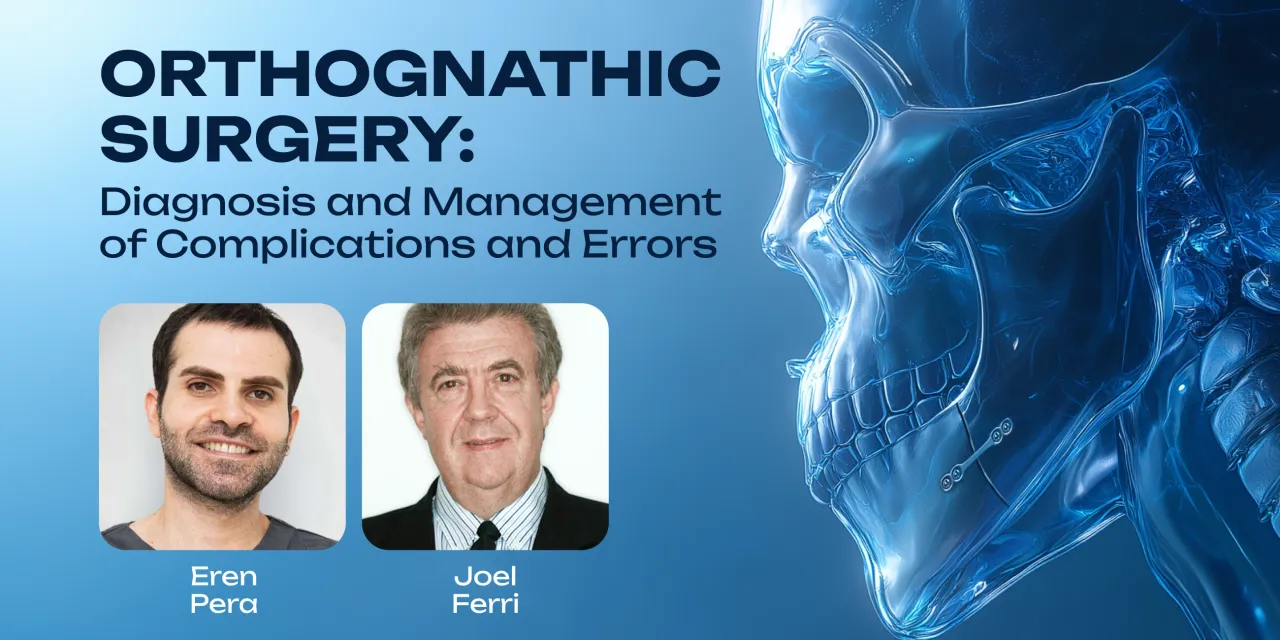
OHI-S Orthognathic Surgery Diagnosis and Management of Complications and Errors 4 lessons 2h 11min
$20.00
This Product is shared via google drive download link, So please share your correct Gmail id while placing the order .Please note that there are no CME points or certificate associated with this course Samples for Courses Can be found here : Free Samples Here!
OHI-S Orthognathic Surgery
Diagnosis and Management of Complications and Errors
4 Lessons | 2 Hours 11 Minutes | Joel Ferri & Eren Pera
Develop a structured approach to recognizing, preventing, and managing errors in orthognathic surgery with OHI-S Orthognathic Surgery: Diagnosis and Management of Complications and Errors.
Presented by Joel Ferri and Eren Pera, this focused clinical program examines complications across the complete orthognathic treatment pathway:
- Diagnosis
- Orthodontic preparation
- Surgical planning
- Surgical execution
- Functional assessment
- Aesthetic assessment
- Postoperative stability
- Relapse
- Complication management
Rather than concentrating only on operative technique, the course investigates why orthognathic treatment can fail or relapse and how errors may arise from diagnostic, orthodontic, surgical, functional, and interdisciplinary factors.
The program covers:
- Dentofacial deformity diagnosis
- Maxillary and mandibular planning
- Sagittal discrepancies
- Vertical discrepancies
- Transverse discrepancies
- Orthodontic compensation
- Orthodontic decompensation
- Surgeon–orthodontist coordination
- New orthognathic techniques
- Relapse mechanisms
- Swallowing dysfunction
- Mouth breathing
- Residual maxillary growth
- Mandibular condylar changes
- Myopathy and muscle typology
- Vascular complications
- Dental complications
- Nerve injuries
- Unfavorable fractures and bad splits
- Infection
- Pseudoarthrosis
- Dentoalveolar necrosis
- TMJ disorders
The central clinical framework is:
Diagnose Correctly → Plan Interdisciplinarily → Execute Safely → Recognize Complications Early → Identify the Cause of Relapse → Manage the Underlying Problem
Course Details
- Course: Orthognathic Surgery: Diagnosis and Management of Complications and Errors
- Provider: OHI-S
- Faculty: Joel Ferri, Eren Pera
- Lessons: 4
- Official Duration: 2 Hours 11 Minutes
- Language: English
- Official OHI-S CE: 2 CE Credits
- Primary Specialty: Oral & Maxillofacial Surgery
- Secondary Specialty: Orthodontics
- Main Focus: Orthognathic Surgery Complications, Errors & Relapse
- Clinical Level: Advanced
Course Overview
Successful orthognathic surgery depends on much more than technically performing an osteotomy.
Treatment begins long before surgery.
A patient may experience an unsatisfactory outcome because of problems involving:
- Initial diagnosis
- Skeletal analysis
- Dental compensation
- Orthodontic preparation
- Surgical movement selection
- Vertical control
- Transverse planning
- Condylar position
- Functional disorders
- Postoperative healing
This course analyzes these potential failure points systematically.
A useful treatment pathway is:
Diagnosis → Orthodontic Preparation → Surgical Plan → Surgery → Functional Recovery → Stability Evaluation
At every stage, clinicians should ask:
What Can Go Wrong Here—and How Can It Be Prevented?
Diagnosis Comes Before Surgery
Orthognathic surgery should address a correctly diagnosed dentofacial deformity.
The clinician must distinguish among:
- Skeletal discrepancies
- Dental compensations
- Functional adaptations
- Soft-tissue concerns
- TMJ-related factors
Incorrect diagnosis may produce an incorrect surgical objective even when the procedure itself is technically well executed.
Three-Dimensional Treatment Planning
Orthognathic planning should evaluate the patient in:
Sagittal Dimension
- Maxillary position
- Mandibular position
- Class II / Class III relationships
- Incisor relationships
Vertical Dimension
- Facial height
- Open bite
- Deep bite
- Maxillary vertical excess or deficiency
- Occlusal-plane relationships
Transverse Dimension
- Maxillary width
- Mandibular width
- Dental compensation
- Facial and occlusal asymmetry
Planning errors in any dimension can affect:
- Occlusion
- Function
- Facial aesthetics
- Stability
LESSON 1
Avoiding Pitfalls in Orthognathic Surgery: Common Errors in Maxillary and Mandibular Procedures
Instructor: Eren Pera
Duration: 12 Minutes
The first lesson establishes the diagnostic and treatment-planning framework.
Topics include:
- Diagnostic errors in dentofacial deformities
- Maxillary surgery planning pitfalls
- Mandibular surgery planning pitfalls
- Orthodontic–surgical treatment planning
- Compensation and decompensation errors
- Sagittal planning mistakes
- Vertical planning errors
- Transverse discrepancies
- Technical pitfalls
- Interdisciplinary workflow problems
- Communication gaps
- Functional stability
- Aesthetic outcomes
- Complication prevention
- Relapse prevention
Diagnostic Errors
One of the most important principles of the course is:
A technically successful operation cannot compensate for an incorrect diagnosis.
Treatment planning should establish:
- Nature of the dentofacial deformity
- Skeletal contribution
- Dental contribution
- Functional contribution
- Soft-tissue objectives
before defining surgical movements.
Maxillary & Mandibular Planning
Surgical planning should consider how movement of one jaw affects:
- Occlusion
- Facial proportions
- Airway relationships
- Soft tissue
- Opposing jaw
- TMJ and condylar position
The maxilla and mandible should therefore be considered within one integrated craniofacial system.
Orthodontic–Surgical Coordination
Orthodontics and surgery are not independent phases.
A strong interdisciplinary pathway is:
Orthodontic Diagnosis → Decompensation → Surgical Planning → Orthognathic Surgery → Finishing Orthodontics
Poor coordination can result in:
- Incorrect dental position
- Compromised surgical movement
- Residual malocclusion
- Unstable outcomes
Compensation and Decompensation
Patients with skeletal discrepancies may develop dental compensation.
Before surgery, orthodontic treatment may need to remove that compensation so the true skeletal discrepancy becomes visible.
Errors may occur when teeth are:
- Under-decompensated
- Over-decompensated
- Positioned inconsistently with the surgical objective
The orthodontic plan must therefore be based on the intended final skeletal correction.
Sagittal Planning Errors
Sagittal mistakes can involve incorrect assessment of:
- Maxillary protrusion or retrusion
- Mandibular protrusion or retrusion
- Dental compensation
- Incisor position
The consequence may be an incomplete or excessive correction of the patient’s profile and occlusion.
Vertical Planning Errors
Vertical planning affects:
- Incisor show
- Smile
- Facial height
- Occlusal plane
- Mandibular autorotation
Small planning changes may have substantial facial effects.
Transverse Errors
Transverse discrepancies may remain hidden if diagnosis concentrates only on sagittal cephalometric relationships.
Potential issues include:
- Maxillary deficiency
- Asymmetry
- Dental compensation
- Crossbite
These must be recognized before final surgical planning.
Interdisciplinary Communication
Poor communication between surgeon and orthodontist can introduce avoidable errors.
Both clinicians should understand:
- Final skeletal objective
- Required decompensation
- Planned surgical movement
- Postoperative orthodontic goals
The treatment should be planned as a single process rather than two separate specialties working independently.
LESSON 2
New Techniques in Orthognathic Surgery: Advances in Precision and Predictability
Instructor: Eren Pera
Duration: 16 Minutes
The second lesson reviews contemporary developments in orthognathic surgery.
Topics include:
- Emerging surgical techniques
- New orthognathic concepts
- Rationale behind newer approaches
- Accuracy
- Stability
- Predictability
- Indications
- Limitations
- Multidisciplinary integration
- Complication reduction
- Evidence-based decision-making
Modern Orthognathic Surgery
Modern treatment has increasingly incorporated:
- Improved diagnostic workflows
- More structured treatment planning
- Digital technologies
- Multidisciplinary collaboration
However, newer technology does not eliminate the need for accurate diagnosis and surgical judgment.
Precision vs. Predictability
These terms should be distinguished.
Precision
Refers to accurately executing the intended plan.
Predictability
Refers more broadly to the consistency of the clinical outcome.
A procedure may be performed precisely but still fail to produce the expected result if:
- Diagnosis was incorrect
- Planning was inadequate
- Biological factors were underestimated
Indications and Limitations
The course emphasizes evaluating both the potential advantages and limitations of contemporary techniques.
The appropriate question is not:
“What Is the Newest Technique?”
but:
“Which Technique Is Appropriate for This Patient and Treatment Objective?”
Evidence-Based Decision-Making
New surgical concepts should be evaluated according to:
- Indication
- Clinical evidence
- Patient anatomy
- Stability
- Risk
- Surgical experience
rather than novelty alone.
LESSON 3
Etiology of Relapse in Orthognathic Surgery
Instructor: Joel Ferri
Duration: 40 Minutes
The third lesson focuses on understanding why orthognathic results relapse.
Topics include:
- Persistent dysfunctions
- Abnormal swallowing
- Mouth breathing
- Residual maxillary growth
- Mandibular condylar reshaping
- Myopathy
- Muscle typology
- Early identification of relapse mechanisms
- Prevention of permanent damage
Orthognathic Relapse
Relapse should not always be interpreted simply as:
“The Bone Moved Back.”
The true mechanism may involve:
- Persistent muscular function
- Growth
- Condylar changes
- Occlusal relationships
- Skeletal adaptation
- Uncorrected functional disorders
Understanding the cause is critical before selecting a corrective strategy.
Persistent Dysfunction
The official course specifically highlights persistent dysfunctions such as:
- Abnormal swallowing
- Mouth breathing
If the underlying functional driver remains after surgery, it may continue to influence the dentofacial system.
This emphasizes:
Treat the Cause, Not Only the Skeletal Result
Swallowing Dysfunction
Abnormal swallowing patterns can influence:
- Tongue posture
- Dental relationships
- Muscular forces
Persistent dysfunction may therefore need to be incorporated into multidisciplinary assessment.
Mouth Breathing
Mouth breathing may coexist with:
- Airway-related problems
- Altered oral posture
- Functional adaptation
Its relevance should be evaluated according to the individual patient rather than assumed to be the cause of every relapse.
Residual Maxillary Growth
Growth-related changes can affect long-term stability.
The course discusses the impact of:
Residual Maxillary Growth
on postoperative outcomes.
This reinforces the importance of understanding:
- Patient age
- Growth status
- Deformity pattern
before treatment.
Condylar Reshaping
Changes involving the mandibular condyle can alter:
- Mandibular position
- Occlusion
- Facial symmetry
- Long-term surgical stability
The course discusses unfavorable condylar reshaping as a potential mechanism contributing to relapse.
Myopathy & Muscle Typology
Constitutional muscular factors may influence postoperative adaptation.
The curriculum includes:
- Myopathy
- Muscle typology
as potential contributors to treatment stability.
Early Detection
Relapse management should emphasize:
Recognition Before Severe Secondary Deformity Develops
Early evaluation may allow clinicians to identify:
- Occlusal changes
- Functional abnormalities
- TMJ problems
- Skeletal changes
before they become more difficult to manage.
LESSON 4
Mistakes and Complications in Orthognathic Surgery
Instructor: Joel Ferri
Duration: 1 Hour 1 Minute
The final lesson provides the most comprehensive overview of surgical complications.
Topics include:
- Functional considerations
- Diagnostic errors
- Orthodontic treatment errors
- Surgical planning errors
- Aesthetic planning errors
- Surgical safety
- Risk factors
- Vascular complications
- Dental complications
- Nerve-related complications
- Unfavorable fractures
- Bad splits
- Postoperative infection
- Pseudoarthrosis
- Dentoalveolar necrosis
- TMJ disorders
- Complication prevention
- Early recognition
- Management
Functional Considerations
Orthognathic treatment should not focus exclusively on facial appearance.
Planning may also involve:
- Mastication
- Occlusion
- TMJ function
- Muscle function
- Swallowing
- Airway-related functional considerations
Aesthetic improvement should be integrated with functional goals.
Aesthetic Planning Errors
Orthognathic surgery directly changes facial proportions.
Planning should consider:
- Profile
- Facial height
- Lip support
- Chin projection
- Smile
- Facial symmetry
An ideal occlusal result does not automatically guarantee an ideal facial result.
Vascular Complications
Orthognathic surgery is performed in anatomically vascular regions.
The course includes vascular complications as a major safety topic.
Recognition and management of intraoperative and postoperative bleeding require formal surgical training and appropriate emergency preparedness.
Dental Complications
Potential dental complications may occur in association with:
- Osteotomies
- Segmental procedures
- Surgical manipulation
The course emphasizes prevention and recognition rather than viewing dental complications as isolated technical events.
Nerve-Related Complications
Neurosensory problems are important considerations in orthognathic surgery.
Clinicians should understand the relationship between:
- Surgical anatomy
- Osteotomy design
- Nerve position
- Postoperative neurological symptoms
Unfavorable Fractures & Bad Splits
A bad split is an important intraoperative complication, especially within mandibular osteotomy procedures.
The course reviews:
- Recognition
- Risk considerations
- Management principles
These events require experienced surgical decision-making.
Postoperative Infection
Postoperative infection may compromise:
- Healing
- Fixation
- Bone
- Soft tissues
- Final stability
Prevention and early management are therefore essential components of surgical care.
Pseudoarthrosis
Pseudoarthrosis represents failure to achieve normal bony union between surgical segments.
It can affect:
- Stability
- Occlusion
- Function
and may require further evaluation or intervention.
Dentoalveolar Necrosis
The program also includes dentoalveolar necrosis, an important but potentially serious complication involving compromised vascular supply to dentoalveolar segments.
This emphasizes the importance of:
- Surgical anatomy
- Tissue preservation
- Vascular considerations
Temporomandibular Joint Disorders
TMJ-related problems can influence:
- Diagnosis
- Treatment planning
- Postoperative function
- Stability
The relationship between orthognathic surgery and TMJ conditions must therefore be evaluated at the individual-patient level.
Prevention Before Management
One of the strongest lessons of the course is that complication management begins before surgery.
A useful prevention model is:
Accurate Diagnosis
↓
Appropriate Orthodontic Preparation
↓
Correct Surgical Plan
↓
Recognition of Risk Factors
↓
Careful Execution
↓
Early Detection
↓
Appropriate Management
Orthodontist–Surgeon Collaboration
Orthognathic surgery requires one of the closest collaborations in dentistry.
Orthodontist
Responsible for key components including:
- Dental alignment
- Decompensation
- Arch coordination
- Surgical preparation
- Postoperative finishing
Oral & Maxillofacial Surgeon
Responsible for:
- Skeletal diagnosis
- Surgical planning
- Operative treatment
- Surgical risk management
The best outcomes depend on a shared final objective.
Compensation vs. Decompensation
A patient may appear to have a less severe skeletal discrepancy because the teeth have compensated.
Before surgery, those compensations may need correction.
A simplified example is:
Skeletal Deformity + Dental Compensation
↓
Orthodontic Decompensation
↓
True Skeletal Discrepancy Revealed
↓
Surgical Correction
Incorrect sequencing can compromise final:
- Occlusion
- Facial profile
- Stability
Orthognathic Surgery & TMJ
TMJ evaluation should form part of the diagnostic process when clinically relevant.
Potential considerations include:
- Pain
- Dysfunction
- Condylar morphology
- Range of motion
- Existing joint disease
The presence of TMD does not automatically determine one universal orthognathic strategy.
Relapse Prevention
Long-term stability requires more than rigid fixation.
Factors influencing stability may include:
- Growth
- Muscle function
- Swallowing
- Breathing patterns
- Condylar adaptation
- Orthodontic finishing
- Retention
- Original deformity
The course therefore approaches relapse as a multifactorial problem.
Major Topics Covered
- Orthognathic Surgery
- Orthognathic Surgery Complications
- Orthognathic Surgery Errors
- Dentofacial Deformities
- Maxillary Surgery
- Mandibular Surgery
- Orthodontic Surgical Planning
- Orthodontic Decompensation
- Dental Compensation
- Sagittal Discrepancies
- Vertical Discrepancies
- Transverse Discrepancies
- Orthognathic Relapse
- Swallowing Dysfunction
- Mouth Breathing
- Residual Maxillary Growth
- Mandibular Condyle
- TMJ Disorders
- Myopathy
- Vascular Complications
- Nerve Injury
- Bad Split
- Unfavorable Fracture
- Postoperative Infection
- Pseudoarthrosis
- Dentoalveolar Necrosis
- Surgical Risk Management
- Oral and Maxillofacial Surgery
- Surgical Orthodontics
Who Should Take This Course?
The strongest target audience includes:
- Oral and Maxillofacial Surgeons
- Orthognathic Surgeons
- Oral & Maxillofacial Surgery Residents
- Orthodontists
- Orthodontic Residents involved in surgical cases
The program is particularly useful for clinicians participating in:
Orthodontic–Surgical Management of Dentofacial Deformities
The strongest primary audience is:
Oral and Maxillofacial Surgeons
with Orthodontists as the essential interdisciplinary secondary audience.
Is This an Orthodontics Course?
Orthodontics is a major component because the course covers:
- Compensation
- Decompensation
- Surgical orthodontic planning
- Interdisciplinary coordination
- Orthodontic errors
However, the overall course is officially categorized within:
Oral and Maxillofacial Surgery
and much of Lesson 4 addresses operative complications.
Therefore, the product should be positioned primarily as:
Orthognathic / Oral & Maxillofacial Surgery
with Orthodontics as a major secondary specialty.
Why This Course Is Useful
The strongest value is the integration of several failure domains within one course.
Diagnostic Errors
- Dentofacial diagnosis
- Sagittal / vertical / transverse discrepancies
Orthodontic Errors
- Compensation
- Decompensation
- Coordination
Surgical Planning Errors
- Maxillary movement
- Mandibular movement
- Aesthetic planning
Surgical Complications
- Vascular
- Dental
- Neurologic
- Bad splits
- Infection
- Necrosis
Relapse
- Dysfunction
- Growth
- Condylar changes
- Muscle factors
The complete framework is:
Prevent → Recognize → Understand the Cause → Manage → Improve Long-Term Stability
Important Surgical Training Notice
Orthognathic surgery is an advanced surgical discipline.
Recorded education can improve understanding of:
- Diagnosis
- Treatment planning
- Complication recognition
- Relapse mechanisms
- Interdisciplinary coordination
but it does not substitute for:
- Formal Oral & Maxillofacial Surgery training
- Operative residency training
- Supervised surgical experience
- Advanced airway and emergency management
- Appropriate institutional credentialing
Management of complications such as vascular injury, bad splits, infection, pseudoarthrosis, necrosis, or nerve injury requires appropriately trained surgical teams.
Original OHI-S CE Information
The current official OHI-S course page lists:
2 CE Credits
for the complete:
4-Lesson / 2h 11min
course.
Official CE eligibility applies to participants who complete the applicable requirements through OHI-S.
An independently distributed MedicalAmboss recording package should not automatically be advertised as including:
- OHI-S CE Credits
- OHI-S Certificate
unless official participation and credit eligibility are included.
Product Summary
- Product: Orthognathic Surgery: Diagnosis and Management of Complications and Errors
- Provider: OHI-S
- Faculty: Joel Ferri & Eren Pera
- Lessons: 4
- Official Duration: 2h 11min
- Language: English
- Current Official OHI-S CE: 2 Credits
- Primary Specialty: Oral & Maxillofacial Surgery
- Secondary Specialty: Orthodontics
- Main Focus: Errors, Complications, Relapse & Prevention
4. Short Description
OHI-S Orthognathic Surgery: Diagnosis and Management of Complications and Errors is an advanced 4-lesson, 2h 11min clinical course presented by Joel Ferri and Eren Pera.
The program covers diagnostic errors in dentofacial deformities, maxillary and mandibular treatment-planning pitfalls, orthodontic compensation and decompensation, sagittal/vertical/transverse planning, modern orthognathic techniques, relapse caused by persistent dysfunction and growth-related factors, condylar changes, vascular and nerve complications, bad splits, infection, pseudoarthrosis, dentoalveolar necrosis, and TMJ disorders.
Topics
Lesson 1. Avoiding Pitfalls in Orthognathic Surgery: Common Errors in Maxillary and Mandibular Procedures
-
Diagnostic errors in dentofacial deformities
-
Treatment planning pitfalls in maxillary and mandibular surgery
-
Orthodontic–surgical planning principles
-
Errors in orthodontic compensation and decompensation
-
Sagittal discrepancies: planning mistakes
-
Vertical dimension errors in surgical planning
-
Transverse discrepancies and miscalculations
-
Surgical and technical pitfalls
-
Workflow and interdisciplinary coordination issues
-
Communication gaps between orthodontist and surgeon
-
Factors affecting functional stability
-
Factors influencing aesthetic outcomes
-
Prevention of complications and relapse
-
Systematic approach to predictable treatment outcomes
-
Clinical strategies for improving surgical predictability
Lesson 2. New Techniques in Orthognathic Surgery: Advances in Precision and Predictability
-
Emerging techniques in modern orthognathic surgery
-
Rationale behind new surgical concepts
-
Impact on accuracy, stability, and predictability
-
Indications and limitations of contemporary techniques
-
Integration into multidisciplinary workflows
-
Strategies to improve outcomes and minimize complications
-
Evidence-based decision-making in clinical practice
Lesson 3. Etiology of Relapse in Orthognathic Surgery
-
Relapse due to persistent dysfunctions: swallowing abnormalities and mouth breathing
-
Residual maxillary growth and its impact
-
Unfavorable mandibular condyle reshaping
-
Constitutional abnormalities: myopathy and muscle typology
-
Importance of early detection and management to prevent permanent damage
Lesson 4. Mistakes and Complications in Orthognathic Surgery
-
Functional considerations in orthognathic surgery
-
Diagnostic errors
-
Errors in orthodontic treatment
-
Errors in surgical planning
-
Errors in aesthetic considerations
-
Overview of surgical safety and risk factors
-
Vascular complications
-
Dental complications
-
Nerve-related complications
-
Unfavorable fractures and bad splits
-
Postoperative infections
-
Pseudoarthrosis
-
Dentoalveolar necrosis
-
Temporomandibular joint (TMJ) disorders
-
Other potential complications
-
Importance of prevention, early detection, and proper management
Related products

DENTAL

DENTAL
Sinus Grafting for Implant Reconstruction (Pikos Online MasterClass Series) – Michael A. Pikos

Anesthesiology & pain medicine