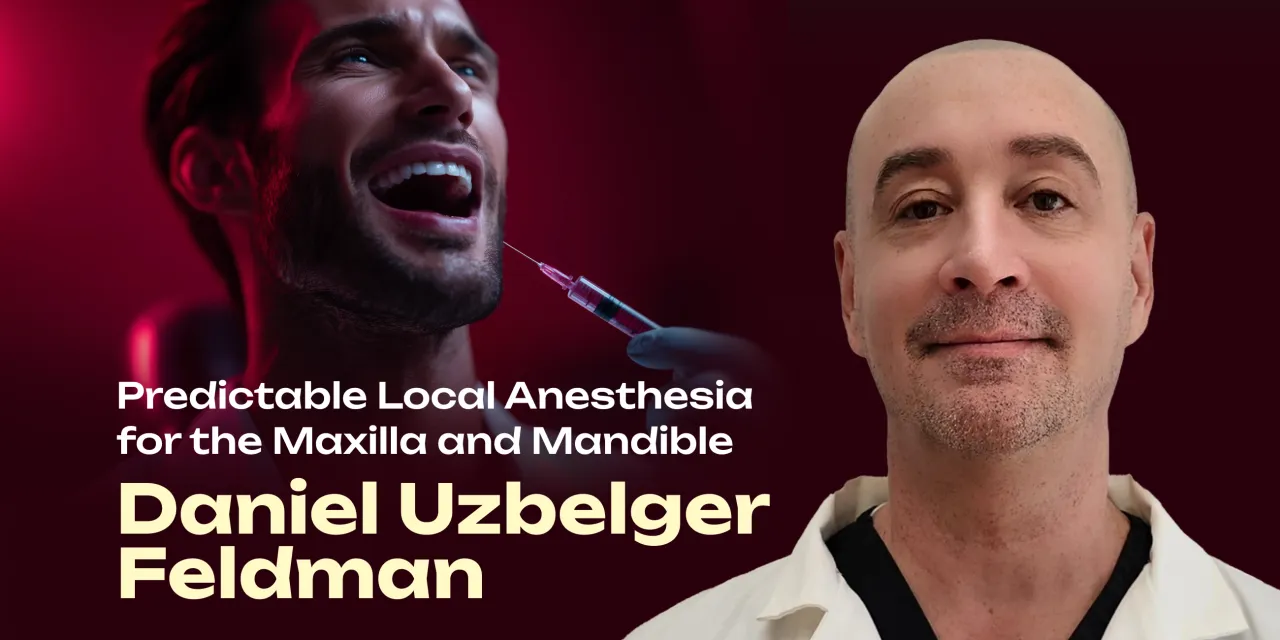
OHI-S Predictable Local Anesthesia for the Maxilla and Mandible 7 lessons 4h 19min
Original price was: $350.00.$45.00Current price is: $45.00.
This Product is shared via google drive download link, So please share your correct Gmail id while placing the order .Please note that there are no CME points or certificate associated with this course Samples for Courses Can be found here : Free Samples Here!
OHI-S Predictable Local Anesthesia for the Maxilla and Mandible
Evidence-Based Dental Anesthesia, Maxillary Protocols, Mandibular Blocks & ICPAT
6 Lessons + 1 Free | 4 Hours 19 Minutes | 3.5 CE Credits
Build a deeper, anatomy-driven understanding of dental local anesthesia with OHI-S Predictable Local Anesthesia for the Maxilla and Mandible, presented by Daniel Uzbelger Feldman.
This comprehensive clinical course addresses one of the most common frustrations in dentistry:
Why can local anesthesia fail even when the injection appears technically correct?
The program connects:
- Pain perception
- Neurophysiology
- Local anesthetic pharmacology
- Trigeminal nerve anatomy
- Maxillary innervation
- Mandibular innervation
- Inferior alveolar nerve block failure
- Accessory innervation
- Painless injection concepts
- Local anesthetic selection
- Dosage and toxicity awareness
- Intraoral Cervical Plexus Anesthetic Technique – ICPAT
- Supplemental injection strategies
- Emerging anesthesia technologies
The central clinical framework is:
Understand the Pain Mechanism → Identify the Relevant Innervation → Select the Appropriate Anesthetic Strategy → Deliver Carefully → Assess the Response → Adapt When Needed
Course Details
- Course: Predictable Local Anesthesia for the Maxilla and Mandible
- Provider: OHI-S
- Instructor: Daniel Uzbelger Feldman
- Official Structure: 6 Lessons + 1 Free
- Total Presentations: 7
- Official Duration: 4 Hours 19 Minutes
- Language: English
- Official OHI-S CE: 3.5 CE Credits
- Primary Field: Dentistry / Dental Local Anesthesia
- Clinical Focus: Maxillary & Mandibular Anesthesia
- Advanced Topic: Intraoral Cervical Plexus Anesthetic Technique – ICPAT
Course Overview
Successful dental anesthesia is influenced by much more than needle placement.
Clinical failure can involve interactions among:
- Anatomy
- Accessory innervation
- Nerve physiology
- Tissue characteristics
- Pain perception
- Injection pressure
- Anesthetic formulation
- Clinical technique
- Patient-related factors
The course therefore moves beyond a simple list of injection points and asks:
Why does anesthesia work in one patient but fail in another?
Pain During Dental Injection
The course breaks the injection experience into several components, including:
- Needle insertion
- Temperature change
- Chemical irritation
- Pressure
- Tissue distension
- Central pain amplification
This helps clinicians understand that “injection pain” is not a single physiological event.
Pain Perception
Pain is influenced by both:
Peripheral nociceptive input
and:
Central processing
Therefore, the patient’s experience can vary even when apparently similar techniques are used.
Clinical communication, anxiety, previous experience, tissue conditions, and pain modulation can all influence the overall experience.
C-Fibers & A-Delta Fibers
The foundational section reviews the role of nerve fibers involved in pain transmission.
Understanding nerve physiology supports a clearer interpretation of:
- Local anesthetic onset
- Sensory blockade
- Pain transmission
- Incomplete anesthesia
Sodium-Channel Blockade
Local anesthetics act primarily by interfering with voltage-gated sodium-channel function and preventing normal propagation of nerve impulses.
This provides the pharmacologic basis of dental local anesthesia.
However, the course emphasizes that pharmacology alone does not explain every clinical failure.
LESSON 1
Foundations of Dental Anesthesia and Pain Perception
Instructor: Daniel Uzbelger Feldman
Duration: 55 Minutes
The opening lesson establishes the scientific foundation.
Topics include:
- Foundations of dental anesthesia
- What patients perceive during injections
- Needle insertion
- Temperature change
- Chemical irritation
- Tissue pressure and distension
- Central amplification
- Conceptual mechanisms of anesthesia
- C-fibers
- A-delta fibers
- Evolution and history of dental anesthesia
- Types of local anesthetic formulations
Understanding the Injection Experience
Injection discomfort can originate from multiple stages.
A useful conceptual framework is:
Needle Contact → Tissue Penetration → Solution Deposition → Tissue Expansion → Neural Processing
Recognizing these components allows clinicians to consider comfort during the complete injection sequence.
Local Anesthetic Formulations
The course reviews different local anesthetic types and formulations.
Selection should consider factors such as:
- Procedure
- Expected duration
- Patient medical history
- Maximum recommended exposure
- Product labeling
- Clinical setting
No single anesthetic is universally optimal for every dental procedure.
LESSON 2
Mechanisms of Action and Limitations of Dental Anesthesia
Instructor: Daniel Uzbelger Feldman
Duration: 9 Minutes
Format: Clinical Video
This focused lesson examines why understanding pharmacology is necessary—but not sufficient.
Topics include:
- Sodium-channel blockade
- Nerve-fiber physiology
- Conduction physiology
- Limits of pharmacologic explanations
- Pain perception
- Pain modulation
- Patient body language
- Common anesthesia myths
- Why dental anesthesia presents unique challenges
Why Anesthesia May Fail
An unsuccessful outcome should not immediately be reduced to:
“The Dentist Missed the Nerve.”
Possible contributors may involve:
- Anatomy
- Innervation variability
- Accessory innervation
- Local tissue factors
- Technique
- Drug selection
- Pain-processing factors
The course develops this broader framework before moving into specific techniques.
LESSON 3
Maxillary Anesthesia: Anatomy, Variability, and Painless Clinical Protocols
Instructor: Daniel Uzbelger Feldman
Duration: 32 Minutes
This lesson focuses on maxillary neuroanatomy and clinical variability.
Topics include:
- Trigeminal nerve anatomy
- Maxillary nerve origin and pathway
- Nerve structure
- Nerve fascicles
- Paresthesia considerations
- Local anesthetic diffusion
- Primary maxillary techniques
- Maxillary anatomical variability
- Buccal infiltration limitations in molars
- Infraorbital anesthesia
- Palatal anesthesia considerations
- Needle-insertion protocols
- Strategies intended to improve patient comfort
Trigeminal Nerve
The trigeminal nerve provides the principal sensory innervation of the face and oral structures.
Understanding its branches is essential when planning regional dental anesthesia.
For maxillary treatment, the curriculum focuses on pathways associated with the:
Maxillary Division – V2
and its clinically relevant branches.
Why Maxillary Infiltration Can Vary
Although maxillary infiltration is frequently effective, clinical response is not identical in every situation.
Potential considerations include:
- Tooth location
- Root anatomy
- Cortical bone
- Nerve distribution
- Tissue diffusion
- Anatomical variation
The course explores why molars may require particular consideration.
Infraorbital Anesthesia
The program discusses the relevance of infraorbital anesthesia within selected maxillary treatment strategies.
The key educational objective is understanding:
Which nerve territories are being targeted and why.
Palatal Injection Discomfort
Palatal injections can be particularly uncomfortable because of tightly adherent tissue.
The course includes clinical concepts aimed at improving comfort during maxillary anesthesia and reducing unnecessary painful injections where appropriate.
LESSON 4
Predictable Maxillary Anesthesia: Techniques for 100% Success
Instructor: Daniel Uzbelger Feldman
Duration: 33 Minutes
This is the official OHI-S lesson title.
The lesson focuses on:
- Single-tooth maxillary anesthesia
- Multiple-tooth maxillary anesthesia
- Topical anesthetic application
- Needle insertion
- Tissue pressure
- Tissue distension
- Injection comfort
- Dose awareness
- Toxicity awareness
- Clinical calculation concepts
- Local anesthetic selection
Important Note About “100% Success”
Although “Techniques for 100% Success” is the official title of the OHI-S lesson, MedicalAmboss should not translate that wording into a guarantee of clinical outcome.
Individual anesthesia results can vary according to:
- Anatomy
- Inflammation
- Patient factors
- Drug choice
- Technique
- Procedure
A safer SEO description is:
“strategies designed to improve the reliability and predictability of maxillary anesthesia.”
Single-Tooth vs. Multiple-Tooth Anesthesia
The course differentiates between treatment requiring:
Localized Anesthesia
for an individual tooth
and:
Broader Regional Coverage
for multiple teeth.
The underlying principle is to select the smallest appropriate anesthetic strategy capable of supporting the planned treatment.
Dosage & Toxicity Awareness
Safe anesthesia requires awareness of:
- Agent concentration
- Total administered amount
- Patient factors
- Product-specific limits
Exact dosing should always follow current product labeling, professional training, and patient-specific medical assessment.
LESSON 5
Mandibular Anesthesia Failure: Limitations, Anatomy, and Clinical Challenges
Instructor: Daniel Uzbelger Feldman
Duration: 20 Minutes
The mandibular section begins by examining why conventional anesthesia may fail.
Topics include:
- Limitations of mandibular anesthesia
- Mandibular anatomical variation
- Inferior alveolar nerve
- Conventional mandibular block failure
- Accessory innervation concepts
- Clinical challenges of achieving profound mandibular anesthesia
Inferior Alveolar Nerve Block
The inferior alveolar nerve block – IANB is one of the central techniques discussed in the course.
The program examines why failure can occur despite apparently correct execution.
Potential considerations include:
- Anatomical variability
- Needle position
- Neural pathways
- Accessory innervation
Failed Mandibular Blocks
Repeatedly administering the same technique after failure may not always address the underlying reason for inadequate anesthesia.
The course instead encourages clinicians to consider:
Why Did the Block Fail?
before selecting a supplemental or alternative strategy.
LESSON 6
Predictable Mandibular Anesthesia: Intraoral Cervical Plexus Technique
Instructor: Daniel Uzbelger Feldman
Duration: 1 Hour 22 Minutes
Official OHI-S CE: 1.25 Credits
This is one of the most distinctive modules in the course.
It presents the:
ICPAT
Intraoral Cervical Plexus Anesthetic Technique
developed and published by Daniel Uzbelger Feldman.
The lesson covers:
- ICPAT concept
- Clinical trial results discussed by the instructor
- Validation studies presented in the curriculum
- Mandibular neuroanatomy
- Accessory innervation
- Historical evidence
- Contemporary evidence
- Cervical plexus contribution
- Sihler staining
- Cadaveric findings
- Step-by-step clinical demonstration
- Accessory Innervation Technique Protocols – AITP
Accessory Innervation
Traditional models of mandibular dental anesthesia focus heavily on trigeminal pathways.
The course explores evidence presented by Feldman concerning additional sensory contribution involving the cervical plexus.
This is used to explain selected cases of persistent sensation despite conventional mandibular nerve blockade.
Sihler Staining & Cadaveric Anatomy
The course reviews anatomical investigations using Sihler staining and cadaveric material to demonstrate proposed accessory innervation pathways reaching the mandible.
This is one of the most scientifically distinctive aspects of the program.
ICPAT: Appropriate SEO Positioning
MedicalAmboss should describe ICPAT as:
“Daniel Uzbelger Feldman’s published Intraoral Cervical Plexus Anesthetic Technique, with anatomical rationale and clinical evidence discussed in the course.”
Avoid stronger claims such as:
“ICPAT universally replaces the inferior alveolar nerve block.”
or:
“ICPAT guarantees anesthesia in every patient.”
The course presents an advanced clinical technique and supporting evidence, but clinicians should evaluate it within their training, available evidence, patient anatomy, and applicable professional standards.
Supplemental Injections
The curriculum discusses strategies intended to reduce reliance on:
- Intraligamentary injections
- Intraosseous injections
- Intrapulpal injections
This should be described as an educational objective rather than a guaranteed elimination of supplemental anesthesia in every clinical scenario.
LESSON 7
The Future of Dental Local Anesthesia: Innovation, Technology, and New Formulations
Instructor: Daniel Uzbelger Feldman
The final lesson explores emerging concepts in dental anesthesia.
Topics include:
- Anatomy-driven anesthesia
- Warm local anesthetic solutions
- Buffered anesthetic concepts
- Electronic delivery systems
- New formulations
- Technology-assisted anesthesia
- Ultrasound guidance
- Imaging
- Artificial intelligence
- Future pain-control strategies
Warm & Buffered Local Anesthesia
The program explores whether modification of solution preparation or delivery may influence:
- Patient comfort
- Anesthetic onset
- Clinical experience
These concepts should be evaluated according to the specific agent, delivery system, available evidence, and regulatory labeling.
Electronic Delivery Systems
Technology can influence the way local anesthetic is delivered.
Potential aims include improving:
- Delivery control
- Injection speed
- Patient comfort
However, technology does not replace an understanding of anatomy and pharmacology.
Ultrasound-Guided Dental Anesthesia
Ultrasound is discussed as a potential future or developing tool for visualizing anatomy during selected regional anesthetic procedures.
Its use requires separate ultrasound competency and procedural training.
AI & Imaging
The final lesson examines the future possibility of integrating:
- Imaging
- Anatomical visualization
- Artificial intelligence
into dental anesthesia planning.
The central concept is:
Better Anatomical Information → Better-Informed Anesthetic Strategy
rather than AI independently selecting or delivering anesthesia.
Maxilla vs. Mandible
One of the strongest educational structures of the course is the direct comparison between:
Maxillary Anesthesia
Often relying heavily on infiltration and regional techniques.
Mandibular Anesthesia
Frequently requiring deeper regional approaches and consideration of anatomical variability and accessory innervation.
The course treats each region according to its anatomy rather than using one universal injection philosophy.
Painless Injection Strategies
A major recurring theme is reducing procedural discomfort.
Relevant concepts include:
- Topical anesthesia
- Needle insertion
- Pressure control
- Tissue distension
- Injection strategy
- Patient communication
- Anatomy
The more accurate marketing term is:
“patient-comfort-focused injection strategies”
rather than guaranteeing a completely painless injection in every patient.
Local Anesthetic Safety
Local anesthetics are pharmacologically active drugs.
Safe administration requires clinicians to consider:
- Medical history
- Drug selection
- Concentration
- Total dose
- Relevant drug interactions
- Patient age and health
- Potential toxicity
The program’s dosage discussion should therefore be presented within professional clinical training.
Local Anesthetic Systemic Toxicity
Clinicians administering local anesthetics should recognize that excessive systemic exposure can produce serious adverse effects.
Training should include:
- Prevention
- Early recognition
- Emergency preparedness
A video course should complement—not replace—formal clinical training in safe drug administration and emergency management.
Major Topics Covered
- Dental Local Anesthesia
- Local Anesthesia Dentistry
- Maxillary Anesthesia
- Mandibular Anesthesia
- Inferior Alveolar Nerve Block
- IANB
- Dental Nerve Block
- Trigeminal Nerve
- Maxillary Nerve
- Accessory Innervation
- Cervical Plexus
- ICPAT
- Intraoral Cervical Plexus Anesthetic Technique
- AITP
- Dental Pain
- Pain Perception
- Sodium Channels
- C-Fibers
- A-Delta Fibers
- Painless Dental Injection
- Local Anesthetic Pharmacology
- Local Anesthetic Toxicity
- Infraorbital Anesthesia
- Palatal Anesthesia
- Mandibular Block Failure
- Sihler Staining
- Ultrasound-Guided Anesthesia
- Buffered Anesthesia
- Electronic Dental Anesthesia
- AI in Dentistry
Who Should Take This Course?
The strongest target audience includes:
- General Dentists
- Endodontists
- Oral and Maxillofacial Surgeons
- Periodontists
The course can also be relevant to:
- Implantologists
- Prosthodontists
- Pediatric Dentists
- Dental clinicians who routinely administer local anesthesia
The broad relevance exists because predictable local anesthesia is foundational to nearly every invasive dental specialty.
Why Endodontists May Find It Valuable
Endodontic procedures frequently involve patients with:
- Significant pain
- Pulpal inflammation
- Previous anesthesia failure
Therefore, the mandibular-anesthesia and failed-block sections are particularly relevant to endodontic practice.
Why Oral Surgeons May Find It Valuable
Oral surgery requires reliable anesthesia across:
- Maxillary teeth
- Mandibular teeth
- Soft tissue
- Regional nerve territories
The course also provides advanced anatomical material relevant to clinicians performing regional blocks.
Why Periodontists & Implantologists May Find It Valuable
Periodontal and implant procedures frequently require:
- Multi-tooth anesthesia
- Regional anesthesia
- Palatal anesthesia
- Surgical field anesthesia
A structured understanding of anatomy and anesthetic coverage can support procedural planning.
Important Clinical Training Notice
Dental nerve blocks and advanced regional anesthetic techniques are clinical procedures.
Recorded education can support understanding of:
- Anatomy
- Pharmacology
- Injection concepts
- Failure mechanisms
- Emerging techniques
but does not independently establish procedural competency.
Advanced techniques such as ICPAT should be used only by appropriately trained dental professionals within their legal scope of practice.
Original OHI-S CE Information
The official OHI-S course is currently listed as:
6 Lessons + 1 Free
with:
4 Hours 19 Minutes
and:
3.5 CE Credits
Official OHI-S CE eligibility applies to participation through OHI-S and completion of its applicable requirements.
An independently distributed MedicalAmboss recording package should not automatically be advertised as providing:
- OHI-S CE Credits
- OHI-S Certificate
unless official OHI-S participation and credit eligibility are actually included.
Product Summary
- Product: Predictable Local Anesthesia for the Maxilla and Mandible
- Provider: OHI-S
- Instructor: Daniel Uzbelger Feldman
- Official Structure: 6 Lessons + 1 Free
- Total Presentations: 7
- Official Duration: 4h 19min
- Language: English
- Official OHI-S CE: 3.5 Credits
- Primary Field: Dental Local Anesthesia
- Main Topics: Maxillary Anesthesia, Mandibular Anesthesia, IANB Failure & ICPAT
4. Short Description
OHI-S Predictable Local Anesthesia for the Maxilla and Mandible is a comprehensive 4h 19min clinical dentistry course by Daniel Uzbelger Feldman, officially structured as 6 lessons + 1 free presentation.
The program covers pain perception, dental anesthesia pharmacology, sodium-channel physiology, trigeminal and maxillary nerve anatomy, maxillary infiltration and regional techniques, inferior alveolar nerve block failure, mandibular anatomical variation, accessory innervation, ICPAT, Sihler staining and cadaveric findings, patient-comfort-focused injection strategies, dosage and toxicity awareness, and emerging ultrasound, imaging and AI-assisted anesthesia concepts.
Topics
Lesson 1. Foundations of Dental Anesthesia and Pain Perception
-
Foundations of dental anesthesia
-
What patients actually feel during injections
-
Sequence of events during injection: Needle insertion, Temperature change, Chemical irritation at the needle tip, Pressure and tissue distension, Central amplification
-
Conceptual mechanisms of anesthesia
-
Evolution of dental structures and C- and A-delta fibers
-
Evolution and history of dental anesthesia
-
Overview of local anesthetic types and formulations
Lesson 2. Mechanisms of action and Limitations of Dental Anesthesia
-
Mechanisms of action: sodium channel blockade, nerve fibers, and conduction physiology
-
What pharmacology cannot explain
-
Pain science: perception, modulation, body language, and myths
-
Setting the stage: why dentistry presents unique challenges compared to medicine
Lesson 3. Maxillary Anesthesia: Anatomy, Variability, and Painless Clinical Protocols
-
Anatomy of the trigeminal nerve: origin and pathway
-
Anatomy of the maxillary nerve: origin and pathway
-
Nerve structure and pathways
-
Fascicles: nerve comparison and paresthesia
-
Diffusion of local anesthetic in the maxilla
-
Primary maxillary techniques
-
Maxillary anesthetic variability
-
Why buccal infiltration alone often fails in molars
-
Why infraorbital anesthesia matters
-
How to eliminate pain when delivering palatal techniques
-
Protocols for integrating the palatal root without palatal injections
-
Needle insertion protocols
-
Protocols for painless maxillary anesthesia
Lesson 4. Predictable Maxillary Anesthesia: Techniques for 100% Success
-
Painless maxillary anesthetic technique for a single tooth
-
Needle insertion and topical anesthetic application
-
Pressure and tissue distension
-
Protocols for painless maxillary anesthesia for multiple teeth
-
Painless anesthesia: single tooth vs multiple teeth
-
Dosage awareness and toxicity
-
Dose awareness: technique calculation
-
Anesthetic selection for different clinical scenarios
Lesson 5. Mandibular Anesthesia Failure: Limitations, Anatomy, and Clinical Challenges
-
Limitations of mandibular anesthesia
-
Anatomical variations of the mandible
-
Inferior alveolar nerve considerations
-
Failure of conventional mandibular anesthesia
-
The real problem: 35 million failed mandibular blocks per year in the U.S.
Lesson 6. Predictable Mandibular Anesthesia: Intraoral Cervical Plexus Technique
-
ICPAT: Intraoral Cervical Plexus Anesthetic Technique. Dr. Uzbelger’s published technique
-
Results from clinical trials and validation studies
-
How to eliminate intraligamentary, intraosseous, and intrapulpal injections
-
Anatomical exploration of mandibular anesthesia
-
Anatomical analysis of mandibular innervation
-
Evidence for accessory innervation: historical, modern, and Dr. Uzbelger’s studies
-
Sihler’s staining and cadaveric findings: the cervical plexus reaches the mandible
-
The first anatomical proof of the accessory innervation pathway
-
Step-by-step video demonstration of the Intraoral Cervical Plexus Anesthetic Technique
-
Step-by-step protocols of accessory innervation technique protocols (AITP)
Lesson 7. The Future of Dental Local Anesthesia: Innovation, Technology, and New Formulations
-
The role of anatomy-driven anesthesia in modern dentistry
-
Warm, buffered, or electronic delivery systems
-
New formulations: will we evolve?
-
How dentistry can finally eliminate fear by achieving predictable anesthesia
-
A new paradigm: shifting from reactive failure management to preemptive anatomical control
-
Integrating technology: ultrasound guidance, imaging, and AI assistance
Related products