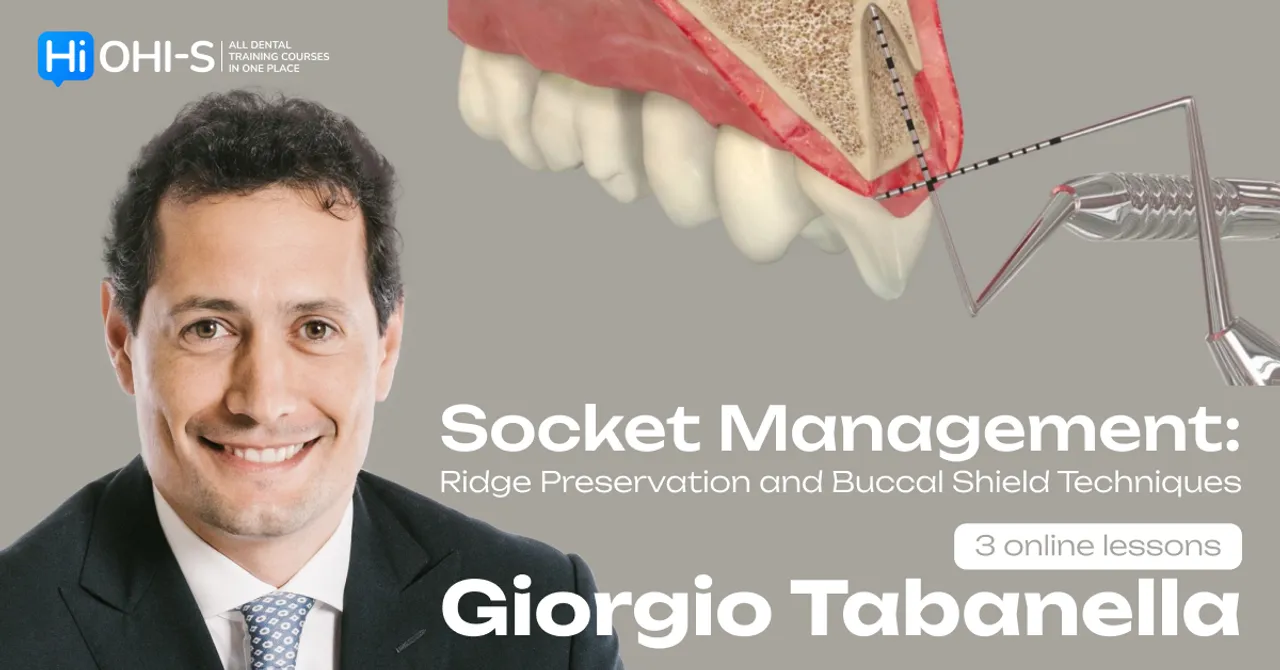
OHI-S Socket Management Ridge Preservation and Buccal Shield Techniques 3 lessons 57min
Original price was: $225.00.$10.00Current price is: $10.00.
This Product is shared via google drive download link, So please share your correct Gmail id while placing the order .Please note that there are no CME points or certificate associated with this course Samples for Courses Can be found here : Free Samples Here!
OHI-S Socket Management
Ridge Preservation, Buccal Shield & NOVAMag® Techniques
2 Lessons + 1 Free | 57 Minutes | Giorgio Tabanella
Develop a biologically driven approach to post-extraction socket management, ridge preservation, and aesthetic implant-site development with OHI-S Socket Management: Ridge Preservation and Buccal Shield Techniques.
Presented by Giorgio Tabanella, this focused clinical program connects post-extraction tissue biology with practical treatment strategies for preserving hard and soft tissue architecture around future and immediate implant sites.
The course covers:
- Post-extraction socket remodeling
- Dimensional ridge changes
- Thin vs. thick tissue phenotypes
- Ridge preservation
- Socket preservation
- Soft-tissue management
- Atraumatic extraction
- Collagen-based grafting
- Emergence-profile development
- Horizontal ridge augmentation
- Peri-implant tissue stability
- Socket shield
- Buccal shield concepts
- NOVAMag® shield techniques
- Magnesium membrane applications
- Immediate implant scenarios
- Compromised alveolar bone
- Aesthetic-zone implant therapy
The central clinical pathway is:
Assess the Socket → Understand the Expected Remodeling → Define the Implant/Restorative Goal → Preserve or Reconstruct Tissue → Manage the Emergence Profile → Monitor Peri-Implant Stability
Course Details
- Course: Socket Management: Ridge Preservation and Buccal Shield Techniques
- Provider: OHI-S
- Instructor: Giorgio Tabanella
- Official Structure: 2 Lessons + 1 Free
- Total Presentations: 3
- Official Duration: 57 Minutes
- Language: English
- Official OHI-S CE: 0.5 CE Credits
- Primary Specialty: Implantology
- Additional Specialties: Periodontology / Oral & Maxillofacial Surgery
- Main Focus: Post-Extraction Socket & Ridge Management
- Advanced Topics: Socket Shield and NOVAMag® Techniques
Course Overview
Tooth extraction initiates biological remodeling of both hard and soft tissues.
For implant clinicians, the key question is not simply:
“How do I fill an extraction socket?”
but rather:
“What tissue changes should I expect, what anatomy needs to be preserved, and what treatment strategy best supports the planned restoration?”
The course approaches socket management through:
Biology → Phenotype → Extraction Strategy → Ridge Preservation → Soft-Tissue Management → Implant/Prosthetic Planning
Post-Extraction Remodeling
Following extraction, the alveolar ridge undergoes structural changes during healing.
The course reviews:
- Biological basis of socket remodeling
- Dimensional changes reported in the literature
- Hard-tissue remodeling
- Soft-tissue changes
- Differences associated with thin and thick phenotypes
Understanding this process is essential when planning:
- Delayed implants
- Early implants
- Immediate implants
- Pontic sites
- Aesthetic-zone rehabilitation
Thin vs. Thick Phenotype
The clinical phenotype can influence treatment planning.
Thin Phenotype
May require greater attention to:
- Buccal tissue support
- Soft-tissue stability
- Grafting strategy
- Emergence-profile design
Thick Phenotype
May provide different tissue behavior and treatment options.
The course uses phenotype assessment as part of a broader decision-making framework rather than treating all extraction sites identically.
Ridge Preservation
Ridge preservation aims to manage post-extraction dimensional change and maintain a more favorable site for future restorative or implant treatment.
The program reviews:
- Case selection
- Biological rationale
- Grafting concepts
- Soft-tissue management
- Aesthetic-zone applications
- Horizontal ridge preservation/augmentation concepts
The appropriate strategy depends on the anatomy and final treatment objective.
LESSON 1
Post-Extraction Tissue Remodeling and Ridge Preservation Protocols
Instructor: Giorgio Tabanella
Duration: 15 Minutes
Format: Free Clinical Video
This lesson establishes the biological foundation of the course.
Topics include:
- Biological basis of post-extraction remodeling
- Dimensional changes after extraction
- Evidence from the literature
- Bone remodeling
- Thin and thick phenotypes
- Healing after extraction
- Post-extraction tissue changes
- Factors influencing ridge preservation
- Soft-tissue management
- Socket preservation in the aesthetic zone
- Horizontal ridge augmentation using socket-preservation approaches
Biological Healing After Extraction
Extraction creates a healing environment involving:
- Blood clot formation
- Soft-tissue healing
- Bone remodeling
- Structural change of the ridge
The course emphasizes that clinicians should anticipate these changes before selecting the restorative timeline.
Dimensional Changes
Post-extraction remodeling can affect:
- Ridge width
- Ridge contour
- Buccal architecture
- Soft-tissue position
These changes are particularly important in the anterior aesthetic zone.
Soft-Tissue Management
Hard-tissue preservation alone does not determine an aesthetic implant result.
Treatment planning should also consider:
- Gingival architecture
- Tissue thickness
- Soft-tissue sealing
- Emergence profile
- Peri-implant stability
Aesthetic-Zone Socket Preservation
Aesthetic cases require coordination of:
Bone + Soft Tissue + Implant Position + Restoration
The treatment objective is to create an anatomical environment that can support the planned restorative outcome.
Horizontal Ridge Management
The official curriculum includes horizontal ridge augmentation using socket preservation techniques.
This is especially relevant when buccolingual ridge dimensions are at risk of becoming inadequate for the planned implant or prosthetic restoration.
LESSON 2
Advanced Protocols for Socket Preservation and Aesthetic Tissue Management
Instructor: Giorgio Tabanella
Duration: 22 Minutes
This lesson moves from biology into advanced aesthetic-zone protocols.
Topics include:
- Thin phenotype management
- Atraumatic tooth extraction
- Collagen-based grafts
- Emergence-profile shaping
- Pink–white aesthetic evaluation
- Socket-preservation protocols
- Bone augmentation demonstrations
- Soft-tissue sealing
- Peri-implant tissue stability
- Stem-cell-related socket-preservation protocols discussed by the instructor
Atraumatic Tooth Extraction
Preserving existing anatomy begins at extraction.
Atraumatic extraction strategies aim to minimize unnecessary trauma to:
- Buccal bone
- Interproximal bone
- Soft tissues
This can be especially important when implant placement or aesthetic rehabilitation is planned.
Collagen-Based Grafting
The course demonstrates the use of a collagen-based graft within selected thin-phenotype aesthetic-zone cases.
The clinical objective should be understood within the complete treatment plan rather than as a universal material recommendation.
Emergence Profile
The emergence profile influences the transition between:
Implant Restoration → Peri-Implant Soft Tissue
The course integrates emergence-profile development with soft-tissue management.
Important considerations can include:
- Tissue support
- Contour
- Cervical restoration shape
- Aesthetic integration
Pink–White Aesthetics
Successful implant therapy in the aesthetic zone involves both:
White Aesthetics
The restorative component.
Pink Aesthetics
The surrounding soft tissues.
The course evaluates the interaction between these components when reviewing final treatment results.
Soft-Tissue Sealing
The curriculum includes evaluation of soft-tissue sealing around the treated site.
This is relevant to:
- Peri-implant tissue stability
- Hygiene
- Aesthetic integration
Peri-Implant Tissue Stability
Long-term implant assessment should consider more than osseointegration alone.
Important tissue outcomes include:
- Soft-tissue stability
- Mucosal architecture
- Bone levels
- Restorative contour
- Maintenance access
Stem-Cell-Related Content
OHI-S specifically lists protocols for stem cell transplantation for socket preservation within this lesson.
For MedicalAmboss, this should be presented cautiously as:
“stem-cell-related socket-preservation protocols discussed in the course.”
It should not be marketed as a universally established standard of care or as guaranteeing bone regeneration.
LESSON 3
Socket Shield and NOVAMag® Techniques in Implant Dentistry: Advanced Clinical Protocols
Instructor: Giorgio Tabanella
Duration: 19 Minutes
The final module focuses on advanced partial-root/shield concepts and magnesium membrane applications.
Topics include:
- Socket shield technique
- Buccal shield
- Crestal shield
- Magnesium membrane
- NOVAMag® shield
- Compromised alveolar bone
- Immediate implant placement
- Step-by-step clinical demonstration
- Case analysis
Socket Shield Technique
The socket shield concept involves intentionally retaining a selected root fragment in carefully chosen implant cases.
The biological rationale is related to preservation of the facial periodontal attachment/buccal architecture associated with the retained root portion.
This is an advanced technique requiring:
- Careful case selection
- Detailed anatomical understanding
- Appropriate preparation of the retained fragment
- Implant-position planning
- Complication awareness
Buccal Shield
The buccal shield is designed around retaining a facial root component in selected situations.
The course discusses its use as part of advanced implant-site management.
It should not be described as appropriate for every immediate implant socket.
Socket Shield vs. Conventional Socket Preservation
These are different treatment concepts.
Conventional Ridge / Socket Preservation
Typically manages the extraction site using grafting and/or barrier approaches.
Socket Shield
Retains a selected dental root fragment as part of a partial extraction strategy.
Case selection determines which concept, if either, may be appropriate.
NOVAMag® Shield Technique
The official curriculum specifically includes the NOVAMag® shield technique.
Clinical scenarios include:
- Compromised alveolar bone with buccal and crestal shield
- Immediate implant placement
- Compromised alveolar bone with buccal shield
The course also provides a step-by-step video demonstration.
Magnesium Membrane
The lesson discusses a magnesium membrane in connection with shield-based implant protocols.
Material selection should be based on:
- Defect anatomy
- Treatment objective
- Product instructions
- Clinical experience
- Available evidence
rather than using the same membrane for every extraction defect.
Compromised Buccal Bone
Loss or compromise of the buccal plate can make aesthetic implant therapy substantially more challenging.
Treatment planning may require consideration of:
- Defect morphology
- Remaining bone
- Implant timing
- Grafting
- Barrier techniques
- Soft-tissue augmentation
- Restorative strategy
Immediate Implant Placement
The course includes NOVAMag® shield applications in immediate implant placement.
Immediate placement should be distinguished from:
Immediate Loading
because implant placement timing and prosthetic loading timing are separate clinical decisions.
SOCKET PRESERVATION vs. IMMEDIATE IMPLANT
A key clinical decision is whether the extraction site should receive:
Ridge Preservation
followed by later implant placement,
or:
Immediate Implant Placement
with appropriate site-management strategies.
The decision depends on factors such as:
- Socket anatomy
- Buccal plate status
- Infection
- Soft-tissue phenotype
- Implant stability
- Aesthetic risk
Aesthetic-Zone Treatment Framework
A useful conceptual workflow is:
Assess Tooth & Socket
↓
Perform Controlled Extraction
↓
Evaluate Buccal Bone and Phenotype
↓
Choose Ridge Preservation / Immediate Implant / Advanced Shield Strategy
↓
Manage Hard Tissue
↓
Manage Soft Tissue
↓
Develop the Emergence Profile
↓
Evaluate Peri-Implant Stability
Biological vs. Prosthetic Planning
The best surgical site is not necessarily the site with the greatest volume of regenerated tissue.
The final implant position should also support:
- Restorative emergence
- Cleanability
- Occlusion
- Aesthetics
- Long-term maintenance
Therefore:
Biological Planning + Prosthetic Planning
should occur together.
Major Topics Covered
- Socket Management
- Ridge Preservation
- Socket Preservation
- Alveolar Ridge Preservation
- Post-Extraction Remodeling
- Extraction Socket Healing
- Atraumatic Extraction
- Aesthetic-Zone Implants
- Thin Gingival Phenotype
- Collagen Graft
- Soft-Tissue Management
- Emergence Profile
- Pink Aesthetics
- Peri-Implant Tissue Stability
- Horizontal Ridge Augmentation
- Socket Shield
- Buccal Shield
- Partial Extraction Therapy
- NOVAMag
- NOVAMag Shield
- Magnesium Membrane
- Immediate Implant Placement
- Compromised Alveolar Bone
- Implantology
- Periodontology
- Regenerative Implant Dentistry
Who Should Take This Course?
The strongest target audience includes:
- Implantologists
- Periodontists
- Oral and Maxillofacial Surgeons
- Implant Dentistry Residents
- Periodontology Residents
- Advanced General Dentists performing implant surgery within their training and scope
The strongest primary audiences are:
Implantologists + Periodontists
because the course combines implant-site development with periodontal tissue biology.
Oral and maxillofacial surgeons are also highly relevant, particularly for advanced surgical socket management.
Why This Course Is Useful
The program connects three stages frequently taught separately.
1. Biology
- Post-extraction remodeling
- Thin vs. thick phenotype
- Healing
2. Preservation & Reconstruction
- Ridge preservation
- Collagen-based grafting
- Horizontal augmentation
- Soft-tissue management
3. Advanced Implant Strategies
- Socket shield
- Buccal shield
- NOVAMag®
- Immediate implant placement
This makes the course useful as a compact bridge between:
Extraction → Site Preservation → Implant Rehabilitation
Important Surgical Training Notice
Socket shield, advanced bone augmentation, immediate implant surgery, and related shield procedures are technique-sensitive surgical procedures.
Recorded education can support understanding of:
- Biological principles
- Case selection
- Surgical sequence
- Material concepts
- Complication awareness
but it does not replace:
- Formal implantology training
- Hands-on surgical instruction
- Supervised clinical experience
- Appropriate management of complications
- Legal scope and credentialing requirements
Evidence & Outcome Positioning
Avoid marketing statements such as:
“Guarantees stable peri-implant tissues”
or:
“Prevents all ridge resorption.”
More accurate wording is:
“The course presents strategies designed to manage post-extraction remodeling and support hard- and soft-tissue preservation in selected cases.”
Clinical results depend on:
- Anatomy
- Phenotype
- Patient factors
- Extraction technique
- Implant position
- Grafting
- Healing
- Restorative design
- Maintenance
Original OHI-S CE Information
The official OHI-S course is listed as:
2 Lessons + 1 Free
with:
57 Minutes
and:
0.5 CE Credits
Official CE eligibility applies to participation through OHI-S and completion of its applicable requirements.
An independently distributed MedicalAmboss recording package should not automatically be advertised as including:
- OHI-S CE Credits
- OHI-S Certificate
unless official participation and credit eligibility are specifically included.
Product Summary
- Product: Socket Management: Ridge Preservation and Buccal Shield Techniques
- Provider: OHI-S
- Instructor: Giorgio Tabanella
- Official Structure: 2 Lessons + 1 Free
- Total Presentations: 3
- Official Duration: 57min
- Language: English
- Official OHI-S CE: 0.5 Credits
- Primary Specialty: Implantology
- Secondary Specialty: Periodontology
- Additional Specialty: Oral & Maxillofacial Surgery
- Core Topics: Ridge Preservation, Socket Shield, NOVAMag® & Aesthetic Tissue Management
4. Short Description
OHI-S Socket Management: Ridge Preservation and Buccal Shield Techniques is a focused 57-minute implantology and periodontology course presented by Giorgio Tabanella, officially structured as 2 lessons + 1 free clinical video.
The program covers post-extraction tissue remodeling, dimensional ridge changes, thin and thick phenotypes, aesthetic-zone ridge preservation, atraumatic extraction, collagen-based grafting, emergence-profile development, horizontal ridge augmentation, peri-implant tissue stability, socket shield, buccal and crestal shield concepts, NOVAMag® protocols, magnesium membrane applications, and immediate implant scenarios.
Topics
Lesson 1. Post-Extraction Tissue Remodeling and Ridge Preservation Protocols
-
The biological basis of post-extraction remodeling
-
Dimensional changes: evidence from the literature
-
Bone remodeling after extraction: thin and thick phenotypes
-
Healing and post-extraction tissue changes
-
Key factors influencing ridge preservation and long-term implant success
-
Step-by-step protocols for soft-tissue management
-
Socket preservation techniques in the aesthetic zone
-
Horizontal ridge augmentation using socket preservation techniques
Lesson 2. Advanced Protocols for Socket Preservation and Aesthetic Tissue Management
-
Management of thin phenotype in the aesthetic zone:
-
Atraumatic tooth extraction
-
Application of a collagen-based graft
-
Shaping the emergence profile
-
Evaluation of the final treatment results and pink–white aesthetics
-
-
Protocols for stem cell transplantation for socket preservation
-
Step-by-step video demonstration of bone augmentation and socket preservation techniques in the aesthetic zone
-
Evaluation of soft tissue sealing
-
Analysis of peri-implant tissue stability
Lesson 3. Socket Shield and NOVAMag® Techniques in Implant Dentistry: Advanced Clinical Protocols
-
Application of the socket shield technique with a magnesium membrane
-
NOVAMag® shield technique:
-
In compromised alveolar bone with buccal and crestal shield
-
In immediate implant placement
-
In compromised alveolar bone with buccal shield
-
-
Step-by-step video demonstration of the NOVAMag® shield technique
-
Analysis of clinical cases
Related products
Anesthesiology & pain medicine