
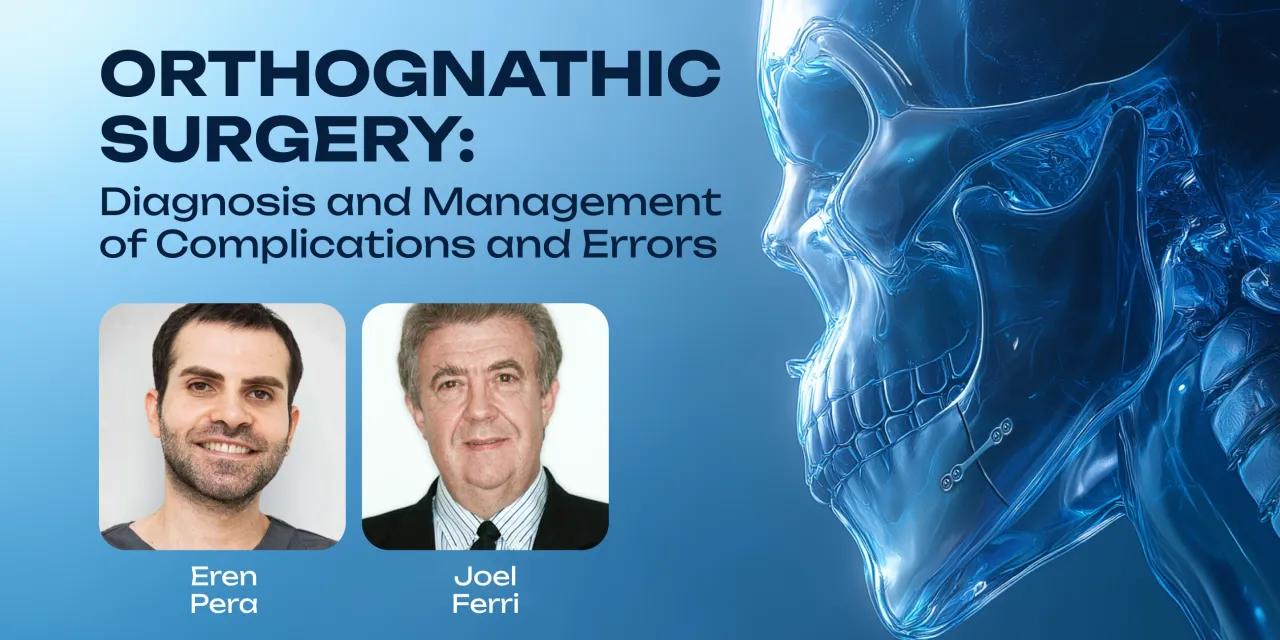
OHI-S Orthognathic Surgery Diagnosis and Management of Complications and Errors 4 lessons 2h 11min

Original price was: $350.00.$20.00Current price is: $20.00.
Review orthognathic treatment errors, complications, and relapse with Joel Ferri and Eren Pera. Four lessons cover diagnosis, orthodontic–surgical planning, newer techniques, persistent functional problems, and surgical complications, with attention to prevention, early recognition, interdisciplinary coordination, and the factors that influence long-term stability.
Delivery Information: This Product is shared via google drive download link. Please use your correct Gmail address at checkout.
Please note: there are no CME points or certificate associated with this course.
Samples for Courses Can be found here: Free Samples Here!
Joel Ferri and Eren Pera examine why orthognathic treatment can produce complications or relapse, from the initial diagnosis through postoperative stability. This four-lesson OHI-S course totals 2 hours 11 minutes and addresses diagnostic errors, orthodontic compensation and decompensation, and maxillary and mandibular planning. It also reviews newer surgical techniques, functional contributors to relapse, and complications involving vessels, teeth, nerves, bone healing, and the temporomandibular joint. The emphasis on coordination between surgeon and orthodontist makes the program relevant to oral and maxillofacial surgeons and orthodontists involved in complex dentofacial treatment planning.
The original OHI-S activity listed two CE credits; these are not included with store files. This advanced educational course does not replace supervised surgical training, patient-specific assessment, or professional credentialing. Management of serious surgical complications requires appropriately trained teams.
Topics
Lesson 1. Avoiding Pitfalls in Orthognathic Surgery: Common Errors in Maxillary and Mandibular Procedures
-
Diagnostic errors in dentofacial deformities
-
Treatment planning pitfalls in maxillary and mandibular surgery
-
Orthodontic–surgical planning principles
-
Errors in orthodontic compensation and decompensation
-
Sagittal discrepancies: planning mistakes
-
Vertical dimension errors in surgical planning
-
Transverse discrepancies and miscalculations
-
Surgical and technical pitfalls
-
Workflow and interdisciplinary coordination issues
-
Communication gaps between orthodontist and surgeon
-
Factors affecting functional stability
-
Factors influencing aesthetic outcomes
-
Prevention of complications and relapse
-
Systematic approach to predictable treatment outcomes
-
Clinical strategies for improving surgical predictability
Lesson 2. New Techniques in Orthognathic Surgery: Advances in Precision and Predictability
-
Emerging techniques in modern orthognathic surgery
-
Rationale behind new surgical concepts
-
Impact on accuracy, stability, and predictability
-
Indications and limitations of contemporary techniques
-
Integration into multidisciplinary workflows
-
Strategies to improve outcomes and minimize complications
-
Evidence-based decision-making in clinical practice
Lesson 3. Etiology of Relapse in Orthognathic Surgery
-
Relapse due to persistent dysfunctions: swallowing abnormalities and mouth breathing
-
Residual maxillary growth and its impact
-
Unfavorable mandibular condyle reshaping
-
Constitutional abnormalities: myopathy and muscle typology
-
Importance of early detection and management to prevent permanent damage
Lesson 4. Mistakes and Complications in Orthognathic Surgery
-
Functional considerations in orthognathic surgery
-
Diagnostic errors
-
Errors in orthodontic treatment
-
Errors in surgical planning
-
Errors in aesthetic considerations
-
Overview of surgical safety and risk factors
-
Vascular complications
-
Dental complications
-
Nerve-related complications
-
Unfavorable fractures and bad splits
-
Postoperative infections
-
Pseudoarthrosis
-
Dentoalveolar necrosis
-
Temporomandibular joint (TMJ) disorders
-
Other potential complications
-
Importance of prevention, early detection, and proper management
Related products
DENTAL
Basic science

DENTAL