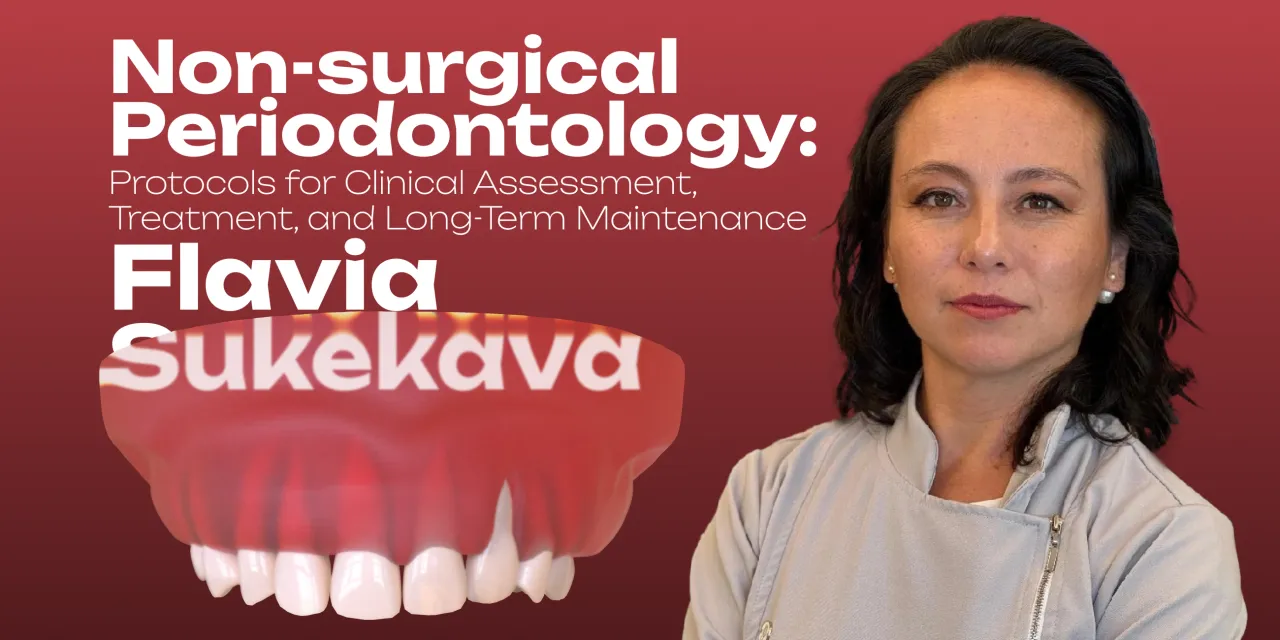
OHI-S Non-surgical Periodontology Protocols for Clinical Assessment, Treatment, and Long-Term Maintenance 3 lessons 1h 55min
$20.00
This Product is shared via google drive download link, So please share your correct Gmail id while placing the order .Please note that there are no CME points or certificate associated with this course Samples for Courses Can be found here : Free Samples Here!
OHI-S Non-Surgical Periodontology
Protocols for Clinical Assessment, Treatment & Long-Term Maintenance
2 Lessons + 1 Free | 1 Hour 55 Minutes | Flavia Sukekava
Build a structured, biologically driven approach to periodontal disease management with OHI-S Non-surgical Periodontology: Protocols for Clinical Assessment, Treatment, and Long-Term Maintenance.
Presented by Flavia Sukekava, this focused periodontology course moves beyond basic instrumentation to provide a clinical framework connecting:
- Periodontal biology
- Periodontal and peri-implant anatomy
- Gingivitis and periodontitis pathogenesis
- Classification, staging and grading
- Clinical diagnosis
- Risk assessment
- Non-surgical periodontal therapy
- Mechanical debridement
- Oral-hygiene optimization
- Adjunctive therapies
- Reevaluation
- Residual periodontal pockets
- Periodontal complications
- Surgical treatment decision-making
- Supportive periodontal care
- Long-term maintenance
The central clinical pathway is:
Understand Disease → Diagnose & Classify → Control Etiologic Factors → Treat Non-Surgically → Reevaluate → Manage Residual Disease → Maintain Long-Term Stability
Course Details
- Course: Non-surgical Periodontology: Protocols for Clinical Assessment, Treatment, and Long-Term Maintenance
- Provider: OHI-S
- Instructor: Flavia Sukekava
- Official Structure: 2 Lessons + 1 Free
- Total Presentations: 3
- Official Duration: 1 Hour 55 Minutes
- Language: English
- Official OHI-S CE: 1.75 CE Credits
- Primary Specialty: Periodontology
- Main Focus: Non-Surgical Periodontal Disease Management
- Additional Focus: Peri-Implant Tissue Assessment & Periodontal Maintenance
Course Overview
Periodontal disease is not simply the presence of plaque, calculus, or periodontal pockets.
It represents a complex inflammatory process involving interactions among:
- Dental biofilm
- Microbial communities
- Host immune response
- Local environmental factors
- Behavioral risk factors
- Systemic health
Effective periodontal care therefore requires more than instrumentation alone.
A comprehensive approach involves:
Biology + Diagnosis + Risk Assessment + Etiologic Therapy + Reevaluation + Maintenance
Understanding Periodontal Disease
The course begins with the biological foundations required to understand why periodontal disease develops and progresses.
The periodontal tissues include structures responsible for:
- Tooth support
- Soft-tissue attachment
- Protection
- Functional stability
A clinician should understand healthy anatomy before interpreting disease.
Gingivitis vs. Periodontitis
A fundamental distinction is:
Gingivitis
Inflammatory changes primarily involving gingival tissues without the defining attachment loss characteristic of periodontitis.
Periodontitis
A more destructive periodontal disease involving loss of periodontal attachment and supporting tissues.
Accurate differentiation influences:
- Diagnosis
- Prognosis
- Treatment
- Follow-up
Periodontal Disease Is Dynamic
Periodontal disease should not be regarded as a static finding.
Disease expression can change according to:
- Biofilm
- Host response
- Smoking
- Systemic conditions
- Patient compliance
- Treatment
- Time
This is why repeated assessment is essential.
LESSON 1
Periodontal and Peri-Implant Tissues: Anatomy, Health, and Disease Progression
Instructor: Flavia Sukekava
Duration: 17 Minutes
Official OHI-S CE: 0.25 Credit
Format: Free Clinical Video
The first lesson establishes the biological foundation for the remainder of the course.
Topics include:
- Periodontal tissue definition
- Periodontal functions
- Anatomy
- Histology
- Periodontal disease classification
- Peri-implant disease classification
- Healthy gingival tissues
- Experimental gingivitis
- Classical periodontal research
- Dental biofilm
- Etiology of periodontal disease
Periodontal Anatomy
Periodontal diagnosis starts with understanding the tissues surrounding and supporting the teeth.
Important components include:
- Gingiva
- Periodontal ligament
- Cementum
- Alveolar bone
Each has a different biological role in periodontal health and disease.
Peri-Implant Tissues
The course also introduces tissues surrounding dental implants.
Although periodontal and peri-implant tissues share certain features, they should not be assumed to be biologically identical.
This distinction becomes important when evaluating:
- Peri-implant health
- Peri-implant mucositis
- Peri-implantitis
Healthy Gingiva
Understanding healthy periodontal anatomy provides the reference point required for identifying:
- Inflammation
- Edema
- Bleeding
- Tissue changes
- Periodontal destruction
Diagnosis should always begin by knowing what health looks like.
Experimental Gingivitis
The course reviews foundational experimental gingivitis research to illustrate the relationship between:
Dental Biofilm → Gingival Inflammation
and the biological response that follows plaque accumulation.
Dental Biofilm
Dental plaque should be understood as a structured microbial biofilm rather than simply loose bacteria on the tooth surface.
Biofilm ecology influences:
- Gingival inflammation
- Microbial interactions
- Periodontal disease development
LESSON 2
Non-Surgical Periodontology: From Biology and Pathogenesis to Evidence-Based Clinical Management
Instructor: Flavia Sukekava
Duration: 1 Hour 5 Minutes
Official OHI-S CE: 1 Credit
This is the core lesson of the program.
It connects periodontal biology with practical clinical management.
Topics include:
- Periodontal anatomy and histology
- Periodontal classification
- Clinical stages of disease
- Experimental gingivitis
- Dental biofilm
- Microbial species
- Bacterial interactions
- Dysbiotic ecological environment
- Gingival inflammation
- Histological progression to periodontitis
- Cellular inflammation
- Immune cells
- Chemical mediators
- Periodontal risk factors
- Smoking
- Systemic health associations
- Antibiotics
- EFP clinical practice guidelines
- Step-by-step periodontal treatment
- Iatrogenic periodontal disease
- Probiotics
- Immunomodulators
- Oral hygiene
- Patient education
- Artificial intelligence in oral-health management
- Patient compliance
- Periodontal digital tools
Periodontal Classification
Modern periodontal management requires more than labeling a patient as having “mild” or “severe” disease.
The clinician should characterize disease systematically.
Important concepts include:
- Periodontal health
- Gingivitis
- Periodontitis
- Disease severity
- Complexity
- Progression risk
Staging Periodontitis
Staging helps characterize the severity and complexity of periodontitis.
The clinician may consider factors such as:
- Attachment loss
- Bone loss
- Tooth loss related to periodontitis
- Pocket depth
- Furcation involvement
- Complexity of rehabilitation
The goal is to describe:
How Severe and Complex Is the Disease?
Grading Periodontitis
Grading addresses progression and risk.
It helps answer:
How Rapidly Is This Disease Likely to Progress?
Important considerations may include:
- Previous progression
- Bone-loss patterns
- Risk factors
- Smoking
- Diabetes
Biofilm Dysbiosis
The course specifically discusses the dysbiotic ecological environment.
Periodontitis is not adequately explained by the simple presence of one bacterial species.
Instead, disease develops within a complex relationship among:
Microbial Community + Local Environment + Host Response
Pathogenesis of Gingival Inflammation
The inflammatory response includes interactions among:
- Microorganisms
- Epithelial tissues
- Immune cells
- Blood cells
- Chemical mediators
- Cellular receptors
Understanding this biology explains why periodontal destruction cannot be managed simply by treating the visible pocket.
Gingivitis-to-Periodontitis Transition
The course examines histological progression from gingival inflammation to periodontal destruction.
This reinforces an important clinical principle:
Inflammation Control Matters Before Irreversible Tissue Destruction Progresses
Clinical Diagnosis
A structured periodontal assessment may incorporate:
- Medical history
- Dental history
- Periodontal probing
- Bleeding on probing
- Plaque
- Gingival inflammation
- Recession
- Attachment level
- Tooth mobility
- Furcation involvement
- Radiographic findings
No single measurement should define the entire patient.
Risk Assessment
Periodontal treatment planning should include patient-level risk.
Important factors addressed in the course include:
- Smoking
- Diabetes
- Oral hygiene
- Biofilm control
- Patient behavior
These factors can influence:
- Disease progression
- Healing
- Long-term stability
Smoking & Periodontitis
Smoking is specifically discussed as a periodontal risk factor.
The clinician should incorporate smoking status into:
- Risk assessment
- Prognosis
- Patient communication
- Maintenance planning
Periodontal Disease & Systemic Health
The program discusses associations between periodontal disease and systemic conditions including:
- Diabetes
- Cardiovascular disease
These relationships should be communicated carefully.
Association does not automatically establish that periodontal treatment prevents or cures systemic disease.
Evidence-Based Periodontal Management
The course incorporates EFP clinical practice guidelines into treatment planning.
This provides a structured framework for moving from diagnosis to staged periodontal therapy.
Step-by-Step Periodontal Treatment
A clinically useful pathway is:
Assessment
↓
Diagnosis & Staging/Grading
↓
Patient Education & Risk-Factor Control
↓
Oral-Hygiene Optimization
↓
Subgingival Instrumentation / Mechanical Debridement
↓
Reevaluation
↓
Management of Residual Disease
↓
Supportive Periodontal Therapy
Mechanical Debridement
Mechanical disruption of pathogenic biofilm and removal of deposits remain fundamental to non-surgical periodontal therapy.
Treatment may involve:
- Supra-gingival instrumentation
- Subgingival instrumentation
- Root-surface debridement
The technique should be adapted to:
- Pocket anatomy
- Root morphology
- Disease severity
- Access
Oral Hygiene & Patient Education
Professional treatment cannot compensate indefinitely for uncontrolled daily biofilm accumulation.
Patient education is therefore part of periodontal therapy—not an optional extra.
The program emphasizes:
- Oral-hygiene optimization
- Patient communication
- Motivation
- Behavioral adherence
Patient Compliance
Long-term periodontal stability depends substantially on patient participation.
The course provides strategies and practical tips for improving periodontal patient compliance.
A useful principle is:
Clinical Treatment + Effective Home Care + Maintenance = Better Disease Control
Antibiotics in Periodontitis
The course discusses the role of antibiotics in periodontal treatment.
Systemic antibiotics should not automatically accompany every case of periodontitis.
Their use requires appropriate:
- Indication
- Risk-benefit assessment
- Antimicrobial stewardship
- Patient evaluation
They should complement, not substitute for, adequate periodontal treatment when clinically indicated.
Probiotics
The official curriculum includes probiotics as a potential adjunctive topic in periodontal management.
They should be presented as an adjunctive area of discussion rather than a replacement for:
- Biofilm control
- Mechanical debridement
- Evidence-based periodontal therapy
Immunomodulators
The course also discusses immunomodulation in periodontal treatment.
This reflects the increasing understanding that periodontal disease involves both:
- Microbial challenge
- Host inflammatory response
However, adjunctive concepts should remain subordinate to established disease-control protocols.
Iatrogenic Periodontal Disease
An important practical topic is the effect of overhanging restorations.
Poor restorative contours can:
- Retain biofilm
- Complicate hygiene
- Contribute to local inflammation
Periodontal management may therefore require correction of local iatrogenic factors.
Artificial Intelligence in Periodontal Care
The course includes a contemporary topic:
AI in oral-health management
with applications involving assessment of:
- Dental plaque
- Gingival inflammation
AI should be viewed as a supporting assessment technology rather than a replacement for clinical examination and professional diagnosis.
Digital Periodontal Tools
The curriculum also introduces an online periodontal portal and digital perio-tool.
These tools support structured:
- Assessment
- Clinical decision-making
- Guideline implementation
LESSON 3
Management of Periodontal Complications and Surgical Treatment Decision-Making
Instructor: Flavia Sukekava
Duration: 33 Minutes
Official OHI-S CE: 0.5 Credit
Although the overall course is titled Non-surgical Periodontology, the final lesson importantly addresses what happens when non-surgical treatment is insufficient.
Topics include:
- Sequence of non-surgical and surgical treatment
- Staging and grading
- EFP clinical practice guidelines
- Timing of reevaluation
- Residual periodontal disease
- Regenerative surgery vs. access flap
- Surgical complications
- Treatment errors
- Periodontal abscesses
- Necrotizing periodontal disease
- Endo-periodontal lesions
- Antibiotics for selected periodontal abscesses
- Stage I–III treatment guidelines
- Access flap technique
- Palatal grooves
- Stage III/IV periodontal therapy
- Non-surgical vs. surgical effectiveness
Periodontal Reevaluation
Reevaluation is one of the most important stages of treatment.
The clinician should assess changes in:
- Plaque
- Bleeding
- Inflammation
- Probing depths
- Tissue response
- Residual pockets
The question is:
Did the Initial Therapy Achieve Adequate Disease Control?
Residual Periodontal Pockets
Residual pockets may indicate:
- Persistent inflammation
- Remaining deposits
- Anatomical complexity
- Advanced periodontal destruction
Management should be based on:
- Site characteristics
- Pocket depth
- Bleeding
- Anatomy
- Overall patient risk
rather than repeatedly instrumenting every site indefinitely.
When to Consider Periodontal Surgery
The presence of persistent disease after appropriate non-surgical treatment may require evaluation for surgical therapy.
The decision should consider:
- Disease severity
- Pocket morphology
- Bony defect anatomy
- Access
- Tooth prognosis
- Patient factors
Access Flap vs. Regenerative Surgery
The course compares important surgical pathways.
Access Flap
May be used to improve access for debridement in selected situations.
Regenerative Surgery
May be considered for suitable periodontal defects when anatomical and patient conditions support a regenerative approach.
The correct strategy depends on the defect—not simply the pocket depth.
Acute Periodontal Lesions
The curriculum includes:
- Periodontal abscesses
- Necrotizing periodontal diseases
These conditions require specific diagnosis and management rather than simply applying routine chronic-periodontitis protocols.
Periodontal Abscess
A periodontal abscess represents an acute clinical problem requiring assessment of:
- Infection
- Drainage
- Periodontal pocket
- Tooth prognosis
- Systemic involvement
The course also addresses when systemic antibiotics may be relevant.
Endo-Periodontal Lesions
Endodontic and periodontal pathology can occur simultaneously or communicate anatomically.
Proper diagnosis is important because treatment may require coordination between:
- Periodontal therapy
- Endodontic therapy
Palatal Grooves
Anatomical developmental features such as palatal grooves can contribute to localized periodontal disease.
This reinforces the need to identify:
Why a Specific Site Is Not Responding
instead of treating every persistent pocket identically.
Stage III & IV Periodontitis
Advanced periodontitis frequently requires more complex treatment planning.
The course reviews evidence comparing:
- Non-surgical therapy
- Surgical therapy
in more advanced disease.
The clinical goal is not to choose one philosophy universally but to select the appropriate intervention according to disease response and anatomy.
SUPPORTIVE PERIODONTAL THERAPY
Successful periodontal treatment does not end when active therapy finishes.
Long-term maintenance is essential.
Supportive care may include:
- Periodontal reassessment
- Plaque monitoring
- Bleeding assessment
- Professional instrumentation when required
- Risk-factor review
- Oral-hygiene reinforcement
- Evaluation of residual/recurrent disease
Long-Term Maintenance
Maintenance intervals should be individualized according to:
- Periodontal history
- Disease severity
- Smoking
- Diabetes
- Plaque control
- Previous treatment response
The objective is:
Prevent Recurrence → Detect Disease Early → Preserve Periodontal Stability
Disease Recurrence
Periodontitis should generally be approached as a chronic disease requiring ongoing risk management.
Successful treatment therefore includes:
Active Therapy + Supportive Care
rather than a one-time procedure.
Periodontal and Peri-Implant Health
Because the program begins with periodontal and peri-implant tissue classification, it also provides useful biological context for clinicians involved in implant maintenance.
However, the principal focus remains:
Periodontal Disease Management Around Natural Teeth
rather than comprehensive peri-implantitis treatment.
Key Topics Covered
- Non-Surgical Periodontology
- Non-Surgical Periodontal Therapy
- Periodontology
- Periodontitis
- Gingivitis
- Periodontal Diagnosis
- Periodontal Classification
- Periodontitis Staging
- Periodontitis Grading
- Periodontal Risk Assessment
- Dental Biofilm
- Periodontal Dysbiosis
- Gingival Inflammation
- Periodontal Pathogenesis
- Mechanical Debridement
- Subgingival Instrumentation
- Scaling and Root Planing
- EFP Periodontal Guidelines
- Smoking and Periodontitis
- Diabetes and Periodontal Disease
- Periodontal Reevaluation
- Residual Periodontal Pockets
- Supportive Periodontal Therapy
- Periodontal Maintenance
- Periodontal Abscess
- Necrotizing Periodontal Disease
- Endo-Periodontal Lesions
- Periodontal Surgery Decision-Making
- Peri-Implant Tissues
- AI in Periodontology
Who Should Take This Course?
The program is particularly relevant for:
- Periodontists
- General Dentists
- Dental Hygienists
- Periodontology Residents
- Dental Professionals providing periodontal maintenance
- Clinicians managing periodontal patients in general practice
The strongest audiences are:
Periodontists + General Dentists + Dental Hygienists
The course is particularly useful for professionals seeking to connect routine periodontal instrumentation with:
Diagnosis → Evidence-Based Treatment → Reevaluation → Maintenance
Why This Course Is Useful
The major strength of this OHI-S course is the complete disease-management sequence.
Biology
- Anatomy
- Biofilm
- Dysbiosis
- Host response
Diagnosis
- Classification
- Staging
- Grading
- Risk assessment
Treatment
- Oral hygiene
- Mechanical debridement
- Adjunctive approaches
- Risk-factor control
Reevaluation
- Residual pockets
- Response to treatment
Escalation
- Surgical vs. non-surgical decision-making
Maintenance
- Compliance
- Supportive therapy
- Recurrence prevention
The complete framework is:
Biology → Diagnosis → Etiologic Therapy → Reevaluation → Residual-Site Management → Long-Term Maintenance
Evidence-Based Positioning
This course should be marketed as an evidence-informed periodontal management program, not simply as a scaling-and-root-planing demonstration.
Its strongest differentiators include:
- EFP clinical practice guidelines
- Disease staging and grading
- Biological pathogenesis
- Risk-factor analysis
- Adjunctive treatment discussion
- Surgical decision-making
- Maintenance strategy
Important Clinical Notice
Online education can support understanding of:
- Diagnosis
- Risk assessment
- Periodontal treatment planning
- Evidence-based protocols
- Maintenance
but it does not replace:
- Formal dental training
- Clinical periodontal examination
- Supervised procedural instruction
- Patient-specific diagnosis
- Professional judgment
Treatment involving antibiotics or surgical periodontal therapy should follow appropriate clinical indications, current guidelines, and local prescribing/professional requirements.
Original OHI-S CE Information
The official OHI-S course is listed for:
1.75 CE Credits
The official lesson structure is:
- Lesson 1 – 17 min – 0.25 CE
- Lesson 2 – 1h 05min – 1 CE
- Lesson 3 – 33min – 0.5 CE
Total:
1h 55min / 1.75 CE Credits
These CE credits apply to eligible participation through the official OHI-S educational activity.
An independently distributed MedicalAmboss recording package should not automatically be advertised as providing official OHI-S CE credits or certificate unless official OHI-S participation and credit eligibility are included.
Product Summary
- Product: Non-surgical Periodontology: Protocols for Clinical Assessment, Treatment, and Long-Term Maintenance
- Provider: OHI-S
- Instructor: Flavia Sukekava
- Official Structure: 2 Lessons + 1 Free
- Total Presentations: 3
- Official Duration: 1h 55min
- Language: English
- Official OHI-S CE: 1.75 Credits
- Primary Specialty: Periodontology
- Main Focus: Assessment, Non-Surgical Therapy, Reevaluation & Maintenance
4. Short Description
OHI-S Non-surgical Periodontology: Protocols for Clinical Assessment, Treatment, and Long-Term Maintenance is a 1h 55min periodontology program by Flavia Sukekava, officially structured as 2 lessons + 1 free clinical video.
The course covers periodontal and peri-implant anatomy, gingivitis and periodontitis biology, biofilm dysbiosis, staging and grading, clinical diagnosis, risk assessment, EFP clinical guidelines, non-surgical periodontal therapy, mechanical debridement, smoking and systemic risk factors, adjunctive therapies, oral-hygiene optimization, patient compliance, reevaluation, residual pockets, periodontal complications, and surgical treatment decision-making.
Topics
Lesson 1. Periodontal and Peri-Implant Tissues: Anatomy, Health, and Disease Progression
-
Periodontal tissues: definition, functions, anatomy, and histology
-
Classification of periodontal and peri-implant diseases and conditions
-
Healthy periodontal tissues: the gingiva
-
Experimental gingivitis: key findings from classical research
-
Etiology of periodontal diseases: dental biofilm
Lesson 2. Non-Surgical Periodontology: From Biology and Pathogenesis to Evidence-Based Clinical Management
-
Periodontal tissues: definition, functions, anatomy, and histology
-
Classification of periodontal and peri-implant diseases and conditions
-
Healthy periodontal tissues: the gingiva
-
Periodontal disease: clinical scenarios of different stages
-
Experimental gingivitis: classic research results
-
Etiology of periodontal diseases: dental biofilms
-
Microbial species in dental plaque and bacterial interactions
-
The dysbiotic ecological environment
-
Pathogenesis of gingival inflammation
-
Histological transition from gingivitis to periodontitis
-
Irreversibility of periodontal diseases
-
Inflammation at the cellular level: blood and immune cells, chemical mediators, and receptors
-
Antibiotics in the treatment of periodontitis
-
Smoking as a risk factor for periodontitis
-
The link between periodontal disease and systemic conditions (diabetes and cardiovascular disease)
-
The EFP clinical practice guidelines
-
Step-by-step periodontal disease treatment protocols
-
Iatrogenic periodontal disease: overhanging restorations
-
Probiotics in the treatment of periodontitis
-
Immunomodulators in the treatment of periodontitis
-
Oral hygiene and patient education
-
AI in oral health management: dental plaque and gingival inflammation assessment
-
Strategies and tips for improving periodontal patient compliance
-
Online portal for periodontists
-
A comprehensive guide to using online perio-tool
Lesson 3. Management of Periodontal Complications and Surgical Treatment Decision-Making
-
Sequence of surgical and non-surgical periodontal treatments
-
Staging and grading of periodontitis
-
The EFP clinical practice guidelines
-
Timing of re-evaluation after periodontal therapy
-
Treatment tactics: regenerative surgery vs. access flap
-
Complications and treatment errors in regenerative periodontal surgery
-
Clinical case presentation
-
Acute periodontal lesions (periodontal abscesses and necrotizing periodontal diseases) and endo-periodontal lesions
-
Clinical case presentation
-
Systemic antibiotics in the treatment of periodontal abscesses
-
Guidelines for the treatment of stage I–III periodontitis
-
Clinical example of the access flap technique
-
Palatal grooves associated with periodontal lesions
-
Clinical cases presentation
-
Comparative efficacy of non-surgical vs. surgical therapy for stage III/IV periodontitis
-
Online portal for periodontists
-
A comprehensive guide to using online perio-tool
Related products