
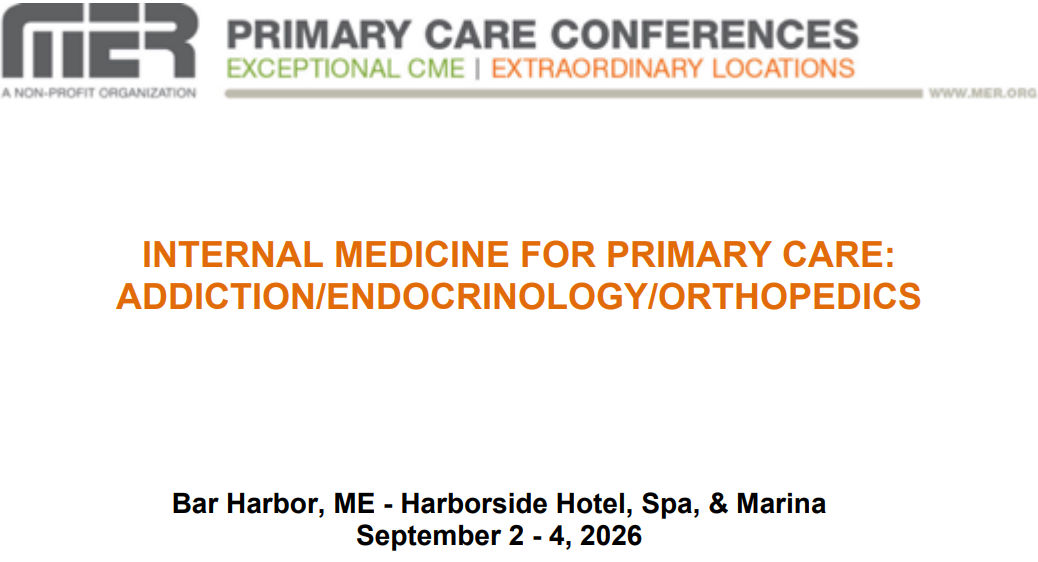
MER Primary Care Conferences Internal Medicine for Primary Care Addiction Endo Ortho Sep 02-04, 2026

$100.00
This Product is shared via google drive download link, So please share your correct Gmail id while placing the order .Please note that there are no CME points or certificate associated with this course Samples for Courses Can be found here : Free Samples Here!
MER Primary Care Conferences Internal Medicine for Primary Care Addiction Endo Ortho Sep 02-04, 2026
Addiction Medicine • Endocrinology • Orthopedics • Primary Care
September 2–4, 2026 | Bar Harbor, Maine
Review practical, evidence-based updates across three important areas of outpatient medicine with MER Primary Care Conferences Internal Medicine for Primary Care Addiction Endo Ortho Sep 02-04, 2026.
Organized by Medical Education Resources (MER), the original conference was held September 2–4, 2026, at the Harborside Hotel, Spa, & Marina in Bar Harbor, Maine. MER officially lists the program as Internal Medicine for Primary Care: Addiction/Endo/Ortho.
The three-day program was designed for office-based primary care providers and other healthcare professionals seeking clinically relevant updates across:
- Addiction Medicine
- Endocrinology
- Orthopedics
- Internal Medicine
- Primary Care
The curriculum focuses on common and clinically important issues encountered in outpatient practice, including type 1 and type 2 diabetes, osteoporosis, abnormal thyroid function, shoulder injuries, wrist and hand disorders, knee anatomy and function, foot and ankle pain syndromes, substance use disorders, addictive drugs, opioid-sparing pain management, and Alcohol Use Disorder.
Course Details
- Course: Internal Medicine for Primary Care: Addiction/Endo/Ortho
- Provider: Medical Education Resources – MER
- Year: 2026
- Original Conference Dates: September 2–4, 2026
- Duration: 3 Days
- Venue: Harborside Hotel, Spa, & Marina
- Location: Bar Harbor, Maine
- Primary Specialty: Internal Medicine / Primary Care
- Subspecialties: Addiction Medicine, Endocrinology, Orthopedics
- Original MER Listing: 12 Credit Hours
- ANCC Pharmacotherapeutic Contact Hours: 6.00
- MATE Act: Fulfills 4 Hours of the MATE Act Requirement
- Primary Audience: Office-Based Primary Care Providers and Other Health Professionals
- Primary Clinical Focus: Evidence-Based Primary Care Updates
MER’s official conference page confirms the dates, venue, 12 Credit Hours, 6.00 ANCC pharmacotherapeutic contact hours, and 4-hour MATE Act component.
Who Was the Original Program Designed For?
MER describes the target audience for its Internal Medicine for Primary Care programs as:
Office-based primary care providers and other health professionals seeking updates in primary care medicine.
This conference is particularly relevant for:
- Primary Care Physicians
- Internal Medicine Physicians
- Family Medicine Physicians
- Endocrinologists
- Orthopedic Clinicians
- Addiction Medicine Specialists
- Nurse Practitioners
- Physician Assistants
- Clinicians managing substance use disorders
- Healthcare professionals managing common endocrine and musculoskeletal conditions
The strongest primary audience remains:
Primary Care + Internal Medicine + Addiction Medicine + Endocrinology + Orthopedics
Learning Objectives
Upon completion of this program, participants should be better able to:
- Develop patient-specific treatment plans for the management of type 2 diabetes.
- Diagnose and tailor treatment strategies for type 1 and type 2 diabetes.
- Identify the risks and benefits of utilizing bisphosphonates in the treatment of osteoporosis.
- Identify the risks of abnormal thyroid function.
- Diagnose and treat shoulder injuries.
- Diagnose and treat wrist, hand, and finger injuries.
- Describe the anatomy and function of the knee joint.
- Recognize chronic injuries and pain syndromes to the foot and ankle.
- Describe strategies for identifying and treating substance use disorders.
- Review the effects of addictive drugs including hallucinogens, stimulants, inhalants, sedatives, tobacco and alcohol.
- Identify therapies, including nonpharmacological pain treatment strategies, that can reduce the dose of opioids to control pain.
- Develop a treatment plan for Alcohol Use Disorder.
These objectives align with MER’s recurring specialty curricula for endocrinology, orthopedics, and addiction medicine.
ENDOCRINOLOGY
The endocrinology portion of MER Internal Medicine for Primary Care: Addiction/Endo/Ortho 2026 focuses on several high-frequency endocrine problems encountered in everyday primary care.
Key areas include:
- Type 1 Diabetes
- Type 2 Diabetes
- Individualized Diabetes Management
- Osteoporosis
- Bisphosphonate Therapy
- Abnormal Thyroid Function
Type 1 & Type 2 Diabetes
Diabetes management remains a major responsibility in outpatient internal medicine and primary care.
The program emphasizes the ability to:
- Diagnose type 1 diabetes
- Diagnose type 2 diabetes
- Distinguish between disease types
- Tailor treatment strategies
- Develop patient-specific treatment plans
The goal is to move beyond a single standardized treatment approach toward individualized diabetes management.
Patient-Specific Type 2 Diabetes Management
One of the explicit learning objectives is to develop patient-specific treatment plans for type 2 diabetes.
This emphasizes that treatment decisions should be adapted to the individual patient rather than applying the same strategy universally.
The clinical pathway can be summarized as:
Diagnosis → Patient Assessment → Treatment Selection → Monitoring → Individualization
MER uses these diabetes objectives consistently within its endocrinology-focused primary care curriculum.
Type 1 Diabetes
The course also addresses the diagnosis and treatment of type 1 diabetes.
Primary care clinicians may participate in identifying disease, coordinating treatment, monitoring patients, and recognizing when endocrinology consultation is appropriate.
The learning objective specifically emphasizes tailoring treatment strategies for both type 1 and type 2 diabetes.
Osteoporosis
Osteoporosis represents another major endocrine topic.
The curriculum emphasizes understanding both the disease and the therapeutic decisions associated with its management.
Important areas include:
- Osteoporosis recognition
- Fracture risk
- Treatment selection
- Bisphosphonate therapy
- Potential treatment benefits
- Potential treatment risks
Bisphosphonate Therapy
A specific learning objective is to:
Identify the risks and benefits of utilizing bisphosphonates in the treatment of osteoporosis.
This supports more informed decisions when considering pharmacologic osteoporosis treatment.
The central treatment balance is:
Fracture-Reduction Benefit ↔ Potential Treatment Risks
Abnormal Thyroid Function
Abnormal thyroid function tests are frequently encountered in outpatient medicine.
The endocrinology curriculum emphasizes recognition of the risks associated with abnormal thyroid function.
Clinical assessment may incorporate:
- Symptoms
- Thyroid function testing
- Clinical context
- Follow-up
- Treatment decisions
- Referral when appropriate
ORTHOPEDICS & MUSCULOSKELETAL MEDICINE
Musculoskeletal complaints are among the most common reasons patients seek primary care.
The orthopedic portion of this conference focuses on practical evaluation and management involving:
- Shoulder
- Wrist
- Hand
- Fingers
- Knee
- Foot
- Ankle
MER uses these same orthopedic learning objectives in its 2026 primary care curricula.
Shoulder Injuries
The program aims to improve clinicians’ ability to:
Diagnose and treat shoulder injuries.
MER’s orthopedic education commonly emphasizes clinically relevant shoulder anatomy, examination, and common shoulder disorders. Related official MER agendas include conditions such as rotator cuff syndrome, impingement, frozen shoulder, subacromial bursitis, bicipital tendonitis, and A-C joint disease.
The practical approach centers on:
History → Mechanism → Examination → Diagnosis → Management
Wrist, Hand & Finger Injuries
The conference also focuses on diagnosing and treating conditions involving the:
- Wrist
- Hand
- Fingers
MER’s related orthopedic curriculum commonly addresses conditions such as carpal tunnel syndrome, CMC arthritis of the thumb, ganglion cyst, trigger finger, and de Quervain disease.
This topic is especially relevant because upper-extremity complaints are common in office-based primary care.
The Knee
A dedicated learning objective is to:
Describe the anatomy and function of the knee joint.
Understanding normal anatomy and biomechanics supports assessment of:
- Acute injuries
- Chronic pain
- Sports-related problems
- Degenerative complaints
- Mechanical symptoms
The course therefore connects anatomic understanding with practical clinical examination.
Foot & Ankle
The curriculum also emphasizes recognition of:
Chronic injuries and pain syndromes affecting the foot and ankle.
Primary care clinicians frequently evaluate these complaints and must determine which presentations are appropriate for conservative treatment and which require further evaluation.
Musculoskeletal Clinical Decision-Making
A useful framework for the orthopedic content is:
Location → Mechanism → Examination → Functional Assessment → Diagnosis → Treatment → Referral if Needed
This reflects the practical outpatient focus of MER’s orthopedic education.
ADDICTION MEDICINE
The Addiction Medicine component addresses several issues increasingly encountered in primary care.
Major areas include:
- Substance Use Disorders
- Addictive Drugs
- Alcohol
- Tobacco
- Stimulants
- Hallucinogens
- Inhalants
- Sedatives
- Opioid-Sparing Pain Management
- Alcohol Use Disorder
MER’s Addiction Medicine curricula consistently include these areas.
Substance Use Disorders
A central learning objective is to:
Describe strategies for identifying and treating substance use disorders.
This places primary care clinicians in an important position to:
- Recognize problematic substance use
- Initiate clinical assessment
- Discuss treatment
- Coordinate care
- Refer when appropriate
- Support longer-term management
Identifying Substance Use
Recognition of substance-related problems is the first step toward appropriate treatment.
The program emphasizes practical approaches to substance use disorders within routine healthcare rather than treating addiction as an issue encountered only in specialty clinics.
The pathway can be summarized as:
Identify → Assess → Diagnose → Treat → Monitor → Coordinate Care
Addictive Drugs
The course specifically reviews the effects of several categories of addictive substances:
- Hallucinogens
- Stimulants
- Inhalants
- Sedatives
- Tobacco
- Alcohol
Understanding differences between these substances is important when evaluating clinical presentations, risks, and potential treatment needs.
Hallucinogens
Hallucinogenic substances are included within the broader review of addictive drugs.
The objective is to help clinicians understand their effects as part of a comprehensive approach to substance-related presentations.
Stimulants
Stimulant use is another important area within addiction medicine.
Recognition of stimulant exposure may be relevant to:
- Clinical assessment
- Acute symptoms
- Substance use history
- Treatment planning
- Referral decisions
Inhalants
The curriculum includes inhalant use among the drug categories reviewed.
This broadens the addiction medicine update beyond opioids and alcohol to other clinically relevant patterns of substance use.
Sedatives
Sedative use and misuse are also included.
The course places sedatives within the larger framework of addictive drugs and substance use disorders encountered in clinical practice.
Tobacco
Tobacco remains one of the most common addictive substances encountered by clinicians.
The program includes tobacco within its comprehensive review of addictive substances.
Alcohol
Alcohol receives particular attention both as an addictive substance and through a dedicated objective involving Alcohol Use Disorder.
This makes alcohol-related assessment and treatment a central component of the addiction curriculum.
Alcohol Use Disorder
Participants should be better able to:
Develop a treatment plan for Alcohol Use Disorder.
Alcohol Use Disorder is highly relevant to internal medicine and primary care because patients may initially present through routine medical encounters rather than specialty addiction services.
The educational pathway includes:
Recognition → Assessment → Diagnosis → Treatment Planning → Follow-Up
Pain Management & Opioid Reduction
The conference also focuses on therapies that can help reduce the dose of opioids required to control pain.
Importantly, the learning objective includes:
Nonpharmacological pain treatment strategies
as part of opioid-sparing care.
This connects addiction medicine with practical chronic pain management.
Nonpharmacological Pain Strategies
Nonpharmacological approaches may be considered as part of a broader strategy to reduce reliance on opioid therapy.
The course emphasizes evaluating alternative approaches rather than focusing solely on medication escalation.
The overall strategy is:
Assess Pain → Consider Alternatives → Reduce Opioid Exposure When Appropriate → Monitor Outcomes
Opioid-Sparing Care
The addiction medicine curriculum supports clinicians in evaluating treatment strategies that may decrease opioid requirements while continuing to address patient pain.
This area is particularly relevant to primary care clinicians managing patients with chronic or recurrent pain.
MATE Act Education
The official MER conference listing states that this conference fulfills 4 hours of the MATE Act requirement.
This corresponds with the program’s substantial Addiction Medicine content involving:
- Substance use disorders
- Addictive drugs
- Opioid-related care
- Alcohol Use Disorder
Eligibility and fulfillment depend on participation through the official MER educational activity and the applicable professional requirements.
Three-Specialty Primary Care Integration
The value of the conference comes from integrating three clinically important domains within a single primary care program:
Endocrinology
Diabetes + Osteoporosis + Thyroid
Orthopedics
Shoulder + Wrist/Hand/Fingers + Knee + Foot/Ankle
Addiction Medicine
Substance Use + Addictive Drugs + Opioid-Sparing Pain Care + Alcohol Use Disorder
This structure is particularly useful for clinicians who manage a wide variety of outpatient problems rather than practicing within a single narrow subspecialty.
Major Topics Covered
- Primary Care Medicine
- Internal Medicine
- Addiction Medicine
- Endocrinology
- Orthopedics
- Musculoskeletal Medicine
- Type 1 Diabetes
- Type 2 Diabetes
- Diabetes Management
- Patient-Specific Diabetes Treatment
- Osteoporosis
- Bisphosphonates
- Thyroid Function
- Abnormal Thyroid Function
- Shoulder Injuries
- Shoulder Evaluation
- Wrist Injuries
- Hand Injuries
- Finger Injuries
- Knee Anatomy
- Knee Function
- Foot Injuries
- Ankle Injuries
- Chronic Foot Pain
- Chronic Ankle Pain
- Substance Use Disorders
- Addiction Treatment
- Hallucinogens
- Stimulants
- Inhalants
- Sedatives
- Tobacco
- Alcohol
- Alcohol Use Disorder
- AUD Treatment
- Opioids
- Opioid-Sparing Treatment
- Nonpharmacological Pain Management
- Chronic Pain
- MATE Act Education
- Evidence-Based Primary Care
Who Should Take This Course?
The course is best suited for:
- Primary Care Physicians
- Internists
- Family Medicine Physicians
- Endocrinologists
- Orthopedists
- Addiction Medicine Specialists
- Nurse Practitioners
- Physician Assistants
- Clinicians managing diabetes and metabolic disease
- Clinicians managing common musculoskeletal complaints
- Clinicians treating substance use disorders
- Healthcare professionals involved in outpatient medicine
The strongest primary audience remains:
Primary Care + Internal Medicine
with focused education in:
Addiction Medicine + Endocrinology + Orthopedics
Why This Course Is Useful
MER Primary Care Conferences Internal Medicine for Primary Care Addiction Endo Ortho Sep 02-04, 2026 provides a focused multidisciplinary review of conditions frequently encountered in office-based medicine.
Learners can update their approach to:
Endocrine Disease
- Type 1 diabetes
- Type 2 diabetes
- Individualized diabetes treatment
- Osteoporosis
- Bisphosphonate therapy
- Abnormal thyroid function
Orthopedic Complaints
- Shoulder injuries
- Wrist disorders
- Hand and finger injuries
- Knee anatomy and function
- Chronic foot pain
- Chronic ankle pain
Addiction Medicine
- Substance use disorders
- Addictive drugs
- Alcohol
- Tobacco
- Stimulants
- Sedatives
- Hallucinogens
- Inhalants
Pain & Opioid Management
- Opioid-sparing strategies
- Nonpharmacological pain treatment
- Reduction of opioid requirements
Alcohol Use Disorder
- Identification
- Assessment
- Treatment planning
The overall primary care pathway can be summarized as:
Recognize → Evaluate → Diagnose → Treat → Monitor → Refer When Appropriate
Original MER Credit Information
The official MER conference is listed as:
12 Credit Hours
with:
6.00 ANCC Pharmacotherapeutic Contact Hours
and:
4 Hours Fulfilling the MATE Act Requirement.
These credits and requirements apply to eligible participation in the original MER educational activity and completion of the provider’s applicable requirements.
An independently distributed MedicalAmboss package should not automatically be represented as providing:
- MER CME Credit
- ANCC Pharmacotherapeutic Contact Hours
- Official MATE Act Completion Credit
- MER Certificate
- Official MER Account Access
unless the purchase specifically includes official MER participation and credit-claiming eligibility.
Product Summary
- Product: MER Primary Care Conferences Internal Medicine for Primary Care Addiction Endo Ortho Sep 02-04, 2026
- Official Course: Internal Medicine for Primary Care: Addiction/Endo/Ortho
- Provider: Medical Education Resources – MER
- Year: 2026
- Conference Dates: September 2–4, 2026
- Venue: Harborside Hotel, Spa, & Marina
- Location: Bar Harbor, Maine
- Duration: 3 Days
- Original MER Listing: 12 Credit Hours
- ANCC Pharmacotherapeutic Contact Hours: 6.00
- MATE Act: 4 Hours
- Primary Specialty: Internal Medicine / Primary Care
- Subspecialties: Addiction Medicine, Endocrinology, Orthopedics
- Primary Audience: Office-Based Primary Care Providers and Other Healthcare Professionals
The event details and credit information are confirmed by MER’s official listing.
Short Description
MER Primary Care Conferences Internal Medicine for Primary Care Addiction Endo Ortho Sep 02-04, 2026 provides practical updates across Addiction Medicine, Endocrinology, and Orthopedics for office-based primary care clinicians.
Held September 2–4, 2026, at the Harborside Hotel, Spa, & Marina in Bar Harbor, Maine, the program covers type 1 and type 2 diabetes, osteoporosis and bisphosphonate therapy, abnormal thyroid function, shoulder and upper-extremity injuries, knee anatomy, chronic foot and ankle pain, substance use disorders, addictive drugs, opioid-sparing pain management, and Alcohol Use Disorder.
Topics
Based on the confirmed learning objectives for this specific program, major topic areas include:
Endocrinology
- Type 2 Diabetes Management: Development of patient-specific treatment plans.
- Type 1 & Type 2 Diabetes: Diagnosis and individualized treatment strategies.
- Osteoporosis: Evaluation of treatment considerations.
- Bisphosphonate Therapy: Risks and benefits in osteoporosis management.
- Abnormal Thyroid Function: Recognition of clinically important risks.
Orthopedics
- Shoulder Injuries: Diagnosis and treatment.
- Wrist, Hand, and Finger Injuries: Evaluation and management.
- The Knee: Anatomy and function of the knee joint.
- Foot & Ankle: Chronic injuries and pain syndromes.
Addiction Medicine
- Substance Use Disorders: Strategies for identification and treatment.
- Addictive Drugs: Hallucinogens, stimulants, inhalants, sedatives, tobacco, and alcohol.
- Pain & Opioid Management: Therapies that may reduce opioid requirements.
- Nonpharmacological Pain Treatment: Opioid-sparing approaches to pain management.
- Alcohol Use Disorder: Development of an appropriate treatment plan.
The official MER listing confirms this as an Addiction/Endo/Ortho Internal Medicine for Primary Care program, while MER’s published curricula support these specialty learning areas.
Topics
-
Type 2 Diabetes Mellitus: Diagnosis and treatment; lessons from the DCCT; managing diabetic emergencies; screening; pre-diabetes.
-
Insulin Therapy for Diabetes: Treating T2DM with insulin; T1DM.
-
Osteoporosis: Review the epidemiology and pathophysiology of osteoporosis along with interpretation of DEXA scans and FRAX risk assessment; up-to-date therapeutic options.
-
The Shoulder: Anatomy, Common Injuries, and Exam Techniques: Rotator cuff syndrome; impingement, frozen shoulder; subacromail bursitis; bicipital tendonitis; A-C joint disease.
-
Wrist, Hand, and Fingers: Carpal tunnel, CMC arthritis thumb, ganglion cyst, trigger finger, de Quervains disease.
-
The Knee: Anatomy, Common Injuries, and Exam Techniques: ACL, meniscus, MRI; common sports injuries; osteoarthritis and hyaluronan; bursitis: prepatellar, pesanserine; baker’s cyst; joint injection/X-ray interpretation; pediatrics.
-
Ankle and Foot: This presentation will address a series of common acute and chronic injuries and pain syndromes to the foot and ankle as they would present in the primary care setting. The focus will be on developing a working differential diagnosis based on the historical mechanism of injury and exam findings.
-
Disorders of Thyroid Function: Prevalence, diagnosis and treatment options of hypothyroidism and hyperthyroidism.
-
Substance Use Disorders: Diagnosis and Screening for Primary Care Practitioners: Essential information and skills necessary for identifying substance use and addiction in the primary care setting; Epidemiology, assessment and screening tools; Practical steps for intervention.
-
Drugs: Review of Addictive Drugs and Their Effects: This module will review hallucinogens, stimulants, inhalants, sedatives, tobacco and alcohol.
-
The Opioid Crisis and Primary Care Providers: Update on the opioid crisis; Risk for opioid misuse and addiction; FDA approved medication for treating overdose; FDA approved medication-assisted treatment (MAT) for managing opioid addiction.
-
Treatment of Alcohol Use Disorder in Primary Care: The scope of alcohol related problems and the societal burden of Alcohol Use Disorder; Overview of FDA-approved and more common off-label pharmacotherapies for Alcohol Use Disorder.
Related products

Critical Care - Emergency medicine

Critical Care - Emergency medicine
Anesthesiology & pain medicine
Critical Care - Emergency medicine
Critical Care - Emergency medicine
Anesthesiology & pain medicine
Internal Medicine

Critical Care - Emergency medicine
ASN Critical Care Nephrology – 2022 Update (On-Demand and Livestream)