
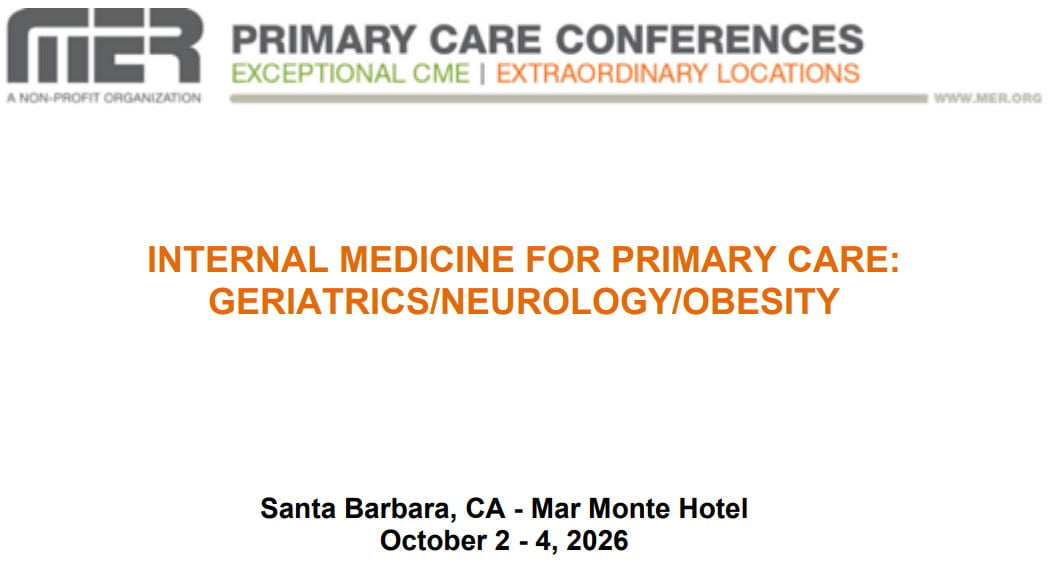
MER Primary Care Conferences Internal Medicine for Primary Care Geri Neuro Obesity Oct 02-04, 2026

$100.00
This Product is shared via google drive download link, So please share your correct Gmail id while placing the order .Please note that there are no CME points or certificate associated with this course Samples for Courses Can be found here : Free Samples Here!
MER Primary Care Conferences Internal Medicine for Primary Care Geri Neuro Obesity Oct 02-04, 2026
MER Internal Medicine for Primary Care 2026 | Geriatrics, Neurology, Obesity Medicine, Osteoporosis, Gout, Alzheimer’s Disease, Parkinson’s Disease, Headaches & Bariatric Surgery
The MER Primary Care Conferences Internal Medicine for Primary Care Geri Neuro Obesity Oct 02-04, 2026 is a comprehensive continuing medical education program providing evidence-based updates across three important clinical specialties: geriatrics, neurology, and obesity medicine.
Organized by Medical Education Resources (MER), the conference was held October 2–4, 2026, at the Mar Monte Hotel in Santa Barbara, California.
Designed for office-based primary care physicians, family medicine practitioners, internists, and other healthcare professionals, the program emphasizes practical diagnosis, contemporary treatment strategies, clinical risk assessment, and individualized management of commonly encountered medical conditions.
The Internal Medicine for Primary Care: Geriatrics/Neurology/Obesity 2026 curriculum covers arthritis pharmacotherapy in older adults, osteoporosis, fracture risk assessment, gait disorders, falls prevention, neurological weakness, headache disorders, Alzheimer’s disease, Parkinson’s disease, movement disorders, gout, pseudogout, obesity pathophysiology, medical weight management, and patient care following bariatric surgery.
Through 12 structured educational presentations, participants explore clinical approaches to conditions that frequently overlap in older adults and patients with multiple chronic diseases.
The program emphasizes interpretation of diagnostic findings, application of current research, medication safety, long-term disease management, and the integration of preventive strategies into primary care.
Course Details
- Course: MER Primary Care Conferences Internal Medicine for Primary Care Geri Neuro Obesity Oct 02-04, 2026
- Official Program: Internal Medicine for Primary Care: Geriatrics/Neurology/Obesity
- Organizer: Medical Education Resources (MER)
- Conference Dates: October 2–4, 2026
- Location: Santa Barbara, California, USA
- Venue: Mar Monte Hotel
- Venue Address: 1111 East Cabrillo Boulevard, Santa Barbara, California 93103
- Original Conference Format: Live In-Person Continuing Medical Education
- Duration: Three Days
- Published Scientific Lectures: 12
- Primary Specialty: Internal Medicine / Primary Care
- Additional Focus: Geriatrics, Neurology, Obesity Medicine, Rheumatology, Endocrinology and Bariatric Medicine
- Language: English
- Official AMA CME: Up to 12 AMA PRA Category 1 Credits™
- ABIM MOC: Up to 12 Points
- AAFP: Up to 12 Live Prescribed Credits
- ANCC: Up to 12 Nursing Contact Hours
- ANCC Pharmacotherapeutic Credit: 5.5 Contact Hours
- AAPA: Up to 12 Category 1 CME Credits
- IPCE: 12 Credits
Official CME credits and certificates apply only to eligible participation in the original MER educational activity.
Target Audience
The program is intended for office-based primary care providers and healthcare professionals seeking practical updates in adult medical care.
The target audience includes:
- Internal Medicine Physicians
- Family Medicine Physicians
- Primary Care Physicians
- General Practitioners
- Geriatricians
- Neurologists
- Obesity Medicine Specialists
- Bariatric Surgeons
- Rheumatologists
- Physiatrists
- Endocrinologists
- Hospitalists
- Rehabilitation Medicine Physicians
- Physician Assistants
- Nurse Practitioners
- Registered Nurses
- Advanced Practice Providers
- Medical Residents
- Clinical Fellows
- Other Healthcare Professionals Involved in Primary Care
The course is particularly relevant to clinicians caring for older adults, patients with neurological disorders, and individuals requiring long-term obesity management.
Program Overview
Primary care clinicians frequently manage patients with overlapping musculoskeletal, neurological, metabolic, and age-related conditions.
Older adults may experience arthritis, osteoporosis, gait impairment, falls, cognitive decline, or movement disorders.
At the same time, obesity is associated with complex metabolic, hormonal, behavioral, and environmental factors that can affect long-term health outcomes.
The MER Geriatrics Neurology Obesity 2026 program addresses these challenges through practical clinical updates.
The curriculum covers:
- Arthritis Pharmacotherapy
- NSAIDs and COX-2 Inhibitors
- Analgesic Safety
- Osteoporosis
- Bone Mineral Density
- DEXA Interpretation
- FRAX Fracture Risk Assessment
- Geriatric Gait Disorders
- Falls Prevention
- Neurological Weakness
- Headaches and Migraines
- Alzheimer’s Disease
- Dementia
- Parkinson’s Disease
- Movement Disorders
- Gout
- Pseudogout
- Crystal Arthritis
- Obesity Pathophysiology
- Genetics and Epigenetics
- Hormonal Regulation
- Metabolic Health
- Medical Obesity Treatment
- Lifestyle Modification
- Weight Management Medications
- Bariatric Surgery
- Post-Bariatric Surgery Care
- Multidisciplinary Obesity Management
Learning Objectives
Upon completion of the original program, participants should be better able to:
- Describe the risks and benefits of traditional pharmacological agents used to treat arthritis.
- Interpret bone density investigations and evaluate fracture risk in older adults.
- Assess and manage gait disorders and implement appropriate strategies to prevent falls.
- Apply current evidence to the treatment of gout and related crystal arthropathies.
- Use clinical history and physical examination to distinguish true neurological weakness from nonspecific symptoms.
- Describe the differential diagnosis and management considerations for headaches and migraines.
- Discuss evidence-based management options for Alzheimer’s disease and other dementias.
- Recognize the cardinal clinical features of Parkinson’s disease and other movement disorders.
- Explain the physiological mechanisms contributing to obesity, including genetic, hormonal, metabolic, epigenetic, and environmental factors.
- Review nonsurgical obesity treatments, including behavioral interventions, lifestyle management, and pharmacological therapies.
- Describe the approach to ongoing patient management after bariatric surgery.
- Counsel patients about medical and surgical weight-management strategies, including appropriate patient selection and coordinated care.
Complete Official Conference Curriculum
Day 1 – Friday, October 2, 2026
7:00 AM – Check-In and Breakfast
Session I – Geriatrics
1. Update in Pharmacology for Arthritis in the Older Adult
7:30 AM – 8:30 AM
This presentation reviews the risks and benefits of commonly prescribed pharmacological treatments for arthritis in older adults.
Important topics include:
- Osteoarthritis
- Arthritis-Related Pain
- Nonsteroidal Anti-Inflammatory Drugs
- COX-2 Inhibitors
- Acetaminophen
- Tramadol
- Opioid Analgesics
- Medication Safety
- Gastrointestinal Adverse Effects
- Renal Risk
- Cardiovascular Risk
- Polypharmacy
- Individualized Treatment Selection
The educational emphasis is on balancing symptom relief with treatment-related risks in older patients.
2. Osteoporosis in the Older Adult
8:30 AM – 9:30 AM
This presentation examines osteoporosis diagnosis, fracture risk evaluation, and contemporary treatment considerations.
Important topics include:
- Osteoporosis
- Bone Mineral Density
- DEXA Scanning
- T-Scores
- FRAX Risk Assessment
- Fragility Fractures
- Fracture Prevention
- Pharmacological Treatment
- Nutritional Considerations
- Fall Risk
- Bone Health Monitoring
The session emphasizes interpreting diagnostic results and selecting appropriate osteoporosis management strategies.
9:30 AM – 9:40 AM: Coffee Break
3. Geriatric Gait Disorders & Falls
9:40 AM – 10:40 AM
This session reviews gait abnormalities and approaches to reducing falls among older adults.
Important clinical considerations include:
- Gait Assessment
- Balance Disorders
- Muscle Weakness
- Neurological Causes of Gait Changes
- Medication-Related Fall Risk
- Orthostatic Hypotension
- Functional Assessment
- Falls Prevention
- Exercise Training
- Balance Training
- Resistance Exercises
- Rehabilitation Strategies
The presentation emphasizes identifying modifiable fall risk factors and maintaining functional independence.
Session II – Neurology
4. Evaluating Weakness
10:40 AM – 11:40 AM
This presentation reviews the assessment of patients reporting weakness.
Important topics include:
- True Muscle Weakness
- Generalized Fatigue
- Neurological Examination
- Muscle Strength Assessment
- Peripheral Nervous System Disorders
- Central Nervous System Disorders
- Neuromuscular Conditions
- Clinical History
- Differential Diagnosis
- Diagnostic Investigations
- Specialist Referral
The educational focus is on differentiating neurological weakness from nonspecific symptoms.
5. Headaches & Migraines
11:40 AM – 12:40 PM
This presentation reviews headache mechanisms, diagnostic assessment, differential diagnosis, and treatment considerations.
Important topics include:
- Primary Headache Disorders
- Migraine
- Tension-Type Headache
- Cluster Headache
- Trigeminal Neuralgia
- Headache History
- Triggering Factors
- Headache Red Flags
- Giant Cell Arteritis
- Intracranial Mass Lesions
- Subarachnoid Hemorrhage
- Acute Headache Management
- Preventive Treatment
- Appropriate Diagnostic Testing
The session emphasizes distinguishing common headache disorders from potentially serious secondary causes.
12:40 PM – Day 1 Adjournment
Day 2 – Saturday, October 3, 2026
7:00 AM – Arrival and Breakfast
Session III – Neurology
6. Alzheimer’s & Other Dementias
7:30 AM – 8:30 AM
This presentation reviews Alzheimer’s disease, other causes of dementia, and their implications for primary care.
Important areas include:
- Alzheimer’s Disease
- Cognitive Decline
- Normal Cognitive Aging
- Dementia
- Vascular Dementia
- Clinical Presentation
- Cognitive Assessment
- Diagnostic Evaluation
- Differential Diagnosis
- Symptomatic Treatment
- Emerging Research Therapies
- Social and Functional Considerations
- Caregiver Support
The educational emphasis is on distinguishing normal aging from cognitive disorders and reviewing evidence-based management approaches.
7. Parkinson’s Disease & Other Movement Disorders
8:30 AM – 9:30 AM
This session examines Parkinson’s disease and other disorders affecting movement.
Important topics include:
- Parkinson’s Disease
- Tremor
- Bradykinesia
- Rigidity
- Postural Instability
- Parkinsonian Syndromes
- Movement Disorders
- Neurochemistry
- Differential Diagnosis
- Medication-Related Movement Disorders
- Chorea
- Treatment Considerations
- Long-Term Complications
The session focuses on identifying characteristic clinical features and developing appropriate diagnostic and management approaches.
9:30 AM – 9:40 AM: Coffee Break
Session IV – Geriatrics and Rheumatology
8. Crystal Disease: Gout and Pseudogout in the Older Adult
9:40 AM – 10:40 AM
This presentation reviews common crystal-associated inflammatory joint disorders in older adults.
Important topics include:
- Gout
- Pseudogout
- Calcium Pyrophosphate Deposition Disease
- Acute Crystal Arthritis
- Joint Inflammation
- Differential Diagnosis
- Synovial Fluid Analysis
- Hyperuricemia
- Anti-Inflammatory Treatment
- Urate-Lowering Therapy
- Medication Safety
- Comorbidities
- Long-Term Disease Management
The session emphasizes accurate diagnosis and appropriate treatment of gout and pseudogout in older patients.
Session V – Obesity Medicine
9. Pathophysiology of Obesity
10:40 AM – 11:40 AM
This presentation examines the biological mechanisms and clinical considerations involved in the development and progression of obesity.
Important topics include:
- Obesity as a Chronic Disease
- Genetics
- Epigenetics
- Hormonal Regulation
- Energy Balance
- Appetite Regulation
- Metabolic Adaptation
- Environmental Influences
- Behavioral Factors
- Clinical Risk Assessment
- Obesity-Related Comorbidities
- Patient-Centered Care
The session reviews the complex biological and environmental processes associated with obesity.
10. Medical Management of Obesity
11:40 AM – 12:40 PM
This presentation reviews nonsurgical approaches to obesity treatment.
Important considerations include:
- Medical Obesity Treatment
- Nutrition
- Physical Activity
- Lifestyle Modification
- Behavioral Interventions
- Anti-Obesity Medications
- Appetite Regulation
- Medication Selection
- Cardiometabolic Risk
- Long-Term Weight Management
- Treatment Monitoring
- Patient Counseling
The educational focus is on developing individualized, sustainable strategies for obesity management.
12:40 PM – Day 2 Adjournment
Day 3 – Sunday, October 4, 2026
7:00 AM – Arrival and Breakfast
Session VI – Bariatric Medicine and Obesity Care
11. Patient Management Post-bariatric Surgery
7:30 AM – 8:30 AM
This presentation reviews the responsibilities of healthcare professionals caring for patients after bariatric surgery.
Important clinical considerations include:
- Post-Bariatric Surgery Care
- Nutritional Assessment
- Dietary Progression
- Nutrient Deficiencies
- Vitamin and Mineral Supplementation
- Weight Monitoring
- Behavioral Support
- Long-Term Follow-Up
- Surgery-Related Complications
- Lifestyle Modification
- Patient Education
- Multidisciplinary Care
The session emphasizes ongoing medical, nutritional, and behavioral support following bariatric procedures.
12. Guiding Patients in the Medical and Surgical Care of Obesity
8:30 AM – 9:30 AM
This concluding presentation explores comprehensive obesity care and the relationship between medical management and surgical treatment pathways.
Important topics include:
- Obesity Treatment Planning
- Medical Weight Management
- Bariatric Surgery
- Patient Selection
- Shared Decision-Making
- Treatment Expectations
- Multidisciplinary Care
- Patient Engagement
- Behavioral Health
- Treatment Coordination
- Long-Term Outcomes
The educational emphasis is on counseling patients and selecting suitable interventions according to individual clinical needs.
9:30 AM – Conference Adjournment
Major Topics Covered
- MER Primary Care Conferences 2026
- Internal Medicine for Primary Care
- Geriatrics
- Neurology
- Obesity Medicine
- Arthritis Treatment
- NSAIDs
- COX-2 Inhibitors
- Osteoporosis
- DEXA Scan
- FRAX
- Fracture Risk Assessment
- Gait Disorders
- Falls Prevention
- Neurological Weakness
- Headaches
- Migraine
- Alzheimer’s Disease
- Dementia
- Parkinson’s Disease
- Movement Disorders
- Gout
- Pseudogout
- Crystal Arthritis
- Obesity Pathophysiology
- Genetics
- Epigenetics
- Metabolic Health
- Hormonal Regulation
- Medical Weight Management
- Anti-Obesity Medications
- Lifestyle Modification
- Bariatric Surgery
- Post-Bariatric Care
- Nutritional Assessment
- Patient Counseling
- Chronic Disease Management
- Evidence-Based Primary Care
Geriatric Medicine and Medication Safety
Older adults frequently require treatment for arthritis, osteoporosis, chronic pain, and mobility limitations.
The conference examines the risks and benefits of common medications, the evaluation of bone health, and interventions intended to reduce falls.
The curriculum emphasizes individualized care that considers comorbidities, medication-related risks, and functional status.
Osteoporosis and Fracture Prevention
Osteoporosis is an important contributor to fracture risk among older adults.
The program includes a dedicated session reviewing:
- Bone Mineral Density
- DEXA Interpretation
- FRAX Risk Assessment
- Fragility Fracture Prevention
- Medical Therapy
- Long-Term Monitoring
These subjects support practical decisions related to osteoporosis diagnosis and treatment.
Neurology and Cognitive Disorders
Neurological symptoms are frequently encountered in primary care.
The course examines weakness, headaches, Alzheimer’s disease, dementia, Parkinson’s disease, and other movement disorders.
The educational focus includes neurological assessment, differential diagnosis, appropriate investigations, and management strategies.
Obesity and Metabolic Health
Obesity is a chronic disease influenced by genetics, hormones, metabolic regulation, behavior, and environmental factors.
The curriculum reviews obesity pathophysiology, epigenetics, medical treatment, lifestyle strategies, and patient-centered care.
It also examines long-term management after bariatric surgery and the importance of coordinated multidisciplinary support.
Gout and Crystal-Induced Arthritis
Crystal-associated joint disease is another major educational theme.
The program discusses gout and pseudogout in older adults, emphasizing accurate diagnosis, treatment selection, medication safety, and individualized management.
Bariatric Surgery and Long-Term Follow-Up
Post-bariatric care requires coordinated medical, nutritional, and behavioral follow-up.
The program reviews patient monitoring, nutrition, lifestyle adaptation, and management considerations following weight-loss surgery.
The curriculum also explores counseling and patient selection for medical versus surgical obesity care.
Evidence-Based Clinical Decision-Making
The MER Internal Medicine for Primary Care Geriatrics Neurology Obesity 2026 program emphasizes incorporating clinical evidence into everyday outpatient practice.
Major clinical considerations include:
- Diagnostic Accuracy
- Patient Risk Assessment
- Medication Safety
- Clinical Guidelines
- Multimorbidity
- Lifestyle Management
- Preventive Care
- Patient Counseling
- Multidisciplinary Care
- Long-Term Follow-Up
Continuing Medical Education
Medical Education Resources designated the original live educational activity for a maximum of:
- 12 AMA PRA Category 1 Credits™
- 12 ABIM MOC Points
- 12 Live AAFP Prescribed Credits
- 12 ANCC Nursing Contact Hours
- 5.5 ANCC Pharmacotherapeutic Contact Hours
- 12 AAPA Category 1 CME Credits
- 12 Interprofessional Continuing Education Credits
These credits apply to eligible participants who satisfy the original provider’s attendance and completion requirements.
Important CME Notice
Purchasing separately distributed educational files through MedicalAmboss does not provide:
- Official MER CME Credits
- ABIM MOC Points
- Continuing Education Certificates
- Original Conference Registration
- Live Attendance
- Publisher Streaming Platform Access
- Publisher Memberships
- Official MER Accounts
- Publisher-Hosted Extras
Why This Course Is Relevant
The MER Primary Care Conferences Internal Medicine for Primary Care Geri Neuro Obesity Oct 02-04, 2026 program offers a practical clinical review across geriatrics, neurology, and obesity medicine.
These specialties frequently overlap in patients requiring comprehensive primary care, particularly older adults living with chronic medical conditions, mobility limitations, neurological symptoms, or obesity-related complications.
The program supports clinical understanding of arthritis pharmacotherapy, osteoporosis, falls, headache disorders, cognitive decline, Parkinson’s disease, crystal arthritis, obesity treatment, and post-bariatric care.
Its multidisciplinary educational approach makes it relevant to internists, family physicians, geriatricians, neurologists, obesity medicine specialists, rheumatologists, and other healthcare professionals.
Official Program Reference and MedicalAmboss Purchase Scope
Official MER Conference:
https://www.mer.org/conference/MTMyMSxPY3RvYmVyLDIwMjY%3D/view-agenda/
Official Conference Agenda:
https://www.mer.org/wp-content/uploads/2026/01/26_1002_IM_SB_Agenda_Web_01_27_26.pdf
These references describe the original conference, including dates, venue, lectures, learning objectives, and accreditation.
They do not independently verify the file inventory of a separately distributed MedicalAmboss listing.
MedicalAmboss File Scope: The educational information is provided for reference. Original MER registration, live attendance, official credits or certificates, and publisher-hosted services are not included unless specifically listed with the store product.
Short Description
MER Primary Care Conferences Internal Medicine for Primary Care Geri Neuro Obesity 2026 provides an evidence-based educational update in geriatrics, neurology, obesity medicine, and adult primary care.
Held October 2–4, 2026, at the Mar Monte Hotel in Santa Barbara, California, the original conference includes 12 educational presentations covering arthritis treatment, osteoporosis, gait disorders, headaches, Alzheimer’s disease, Parkinson’s disease, gout, obesity management, and post-bariatric care.
Topics
-
Friday, October 2, 2026
-
Geriatrics: Update in Pharmacology for Arthritis in the Older Adult (Review risks and benefits of traditional NSAIDs and cox-2 inhibitors; analgesics [narcotics and tramadol] and acetaminophen)
-
Geriatrics: Osteoporosis in the Older Adult (Review the epidemiology and pathophysiology of osteoporosis along with interpretation of DEXA scans and FRAX risk assessment; up-to-date therapeutic options)
-
Geriatrics: Geriatric Gait Disorders & Falls (Diagnosing problems associated with gait abnormalities; considering causes and prevention of falls; exercise training, aerobics, balance training, resistance)
-
Neurology: Evaluating Weakness (Using the history and physical examination to distinguish weakness from non-specific symptoms; characteristics of neurological diseases that produce weakness; presentations of representative diseases of the nervous system)
-
Neurology: Headaches & Migraines (Basic headache mechanisms; headache history: characteristics, precipitating factors, medical conditions; migraine: common tension, classic, treatment, complicated, cluster, sinus; trigeminal neuralgia; Giant Cell Arteritis; brain tumor; subarachnoid hemorrhage; emergency room treatment)
-
-
Saturday, October 3, 2026
-
Neurology: Alzheimer’s & Other Dementias (Definition; statistics; neurological changes of normal aging; pathology; etiological theories; vascular dementias; investigations; social issues; symptomatic treatment; research therapies)
-
Neurology: Parkinson’s Disease & Other Movement Disorders (Epidemiology; cardinal features; secondary features; pathology; neurochemistry; differential diagnosis; treatment; complication; other movement disorders; neuroleptic-induced movement disorders; chorea)
-
Geriatrics: Crystal Disease: Gout and Pseudogout in the Older Adult (Properly diagnosing and treating crystal diseases such as gout and pseudogout)
-
Obesity: Pathophysiology of Obesity (A guide to understanding practice demographics and considerations; The what and why of epigenetics; A practical guide to behavioral and medication management)
-
Obesity: Medical Management of Obesity (Overview of obesity as a disease state; Costs to the individual of being obese; Use of appetite suppressant medications and lifestyle modifications)
-
-
Sunday, October 4, 2026
-
Obesity: Patient Management Post-bariatric Surgery (The role of the clinician for support and behavior modification, nutrition, and the stages of patient management post-surgery)
-
Obesity: Guiding Patients in the Medical and Surgical Care of Obesity (Differences in treating obesity vs. other medical conditions, treatments, and procedures; Strategies for better engagement and understanding of patient pathways, perspectives, and team partnership)
-
Related products

Internal Medicine

Medical Accounts
Critical Care - Emergency medicine
Critical Care - Emergency medicine
Internal Medicine

Medical Accounts