
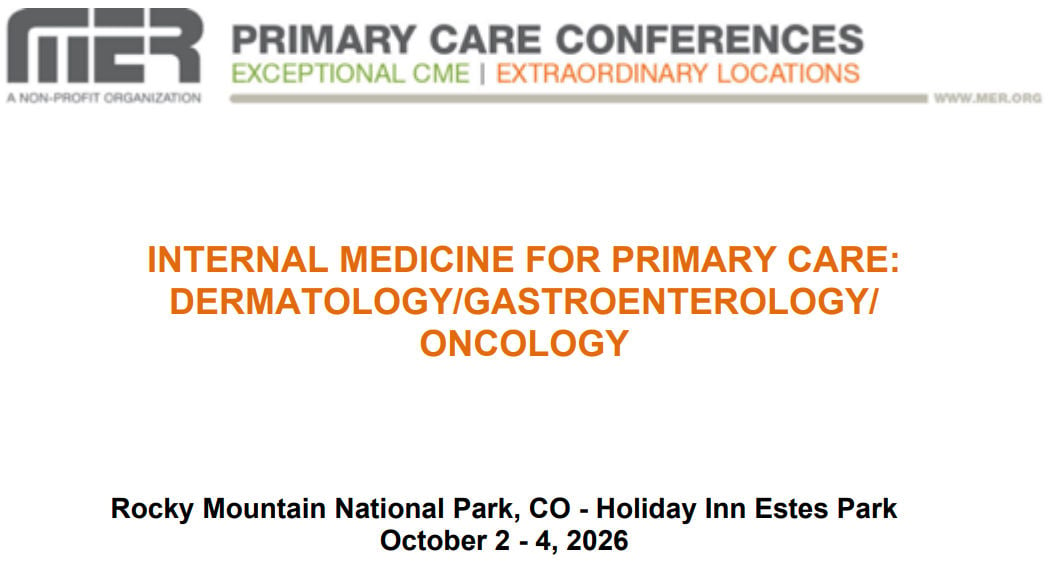
MER Primary Care Conferences Internal Medicine for Primary Care Derm Gastro Onc Oct 02-04, 2026

$100.00
A primary care review of common skin, gastrointestinal and cancer-related problems. This MER October 2026 program includes colorectal screening, hepatitis, acne and skin tumors, cancer survivorship and anticoagulants. The complete lecture descriptions below help you assess its relevance to your clinical work.
Delivery Information: This Product is shared via google drive download link. Please use your correct Gmail address at checkout.
Please note: there are no CME points or certificate associated with this course.
Samples for Courses Can be found here: Free Samples Here!
Course Overview
MER’s October 2026 primary care program brings dermatology, gastroenterology and oncology into one clinical review. The agenda covers gastrointestinal bleeding, colorectal screening, celiac disease, hepatitis, skin lesions and the assessment and follow-up of patients with cancer.
The original meeting took place October 2–4, 2026, at the Holiday Inn Estes Park in Colorado. It is intended for clinicians working in primary care and internal medicine, including nurse practitioners and physician assistants.
Learning Objectives
Upon completion of the original educational program, participants should be better able to:
- List current treatment recommendations for the management of lower gastrointestinal bleeding.
- Discuss guidelines for colonoscopic colorectal cancer screening and surveillance.
- Recommend appropriate testing for the evaluation of celiac disease.
- List current treatment recommendations for hepatitis B virus (HBV) and hepatitis C virus (HCV).
- Identify cutaneous findings that may serve as clinical indicators of underlying internal diseases.
- Describe a stepwise approach to the diagnosis and treatment of acne and acneiform eruptions.
- Differentiate benign and malignant skin tumors and employ appropriate office-based dermatologic procedures.
- Detect premalignant and malignant skin lesions.
- Identify clinical practices shown to prevent cancer.
- Discuss the diagnostic approach to patients with suspected malignancy.
- Evaluate and manage important medical risks associated with cancer survivorship.
- Manage patients receiving newer oral anticoagulant medications.
Topics
-
Friday, October 2, 2026
-
Gastroenterology: Management of Lower GI Bleeding – From Occult to Massive (The correct use and interpretation of tests for occult blood in the stool will be discussed in relation to lower GI bleeding; focus on the utility of different diagnostic and management approaches to the spectrum of patients presenting with hematochezia)
-
Gastroenterology: Colorectal Cancer Screening and Surveillance (Reviews the most recent recommendations for CRC screening in the general population at average risk for CRC)
-
Gastroenterology: Celiac Disease and Chronic Diarrhea (Millions of Americans are now on a gluten free diet. Only some of them actually have Celiac disease. We will review the workup of diarrhea and malabsorption with a focus on celiac disease; We will discuss how to diagnose celiac disease when a patient is already on a gluten free diet and an appropriate differential diagnosis)
-
Dermatology: Skin Manifestations of Systemic Disease (Skin will often reflect signs of systemic diseases, be useful for diagnosis, or suffer from a complication of disease or its treatment; Diagnosis of rheumatologic, endocrine, gastrointestinal, and psychologic conditions based on cutaneous findings)
-
Dermatology: Acne and Acneiform Eruptions (Identification of noninflammatory open or closed comedones and inflammatory lesions; Determination of treatment therapies based on acne grading scale; Bacterial folliculitis, drug-induced acne, hidradenitis suppurativa, miliaria, perioral dermatitis, pseudofolliculitis barbae, rosacea, seborrheic dermatitis; Topical and systemic therapy)
-
-
Saturday, October 3, 2026
-
Dermatology: Benign Skin Tumors (Proper diagnosis and treatment of common benign tumors; Biopsies and histopathologic examination; Nevi, seborrheic keratosis, keloids, hemangiomas and miscellaneous tumors; When to refer)
-
Dermatology: Premalignant and Malignant Skin Tumors (Recognition of precursors of malignancies; Excisional and punch biopsies; Actinic keratosis, Bowen’s disease, squamous cell carcinoma, basal cell carcinoma, melanoma and other selected tumors; Risk reduction education)
-
Gastroenterology: Hepatitis B and C Management (HBV screening: whom to screen, whom to vaccinate; management of patients with decompensated hepatitis B related liver disease; treatment in special populations)
-
Oncology: Cancer Prevention (Cancer screening and clinical practices shown to prevent cancer will be reviewed)
-
Oncology: Approach to the Patient with Suspected Cancer (Symptoms, signs and diagnoses that raise the suspicion of cancer will be reviewed, and an approach to evaluating these patients will be presented)
-
-
Sunday, October 4, 2026
-
Oncology: Management of Cancer Survivors (Medical issues related to cancer survivorship and approaches to surveillance for cancer recurrence will be reviewed)
-
Oncology: A Primary Care Review of New Oral Anticoagulants (Mechanisms of action, clinical indications, therapeutic indices, perioperative management and approaches to reversal of new anticoagulant and antiplatelet medications will be reviewed)
-
Related products

Critical Care - Emergency medicine

Internal Medicine
Internal Medicine

Cardiology

Medical Accounts

Cardiology

Internal Medicine
Critical Care - Emergency medicine