
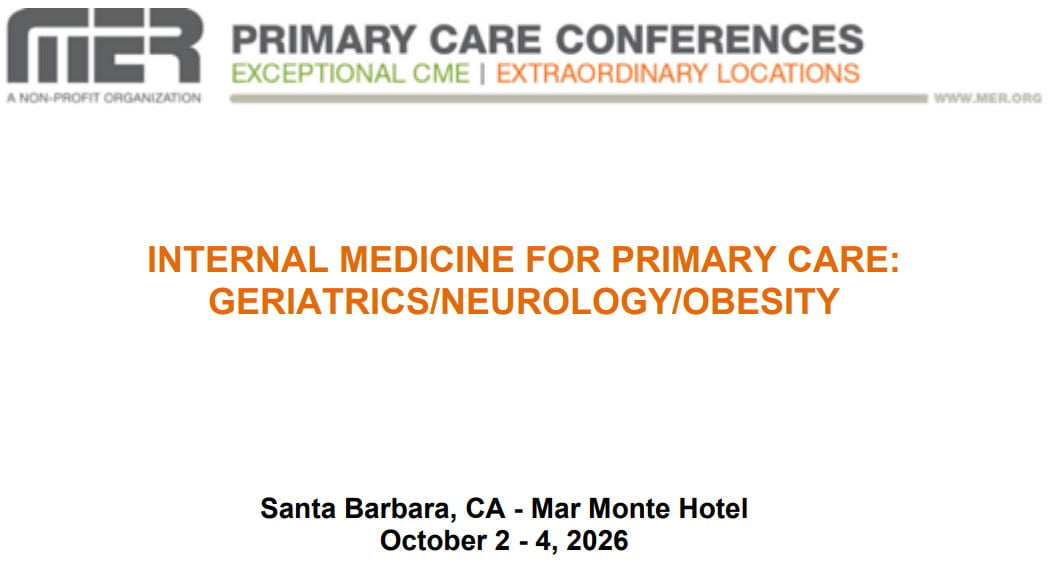
MER Primary Care Conferences Internal Medicine for Primary Care Geri Neuro Obesity Oct 02-04, 2026
$100.00
Review geriatric care, neurology and obesity medicine through MER’s October 2–4, 2026 primary care program. Sessions address falls, osteoporosis, dementia, headaches and weight management, including care after bariatric surgery. The full lecture list provides the scope of each session.
Delivery Information: This Product is shared via google drive download link. Please use your correct Gmail address at checkout.
Please note: there are no CME points or certificate associated with this course.
Samples for Courses Can be found here: Free Samples Here!
Course Overview
This MER program connects three areas of primary care: the needs of older adults, common neurological presentations and obesity management. Topics include arthritis and osteoporosis, falls, dementia, headache disorders, medical weight management and follow-up after bariatric surgery.
The original conference took place October 2–4, 2026, at the Mar Monte Hotel in Santa Barbara, California. It is designed for primary care physicians, internists, nurse practitioners and physician assistants. The agenda below preserves the individual lectures and their descriptions.
Learning Objectives
Upon completion of the original program, participants should be better able to:
- Describe the risks and benefits of traditional pharmacological agents used to treat arthritis.
- Interpret bone density investigations and evaluate fracture risk in older adults.
- Assess and manage gait disorders and implement appropriate strategies to prevent falls.
- Apply current evidence to the treatment of gout and related crystal arthropathies.
- Use clinical history and physical examination to distinguish true neurological weakness from nonspecific symptoms.
- Describe the differential diagnosis and management considerations for headaches and migraines.
- Discuss evidence-based management options for Alzheimer’s disease and other dementias.
- Recognize the cardinal clinical features of Parkinson’s disease and other movement disorders.
- Explain the physiological mechanisms contributing to obesity, including genetic, hormonal, metabolic, epigenetic, and environmental factors.
- Review nonsurgical obesity treatments, including behavioral interventions, lifestyle management, and pharmacological therapies.
- Describe the approach to ongoing patient management after bariatric surgery.
- Counsel patients about medical and surgical weight-management strategies, including appropriate patient selection and coordinated care.
Topics
-
Friday, October 2, 2026
-
Geriatrics: Update in Pharmacology for Arthritis in the Older Adult (Review risks and benefits of traditional NSAIDs and cox-2 inhibitors; analgesics [narcotics and tramadol] and acetaminophen)
-
Geriatrics: Osteoporosis in the Older Adult (Review the epidemiology and pathophysiology of osteoporosis along with interpretation of DEXA scans and FRAX risk assessment; up-to-date therapeutic options)
-
Geriatrics: Geriatric Gait Disorders & Falls (Diagnosing problems associated with gait abnormalities; considering causes and prevention of falls; exercise training, aerobics, balance training, resistance)
-
Neurology: Evaluating Weakness (Using the history and physical examination to distinguish weakness from non-specific symptoms; characteristics of neurological diseases that produce weakness; presentations of representative diseases of the nervous system)
-
Neurology: Headaches & Migraines (Basic headache mechanisms; headache history: characteristics, precipitating factors, medical conditions; migraine: common tension, classic, treatment, complicated, cluster, sinus; trigeminal neuralgia; Giant Cell Arteritis; brain tumor; subarachnoid hemorrhage; emergency room treatment)
-
-
Saturday, October 3, 2026
-
Neurology: Alzheimer’s & Other Dementias (Definition; statistics; neurological changes of normal aging; pathology; etiological theories; vascular dementias; investigations; social issues; symptomatic treatment; research therapies)
-
Neurology: Parkinson’s Disease & Other Movement Disorders (Epidemiology; cardinal features; secondary features; pathology; neurochemistry; differential diagnosis; treatment; complication; other movement disorders; neuroleptic-induced movement disorders; chorea)
-
Geriatrics: Crystal Disease: Gout and Pseudogout in the Older Adult (Properly diagnosing and treating crystal diseases such as gout and pseudogout)
-
Obesity: Pathophysiology of Obesity (A guide to understanding practice demographics and considerations; The what and why of epigenetics; A practical guide to behavioral and medication management)
-
Obesity: Medical Management of Obesity (Overview of obesity as a disease state; Costs to the individual of being obese; Use of appetite suppressant medications and lifestyle modifications)
-
-
Sunday, October 4, 2026
-
Obesity: Patient Management Post-bariatric Surgery (The role of the clinician for support and behavior modification, nutrition, and the stages of patient management post-surgery)
-
Obesity: Guiding Patients in the Medical and Surgical Care of Obesity (Differences in treating obesity vs. other medical conditions, treatments, and procedures; Strategies for better engagement and understanding of patient pathways, perspectives, and team partnership)
-
Related products

Critical Care - Emergency medicine
The Brigham Board Review in Infectious Diseases Brigham and Women’s Hospital Board Review
Critical Care - Emergency medicine
2022 ISICEM International Symposium on Intensive Care & Emergency Medicine
Critical Care - Emergency medicine
Internal Medicine
Internal Medicine

Pediatrics
Medical Accounts
Critical Care - Emergency medicine