
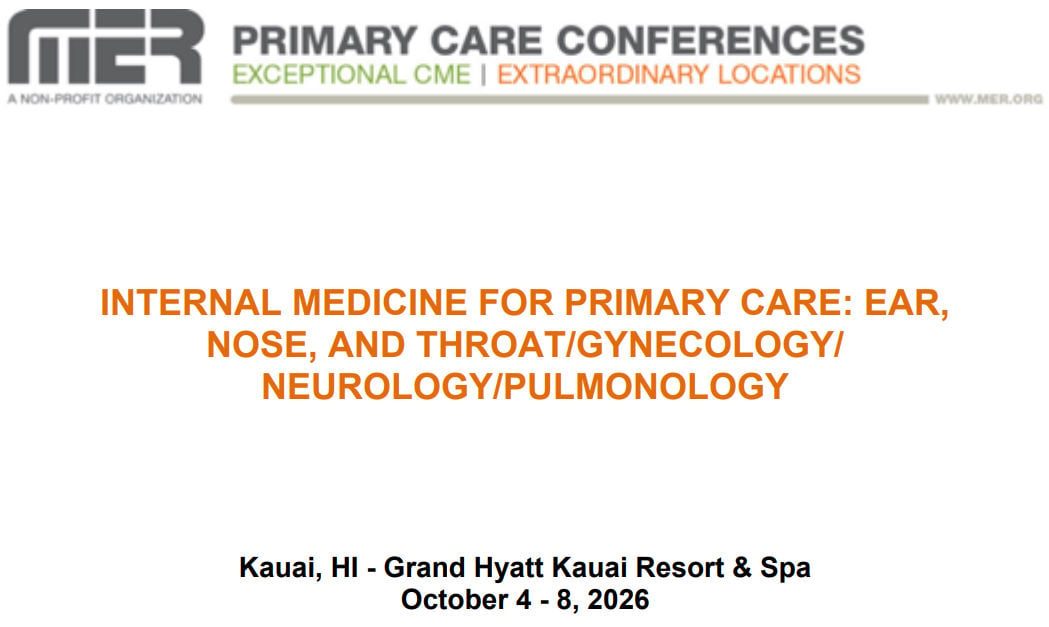
MER Primary Care Conferences Internal Medicine for Primary Care ENT Gyn Neuro Pulm Oct 04-08, 2026


$130.00
A focused review of ENT, gynecology, neurology and pulmonology for primary care. The October 4–8, 2026 MER program covers common outpatient problems, including headache, asthma, COPD, hearing loss, contraception and abnormal uterine bleeding. Review the complete lecture list below.
Delivery Information: This Product is shared via google drive download link. Please use your correct Gmail address at checkout.
Please note: there are no CME points or certificate associated with this course.
Samples for Courses Can be found here: Free Samples Here!
Course Overview
This MER primary care program reviews ENT, gynecology, neurology and pulmonary medicine through common outpatient presentations. Sessions range from weakness, seizures and headaches to asthma, COPD, hearing loss and women’s preventive care.
The original meeting took place October 4–8, 2026, at the Grand Hyatt Kauai Resort & Spa in Hawaii. It is intended for primary care physicians, internists, nurse practitioners and physician assistants. The complete agenda below lists each lecture and its clinical scope.
Learning Objectives
Upon completion of the original educational activity, participants should be better able to:
- Utilize prevention and treatment strategies for cerebrovascular disorders.
- Discuss evidence-based clinical management options for neurological diseases.
- Evaluate patients presenting with weakness or other neurological symptoms.
- Differentiate seizures, epilepsy, and related paroxysmal disorders.
- Compare pharmacological treatments used in epilepsy.
- Describe the differential diagnosis and treatment options for headaches and migraines.
- Diagnose and manage patients with asthma.
- Apply evidence-based treatment strategies for common respiratory infections.
- Describe contemporary management approaches for COPD.
- Discuss appropriate lung cancer screening and pulmonary nodule evaluation.
- Diagnose DVT and pulmonary embolism and review therapeutic options.
- Determine when imaging or ENT referral is indicated for patients with neck masses.
- Review systemic and topical antimicrobial options for sinusitis.
- Explain allergic pathways relevant to nasal and sinus disorders.
- Differentiate sensorineural from conductive hearing loss.
- Identify management approaches for tinnitus.
- Review evidence-based components of annual women’s health visits.
- Provide patient-centered counseling for complex contraceptive decisions.
- Evaluate breast cancer screening recommendations.
- Diagnose and manage abnormal uterine bleeding.
- Review the management of abnormal cervical cytology and HPV-related abnormalities.
Topics
-
Sunday, October 4, 2026
-
Neurology: Stroke and TIA Management in Primary Care (Epidemiology; identifying the high-risk patient; treatment effects; transient neurological deficit: carotid, vertebrobasilar; non-specific cerebral symptoms; migraines vs. TIA; treatment options)
-
Neurology: Delirium and Dementia (Review changes in cognition with normal aging; Behavioral changes that may precede early dementia; Screening tools for dementia; Characteristics of different dementia syndromes; Risks and benefits for treatment of Alzheimer Disease; Risk factors and causes of delirium, and how to reduce them; How to suspect and identify delirium; Management of the symptoms of delirium; Distinguishing delirium from dementia)
-
Neurology: The Medically Complex Patient with POTS, EDS and Mast Cell Activation (MCAS) (Strategies for handling challenging and complex presentations in neurology)
-
-
Monday, October 5, 2026
-
Pulmonology: Asthma (The medical impact of asthma; fundamental role of inflammation, with possible scarring and irreversible loss of lung function; practical points of diagnosis; goal setting management based on levels of severity; risk factors for mortality and treatment in the acute setting; management options for the difficult to control asthmatic patient)
-
Pulmonology: Controversies in the Treatment of Common Respiratory Infections (Acute and chronic bronchitis; pneumonia [community versus hospital-acquired]; role of the Pneumonia Severity Index score in determining indication for hospitalization; cost-effective use of antibiotics; clinical significance of drug resistance; guidelines for management)
-
Pulmonology: COPD (Definition; pathophysiology; early detection and intervention; risk reduction; management update including new modalities [including lung volume reduction surgery] and the role of inhaled corticosteroids and domiciliary oxygen)
-
Neurology: Migraine and Chronic Daily Headache (Diagnosis based on headache history; Classification and pathophysiology of migraine; Acute migraine treatment; Prophylaxis for recurrent migraine attacks; Chronic migraine, tension-type headaches, and cluster headaches; Trigeminal Neuralgia)
-
Neurology: An Approach to the Dizzy Patient (Definition of terms; concepts; physiologic mechanisms; medical, neurological and laboratory evaluation of the patient; diseases that present with a complaint of dizziness; acute paroxysmal vertigo; acute positional vertigo; Meniere’s disease; acoustic neuroma; cerebellar hemorrhage, etc.)
-
-
Tuesday, October 6, 2026
-
ENT: Evaluation of the Neck Mass (Patients presenting with masses in the neck are challenging and worrisome. The diagnostic and therapeutic process is described. A method for evaluating the mass, guidance on when imaging studies are indicated, and when immediate or routine referral to ENT becomes appropriate is discussed)
-
ENT: Antimicrobial Therapy in Treating Sinusitis (Symptoms, signs and examination findings helpful in diagnosing sinusitis are outlined. When to use systemic and topical agents as well as emerging resistance to these agents is discussed. Imaging studies and proper referral to specialists is described with clarity)
-
ENT: Allergic Rhinitis (The lecture will focus on a review of the basic allergic pathways that affect the body. Special emphasis will be given to the nasal and sinus regions, with discussion to include diagnostic testing and modes of treatment, including avoidance, pharmacotherapy and immunotherapy)
-
Pulmonology: Lung Cancer Screening & Pulmonary Nodules (Appropriate use of the new lung cancer screening recommendations; Fleischner Society guidelines and American College of Chest Physician Lung Cancer guidelines; approach to definitive evaluation and management strategies)
-
Pulmonology: Deep Vein Thrombosis & Pulmonary Embolism (Clinical presentation: The great masquerader; diagnostic controversies; acute treatment; chronic therapy and complications; ACCP Guidelines)
-
-
Wednesday, October 7, 2026
-
Gynecology: Annual Exam for Women (Best practices in offering annual pelvic examinations in asymptomatic non-pregnant women; Determination of who should be offered a clinical breast exam as a routine part of the annual women’s health exam; The principal elements of the annual women’s health visit: screening, vaccinations, evaluation of health risks and needs, counseling; Evidence-based tools to guide components of the annual women’s health visit based on age and health needs)
-
Gynecology: Contraception: A Primary Care Review of Best Practice (Coverage of the effectiveness, side effects and non-contraceptive benefits of available contraceptive options in the U.S.; Discussion of contraceptive counseling that is patient-centric including communicating without coercion; Management strategies for medically complex contraceptive decisions [patients with a history of VTE, breast cancer, hypertension])
-
Gynecology: Breast Cancer Screening (Comparison of recent breast cancer screening recommendations from U.S. Preventive Services Task Force, ACOG/ACS/NCCN, including a discussion of risks and benefits of screening at various ages; Review of the new USPSTF guideline on BRCA-related cancer: risk assessment, genetic counseling, and genetic testing, including risk assessment tools for women with a personal or family history of breast, ovarian and related cancers)
-
ENT: A Primary Care Approach to Sudden Hearing Loss (When a patient presents with sudden hearing loss, accurate differentiation of sensorineural versus conductive loss is essential. Techniques to make that differentiation, testing and treatment strategies will be discussed; Urgent treatment and when to render for audiometric testing and ENT referral will be outlined)
-
ENT: Tinnitus (Primary care approach to proper diagnosis and treatment of common ringing in the ear; includes latest advancements in treatment approaches)
-
-
Thursday, October 8, 2026
-
Gynecology: Abnormal Uterine Bleeding (Overview of normal/abnormal menstrual physiology/profile; Menstrual disturbances; Ovulatory and anovulatory uterine bleeding; Other menstrual abnormalities; Diagnosis and appropriate treatment options)
-
Gynecology: Abnormal Pap Smears and High Risk HPV (Current recommendations for cervical cancer screening; Incorporating the ASCCP consensus guidelines for management of cytologic cervical abnormalities [including ASCUS, LGSIL, HGSIL and atypical glandular cells] into your practice; Algorithm for the appropriate use of HPV testing; History of HPV and effectiveness of its use; Recommendations for missed doses; Storage and administration of HPV vaccines)
-
Related products

Critical Care - Emergency medicine

Internal Medicine

Critical Care - Emergency medicine
ASN Critical Care Nephrology – 2022 Update (On-Demand and Livestream)

Critical Care - Emergency medicine
Critical Care - Emergency medicine
2022 UPDATES IN THERAPEUTICS: CRITICAL CARE PHARMACY PREPARATORY REVIEW AND RECERTIFICATION COURSE

Critical Care - Emergency medicine
Anesthesiology & pain medicine
Critical Care Symposium: Mastering ED Mechanical Ventilation

Internal Medicine