
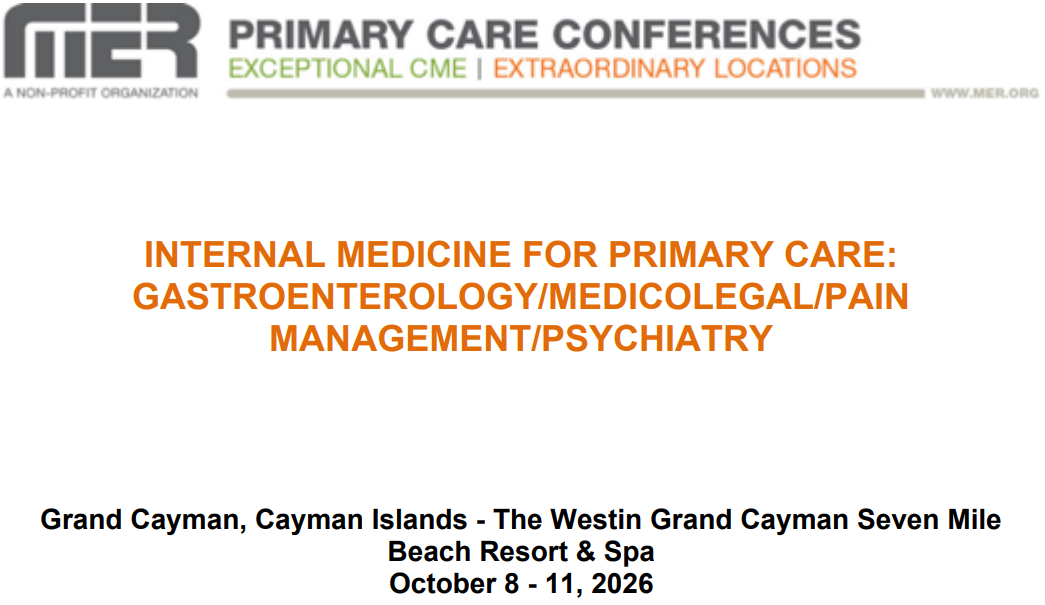
MER Primary Care Conferences Internal Medicine for Primary Care Gastro Medicolegal Pain Psych Oct 08-11, 2026

$120.00
This Product is shared via google drive download link, So please share your correct Gmail id while placing the order .Please note that there are no CME points or certificate associated with this course Samples for Courses Can be found here : Free Samples Here!
MER Primary Care Conferences Internal Medicine for Primary Care Gastro Medicolegal Pain Psych Oct 08–11, 2026
MER Internal Medicine for Primary Care 2026 | Gastroenterology, Medical Risk Management, Pain Management, Psychiatry, ADHD, Bipolar Disorder, Fibromyalgia & Clinical Updates
The MER Primary Care Conferences Internal Medicine for Primary Care: Gastroenterology/Medicolegal/Pain Management/Psychiatry 2026 is a comprehensive four-day continuing medical education conference designed to provide physicians, nurse practitioners, physician assistants, and other healthcare professionals with practical, evidence-based updates across four important areas of primary care medicine.
Organized by Medical Education Resources (MER), a nonprofit continuing medical education organization, the conference was held October 8–11, 2026, at The Westin Grand Cayman Seven Mile Beach Resort & Spa in Grand Cayman, Cayman Islands.
The program focuses on common and challenging conditions encountered in office-based medicine, with particular attention to gastrointestinal disease, medical malpractice prevention, risk management, chronic pain, psychiatric disorders, medication safety, and interprofessional patient care.
Through expert-led educational sessions, diagnostic reviews, clinical examples, and practical treatment discussions, the course examines strategies for reducing medicolegal risk, improving informed consent, strengthening clinical documentation, and supporting effective patient communication.
The curriculum also addresses nonopioid and opioid pain management, fibromyalgia, adult ADHD, bipolar spectrum disorders, anxiety disorders, substance use disorders, lower gastrointestinal bleeding, colorectal cancer screening, celiac disease, chronic diarrhea, and hepatitis B and C management.
The MER Internal Medicine for Primary Care 2026 program emphasizes applying current clinical recommendations, recognizing diagnostic challenges, selecting evidence-based interventions, and improving the quality and safety of outpatient medical care.
The original conference includes 16 scientific presentations across four days, with a maximum of 16 AMA PRA Category 1 Credits available to eligible participants through MER.
Course Details
- Course: MER Primary Care Conferences Internal Medicine for Primary Care Gastro/Medicolegal/Pain/Psych
- Official Conference: Internal Medicine for Primary Care: Gastroenterology/Medicolegal/Pain Management/Psychiatry
- Organizer: Medical Education Resources (MER)
- Organization Type: Nonprofit Continuing Medical Education Provider
- Edition: 2026
- Conference Dates: October 8–11, 2026
- Duration: Four Days
- Original Venue: The Westin Grand Cayman Seven Mile Beach Resort & Spa
- Location: Seven Mile Beach, Grand Cayman, Cayman Islands
- Original Format: In-Person Continuing Medical Education Conference
- Published Scientific Lectures: 16
- Original Maximum CME: 16 AMA PRA Category 1 Credits
- Original ABIM MOC: Up to 16 Points
- Original AAFP Prescribed Credits: Up to 16
- IPCE Credits: 16
- ANCC Contact Hours: Up to 16
- ANCC Pharmacotherapeutic Contact Hours: 5.75
- Original AAPA Category 1 CME: Up to 16 Credits
- Primary Specialty: Internal Medicine / Primary Care
- Core Areas: Gastroenterology, Medicolegal Risk Management, Pain Medicine and Psychiatry
- Language: English
- Educational Methods: Expert Lectures, Clinical Reviews, Case-Oriented Discussions and Evidence-Based Treatment Updates
The original conference benefits and professional credits require eligible participation through MER. Exact recordings, presentation slides, PDFs, and other materials in independently distributed educational packages must be verified separately.
Course Highlights
- Four-Day Primary Care CME Conference
- Sixteen Scientific Presentations
- Medical Malpractice Risk Reduction
- Informed Consent
- Shared Decision-Making
- Clinical Documentation
- Patient–Physician Communication
- Nonverbal Communication in Medicine
- Nonopioid Pain Management
- Opioid Pharmacotherapy
- Fibromyalgia
- Pain Management Controversies
- Adult ADHD
- Bipolar Spectrum Disorders
- Anxiety Disorders
- Substance Use Disorders
- Lower Gastrointestinal Bleeding
- Colorectal Cancer Screening
- Celiac Disease
- Chronic Diarrhea
- Hepatitis B
- Hepatitis C
- Patient Safety
- Evidence-Based Outpatient Management
Target Audience
The program is intended for office-based primary care providers and healthcare professionals seeking updates in clinical medicine.
Relevant participants include:
- Internal Medicine Physicians
- Primary Care Physicians
- Family Medicine Physicians
- General Practitioners
- Gastroenterologists
- Hepatologists
- Pain Medicine Specialists
- Psychiatrists
- Addiction Medicine Physicians
- Clinical Pharmacologists
- Hospitalists
- Nurse Practitioners
- Physician Assistants
- Physician Associates
- Registered Nurses
- Clinical Pharmacists
- Medical Residents
- Clinical Fellows
- Other Healthcare Professionals Involved in Primary Care
Learning Objectives
Upon completion of the original educational activity, participants should be better able to:
- Develop strategies for reducing medical malpractice risk in common and complex clinical situations.
- Explain the importance of informed consent and shared decision-making in patient care.
- Identify documentation practices that improve patient safety and reduce medicolegal risk.
- Recognize types of nonverbal communication and understand their effects on clinical interactions.
- Develop evidence-based nonopioid pain management strategies.
- Compare pharmacological treatment options for fibromyalgia, including efficacy and adverse effects.
- Discuss controversies involving chronic pain management.
- Develop safe and appropriate opioid treatment strategies.
- Evaluate pharmacological therapies for adult ADHD.
- Review psychosocial and pharmacological management of bipolar spectrum disorders.
- Identify evidence-based treatment approaches for anxiety disorders.
- Recognize and manage substance use disorders.
- Apply current recommendations for lower gastrointestinal bleeding.
- Review colorectal cancer screening and surveillance guidelines.
- Select appropriate investigations for suspected celiac disease and chronic diarrhea.
- Review contemporary management principles for hepatitis B and hepatitis C.
Complete Official 2026 Scientific Curriculum
The following program preserves the 16 lecture titles, dates, and times published by Medical Education Resources for the October 2026 conference.
The clinical explanations supplement the official agenda and do not represent additional independently verified lectures.
Day 1 – Thursday, October 8, 2026
Medical Risk Management and Pain Medicine
7:00 AM – Conference Check-In and Breakfast
1. The Anatomy of Medical Malpractice
7:30 AM – 8:30 AM
Specialty: Medicolegal / Risk Management
This presentation examines the essential elements of medical malpractice claims and the clinical circumstances that may increase legal and professional risk.
Major Educational Topics:
- Medical Malpractice
- Professional Liability
- Standard of Care
- Clinical Risk Assessment
- Patient Safety
- Common Risk Scenarios
- Unusual Clinical Situations
- Preventable Medical Errors
- Risk Management
- Quality of Care
Learning Focus:
Understand the principal elements of malpractice claims, recognize situations that may increase professional liability, and identify appropriate risk-reduction strategies.
2. Risky Business: Consent and Communication
8:30 AM – 9:30 AM
Specialty: Medicolegal / Patient Communication
Reviews informed consent and the importance of communication in clinical practice.
Major Educational Topics:
- Informed Consent
- Shared Decision-Making
- Patient Autonomy
- Risk Disclosure
- Communication with Families
- Unanticipated Clinical Outcomes
- Adverse Event Disclosure
- Patient–Provider Relationships
- Documentation
- Medical Liability
Learning Focus:
Describe the essential elements of informed consent, understand the importance of shared decision-making, and review appropriate methods for communicating unexpected outcomes.
Coffee Break
9:30 AM – 9:40 AM
3. Documentation: Effective Strategies and Pitfalls
9:40 AM – 10:40 AM
Specialty: Medicolegal / Clinical Documentation
Examines the role of clinical documentation in patient care, medical communication, and medicolegal risk.
Major Educational Topics:
- Medical Records
- Clinical Documentation
- Patient Safety
- Documentation Standards
- Clinical Decision-Making
- Communication Between Providers
- Risk Reduction
- Common Documentation Errors
- Clinical Encounter Records
- Shared Decision-Making
Learning Focus:
Identify documentation practices appropriate to different clinical encounters and understand how accurate records support patient safety, continuity of care, and professional accountability.
4. Non-Opioid Pharmacologic Options in Pain Management
10:40 AM – 11:40 AM
Specialty: Pain Medicine / Clinical Pharmacology
Reviews nonopioid treatment options for acute and chronic pain conditions.
Major Educational Topics:
- Nonsteroidal Anti-Inflammatory Drugs
- Acetaminophen
- Topical Analgesics
- Injection-Based Treatments
- Antidepressants for Pain
- Anticonvulsants
- Cannabinoid-Related Treatment Considerations
- Medication Selection
- Drug Safety
- Individualized Pain Management
Learning Focus:
Evaluate the benefits, adverse effects, and clinical considerations associated with different nonopioid pharmacological interventions.
5. Fibromyalgia
11:40 AM – 12:40 PM
Specialty: Pain Medicine / Rheumatology
Reviews fibromyalgia as a complex chronic pain syndrome requiring careful diagnostic assessment and individualized management.
Major Educational Topics:
- Fibromyalgia
- Chronic Widespread Pain
- Diagnostic Assessment
- Differential Diagnosis
- Sleep Disturbance
- Functional Impairment
- Anticonvulsant Medications
- Serotonin-Norepinephrine Reuptake Inhibitors
- Nonpharmacological Treatment
- Multidisciplinary Care
Learning Focus:
Differentiate fibromyalgia from other causes of widespread pain and compare the benefits and adverse effects of available treatment options.
12:40 PM – Sessions Adjourn
Day 2 – Friday, October 9, 2026
Chronic Pain, Communication, ADHD and Bipolar Disorder
7:00 AM – Arrival and Breakfast
6. Controversies in Pain Management
7:30 AM – 8:30 AM
Specialty: Pain Medicine
Examines clinical controversies surrounding chronic pain management.
Major Educational Topics:
- Chronic Pain
- Urine Drug Testing
- Cannabinoids
- Treatment Monitoring
- Medication Safety
- Clinical Evidence
- Patient Selection
- Regulatory Considerations
- Risk-Benefit Assessment
Learning Focus:
Review selected controversial issues in pain management and assess the evidence, limitations, and safety considerations surrounding different therapeutic strategies.
7. Opioid Pharmacologic Options in Pain Management
8:30 AM – 9:30 AM
Specialty: Pain Medicine / Clinical Pharmacology
Reviews opioid pharmacotherapy in selected patients with chronic pain.
Major Educational Topics:
- Opioid Analgesics
- Treatment Effectiveness
- Adverse Effects
- Patient Selection
- Opioid Risk Assessment
- Treatment Agreements
- Urine Drug Testing
- Monitoring
- Regulatory Requirements
- Safe Prescribing
Learning Focus:
Understand appropriate opioid treatment considerations, patient monitoring, clinical safety, and relevant regulatory issues.
Coffee Break
9:30 AM – 9:40 AM
8. Non-Verbal Communication in Medicine
9:40 AM – 10:40 AM
Specialty: Medicolegal / Clinical Communication
Examines nonverbal communication and its role in effective patient–physician relationships.
Major Educational Topics:
- Nonverbal Communication
- Body Language
- Facial Expressions
- Gestures
- Eye Contact
- Communication Signals
- Clinical Interaction
- Patient Understanding
- Professional Communication
- Therapeutic Relationships
Learning Focus:
Define nonverbal communication, identify its different forms, and understand how appropriate communication practices may improve clinical interactions.
9. The Complexity of Adult ADHD
10:40 AM – 11:40 AM
Specialty: Psychiatry
Reviews the diagnosis and management of attention-deficit/hyperactivity disorder in adult patients.
Major Educational Topics:
- Adult ADHD
- Inattention
- Hyperactivity and Impulsivity
- Clinical Screening
- Psychiatric Comorbidities
- Medical Differential Diagnosis
- Functional Impairment
- Pharmacological Treatment
- Medication Safety
- Clinical Follow-Up
Learning Focus:
Recognize adult ADHD presentations, consider coexisting conditions, and review evidence-based treatment options.
10. Bipolar Spectrum Disorders
11:40 AM – 12:40 PM
Specialty: Psychiatry
Examines bipolar spectrum conditions and their clinical management.
Major Educational Topics:
- Bipolar I Disorder
- Bipolar II Disorder
- Mood Episodes
- Clinical History
- Differential Diagnosis
- Psychiatric Comorbidity
- Medical Comorbidity
- Mood-Stabilizing Medications
- Psychosocial Treatment
- Phase-Specific Management
Learning Focus:
Recognize bipolar presentations and review pharmacological and psychosocial treatment approaches appropriate to different phases of illness.
12:40 PM – Sessions Adjourn
Day 3 – Saturday, October 10, 2026
Psychiatry and Gastroenterology
7:00 AM – Arrival and Breakfast
11. Anxiety Disorders
7:30 AM – 8:30 AM
Specialty: Psychiatry
Reviews common anxiety conditions and their diagnosis and management.
Major Educational Topics:
- Generalized Anxiety Disorder
- Panic Disorder
- Social Anxiety Disorder
- Post-Traumatic Stress Disorder
- Clinical Assessment
- Differential Diagnosis
- Psychiatric Comorbidity
- Cognitive Behavioral Therapy
- Pharmacological Treatment
- Long-Term Management
Learning Focus:
Recognize important anxiety presentations, understand associated conditions, and review evidence-based therapeutic approaches.
12. Substance Use Disorders
8:30 AM – 9:30 AM
Specialty: Psychiatry / Addiction Medicine
Reviews the identification and clinical management of substance use disorders.
Major Educational Topics:
- Substance Use Disorders
- Clinical History-Taking
- Screening Tools
- Patient Communication
- Brief Intervention
- Motivational Interviewing
- Recovery Support
- Treatment Options
- Family Dynamics
- Long-Term Follow-Up
Learning Focus:
Develop practical approaches to screening, diagnosis, patient engagement, treatment planning, and recovery support.
Coffee Break
9:30 AM – 9:40 AM
13. Management of Lower GI Bleeding – From Occult to Massive
9:40 AM – 10:40 AM
Specialty: Gastroenterology
Reviews diagnostic evaluation and management of lower gastrointestinal bleeding.
Major Educational Topics:
- Lower Gastrointestinal Bleeding
- Occult Blood Loss
- Hematochezia
- Stool-Based Testing
- Bleeding Severity
- Clinical Risk Assessment
- Diagnostic Evaluation
- Colonoscopy
- Management Strategies
- Specialist Referral
Learning Focus:
Understand appropriate use and interpretation of occult blood testing and evaluate diagnostic and management approaches for patients presenting with lower GI bleeding.
14. Colorectal Cancer Screening and Surveillance
10:40 AM – 11:40 AM
Specialty: Gastroenterology / Preventive Medicine
Reviews evidence-based colorectal cancer screening recommendations.
Major Educational Topics:
- Colorectal Cancer Prevention
- Screening Eligibility
- Average-Risk Screening
- Colonoscopy
- Stool-Based Screening
- Screening Intervals
- Colorectal Polyps
- Surveillance
- Clinical Guidelines
- Patient Counseling
Learning Focus:
Review screening and surveillance recommendations and understand their application to adult primary care.
11:40 AM – Sessions Adjourn
Day 4 – Sunday, October 11, 2026
Celiac Disease, Chronic Diarrhea and Viral Hepatitis
7:00 AM – Arrival and Breakfast
15. Celiac Disease and Chronic Diarrhea
7:30 AM – 8:30 AM
Specialty: Gastroenterology
Reviews celiac disease and other causes of chronic diarrhea and malabsorption.
Major Educational Topics:
- Celiac Disease
- Chronic Diarrhea
- Malabsorption
- Gluten-Related Conditions
- Diagnostic Serology
- Dietary History
- Gluten-Free Diet
- Intestinal Evaluation
- Differential Diagnosis
- Patient Counseling
Learning Focus:
Understand appropriate testing for suspected celiac disease, including diagnostic challenges in patients who have already adopted a gluten-free diet.
16. Hepatitis B and C Management
8:30 AM – 9:30 AM
Specialty: Gastroenterology / Hepatology
Reviews current clinical considerations involving hepatitis B and hepatitis C.
Major Educational Topics:
- Hepatitis B
- Hepatitis C
- Viral Hepatitis Screening
- Hepatitis B Vaccination
- Chronic Viral Hepatitis
- Antiviral Treatment
- Liver Disease
- Decompensated Cirrhosis
- Treatment in Special Populations
- Clinical Monitoring
Learning Focus:
Review recommendations for hepatitis screening, vaccination, treatment selection, and management of patients with advanced liver disease.
9:30 AM – Conference Adjourns
Major Topics Covered
- MER Primary Care Conference 2026
- Internal Medicine for Primary Care
- Gastroenterology
- Medicolegal Medicine
- Medical Malpractice
- Risk Management
- Informed Consent
- Shared Decision-Making
- Clinical Documentation
- Nonverbal Communication
- Pain Management
- Nonopioid Analgesics
- Opioid Pharmacotherapy
- Fibromyalgia
- Chronic Pain
- Adult ADHD
- Bipolar Spectrum Disorders
- Anxiety Disorders
- Substance Use Disorders
- Addiction Medicine
- Lower Gastrointestinal Bleeding
- Colorectal Cancer Screening
- Celiac Disease
- Chronic Diarrhea
- Malabsorption
- Hepatitis B
- Hepatitis C
- Patient Safety
- Evidence-Based Medicine
Medicolegal Risk Management
The program provides practical education on malpractice prevention, informed consent, documentation, and clinical communication.
These sessions address situations in which poor communication, inadequate documentation, or unclear clinical decisions may affect patient care and professional risk.
Pain Management
The pain medicine curriculum reviews fibromyalgia, nonopioid pharmacological treatments, opioid prescribing, and selected controversies in chronic pain management.
The educational focus includes treatment selection, safety monitoring, patient-specific considerations, and responsible prescribing practices.
Psychiatry in Primary Care
The psychiatry curriculum addresses adult ADHD, bipolar spectrum disorders, anxiety conditions, and substance use disorders.
The program emphasizes clinical assessment, differential diagnosis, psychiatric comorbidities, medication safety, and appropriate treatment planning.
Gastroenterology and Hepatology
The gastroenterology curriculum reviews lower GI bleeding, colorectal cancer screening, celiac disease, chronic diarrhea, and hepatitis B and C management.
These sessions are particularly relevant to primary care physicians responsible for identifying gastrointestinal disease, providing preventive care, and determining when specialist referral is necessary.
Patient Communication and Shared Decision-Making
Clinical communication plays an important role in patient understanding, satisfaction, treatment adherence, and safety.
The program examines informed consent, disclosure of unexpected clinical outcomes, nonverbal communication, and effective interaction between patients and healthcare professionals.
Continuing Medical Education
The original MER conference offered the following accreditation opportunities:
- 16 AMA PRA Category 1 Credits
- Up to 16 ABIM MOC Points
- 16 AAFP Prescribed Credits
- 16 IPCE Credits
- 16 ANCC Nursing Contact Hours
- 5.75 ANCC Pharmacotherapeutic Contact Hours
- 16 AAPA Category 1 CME Credits
- 16 ACPE Contact Hours (1.6 CEUs)
Other professional education recognition may apply according to the provider’s accreditation arrangements and individual licensing requirements.
Credits require eligible participation and completion of the relevant conference evaluation and reporting procedures.
Important CME Notice
Purchasing separately distributed educational materials does not automatically include:
- Official MER CME Credits
- ABIM MOC Points
- AAFP Prescribed Credits
- ANCC Contact Hours
- AAPA CME Credits
- Pharmacy Continuing Education Credits
- Official Completion Certificates
- Conference Registration
- In-Person Attendance
- MER Learning Platform Access
- Hotel or Travel Arrangements
Why This Course Is Relevant
The MER Primary Care Conferences Internal Medicine for Primary Care Gastro/Medicolegal/Pain/Psych 2026 provides an interdisciplinary review of practical clinical and professional issues encountered in outpatient medicine.
The four-day curriculum addresses medicolegal risk reduction, patient communication, chronic pain management, common psychiatric disorders, gastrointestinal disease, viral hepatitis, and preventive screening.
Its emphasis on clinical safety, evidence-based treatment, diagnostic reasoning, and professional communication makes the program relevant to internists, primary care physicians, family physicians, gastroenterologists, psychiatrists, pain management specialists, nurse practitioners, and physician assistants.
Course Information
| Feature | Details |
|---|---|
| Course | Internal Medicine for Primary Care: Gastro/Medicolegal/Pain/Psych |
| Organizer | Medical Education Resources |
| Conference Dates | October 8–11, 2026 |
| Duration | Four Days |
| Venue | The Westin Grand Cayman Seven Mile Beach Resort & Spa |
| Location | Grand Cayman, Cayman Islands |
| Original Format | In-Person CME Conference |
| Scientific Lectures | 16 |
| Original CME | Up to 16 Credits |
| ANCC Pharmacotherapeutic Hours | 5.75 |
| Primary Specialty | Internal Medicine |
| Language | English |
Official Program References
MER Official Conference:
https://www.mer.org/conference/MTIzOCxPY3RvYmVyLDIwMjY%3D/
Official Scientific Agenda:
https://www.mer.org/wp-content/uploads/2026/03/26_1008_IM_CAY_Agenda_Web_03_02_26.pdf
The original MER references provide the educational objectives, lecture titles, session times, conference dates, venue, and accreditation statements.
They do not establish the exact video, slide, PDF, or other digital file inventory available through an independent retailer.
Frequently Asked Questions
What is MER Internal Medicine for Primary Care Gastro/Medicolegal/Pain/Psych 2026?
It is a four-day educational conference covering gastroenterology, medicolegal risk management, pain medicine, and psychiatry.
When was the conference held?
October 8–11, 2026.
Where was the conference held?
The Westin Grand Cayman Seven Mile Beach Resort & Spa in the Cayman Islands.
How many scientific lectures were scheduled?
The official agenda lists 16 scientific lectures.
Does it include medical malpractice and risk management?
Yes. The program includes sessions covering malpractice prevention, informed consent, clinical documentation, and communication.
Does it cover chronic pain and opioids?
Yes. The curriculum addresses nonopioid treatments, opioid pharmacotherapy, fibromyalgia, and pain management controversies.
Does it include psychiatry?
Yes. Topics include adult ADHD, bipolar disorder, anxiety disorders, and substance use disorders.
Does the course cover gastrointestinal diseases?
Yes. The program includes lower GI bleeding, colorectal cancer screening, celiac disease, chronic diarrhea, and hepatitis B and C.
Are CME credits included with independent educational files?
No. Official credits require eligible participation through Medical Education Resources.
Short Description
MER Primary Care Conferences Internal Medicine for Primary Care Gastro/Medicolegal/Pain/Psych October 8–11, 2026 provides a comprehensive four-day review of gastroenterology, medical malpractice prevention, pain medicine, psychiatry, and clinical risk management.
Held at The Westin Grand Cayman Seven Mile Beach Resort & Spa, the original MER conference includes 16 scientific lectures emphasizing practical patient care, diagnostic evaluation, medication safety, professional communication, and evidence-based treatment.
Topics
Thursday, October 8, 2026
-
7:00 am: Check-In and Breakfast
-
7:30 am – 8:30 am | Risk Management: The Anatomy of Medical Malpractice
-
Identify the key elements of a malpractice claim in the practice setting; Assess the risk of malpractice in common and unusual situations; Identify risk management strategies for preventing claims
-
-
8:30 am – 9:30 am | Risk Management: Risky Business: Consent and Communication
-
Describe the necessary elements of an informed consent process; Discover why the shared decision making process represents and opportunity rather than an obligation for the provider; Discuss the importance of early disclosure of unanticipated outcomes; Learn methods to disclose and reconcile events with patients, families and providers
-
-
9:30 am – 9:40 am: Coffee Break
-
9:40 am – 10:40 am | Risk Management: Documentation: Effective Strategies and Pitfalls
-
Articulate major patient safety and lawsuit risk areas abetted by the quality of documentation; Discuss what is considered adequate documentation in a given clinical encounter; Anticipate when more thorough documentation and direct communication with other providers may reduce adverse outcomes; Describe clinical situations where documentation may enhance shared decision making to improve patient safety
-
-
10:40 am – 11:40 am | Pain: Non-Opioid Pharmacologic Options in Pain Management
-
NSAID’s; Acetaminophen; Topicals; Injections; Antidepressants; Anticonvulsants; Medical marijuana
-
-
11:40 am – 12:40 pm | Pain: Fibromyalgia
-
Differential diagnosis and treatment of this difficult-to-manage pain syndrome; Treatment options of anti-epileptics and SNRI’s
-
-
12:40 pm: Session Adjourns
Friday, October 9, 2026
-
7:00 am: Arrival and Breakfast
-
7:30 am – 8:30 am | Pain: Controversies in Pain Management
-
Urine drug testing, cannabinoids
-
-
8:30 am – 9:30 am | Pain: Opioid Pharmacologic Options in Pain Management
-
Overall safety and efficacy; Selecting and monitoring patients; Pain contracts; Regulatory issues; Urine drug testing
-
-
9:30 am – 9:40 am: Coffee Break
-
9:40 am – 10:40 am | Risk Management: Medical Gaslighting: What It Is and How to Avoid It
-
Medical gaslighting is recognized as a serious patient safety concern. The term describes situations in which a patient’s symptoms, concerns, or lived experience are minimized, dismissed, or misattributed by a clinician-often unintentionally. The impact can be significant: delays in diagnosis, erosion of trust, and preventable adverse outcomes. This discussion will explore how cognitive biases, communication breakdowns, and system pressures contribute to these experiences.
-
-
10:40 am – 11:40 am | Psychiatry: The Complexity of Adult ADHD
-
ADHD in adults with an emphasis on symptom identification; Co-occurring conditions; Psychiatric and medical differential diagnosis; evidence-based and FDA approved pharmacological treatments
-
-
11:40 am – 12:40 pm | Psychiatry: Bipolar Spectrum Disorders
-
Bipolar spectrum disorders in adults as compared to youth; Comprehensive history-taking; Differential diagnosis; Co-occurring psychiatric and medical conditions; Phase specific treatment considerations and interventions
-
-
12:40 pm: Session Adjourns
Saturday, October 10, 2026
-
7:00 am: Arrival and Breakfast
-
7:30 am – 8:30 am | Psychiatry: Anxiety Disorders
-
The nature of anxiety; Generalized anxiety disorder, panic disorder, social anxiety disorder and post-traumatic stress disorder; etiology and diagnosis; Co-occurring conditions; Treatment options for these disabling conditions
-
-
8:30 am – 9:30 am | Psychiatry: Substance Use Disorders
-
Substance abuse history-taking to encourage patient honesty; Accurate diagnosis; Use of screening tools; Brief intervention; Recovery and treatment options; Motivational interviewing; Family symptoms and codependency
-
-
9:30 am – 9:40 am: Coffee Break
-
9:40 am – 10:40 am | Gastroenterology: Management of Lower GI Bleeding – From Occult to Massive
-
The correct use and interpretation of tests for occult blood in the stool will be discussed in relation to lower GI bleeding; focus on the utility of different diagnostic and management approached to the spectrum of patients presenting with hematochezia
-
-
10:40 am – 11:40 am | Gastroenterology: Colorectal Cancer Screening and Surveillance
-
Reviews the most recent recommendations for CRC screening in the general population at average risk for CRC.
-
-
11:40 am: Session Adjourns
Sunday, October 11, 2026
-
7:00 am: Arrival and Breakfast
-
7:30 am – 8:30 am | Gastroenterology: Celiac Disease and Chronic Diarrhea
-
Millions of Americans are now on a gluten free diet. Only some of them actually have Celiac disease. We will review the workup of diarrhea and malabsorption with a focus on celiac disease; We will discuss how to diagnose celiac disease when a patient is already on a gluten free diet and an appropriate differential diagnosis
-
-
8:30 am – 9:30 am | Gastroenterology: Hepatitis B and C Management
-
HBV screening: whom to screen, whom to vaccinate; management of patients with decompensated hepatitis B related liver disease; treatment in special populations
-
-
9:30 am: Conference Adjourns
Related products
Critical Care - Emergency medicine
Critical Care - Emergency medicine
Medical Accounts
Critical Care - Emergency medicine
40th ISICEM International Symposium on Intensive Care & Emergency Medicine 2021

USMLE / kaplan and Board Review
Uworld USMLE COMLEX Level 1 Qbank, Updated Jan 2023, System- and Subject-wise (PDF)

Critical Care - Emergency medicine
Critical Care - Emergency medicine