
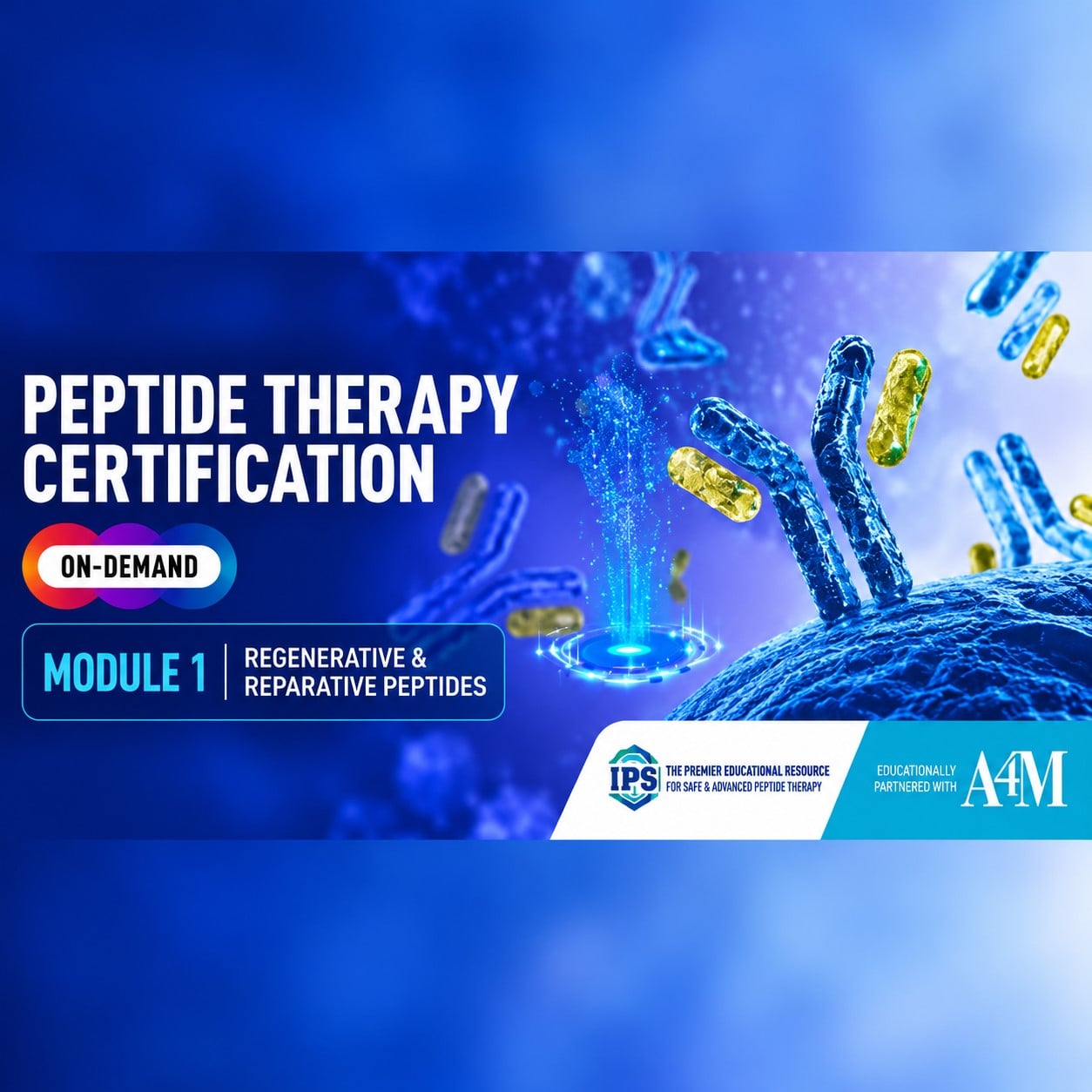
A4M Peptide Therapy Certification – On-Demand – 2026 – Module I: Regenerative & Reparative Peptides
Original price was: $250.00.$200.00Current price is: $200.00.
Study the foundations of regenerative and reparative peptide medicine through A4M Module I. Topics include metabolic signaling, immune pathways, tissue repair, pharmaceutical quality and regulatory considerations. The listed package contains videos, subtitles and PDFs, with a curriculum intended for licensed healthcare practitioners.
Delivery Information: This Product is shared via google drive download link. Please use your correct Gmail address at checkout.
Please note: there are no CME points or certificate associated with this course.
Samples for Courses Can be found here: Free Samples Here!
Regenerative and Reparative Peptides
A4M’s Module I examines regenerative and reparative peptides and their scientific basis for licensed healthcare practitioners. The lectures connect metabolic signaling, immune regulation and tissue biology with pharmaceutical quality, regulatory distinctions and clinical assessment. Topics range from body composition and glucose regulation to gut health, cellular senescence, hormone receptors and neuroinflammation. The program also considers nutrition, exercise and other lifestyle factors alongside emerging peptide research.
The listed package contains videos, subtitles and PDFs. The timetable below describes the source program, rather than a verified runtime of the supplied files. Module I is part of a two-module provider certification pathway; this purchase does not include A4M registration, membership, examinations or learning-platform access.
Learning Objectives
After completing the educational program, participants should be better able to:
- Explain the fundamentals of peptide science and its relationship to metabolic signaling, immune regulation, endocrine function, and tissue biology.
- Recognize the regulatory distinctions between FDA-approved peptide medications, investigational compounds, and compounded preparations.
- Discuss pharmaceutical quality assurance, sterile manufacturing, product integrity, and related patient safety concerns.
- Apply individualized clinical assessment principles when evaluating proposed peptide-related treatment approaches.
- Review the role of nutrition, exercise, sleep, and lifestyle factors in metabolic and regenerative medicine.
- Evaluate contemporary research involving body composition, insulin regulation, and peptide-related metabolic pathways.
- Describe the relationship between gut barrier biology, inflammation, and immune modulation.
- Critically assess scientific evidence involving regenerative and reparative peptides.
- Review the physiological pathways associated with growth hormone signaling and related compounds.
- Explain fundamental concepts involving cellular senescence, DNA damage, telomere biology, and aging research.
- Review peptide-related research involving neuroinflammation, autoimmune mechanisms, and central nervous system signaling.
- Integrate principles of evidence appraisal, clinical safety, regulatory compliance, and patient communication into professional decision-making.
Official Faculty
The published 2026 Module I faculty includes:
- Anthony J. Campbell, PharmD, BCSCP
- Tyler Chamberlain, PharmD, FAPC
- Gordon Crozier, DO
- Marisol Duque, MD
- James LaValle, RPh, CCN, MT, DHM, DHPh
- Stephanie Mazurek, PharmD
- Kathleen O’Neil-Smith, MD, FAARM
- Erika Schwartz, MD
- Christopher Shade, PhD
The faculty include physicians, pharmacists, and researchers involved in peptide medicine, pharmaceutical quality, regenerative medicine, metabolism, and clinical education.
Module I Course Content
| Lecture | Duration |
|---|---|
| Peptides Overview: Controlling Metaflammation, Metabolic Signaling & Clinical Value | 1 hr |
| FDA, Quality Assurance & State-to-State Status | 1.5 hr |
| Manufacturing of Sterile Product Quality Control — Parts I & II | 2 hrs |
| Personalized Peptide Protocols | 0.5 hr |
| Integrating Peptides into Clinical Practice | 1 hr |
| Global Lifestyle Considerations in Peptide Medicine | 1.5 hr |
| SARMs: Science & Controversy | 1 hr |
| Body Composition & Metabolism | 2.5 hrs |
| Immune Modulation & Gut Repair | 1.5 hr |
| Liposomal Oral Peptides | 0.5 hr |
| Peptides in Glucose & Insulin Regulation | 1 hr |
| Peptides & Bioregulators | 1 hr |
| Connective Tissue & Organ Repair | 1.5 hr |
| Cellular Senescence, DNA Damage & Telomeres | 1 hr |
| Hormone Signaling & Receptor Modulation | 2 hrs |
| Brain Inflammation & Autoimmune | 1 hr |
| Patient Case Panel | 1 hr |
Related products
Internal Medicine
Harvard Updates in General Internal Medicine for Specialists 2022
Cardiology
Endocrine and Nutrition
Harvard Testosterone Therapy and Sexual Dysfunction February 2023
Endocrine and Nutrition
Endocrine and Nutrition