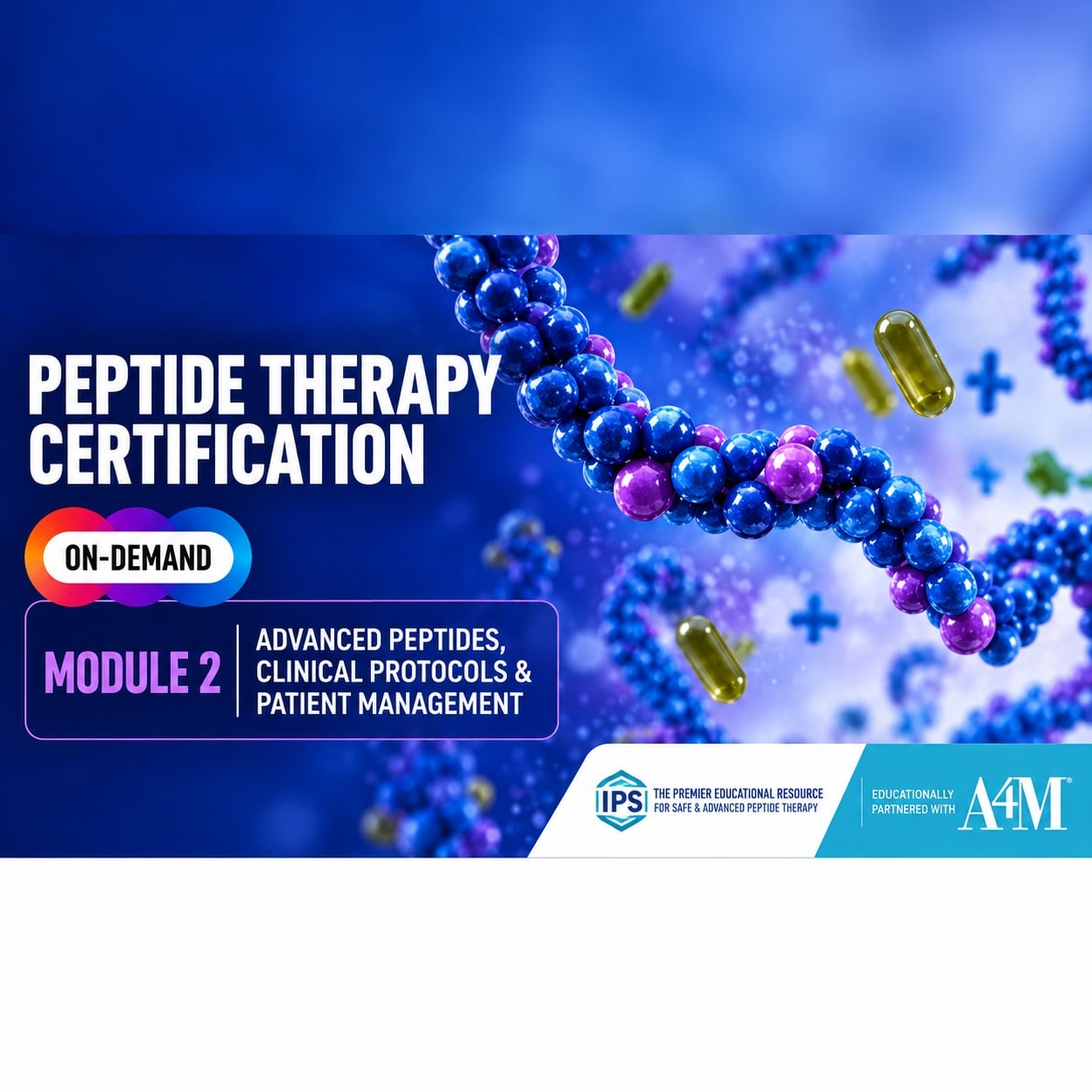
A4M Peptide Therapy Certification – On-Demand – 2026 – Module II: Clinical Peptide Applications by Domain


Original price was: $250.00.$200.00Current price is: $200.00.
Explore A4M’s 2026 Module II curriculum on clinical peptide applications, from laboratory assessment and biological aging to neurocognitive, metabolic and aesthetic topics. Listed materials include videos, subtitles and course PDFs. The original session table shows scheduled durations; provider certification and platform access are not included.
Delivery Information: This Product is shared via google drive download link. Please use your correct Gmail address at checkout.
Please note: there are no CME points or certificate associated with this course.
Samples for Courses Can be found here: Free Samples Here!
A4M Peptide Therapy Module II 2026: Overview
A4M Peptide Therapy Module II 2026 examines clinical applications by domain, including laboratory assessment, biological aging, neurocognitive topics, metabolic health and aesthetic practice. The program combines lectures, procedure demonstrations and cases, with discussions of regenerative medicine and emerging therapies.
It is intended for licensed healthcare practitioners studying these areas. The listed package includes Module II videos, subtitle files and course PDFs; exact file counts are not specified. The original session table below provides the listed teaching durations, rather than a verified runtime of the delivered files.
Scope: Course coverage does not establish that a compound is approved or appropriate for treatment. Provider enrollment, membership, assessments and the two-module certification pathway are separate from this purchase.
Learning Objectives
After completing the original educational program, participants should be better able to:
- Understand the legal and regulatory landscape of peptides and regenerative therapies.
- Discuss biological aging, epigenetics, methylation, telomere biology, and their relevance to research on healthy aging.
- Evaluate nutritional and lifestyle considerations that may influence metabolic health and regenerative medicine outcomes.
- Apply individualized clinical assessment frameworks, including A4M’s TRIAD model, to evaluate patient needs and treatment considerations.
- Interpret baseline laboratory findings relevant to metabolic, hormonal, and physiological assessment.
- Distinguish between FDA-approved peptide medications, off-label applications, compounded products, and investigational compounds.
- Evaluate clinical and preclinical evidence involving neurocognitive peptides and central nervous system research.
- Review current scientific understanding of cellular senescence, mitochondrial biology, and senolytic research.
- Examine the clinical evidence and regulatory considerations associated with PRP, exosomes, peptides, and other regenerative medicine approaches.
- Review established GLP-1 therapies and emerging multi-receptor agonists in metabolic medicine and weight management.
- Discuss peptide-related research in skin biology, aesthetic medicine, hair restoration, and tissue repair.
- Recognize potential adverse effects, contraindications, interactions, and uncertainties associated with peptide-related products.
- Evaluate new peptide and small-molecule therapies using appropriate scientific and clinical evidence.
- Apply principles of patient counseling, informed consent, safety monitoring, and individualized medical decision-making.
Official Faculty
The published Module II faculty includes:
- Joseph Cleaver, MD, FAARM, ABAARM
- Gordon Crozier, DO
- Marisol Duque, MD
- James LaValle, RPh, CCN, MT, DHM, DHPh
- Kathleen O’Neil-Smith, MD, FAARM
Additional Non-CME Presenter:
- Ben Greenfield
The program combines perspectives from clinicians, pharmacists, and professionals involved in peptide medicine, regenerative therapies, metabolic health, and longevity research.
Module II Course Content
| Lecture | Duration |
|---|---|
| Baseline Lab Testing for Targeted Peptide Therapies | 2 hrs |
| Peptides, Telomeres & Markers of Biological Age | 1.5 hrs |
| Peptide Bioregulators | 1.5 hrs |
| Biohacker Insights on Peptide Therapies | 0.5 hr |
| Neurotherapy & Peptides | 2 hrs |
| Cellular Senescence & Peptide Therapy | 0.5 hr |
| PRP, Exosomes & Peptides in Regenerative Medicine | 2 hrs |
| Practical Approach & Procedure Demonstration | 1.5 hrs |
| Clinical Cases | 1 hr |
| Everything Face & Youth | 2 hrs |
| PRP, Peptides & Compounds for Skin Restoration | 1.5 hrs |
| Peptides & Hair Replacement | 1 hr |
| GLP-1s & Introduction of Retatrutide | 1 hr |
| Future of Peptides & Small-Molecule Therapies | 1 hr |
Who Is This Course For?
Designed for licensed healthcare practitioners interested in advanced peptide therapy, longevity and anti-aging medicine, regenerative medicine, functional medicine, metabolic health, aesthetics, neurotherapy, and clinical optimization.
Related products
Internal Medicine
Endocrine and Nutrition
Cardiology
Endocrine and Nutrition
Harvard The Blackburn Course in Obesity Medicine Treating Obesity 2023
Endocrine and Nutrition
Endocrine and Nutrition

Endocrine and Nutrition
Comprehensive Care for Persons with Diabetes 2022: A Certificate Program