
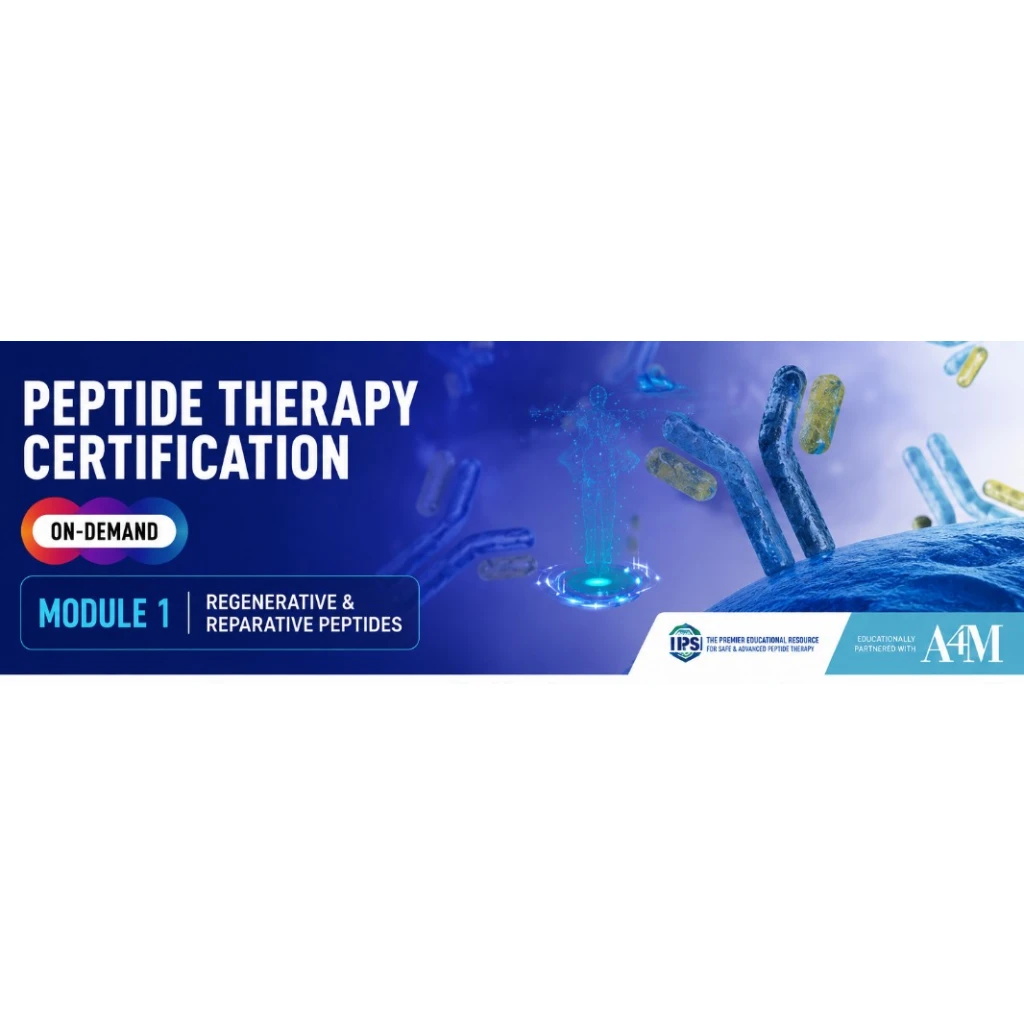
American Academy of Anti-Aging Medicine Peptide Therapy Certification – Module I 2026
$250.00
A4M Peptide Therapy Module I 2026 covers peptide science, evidence appraisal, product quality, metabolic signaling and clinical context. Review the detailed curriculum and faculty below. The MedicalAmboss file purchase provides no CME points or certificate; it does not complete the official certification pathway.
Delivery Information: This Product is shared via google drive download link. Please use your correct Gmail address at checkout.
Please note: there are no CME points or certificate associated with this course.
Samples for Courses Can be found here: Free Samples Here!
A4M Peptide Therapy Module I 2026 brings together the curriculum, faculty and subject areas listed below. Compare the program with your learning needs and check the sample for the files supplied with this purchase.
A4M Peptide Therapy Certification – Module I 2026
Regenerative & Reparative Peptides
Peptide Medicine • Metabolic Signaling • Regenerative Medicine • Immune Modulation • Hormone Signaling • Longevity Science
Explore contemporary peptide science, regulatory considerations, metabolic signaling, regenerative medicine concepts, and clinical integration with the A4M Peptide Therapy Certification – Module I 2026: Regenerative & Reparative Peptides.
Presented by the American Academy of Anti-Aging Medicine (A4M), this advanced on-demand educational module is designed specifically for licensed healthcare practitioners seeking structured education in peptide medicine and related areas of regenerative and metabolic medicine.
The 2026 Module I curriculum combines:
- Peptide science
- Strength-of-evidence assessment
- Regulatory and legal considerations
- FDA and state-level status
- Pharmaceutical quality assurance
- Sterile product manufacturing
- Personalized clinical assessment
- Nutrition and lifestyle integration
- Metabolic signaling
- Body composition
- Glucose and insulin regulation
- Immune modulation
- Gut biology
- Tissue repair and recovery
- Cellular senescence
- Hormone receptor signaling
- Brain inflammation
- Patient case discussions
The course emphasizes understanding the science, evidence, quality, regulatory status, and clinical context surrounding peptide-related interventions rather than viewing every peptide as having equivalent evidence or regulatory standing.
Course Details
- Course: Peptide Therapy Certification – Module I
- Module: Regenerative & Reparative Peptides
- Provider: American Academy of Anti-Aging Medicine – A4M
- Year: 2026
- Format: On-Demand
- Estimated Scheduled Instruction: Approximately 21.5 Hours
- Primary Focus: Peptide Medicine
- Additional Focus: Regenerative Medicine / Metabolic Health / Longevity Science
- Audience: Licensed Healthcare Practitioners
- Certification Structure: Two Modules Required
- Module I Alone: Does Not Complete the Full A4M Peptide Therapy Certification
- A4M / International Peptide Society Membership: Required for Certification
Important Certification Requirement
The A4M Peptide Therapy Certification is presented as a two-module program.
To satisfy A4M’s certification pathway, participants must complete:
Module I + Module II
and meet the organization’s applicable membership and eligibility requirements.
Therefore, Module I should not be described as providing the complete A4M Peptide Therapy Certification by itself.
Module I is one component of the provider’s certification pathway. This MedicalAmboss file purchase does not enroll the buyer in that pathway.
Program Overview
Peptides are short chains of amino acids involved in many biological signaling pathways.
Depending on the molecule, peptide-related signaling can influence areas such as:
- Metabolism
- Hormone pathways
- Immune signaling
- Cellular communication
- Tissue biology
- Appetite regulation
- Glucose homeostasis
- Inflammation
- Neuroendocrine pathways
However, the evidence and regulatory status vary substantially among individual products.
The 2026 A4M curriculum therefore includes not only potential clinical applications but also dedicated education in:
FDA Status → Legal Considerations → Quality Assurance → Sterile Manufacturing → Strength of Evidence → Clinical Integration
Official Module I Faculty
The 2026 Module I faculty includes:
- Anthony J. Campbell, PharmD, BCSCP
- Tyler Chamberlain, PharmD, FAPC
- Gordon Crozier, DO
- Marisol Duque, MD
- James LaValle, RPh, CCN, MT, DHM, DHPh
- Stephanie Mazurek, PharmD
- Kathleen O’Neil-Smith, MD, FAARM
- Erika Schwartz, MD
- Christopher Shade, PhD
The multidisciplinary faculty includes physicians, pharmacists, researchers, and clinicians involved in integrative and regenerative medicine education.
OFFICIAL MODULE I CURRICULUM
1. Peptides Overview: Controlling Metaflammation, Metabolic Signaling & Clinical Value
Faculty: James LaValle, RPh, CCN, MT, DHM, DHPh
Duration: 1 Hour
Introduces peptide-related biological signaling and discusses their place within metabolic and inflammatory medicine.
Major themes include:
- Peptide signaling
- Metabolic pathways
- Metaflammation
- Clinical evidence
- Patient selection
- Translational considerations
Metaflammation
Metaflammation refers to chronic low-grade inflammatory signaling associated with metabolic dysfunction.
The course examines the relationship among:
Metabolism → Inflammatory Signaling → Cellular Function → Clinical Phenotype
2. FDA, Quality Assurance, and State-to-State Status: Where Are We Now and Where Is It Going?
Faculty: Tyler Chamberlain, PharmD, FAPC
Duration: 1.5 Hours
This is one of the most important sessions in the program.
Topics include:
- FDA regulatory status
- Compounding considerations
- Quality assurance
- State-specific regulatory issues
- Legal considerations
- Changes in peptide availability
- Clinical responsibility
Regulatory Landscape of Peptide Medicine
Not all substances described as peptides have the same regulatory status.
Clinicians must distinguish among:
- FDA-approved drugs
- Investigational products
- Compounded preparations
- Products with limited clinical evidence
- Products subject to regulatory restrictions
The appropriate question is not simply:
“Can this peptide be obtained?”
but:
“What is its regulatory status, evidence base, quality profile and legally appropriate use?”
3. Manufacturing of Sterile Product Quality Control: Understanding the “For Human Use Difference”
Faculty: Anthony Campbell, PharmD, BCSCP
Duration: 1 Hour
Reviews pharmaceutical quality principles relevant to sterile products intended for human use.
4. Manufacturing of Sterile Product Quality Control – Continued
Faculty: Anthony Campbell, PharmD, BCSCP
Duration: 1 Hour
Continues the discussion of:
- Sterile manufacturing
- Quality control
- Product integrity
- Pharmaceutical standards
- Patient safety considerations
Quality Matters
For injectable or sterile preparations, product quality cannot be separated from clinical safety.
Important issues can include:
- Sterility
- Purity
- Manufacturing controls
- Potency
- Contamination
- Storage
- Handling
- Source verification
5. Personalized Peptide Protocols: Integrating Nutrition, Exercise & Lifestyle for Optimal Outcomes
Faculty: Stephanie Mazurek, PharmD
Duration: 30 Minutes
Examines the broader clinical context in which peptide-related therapies may be discussed.
The session integrates:
- Nutrition
- Exercise
- Lifestyle
- Patient assessment
- Treatment planning
Personalized Medicine
The curriculum emphasizes that a treatment plan should not be based simply on selecting a peptide from a list.
Clinical planning requires consideration of:
- Patient history
- Objectives
- Comorbidities
- Medications
- Laboratory findings
- Nutrition
- Physical activity
- Sleep
- Risk factors
6. Integrating Peptides into Clinical Practice
Faculty: Erika Schwartz, MD
Duration: 1 Hour
Reviews practical issues surrounding incorporation of peptide-related education into clinical workflows.
Areas can include:
- Patient assessment
- Clinical decision-making
- Evidence evaluation
- Monitoring
- Practice implementation
7. Global Lifestyle Considerations in Peptide Medicine
Faculty: James LaValle, RPh, CCN, MT, DHM, DHPh
Duration: 1.5 Hours
Places peptide medicine within a broader lifestyle framework.
The session emphasizes the interaction among:
- Nutrition
- Exercise
- Sleep
- Stress
- Metabolism
- Individual biology
8. SARMs – What Are They? The Science and Controversy
Faculty: James LaValle, RPh, CCN, MT, DHM, DHPh
Duration: 1 Hour
Reviews Selective Androgen Receptor Modulators – SARMs.
Importantly:
SARMs are not peptides.
They are included because of their overlap with discussions surrounding:
- Body composition
- Performance
- Muscle biology
- Hormone signaling
The session specifically addresses their scientific and clinical controversy.
9. Body Composition and Metabolism
Faculty: Gordon Crozier, DO
Duration: 2.5 Hours
A major portion of Module I is devoted to metabolic health.
Topics relate to:
- Body composition
- Metabolic regulation
- Energy balance
- Insulin signaling
- Hormonal pathways
- Clinical assessment
Metabolic Health
Body composition cannot be understood through body weight alone.
Important parameters may include:
- Adiposity
- Visceral fat
- Skeletal muscle
- Insulin sensitivity
- Metabolic biomarkers
- Hormonal status
- Lifestyle
10. All Roads of Health Lead to Immune Modulation and Gut Repair
Faculty: James LaValle, RPh, CCN, MT, DHM, DHPh
Duration: 1.5 Hours
Explores interactions among:
- Gut biology
- Immune signaling
- Inflammation
- Metabolism
- Barrier function
Gut–Immune Interaction
The gastrointestinal system has important relationships with:
- Immune regulation
- Metabolic signaling
- Inflammatory pathways
- Nutrient handling
The course discusses peptide-related concepts within this broader systems framework.
11. Liposomal Oral Peptides: Precision Tools for Immune Regulation, Tissue Repair and Longevity Optimization
Faculty: Christopher Shade, PhD
Duration: 30 Minutes
Credit Status: Non-CME session
Reviews oral delivery and liposomal approaches within peptide-related medicine.
This session is explicitly identified by A4M as Non-CME.
12. The Role of Peptides in Glucose and Insulin Regulation – Balancing the Seesaw
Faculty: James LaValle, RPh, CCN, MT, DHM, DHPh
Duration: 1 Hour
Examines metabolic signaling involving:
- Glucose regulation
- Insulin
- Metabolic health
- Peptide-related pathways
GLP-1 and Metabolic Signaling
The official curriculum discusses metabolic peptide-related therapies, including established incretin-based pharmacology.
It is important to distinguish these approved therapeutic classes from investigational or unapproved peptide compounds.
Different compounds have very different:
- Regulatory status
- Clinical evidence
- Safety profiles
- Approved indications
13. What’s New? Peptides and Bioregulators
Faculty: James LaValle, RPh, CCN, MT, DHM, DHPh
Duration: 1 Hour
Explores emerging developments involving:
- Peptide signaling
- Bioregulators
- Experimental concepts
- New research
Because this field evolves rapidly, evidence strength and regulatory status should be evaluated individually.
14. Optimize the Body to Heal from Injury: Connective Tissue Organ Repair
Faculty: Kathleen O’Neil-Smith, MD, FAARM
Duration: 1.5 Hours
Examines the biology of:
- Injury
- Recovery
- Connective tissue
- Tissue repair
- Regenerative signaling
The session discusses peptide-related approaches within this emerging area.
Regenerative & Reparative Peptides
A4M groups several compounds under its Regenerative & Reparative Peptides category.
Examples discussed by A4M include:
- BPC-157
- Thymosin Beta-4 / related compounds
- KPV
- RGN-259
These substances do not all have equivalent evidence or regulatory approval.
For SEO and product-description purposes, the appropriate wording is:
“The course discusses…”
rather than:
“These therapies are proven to…”
15. Cellular Senescence: DNA Damage, Telomeres & Zombie Cells
Faculty: Kathleen O’Neil-Smith, MD, FAARM
Duration: 1 Hour
Reviews emerging longevity science involving:
- Cellular senescence
- DNA damage
- Telomere biology
- Senescent cells
- Aging pathways
Cellular Senescence
Senescent cells remain metabolically active but have undergone important functional changes.
Research is examining their relationship with:
- Aging
- Chronic inflammation
- Tissue dysfunction
- Age-associated disease
Senolytics
The broader A4M certification objectives include the emerging science of:
Senolytics
These are strategies being investigated for selectively targeting senescent cells.
This remains an evolving research field, and clinical claims should reflect the actual evidence for the specific agent being discussed.
16. Hormone Signaling and Hormone Receptor Modulation
Faculty: Marisol Duque, MD
Duration: 2 Hours
Examines interactions among:
- Peptide signaling
- Hormones
- Hormone receptors
- Neuroendocrine pathways
- Metabolic regulation
Growth Hormone Axis
The official Module I material discusses compounds and signaling pathways involving:
- GHRH
- GH
- IGF-1
- Growth-hormone secretagogue pathways
Regulatory status differs substantially among individual compounds.
Hormone Optimization vs. Evidence-Based Endocrinology
The phrase hormone optimization is commonly used in longevity and integrative medicine.
However, treatment decisions should remain based on:
- Established diagnosis
- Valid clinical indications
- Appropriate testing
- Regulatory status
- Evidence
- Risk-benefit assessment
17. Intro to Brain Inflammation and Autoimmune
Faculty: Kathleen O’Neil-Smith, MD, FAARM
Duration: 1 Hour
Introduces concepts involving:
- Neuroinflammation
- Immune signaling
- Autoimmune mechanisms
- Brain health
- Peptide-related research
Neuroprotective & Cognitive Peptides
The broader A4M Module I framework lists compounds associated with research into:
- Neuroimmune modulation
- Cognition
- Mood
- Neuroprotection
Examples appearing in the A4M curriculum include:
- VIP
- Selank
- PE-22-28
- PT-141
These should be described according to their individual evidence and regulatory status rather than collectively as established treatments for cognitive disorders.
18. Patient Case Panel
Faculty: Led by James LaValle, RPh, CCN, MT, DHM, DHPh
Duration: 1 Hour
The Module I curriculum concludes with case-based discussion designed to integrate:
- Patient assessment
- Metabolic health
- Laboratory findings
- Lifestyle
- Clinical reasoning
- Regulatory considerations
- Therapeutic decision-making
Key Peptide Categories Discussed by A4M
The official 2026 Module I page organizes peptide-related content into several broad groups.
Regenerative / Reparative
- BPC-157
- Thymosin Beta-4
- KPV
- RGN-259
Neurocognitive
- VIP
- Selank
- PE-22-28
- PT-141
Growth Hormone Axis
- CJC-1295 / Ipamorelin
- Sermorelin
- Tesamorelin
- Other GHRH-related signaling
Energy & Metabolism
- MOTS-c
- Ghrelin-related signaling
- Macimorelin
Metabolic Regulation
- GLP-1-related therapies
Immune Modulation
- Thymosin Alpha-1
- KPV
- VIP
- Adjunctive compounds discussed in the curriculum
Mitochondrial / Signaling Support
- NR
- IRW
- LRP / LQP
- Related adjunctive compounds
Evidence & Regulatory Status
One of the most important aspects of peptide medicine is recognizing that the term “peptide” includes very different categories of substances.
They can range from:
FDA-Approved Prescription Therapies
to:
Investigational Compounds
to:
Compounded Substances with Regulatory Restrictions or Safety Concerns
Therefore, the course should not be marketed as if every molecule discussed is:
- FDA approved
- Proven effective
- Appropriate for routine prescribing
- Legally available in every jurisdiction
Peptide Quality Assurance
The 2026 curriculum places unusually strong emphasis on:
- FDA status
- State law
- Sterile manufacturing
- Pharmaceutical quality
- Compounding
- Human-use standards
Stem Cells and Exosomes – Important Scope Clarification
The broader A4M Peptide Therapy Certification objectives mention:
- Stem cells
- Exosomes
- Other regenerative therapies
However, the current 2026 Module I schedule does not contain a dedicated stem-cell or exosome lecture.
A dedicated session combining:
PRP + Exosomes + Peptides
appears in Module II.
Therefore, Module I should not be marketed as a comprehensive stem-cell or exosome course.
Who Should Take This Course?
A4M states that enrollment in the Peptide Therapy Certification is limited to:
Licensed Healthcare Practitioners
The program may be relevant to clinicians interested in:
- Peptide Medicine
- Integrative Medicine
- Functional Medicine
- Metabolic Medicine
- Longevity Medicine
- Regenerative Medicine
- Endocrine / Hormonal Signaling
- Sports / Recovery Medicine
- Aesthetic Medicine
- Clinical Pharmacology
Potential audiences include appropriately licensed:
- Physicians
- Osteopathic Physicians
- Pharmacists
- Nurse Practitioners
- Physician Assistants / Associates
- Other healthcare professionals meeting A4M eligibility requirements
Why This Module Is Useful
Module I is particularly valuable because it does not focus exclusively on individual peptide names.
It includes broader practical areas such as:
- Legal landscape
- FDA status
- State regulations
- Sterile manufacturing
- Quality assurance
- Evidence evaluation
- Metabolic assessment
- Lifestyle integration
- Patient personalization
- Gut and immune biology
- Glucose regulation
- Tissue repair
- Cellular senescence
- Hormone signaling
- Neuroinflammation
- Case-based clinical reasoning
The educational pathway can be summarized as:
Science → Evidence → Regulation → Product Quality → Patient Assessment → Clinical Integration
Important Educational & Regulatory Notice
This is an educational program for licensed healthcare professionals.
Discussion of a peptide, drug, biologic, exosome product, stem-cell product, or other regenerative therapy within the course:
does not by itself establish FDA approval, safety, effectiveness, or legal availability for a particular clinical use.
Clinicians should independently verify:
- FDA approval status
- Applicable federal law
- State regulations
- Compounding rules
- Evidence quality
- Product source
- Patient-specific indications and risks
before clinical use.
Product Summary
- Product: A4M Peptide Therapy Certification – Module I
- Subtitle: Regenerative & Reparative Peptides
- Provider: American Academy of Anti-Aging Medicine – A4M
- Year: 2026
- Format: On-Demand
- Scheduled Content: Approximately 21.5 Hours
- Primary Focus: Peptide Medicine
- Additional Areas: Metabolism / Regenerative Medicine / Immune Modulation / Hormone Signaling / Longevity
- Eligibility: Licensed Healthcare Practitioners
- Certification: Requires Modules I & II plus applicable A4M/IPS requirements
Module I at a Glance
A4M Peptide Therapy Certification – Module I 2026: Regenerative & Reparative Peptides provides advanced on-demand education for licensed healthcare practitioners interested in contemporary peptide medicine.
The curriculum covers peptide signaling, FDA and state regulatory status, pharmaceutical quality assurance, sterile manufacturing, personalized clinical assessment, nutrition and lifestyle integration, body composition, glucose and insulin regulation, immune modulation, gut biology, connective-tissue repair, cellular senescence, hormone signaling, neuroinflammation, and patient cases.
The program also reviews emerging peptide categories related to regenerative medicine, metabolic regulation, growth-hormone signaling, immune pathways and longevity research, with emphasis on the differing evidence and regulatory status of individual compounds.
+ Topics:
- Peptides Overview: Controlling Metaflammation, Metabolic Signaling & Clinical Value — 1 hr
- FDA, Quality Assurance & State-to-State Status — 1.5 hr
- Manufacturing of Sterile Product Quality Control — Parts I & II — 2 hrs
- Personalized Peptide Protocols — 0.5 hr
- Integrating Peptides into Clinical Practice — 1 hr
- Global Lifestyle Considerations in Peptide Medicine — 1.5 hr
- SARMs: Science & Controversy — 1 hr
- Body Composition & Metabolism — 2.5 hrs
- Immune Modulation & Gut Repair — 1.5 hr
- Liposomal Oral Peptides — 0.5 hr
- Peptides in Glucose & Insulin Regulation — 1 hr
- Peptides & Bioregulators — 1 hr
- Connective Tissue & Organ Repair — 1.5 hr
- Cellular Senescence, DNA Damage & Telomeres — 1 hr
- Hormone Signaling & Receptor Modulation — 2 hrs
- Brain Inflammation & Autoimmune — 1 hr
- Patient Case Panel — 1 hr
Program Reference and Delivery
Compare the module outline with the official A4M 2026 program. Official enrollment and certification arrangements are separate from the retailer’s files. The scheduled teaching duration is not an independently verified runtime of the delivered package.
Product Summary
Primary Category: Endocrine and Nutrition
Secondary Category: Internal Medicine
Meta Description: A4M Peptide Therapy Module I 2026: review the curriculum, faculty, quality assurance and metabolic topics. Check file delivery and certification terms.
Related products

Endocrine and Nutrition

Endocrine and Nutrition
Endocrine and Nutrition
Nephrology / Urology
Endocrine and Nutrition
Cardiology