
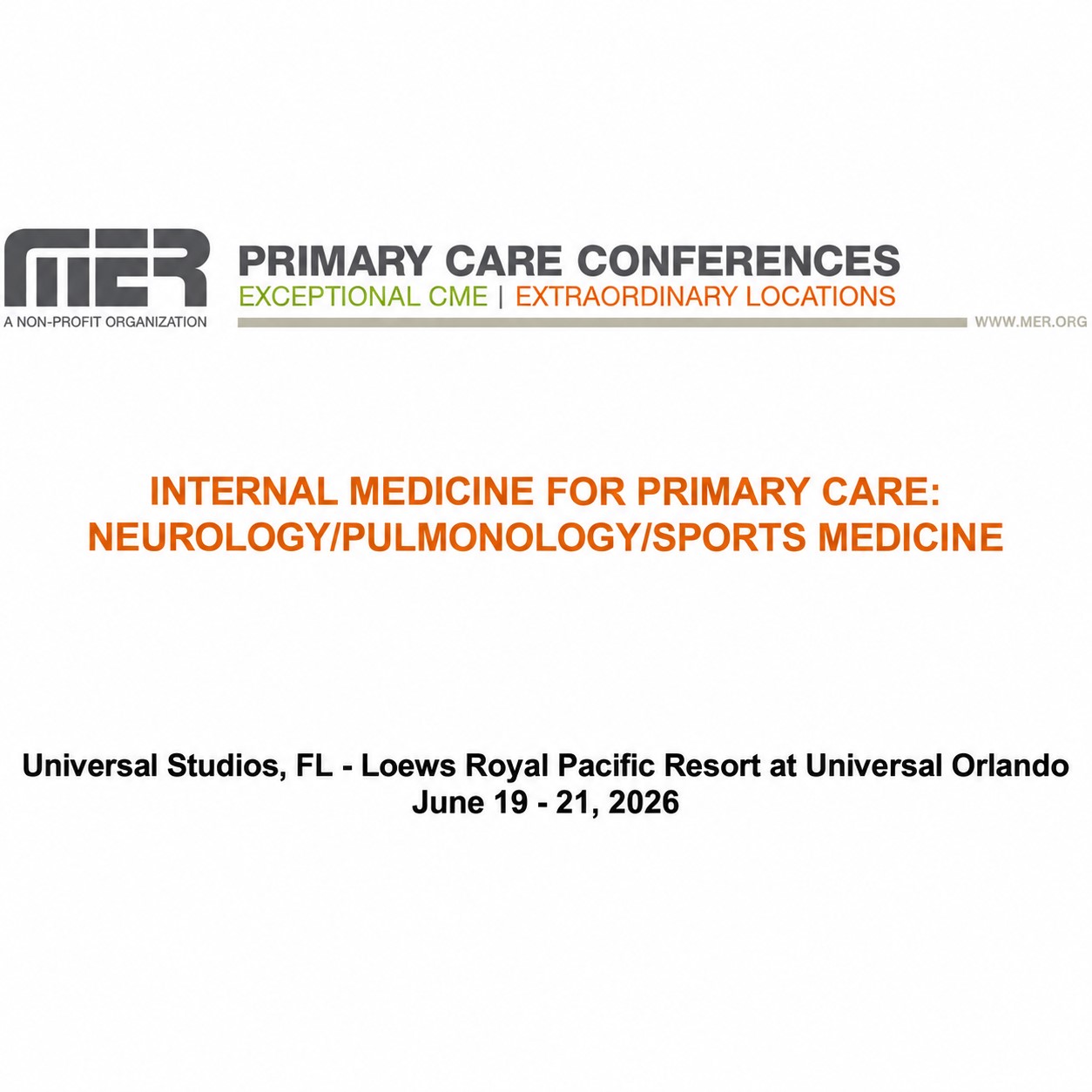
MER Primary Care Conferences Internal Medicine for Primary Care Neuro Pulm Sports Med Jun 19-21, 2026
$100.00
This Product is shared via google drive download link, So please share your correct Gmail id while placing the order .Please note that there are no CME points or certificate associated with this course Samples for Courses Can be found here : Free Samples Here!
MER Internal Medicine for Primary Care: Neuro/Pulm/Sports Med 2026
Neurology • Pulmonology • Sports Medicine | June 19–21, 2026
Strengthen your practical approach to common neurological, pulmonary, and sports medicine problems with MER Internal Medicine for Primary Care: Neuro/Pulm/Sports Med 2026.
Organized by Medical Education Resources (MER), this multidisciplinary primary care program combines clinically relevant updates in Neurology, Pulmonology, and Sports Medicine.
The original conference was held June 19–21, 2026, at Loews Royal Pacific Resort at Universal Orlando in Universal Studios, Florida.
The curriculum focuses on common clinical problems encountered by internists and primary care clinicians, including:
- Neurological weakness
- Alzheimer’s disease and dementia
- Headaches and migraines
- Dizziness and vertigo
- Asthma
- Respiratory infections
- COPD
- Lung cancer screening
- Pulmonary nodules
- Sports-related concussion
- Pre-participation sports examinations
- Relative Energy Deficiency in Sport – RED-S
- Exercise prescription
The course emphasizes practical evaluation, differential diagnosis, evidence-based management, risk assessment, and appropriate referral.
Course Details
- Course: Internal Medicine for Primary Care: Neuro/Pulm/Sports Med
- Provider: Medical Education Resources – MER
- Year: 2026
- Dates: June 19–21, 2026
- Venue: Loews Royal Pacific Resort at Universal Orlando
- Location: Universal Studios, Florida
- Primary Specialty: Internal Medicine / Primary Care
- Additional Specialties: Neurology / Pulmonology / Sports Medicine
- Original Live Activity: 12 Credit Hours
- Language: English
Course Overview
Primary care physicians frequently evaluate patients presenting with symptoms that overlap multiple specialties.
A patient may present with:
- Weakness
- Memory loss
- Headache
- Vertigo
- Shortness of breath
- Chronic cough
- Wheezing
- Exercise intolerance
- Sports-related head injury
- Pulmonary nodules
- Musculoskeletal or exercise-related concerns
This MER program brings together Neurology, Pulmonology, and Sports Medicine to provide a structured review of these common clinical problems.
The curriculum progresses through:
Neurological Evaluation → Pulmonary Disease → Sports Medicine & Exercise
with emphasis on practical application in office-based medicine.
Learning Objectives
Upon completion of this program, participants should be better able to:
- Utilize history and physical examination to distinguish true neurological weakness from nonspecific symptoms.
- Discuss evidence-based management approaches for Alzheimer’s disease and other dementias.
- Develop an appropriate differential diagnosis for headaches and migraines.
- Recognize important disorders presenting with dizziness or vertigo.
- Diagnose and manage patients with asthma.
- Apply current evidence-based approaches to common respiratory tract infections.
- Review contemporary management strategies for COPD.
- Apply current approaches to lung cancer screening and pulmonary nodule evaluation.
- Recognize the signs and symptoms of sports-related concussion and mild traumatic brain injury.
- Understand appropriate evaluation and return-to-play considerations following concussion.
- Review the components of the pre-participation sports physical.
- Identify risk factors for Relative Energy Deficiency in Sport – RED-S.
- Understand the relationship between nutrition, exercise, and athlete health.
- Develop appropriate exercise prescriptions for patients with different levels of health and physical activity.
MER Internal Medicine for Primary Care 2026 Course Content
Day 1 – June 19, 2026
1. Neurology – Evaluating Weakness
This session provides a practical approach to patients presenting with weakness.
The course emphasizes the importance of distinguishing true neurological weakness from nonspecific symptoms such as:
- Fatigue
- Generalized tiredness
- Exercise intolerance
- Malaise
Topics Include
- History taking
- Neurological physical examination
- Patterns of weakness
- Neurological localization
- Representative nervous system diseases
- Differential diagnosis
A structured clinical assessment helps determine whether weakness originates from:
- Central nervous system disease
- Peripheral nerve disease
- Neuromuscular junction disorders
- Muscle disease
- Systemic or non-neurological conditions
2. Neurology – Alzheimer’s & Other Dementias
A comprehensive review of cognitive decline and dementia.
Topics Include
- Definition of dementia
- Epidemiology
- Neurological changes associated with normal aging
- Alzheimer’s disease
- Neuropathology
- Etiological theories
- Vascular dementia
- Diagnostic investigations
- Social considerations
- Symptomatic treatment
- Emerging and investigational therapies
Evaluating Cognitive Decline
Cognitive complaints should not automatically be attributed to Alzheimer’s disease.
Potential considerations include:
- Alzheimer’s disease
- Vascular cognitive impairment
- Medication effects
- Depression
- Sleep disorders
- Metabolic disease
- Other neurological disorders
The lecture helps primary care clinicians approach dementia systematically and recognize when specialist referral may be appropriate.
3. Neurology – Headaches & Migraines
Headache is one of the most common neurological complaints in primary care.
This session reviews:
- Basic headache mechanisms
- Headache history
- Precipitating factors
- Relevant medical conditions
- Migraine
- Tension-type headache
- Cluster headache
- Sinus-related headache
- Trigeminal neuralgia
- Giant cell arteritis
- Brain tumor
- Subarachnoid hemorrhage
- Emergency treatment considerations
Headache Differential Diagnosis
The program helps clinicians differentiate common primary headache disorders from potentially dangerous secondary causes.
A useful clinical framework is:
Migraine → Tension-Type Headache → Cluster Headache → Neuralgia → Vascular Disease → Intracranial Pathology
Recognizing headache red flags is essential when deciding whether urgent imaging or neurological evaluation is required.
4. Pulmonology – Asthma
A practical review of the diagnosis and treatment of asthma.
Topics Include
- Clinical impact of asthma
- Airway inflammation
- Airway remodeling
- Diagnosis
- Disease severity
- Treatment goals
- Mortality risk factors
- Acute asthma management
- Difficult-to-control asthma
- Long-term treatment strategies
Asthma Management
The program emphasizes matching treatment intensity to disease severity and clinical risk.
Important considerations include:
- Symptom frequency
- Exacerbation history
- Lung function
- Medication use
- Treatment adherence
- Environmental triggers
- Risk of severe exacerbation
5. Pulmonology – Controversies in the Treatment of Common Respiratory Infections
This session reviews evidence-based approaches to frequently encountered respiratory infections.
Topics Include
- Acute bronchitis
- Chronic bronchitis
- Community-acquired pneumonia
- Hospital-acquired pneumonia
- Pneumonia Severity Index
- Hospitalization decisions
- Appropriate antibiotic use
- Antibiotic resistance
- Current treatment guidance
Appropriate Antibiotic Use
An important objective is distinguishing patients who benefit from antimicrobial therapy from those who do not.
The course reviews clinical decision-making involving:
Diagnosis → Severity Assessment → Need for Antibiotics → Drug Selection → Outpatient vs Hospital Management
This is particularly relevant to antimicrobial stewardship in primary care.
Day 2 – June 20, 2026
6. Pulmonology – COPD
A comprehensive update on Chronic Obstructive Pulmonary Disease.
Topics Include
- COPD definition
- Pathophysiology
- Early detection
- Early intervention
- Risk reduction
- Smoking-related disease
- Current management
- Inhaled therapies
- Inhaled corticosteroids
- Domiciliary oxygen
- Lung volume reduction surgery
- Newer treatment approaches
COPD Management
COPD treatment involves more than prescribing inhalers.
A comprehensive approach may include:
- Smoking cessation
- Vaccination
- Bronchodilator therapy
- Selected inhaled corticosteroid therapy
- Pulmonary rehabilitation
- Oxygen in appropriate patients
- Exacerbation prevention
- Advanced interventions in selected patients
7. Pulmonology – Lung Cancer Screening & Pulmonary Nodules
This clinically important session reviews contemporary approaches to:
- Lung cancer screening
- Pulmonary nodules
- Incidental lung nodules
- Risk assessment
- Imaging follow-up
- Diagnostic evaluation
- Management
The course incorporates current concepts related to:
- Lung cancer screening recommendations
- Fleischner Society guidance
- American College of Chest Physicians recommendations
Pulmonary Nodule Evaluation
Pulmonary nodules are frequently identified incidentally on imaging.
Evaluation should consider:
- Patient age
- Smoking history
- Cancer risk
- Nodule size
- Nodule morphology
- Nodule growth
- Imaging findings
- Clinical history
The objective is to avoid both unnecessary invasive procedures and delayed diagnosis of clinically important malignancy.
8. Neurology – Dizziness & Vertigo
Dizziness is a common but challenging symptom.
The lecture reviews:
- Definition of dizziness
- Vertigo
- Physiological mechanisms
- Medical evaluation
- Neurological evaluation
- Laboratory assessment
- Acute vertigo
- Positional vertigo
- Ménière’s disease
- Acoustic neuroma
- Cerebellar hemorrhage
- Other causes of dizziness
Peripheral vs Central Vertigo
One of the major clinical decisions is distinguishing benign peripheral vestibular disease from potentially dangerous central neurological pathology.
Peripheral Causes May Include
- Benign positional vertigo
- Ménière’s disease
- Other vestibular disorders
Central Causes May Include
- Cerebrovascular disease
- Cerebellar disorders
- Other intracranial pathology
A careful neurological examination can help determine whether urgent evaluation is required.
9. Sports Medicine – Concussion in Sports
Recognition, Office Evaluation & Management for Primary Care
This session reviews mild traumatic brain injury and sports-related concussion, particularly in younger athletes.
Topics Include
- Definition of concussion
- Signs and symptoms
- Clinical significance
- Office evaluation
- Concussion severity
- Return-to-sport decisions
- Athlete monitoring
- Concussion management tools
- Modern concussion assessment recommendations
The course also discusses concepts arising from the 6th International Conference on Concussion in Sport – Amsterdam 2022, including tools such as:
- CRT6
- SCAT6
- SCOAT6
Return-to-Play Decisions
Returning an athlete to sport should be based on structured clinical assessment rather than symptom pressure from the athlete, family, or team.
Important considerations include:
- Symptom resolution
- Neurological assessment
- Cognitive recovery
- Graduated physical activity
- Risk of repeat injury
- Age of the athlete
10. Sports Medicine – The Pre-Participation Sports Physical
The pre-participation examination helps identify medical conditions that may affect safe athletic participation.
The session reviews recommendations related to:
- Medical history
- Cardiovascular screening
- Musculoskeletal examination
- Neurological assessment
- Previous injuries
- Exercise-related symptoms
- Clearance for participation
- Return-to-play decisions
The program incorporates contemporary concepts from the Preparticipation Physical Evaluation framework used by organizations including the American Academy of Pediatrics, American Academy of Family Physicians, and American Medical Society for Sports Medicine.
Day 3 – June 21, 2026
11. Sports Medicine – Nutritional Considerations for the Young Athlete
Relative Energy Deficiency in Sport – RED-S
This session focuses on the nutritional and metabolic health of physically active young patients.
Topics Include
- Nutrition for young athletes
- Energy requirements
- Exercise demands
- Problematic eating behaviors
- Excessive exercise
- Relative Energy Deficiency in Sport
- RED-S
- Bone health
- Early bone demineralization
- Recognition
- Prevention
- Management
What Is RED-S?
Relative Energy Deficiency in Sport occurs when energy intake is insufficient relative to the demands of exercise and normal physiological function.
Potential effects can extend beyond sports performance and may influence:
- Bone health
- Hormonal function
- Recovery
- Growth
- Metabolism
- General health
Early recognition is particularly important in adolescent and young adult athletes.
12. Sports Medicine – Exercise Prescriptions for Primary Care Practitioners
The final session focuses on the physician’s role in prescribing physical activity.
Topics Include
- Health risks of obesity
- Sedentary lifestyle
- Benefits of exercise
- Risks of exercise
- Exercise physiology terminology
- Patient risk stratification
- Exercise prescriptions
- Weight management
- Individualized exercise planning
Exercise as Medicine
Primary care clinicians can play an important role in promoting safe physical activity.
A structured exercise prescription may include:
Frequency + Intensity + Time + Type
along with individual consideration of:
- Cardiovascular risk
- Age
- Comorbidities
- Previous injuries
- Functional capacity
- Exercise goals
Major Neurology Topics Covered
- Neurological Examination
- Weakness
- Neurological Localization
- Alzheimer’s Disease
- Dementia
- Vascular Dementia
- Headache
- Migraine
- Tension Headache
- Cluster Headache
- Trigeminal Neuralgia
- Giant Cell Arteritis
- Dizziness
- Vertigo
- Ménière’s Disease
- Acoustic Neuroma
- Cerebellar Disorders
Major Pulmonology Topics Covered
- Asthma
- Difficult-to-Control Asthma
- Respiratory Infections
- Acute Bronchitis
- Chronic Bronchitis
- Pneumonia
- Antibiotic Stewardship
- COPD
- Chronic Obstructive Pulmonary Disease
- Lung Cancer
- Lung Cancer Screening
- Pulmonary Nodules
- Fleischner Guidelines
- Pulmonary Risk Assessment
Major Sports Medicine Topics Covered
- Sports Medicine
- Sports-Related Concussion
- Mild Traumatic Brain Injury
- Return to Play
- Sports Physical
- Pre-Participation Examination
- Young Athletes
- Athlete Nutrition
- RED-S
- Relative Energy Deficiency in Sport
- Exercise Physiology
- Exercise Prescription
- Physical Activity
- Obesity
- Weight Management
Who Should Take This Course?
The program is targeted to office-based primary care providers and other health professionals seeking practical updates in primary care medicine.
It is particularly relevant for:
- Internists
- Primary Care Physicians
- Family Medicine Physicians
- Neurologists
- Pulmonologists
- Sports Medicine Physicians
- General Practitioners
- Hospitalists
- Emergency Medicine Physicians
- Residents
- Fellows
- Nurse Practitioners
- Physician Assistants
- Clinicians caring for active adults and young athletes
Why This Course Is Useful
One of the strengths of MER Internal Medicine for Primary Care: Neuro/Pulm/Sports Med 2026 is that it integrates three areas frequently encountered in everyday practice.
The program can help clinicians improve their approach to:
- Neurological weakness
- Cognitive decline
- Dementia
- Headache and migraine
- Dizziness and vertigo
- Asthma
- Respiratory infections
- COPD
- Lung cancer screening
- Pulmonary nodules
- Sports concussion
- Athletic clearance
- RED-S
- Exercise prescription
The overall clinical workflow can be summarized as:
Recognize Symptoms → Perform Focused Examination → Develop Differential Diagnosis → Select Testing → Initiate Management → Determine Need for Referral
Original Conference Accreditation
The original MER live activity was listed as:
Internal Medicine for Primary Care: Neuro/Pulm/Sports Med – 12 Credit Hours
with 4.50 ANCC pharmacotherapeutic contact hours.
Important CME / Certificate Notice
The MedicalAmboss product page specifies that the independently delivered digital course does not include CME points or a certificate.
Therefore, do not advertise:
- 12 CME Credits Included
- Official MER Certificate Included
- ANCC Credit Included
unless official MER registration and credit-claiming access are actually being provided.
The safest wording is:
Original MER Live Activity: 12 Credit Hours
while clearly stating that the digital files themselves do not include CME or certification.
Product / Delivery Information
- Product: MER Internal Medicine for Primary Care: Neuro/Pulm/Sports Med 2026
- Provider: Medical Education Resources – MER
- Year: 2026
- Original Conference: June 19–21, 2026
- Original Venue: Loews Royal Pacific Resort at Universal Orlando
- Location: Universal Studios, Florida
- Specialties: Neurology / Pulmonology / Sports Medicine
- Primary Area: Internal Medicine / Primary Care
- Delivery: Google Drive
- CME / Certificate with Digital Product: Not Included
4. Short Description
MER Internal Medicine for Primary Care: Neuro/Pulm/Sports Med 2026 provides a practical multidisciplinary update in neurology, pulmonology, and sports medicine.
Topics include weakness, Alzheimer’s disease, dementia, headache, migraine, dizziness, vertigo, asthma, respiratory infections, COPD, lung cancer screening, pulmonary nodules, sports concussion, pre-participation examinations, RED-S, athlete nutrition, and exercise prescription.
4. Topics
Friday, June 19, 2026
-
Neurology – Evaluating Weakness: Using the history and physical examination to distinguish weakness from non-specific symptoms; characteristics of neurological diseases that produce weakness; presentations of representative diseases of the nervous system.
-
Neurology – Alzheimer’s & Other Dementias: Definition; statistics; neurological changes of normal aging; pathology; etiological theories; vascular dementias; investigations; social issues; symptomatic treatment; research therapies.
-
Neurology – Headaches & Migraines: Basic headache mechanisms; headache history: characteristics, precipitating factors, medical conditions; migraine: common tension, classic, treatment, complicated, cluster, sinus; trigeminal neuralgia; Giant Cell Arteritis; brain tumor; subarachnoid hemorrhage; emergency room treatment.
-
Pulmonology – Asthma: The medical impact of asthma; fundamental role of inflammation, with possible scarring and irreversible loss of lung function; practical points of diagnosis; goal setting management based on levels of severity; risk factors for mortality and treatment in the acute setting; management options for the difficult to control asthmatic patient.
-
Pulmonology – Controversies in the Treatment of Common Respiratory Infections: Acute and chronic bronchitis; pneumonia (community versus hospital-acquired); role of the Pneumonia Severity Index score in determining indication for hospitalization; cost- effective use of antibiotics; clinical significance of drug resistance; guidelines for management.
Saturday, June 20, 2026
-
Pulmonology – COPD: Definition; pathophysiology; early detection and intervention; risk reduction; management update including new modalities (including lung volume reduction surgery) and the role of inhaled corticosteroids and domiciliary oxygen.
-
Pulmonology – Lung Cancer Screening & Pulmonary Nodules: Appropriate use of the new lung cancer screening recommendations; Fleischner Society guidelines and American College of Chest Physician Lung Cancer guidelines; approach to definitive evaluation and management strategies.
-
Neurology – Dizziness & Vertigo: Definition of terms; concepts; physiologic mechanisms; medical, neurological and laboratory evaluation of the patient; diseases that present with a complaint of dizziness; acute paroxysmal vertigo; acute positional vertigo; Meniere’s disease; acoustic neuroma; cerebellar hemorrhage, etc.
-
Sports Med – Concussion in Sports: Recognition, Office Evaluation and Management for Primary Care: Severity and consequences of concussion for those 18 and younger; Current definition, signs and symptoms, their significance; Up-to-date return to sport guidelines and decision making and provide concussion management tools; Discussion the 6th International Conference on Concussion in Sports in Amsterdam 2022 as well as CRT6, SCAT6, SCOAT6; Discussion of helmets, hype and hope.
-
Sports Med – The Pre-participation Sports Physical: The American Academy of Pediatrics, in conjunction with the American Academy of Family Physicians and American Medical Society for Sports Medicine published the 1st edition of the Preparticipation Sports Physical Examination monograph nearly 30 years ago. Currently in its 5th edition, the monograph contains the most recent evidence and consensus-based recommendations pertaining to the history, physical exam and clearance to play guidelines for practitioners caring for active youth. The presentation will review the contents of this monograph and will also review the latest recommendations for return-to-play for active youth who may have contracted COVID-19.
Sunday, June 21, 2026
-
Sports Med – Nutritional Considerations for the Young Athlete: Relative Energy Deficiency in Sports (RED-S): The growing popularity of organized youth sports is well documented. Young men and women are now participating in organized sports at historic levels. However, many active young athletes are often either misinformed on the proper dietary habits necessary for optimal health or willingly undermine their performance in the short term and adversely impact their health in the long term through destructive eating and exercise behaviors. RED-S (Relative Energy Deficiency in Sports) is an increasingly recognized disorder in which aberrant eating behaviors coupled with excessive exercise leads to early bone demineralization at a crucial developmental period. The basis of this disorder will be discussed, its pathophysiology, early recognition and approaches to management will be presented from a primary.
-
Sports Med – Exercise Prescriptions for Primary Care Practitioners: Discussion of the health risks of obesity and a sedimentary lifestyle; Up-to-date evidence for the health benefits of weight management and the risks and benefits of exercise; Exercise-related terminology used in the science of exercise physiology; Tools to confidently risk stratify the patient wishing to begin an exercise program; Basic components on an individual exercise prescription; Tips for becoming more proactive in prescribing exercise to their patents.
Related products

Internal Medicine

Medical Accounts

USMLE / kaplan and Board Review
Uworld USMLE COMLEX Level 1 Qbank, Updated Jan 2023, System- and Subject-wise (PDF)

Critical Care - Emergency medicine

Internal Medicine
Critical Care - Emergency medicine