
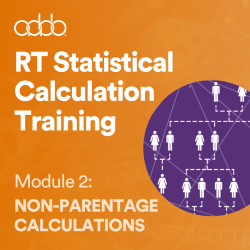
Association for the Advancement of Blood & Biotherapies Relationship Testing Statistical Calculation Training Module 2


$20.00
This Product is shared via google drive download link, So please share your correct Gmail id while placing the order .Please note that there are no CME points or certificate associated with this course Samples for Courses Can be found here : Free Samples Here!
Association for the Advancement of Blood & Biotherapies Relationship Testing Statistical Calculation Training Module 2
Non-Parentage Kinship Calculations • Relationship Testing • Forensic Genetics • Statistical Genetics
Self-Paced Online Training | Approximately 6–8 Hours | 4 Units
Develop practical skills for calculating and interpreting non-parentage familial relationships with the Association for the Advancement of Blood & Biotherapies Relationship Testing Statistical Calculation Training Module 2.
Officially titled Relationship Testing Statistical Calculation Training – Module 2: Non-Parentage Kinship Calculations, this specialized AABB online program is designed to educate laboratory scientists and forensic analysts in the statistical methods used to evaluate genetic relationships beyond routine parentage testing.
The course builds on foundational parentage-statistics knowledge and progresses through calculations involving:
- Full siblings
- Half-siblings
- Aunt / uncle relationships
- Nephew / niece relationships
- Single grandparent relationships
- Two-grandparent relationships
- Multi-person sibling analyses
- Kinship indices
- Probability of relationship
- Reporting uncertainty
The course is delivered as an independent, self-paced multimedia program and includes:
- Training videos
- Practice exercise worksheets
- Downloadable MP3 audio files
- Unit-specific handouts
- Final quiz
- Post-program evaluation
AABB estimates approximately 6–8 hours for completion. Learners receive access through the AABB Education Platform for one year from the date of registration.
Course Details
- Course: Relationship Testing Statistical Calculation Training – Module 2
- Official Subtitle: Non-Parentage Kinship Calculations
- Provider: AABB – Association for the Advancement of Blood & Biotherapies
- Format: Independent Self-Paced Online Training
- Estimated Completion Time: 6–8 Hours
- Number of Units: 4
- Access Period: One Year from Registration
- Primary Field: Relationship Testing
- Related Fields: Forensic Genetics, Human Genetics, Laboratory Medicine, Statistical Genetics
- Educational Materials: Videos, MP3 Audio, Worksheets, Handouts
- Final Assessment: 25-Question Course Quiz
- Passing Requirement: 80%
- Official CE: 8 Continuing Education Credits / Contact Hours for Eligible Participants
- Physician CME: Not Eligible for Physician CME
AABB describes the program as part of its broader Relationship Testing Statistical Calculation Training series and notes that each unit builds on the previous material.
Who Was the Original Program Designed For?
The official AABB audience is:
- Laboratory Scientists
- Forensic Analysts
- Relationship Testing Laboratory Professionals
- DNA Testing Professionals
- Parentage and Kinship Testing Personnel
The course assumes that learners already know how to calculate basic parentage relationship statistics involving:
- Duos
- Trios
This prerequisite is important because Module 2 moves beyond straightforward parentage calculations into more complex kinship structures.
The program may also be relevant to professionals working in related areas such as:
- Medical Genetics
- Forensic Pathology
- Clinical Pathology
- Molecular Genetics
- Forensic DNA Analysis
- Human Identification
The strongest professional audience remains:
Relationship Testing Laboratories + Forensic Genetics + DNA Kinship Analysis
Prerequisites
AABB states that learners should already have the knowledge and ability to calculate basic parentage statistics involving duos and trios before beginning Module 2.
This means that learners should generally already understand basic concepts such as:
- Genetic inheritance
- Relationship testing
- Parentage analysis
- Likelihood-based calculations
- Duo analysis
- Trio analysis
Module 2 is therefore best understood as an expansion from:
Parentage Testing → Extended Kinship Testing
Learning Objectives
Upon successful completion of this course, learners should be able to:
- Discuss the derivation of the kinship index.
- Perform two-party calculations for siblings, half-siblings, avuncular, and single grandparentage.
- Write a statement of the estimation of uncertainty for two-party kinship calculations.
- Perform kinship calculations with three or more people.
AABB’s current official course goals additionally include:
- Calculate the probability of relationship (W).
NON-PARENTAGE KINSHIP ANALYSIS
Traditional relationship testing often focuses on:
Alleged Parent ↔ Child
Module 2 expands the statistical framework to more complex biological relationships.
Examples include:
- Sibling ↔ Sibling
- Half-Sibling ↔ Half-Sibling
- Aunt / Uncle ↔ Niece / Nephew
- Grandparent ↔ Grandchild
- Two Grandparents ↔ Grandchild
- Multiple Siblings ↔ Multiple Siblings
These analyses can require different statistical hypotheses and relationship models than routine paternity testing.
The overall analytical pathway can be summarized as:
Define Relationship Hypothesis → Review Genotypes → Construct Kinship Model → Calculate Relationship Evidence → Interpret Result → Report Uncertainty
Kinship Index
A major course objective is understanding the derivation and application of the:
Kinship Index
The kinship index provides a statistical framework for evaluating how strongly genetic evidence supports one proposed biological relationship compared with an alternative relationship hypothesis.
Rather than relying on simple allele matching, kinship analysis uses statistical evaluation of the observed genetic data.
The learner is therefore trained to move from:
Genetic Observations → Relationship Hypotheses → Statistical Comparison
Biological Relationship Degrees
Unit 1 includes discussion of:
Degrees of Biological Relationships
and the principles used in DNA-based kinship testing.
Understanding degrees of relationship is essential because genetic sharing differs between:
- First-degree relatives
- Second-degree relatives
- More distant relatives
This affects how relationship hypotheses are constructed and interpreted.
UNIT 1
Introduction to Kinship Analysis: Calculation of the Kinship Index for Full Sibling Pairs
The first unit establishes the foundation for non-parentage kinship testing.
Official objectives include:
- Discuss degrees of biological relationships.
- Discuss principles used in DNA-based kinship testing.
- Perform two-party calculations evaluating alleged full-sibling relationships.
Full Sibling Testing
Full siblings generally share both biological parents.
The laboratory question may therefore be framed as:
Are These Two Individuals Full Biological Siblings?
The learner must evaluate the observed genetic evidence according to the appropriate kinship model.
This requires understanding that the genetic possibilities between sibling pairs are different from those encountered in parent-child testing.
Two-Party Kinship Calculations
Unit 1 introduces calculations involving only:
Person A + Person B
without requiring additional known family members.
This forms the foundation for later two-party analyses involving:
- Half-siblings
- Avuncular relationships
- Single grandparentage
Relationship Hypotheses
A core concept in kinship statistics is comparing hypotheses rather than simply determining whether individuals share DNA.
The general structure involves:
Relationship Hypothesis
versus
Alternative Relationship Hypothesis
The genetic data are then evaluated in relation to these competing explanations.
Statistical Evidence in Kinship Testing
Kinship calculations provide a statistical measure of how compatible observed genetic profiles are with a proposed biological relationship.
This approach allows laboratories to report evidence in a quantitative and scientifically defensible manner.
UNIT 2
Second Degree Two Parties Kinship Testing
The full official title of Unit 2 is:
Second Degree Two Parties Kinship Testing: Half Siblings, Aunt/Uncle, Nephew/Niece and Grandparent and Grandchild. Reporting Results for Two Party Testing.
Official objectives include:
- Describe second-degree relationships.
- Perform two-party calculations for half-siblings.
- Perform calculations for avuncular relationships.
- Perform calculations for single-grandparent relationships.
- Write an estimation-of-uncertainty statement when reporting two-party results.
Second-Degree Relationships
Unit 2 moves into relationships where the expected degree of genetic sharing differs from full sibling or parent-child relationships.
Examples include:
- Half-sibling relationships
- Aunt / uncle relationships
- Niece / nephew relationships
- Grandparent / grandchild relationships
These relationships require careful statistical modeling because similar levels of genetic sharing can occur under different family structures.
Half-Sibling Testing
Half-siblings share one biological parent.
The analysis must therefore distinguish:
Full Siblings
from:
Half-Siblings
and other relationship alternatives.
The unit teaches formal calculation methods rather than relying on a qualitative assessment of shared alleles.
Avuncular Relationships
The term avuncular relationship refers to biological relationships such as:
- Aunt ↔ Niece
- Aunt ↔ Nephew
- Uncle ↔ Niece
- Uncle ↔ Nephew
AABB specifically includes avuncular testing in the official Module 2 curriculum.
These cases can arise when a parent is unavailable for direct testing.
Single Grandparentage
Another major Unit 2 topic is:
Single Grandparent ↔ Grandchild Testing
The learner develops the ability to perform calculations when only one alleged grandparent is available.
This differs from Unit 3, where both grandparents may be tested.
Reporting Two-Party Results
Relationship testing does not end with obtaining a numerical result.
The laboratory must communicate the statistical evidence appropriately.
Unit 2 therefore includes explicit training on:
Reporting Results for Two-Party Testing.
Estimation of Uncertainty
One of the official learning objectives is to:
Write a statement of the estimation of uncertainty for two-party kinship calculations.
This is an important component of responsible statistical reporting because relationship-testing conclusions should communicate the limitations and uncertainty associated with the calculation.
Laboratory Reporting
A clear relationship-testing report may need to distinguish between:
- Genetic observations
- Statistical calculations
- Relationship hypothesis
- Probability / likelihood interpretation
- Uncertainty
- Final reported conclusion
The course emphasizes translating calculation results into appropriate laboratory reporting language.
UNIT 3
Grandparentage with Two Grandparents and Grandchild With and Without the Mother
Unit 3 expands grandparentage testing by incorporating:
- Both grandparents
- The grandchild
- Sometimes the biological mother
The official learning objectives include:
- Reconstruct a missing parent’s genotype using the parent’s biological parents.
- Perform grandparentage calculations using both grandparents.
- Discuss advantages and disadvantages of grandparentage testing.
Two-Grandparent Testing
When both alleged grandparents are available, the laboratory has additional genetic information compared with single-grandparent testing.
The family structure can be represented as:
Grandfather + Grandmother → Missing Parent → Grandchild
The genetic profiles of the grandparents can help infer information about the unavailable parent.
Reconstruction of a Missing Parent’s Genotype
One of the most important concepts in Unit 3 is:
Reconstructing the Missing Parent’s Genotype
using the genetic information from that person’s biological parents.
This approach allows laboratories to evaluate certain family relationships even when the most informative person cannot be tested directly.
Grandparentage With the Mother
The curriculum examines grandparentage configurations:
- With the biological mother available
- Without the biological mother available
Adding a known parent may provide additional genetic information that changes the statistical analysis.
Grandparentage Without the Mother
When the mother or another known parent is unavailable, the analysis may contain greater uncertainty.
The laboratory must therefore use the available family structure appropriately and interpret the resulting statistical evidence carefully.
Advantages of Grandparentage Testing
Grandparentage testing can be useful when:
- A parent is deceased
- A parent is unavailable
- Direct parentage testing cannot be performed
- Additional family members are available
The method allows relationship testing to proceed using indirect biological evidence.
Limitations of Grandparentage Testing
Unit 3 explicitly includes discussion of both:
- Advantages
- Disadvantages
of grandparentage testing.
Limitations may arise because indirect relationships can provide less statistical information than direct parent-child testing.
This makes proper interpretation essential.
UNIT 4
Testing with More than Two People in Sibling Relationships
The final unit expands the analysis beyond simple two-person comparisons.
The official full title is:
Testing with More than Two People in Sibling Relationships (Full and Half Siblings).
Multi-Person Kinship Analysis
Unit 4 addresses calculations involving:
Three or More Parties
instead of only two individuals.
The official objectives include:
- Describing testing with an acknowledged or undisputed parent when a sibling relationship is questioned.
- Performing calculations to evaluate full- and half-sibling relationships involving three or more people.
Acknowledged Parent in Sibling Testing
An acknowledged biological parent can provide additional genetic information when the relationship between siblings is uncertain.
A possible configuration is:
Known Parent + Sibling 1 + Sibling 2
The known parent’s genotype may help clarify whether the individuals are:
- Full siblings
- Half-siblings
- Unrelated under the proposed hypotheses
Three-or-More-Person Calculations
Multi-party testing increases the amount of genetic information available but also increases statistical complexity.
The analytical framework may involve:
Multiple Genetic Profiles → Family Structure → Competing Relationship Models → Combined Statistical Evaluation
Unit 4 teaches learners how to structure and perform these more advanced calculations.
Full vs. Half-Sibling Relationships
A major practical question is whether two individuals share:
- Both parents
or:
- Only one parent
When additional family members are included, the laboratory can use the larger pedigree to refine the relationship analysis.
Probability of Relationship – W
The current AABB course goals additionally state that learners should be able to:
Calculate the probability of relationship (W).
This extends the program beyond calculating a kinship statistic and into interpretation of the probability associated with the relationship hypothesis.
Statistical Interpretation
An important distinction in relationship testing is between:
- The underlying genetic evidence
- The calculated statistical weight of that evidence
- The reported probability of the proposed relationship
The course helps learners connect these steps into a coherent interpretation.
Practice Exercises
Each unit includes practice exercise worksheets.
These exercises are intended to reinforce calculation skills rather than relying on passive video learning alone.
The learning approach can be summarized as:
Learn Concept → Review Example → Perform Calculation → Check Understanding → Progress to More Complex Relationships
Multimedia Learning
The official course includes:
- Training videos
- Downloadable MP3 audio
- Handouts
- Worksheets
for each unit.
This makes the program suitable for learners who prefer a combination of:
- Visual instruction
- Audio review
- Written reference
- Calculation practice
Self-Paced Course Design
AABB provides the course as independent study.
Learners can decide how much time they need to:
- Review each unit
- Repeat difficult concepts
- Complete calculations
- Study worksheets
AABB recommends completing the units in sequence because the information builds on previous lessons.
Course Completion Requirements
To complete the original AABB course and obtain the applicable certificate, learners are instructed to:
- Study all four units.
- Watch the training video for each unit.
- Complete the practice worksheets.
- Complete the final course quiz.
- Score at least 80%.
- Complete the post-program evaluation.
- Claim the appropriate continuing education credit type.
Final Quiz
The official assessment contains:
25 Questions
A passing score is:
80% – 20 out of 25 questions
The quiz is structured as:
- Pass / Fail
- Two attempts included
- Multiple-choice questions
- Immediate feedback on whether responses are correct or incorrect
AABB describes the quiz as an opportunity to reinforce course understanding rather than assigning a conventional numerical course grade.
AABB Relationship Testing Training Series
Module 2 is part of the larger:
Relationship Testing Statistical Calculation Training Series
AABB’s current online course catalog identifies:
- Module 1: Parentage Calculations
- Module 2: Non-Parentage Kinship Calculations
as the available training sequence.
Relationship to Module 1
Module 1 provides the foundational statistical training for:
- Parentage calculations
- Paternity trios
- Parentage duos
Module 2 then expands those principles to:
- Siblingship
- Half-siblingship
- Avuncular relationships
- Grandparentage
- Multi-party kinship calculations
The progression can therefore be summarized as:
Module 1: Parentage → Module 2: Extended Kinship
Forensic Genetics Applications
Non-parentage kinship analysis can be relevant when a direct parent-child relationship cannot be tested.
Potential relationship-testing settings can involve:
- Extended-family identification
- Laboratory relationship testing
- Forensic family analysis
- Human identification
- Complex pedigree analysis
The AABB course itself remains focused on teaching the statistical methods used for these relationships rather than on legal case management.
Medical Genetics Relevance
For professionals in medical genetics, the course offers structured exposure to:
- Degrees of biological relatedness
- Genotype reconstruction
- Pedigree relationships
- Statistical kinship evidence
- Probability of relationship
These concepts overlap with broader genetic reasoning but are taught here specifically within the context of DNA relationship testing.
Forensic Pathology Relevance
Forensic pathologists may benefit from understanding how DNA laboratories statistically evaluate familial relationships when:
- Direct relatives are unavailable
- Extended relatives must be tested
- Complex family structures are involved
The course can therefore provide useful context for interpreting laboratory kinship reports.
Clinical Pathology Relevance
Clinical pathologists supervising or working with molecular or relationship-testing laboratories may benefit from the course’s emphasis on:
- Statistical methodology
- Laboratory reporting
- Estimation of uncertainty
- Quality of interpretation
Course Faculty
The program is presented by the AABB Relationship Testing Accreditation Committee.
Key faculty include:
Hristina Lekova, MS
- Supervisor, Parentage and ID Department
- Cuyahoga County Medical Examiner’s Office
John Peterson, PhD
- Laboratory Director
- DNA Diagnostics Center
George C. Maha, JD, PhD, MT(ASCP), A(ABHI)
- Laboratory Director – Retired
AABB staff contributors include:
Marsha Deitz, MBA, MLS(ASCP), CQA(ASQ)
- Director, Relationship Testing and Forensics
Barbara Llewellyn, PhD, MS, MB(ASCP)CM, CQA(ASQ)
- Program Manager, Relationship Testing
Major Topics Covered
- Relationship Testing
- Forensic Genetics
- Statistical Genetics
- Human Identification
- DNA Kinship Analysis
- Non-Parentage Relationships
- Kinship Index
- Kinship Analysis
- Biological Relationships
- Degrees of Relationship
- Full Siblings
- Full Sibling Calculations
- Half-Siblings
- Half-Sibling Calculations
- Second-Degree Relationships
- Avuncular Relationships
- Aunt / Uncle Testing
- Niece / Nephew Testing
- Grandparentage
- Single Grandparent Testing
- Two-Grandparent Testing
- Grandparent / Grandchild Relationships
- Missing Parent Genotype Reconstruction
- Two-Party Kinship Calculations
- Multi-Party Kinship Calculations
- Three-or-More-Person Testing
- Full vs. Half-Sibling Analysis
- Acknowledged Parent Testing
- Probability of Relationship
- Probability of Relationship – W
- Estimation of Uncertainty
- Laboratory Result Reporting
- Kinship Statistics
- Pedigree Analysis
- Relationship Hypotheses
- Practice Calculations
- DNA Laboratory Testing
- Forensic Relationship Testing
Who Should Take This Course?
Association for the Advancement of Blood & Biotherapies Relationship Testing Statistical Calculation Training Module 2 is particularly relevant for:
- Relationship Testing Laboratory Scientists
- Forensic DNA Analysts
- Forensic Geneticists
- Human Identification Specialists
- Molecular Laboratory Scientists
- Parentage Testing Professionals
- DNA Laboratory Supervisors
- Medical Geneticists
- Forensic Pathologists
- Clinical Pathologists
- Molecular Pathologists
- Professionals interpreting kinship-testing results
The strongest original audience remains:
Laboratory Scientists + Forensic Analysts + Relationship Testing Professionals
Why This Course Is Useful
Module 2 provides structured progression from basic parentage statistics into more difficult family relationships.
Kinship Foundations
- Degrees of relationship
- Kinship index
- Full-sibling calculations
Second-Degree Relationships
- Half-siblings
- Avuncular relationships
- Single grandparentage
Grandparentage
- Two grandparents
- Missing-parent genotype reconstruction
- Testing with or without a known parent
Complex Family Structures
- Multiple siblings
- Acknowledged parents
- Three-or-more-party calculations
Reporting
- Estimation of uncertainty
- Relationship probability
- Laboratory reporting
The overall statistical workflow can be summarized as:
Define Pedigree → Establish Relationship Hypotheses → Evaluate Genetic Data → Calculate Kinship Evidence → Estimate Relationship Probability → Report Result and Uncertainty
Original AABB Continuing Education Information
The original AABB course is eligible for:
8 Continuing Education Credits / Contact Hours
for eligible participants in the following categories:
- California Nurses
- California Laboratory Personnel
- Florida Laboratory Personnel
- General Participation Credit
AABB explicitly states:
This course is not eligible for continuing medical education credit for physicians.
A continuing education certificate / certificate of completion is provided through the official AABB Education Platform after the learner:
- Completes all four units
- Passes the course quiz
- Completes the evaluation
- Claims the appropriate CE credit type
These credits and certificates apply only to eligible participation in the original AABB educational activity.
An independently distributed MedicalAmboss package should not automatically be represented as providing:
- AABB CE Credits
- California Nursing Credit
- California Laboratory Personnel Credit
- Florida Laboratory Personnel Credit
- Official AABB Certificate
- Official AABB Course Completion
- AABB Education Platform Access
- One-Year AABB Course Access
- Official Quiz / Assessment Access
unless those services are specifically included with the purchase.
Importantly, this course should not be advertised as physician CME because AABB specifically states that it is not eligible for physician CME credit.
Product Summary
- Product: Association for the Advancement of Blood & Biotherapies Relationship Testing Statistical Calculation Training Module 2
- Official Title: Relationship Testing Statistical Calculation Training – Module 2: Non-Parentage Kinship Calculations
- Provider: AABB – Association for the Advancement of Blood & Biotherapies
- Format: Self-Paced Multimedia Online Training
- Duration: Approximately 6–8 Hours
- Number of Units: 4
- Primary Field: Relationship Testing
- Related Fields: Forensic Genetics, Statistical Genetics, Human Identification
- Primary Topics: Full Siblings, Half-Siblings, Avuncular Testing, Grandparentage, Multi-Person Kinship Analysis
- Educational Materials: Video, MP3 Audio, Handouts, Worksheets
- Final Assessment: 25 Questions
- Passing Score: 80%
- Official CE: 8 CE Credits / Contact Hours for Eligible Participants
- Physician CME: Not Eligible
- Primary Audience: Laboratory Scientists and Forensic Analysts
- Additional Relevant Audience: Medical Geneticists, Forensic Pathologists, Clinical Pathologists
Short Description
Association for the Advancement of Blood & Biotherapies Relationship Testing Statistical Calculation Training Module 2 is a self-paced 6–8 hour training program focused on non-parentage kinship calculations.
The four-unit curriculum covers full-sibling kinship indices, half-sibling and avuncular testing, single and two-grandparent calculations, missing-parent genotype reconstruction, multi-person sibling analysis, estimation of uncertainty, and probability of relationship, with videos, MP3 audio, practice worksheets, and unit handouts.
Topics
Unit 1: Introduction to Kinship Analysis: Calculation of the Kinship Index for Full Sibling Pairs
- Degrees of biological relationships
- Principles of DNA-based kinship testing
- Kinship index
- Full-sibling relationships
- Two-party full-sibling calculations
- Statistical evaluation of alleged sibling relationships
Unit 1 Learning Objectives
- Discuss the degrees of biological relationships.
- Discuss principles used in DNA-based kinship testing.
- Perform two-party calculations evaluating alleged full-sibling relationships.
Unit 2: Second Degree Two Parties Kinship Testing
Half Siblings, Aunt/Uncle, Nephew/Niece and Grandparent/Grandchild
- Second-degree biological relationships
- Half-sibling calculations
- Avuncular calculations
- Aunt / uncle relationships
- Niece / nephew relationships
- Single-grandparent testing
- Grandparent / grandchild relationships
- Two-party kinship statistics
- Reporting two-party results
- Estimation-of-uncertainty statements
Unit 2 Learning Objectives
- Describe second-degree relationships.
- Perform two-party calculations for half-siblings.
- Perform avuncular calculations.
- Perform single-grandparent calculations.
- Write a statement of estimation of uncertainty for two-party calculations.
Unit 3: Grandparentage with Two Grandparents and Grandchild With and Without the Mother
- Two-grandparent testing
- Grandparent / grandchild kinship analysis
- Missing-parent genotype reconstruction
- Grandparentage with a known mother
- Grandparentage without the mother
- Grandparentage calculations
- Advantages of grandparentage testing
- Disadvantages and limitations of grandparentage testing
Unit 3 Learning Objectives
- Reconstruct a missing parent’s genotype using his or her parents.
- Perform grandparentage calculations using both grandparents.
- Discuss advantages and disadvantages of grandparentage testing.
Unit 4: Testing with More Than Two People in Sibling Relationships
Full and Half-Siblings
- Three-or-more-party relationship testing
- Multi-person full-sibling analysis
- Multi-person half-sibling analysis
- Use of an acknowledged parent
- Disputed sibling relationships
- Complex pedigree calculations
- Extended kinship analysis
Unit 4 Learning Objectives
- Describe testing with an acknowledged or undisputed parent when a sibling relationship is questioned.
- Perform calculations to determine full- and half-sibling relationships involving three or more parties.
Topics
The course is divided into four distinct units, each building upon the prior one to establish a comprehensive understanding of non-parentage kinship calculations:
-
Unit 1: Introduction to Kinship Analysis: Calculation of the Kinship Index for Full Sibling Pairs
-
Discuss the degrees of biological relationships and the principles used in DNA-based kinship testing.
-
Perform two-party calculations to evaluate alleged full sibling relationships.
-
-
Unit 2: Second Degree Two Parties Kinship Testing: Half siblings, Aunt/Uncle, Nephew/Niece and Grandparent and Grandchild. Reporting Results for Two Party Testing
-
Describe second degree relationships.
-
Perform two-party calculations for half siblings, avuncular and single grandparent.
-
Write a statement of the estimation of uncertainty for two-party calculations when reporting results.
-
-
Unit 3: Grandparentage with Two Grandparents and Grandchild with and without the Mother
-
Reconstruct a missing parent’s genotype using his or her parents.
-
Perform Grandparentage calculations using both grandparents.
-
Discuss the advantages and disadvantages of Grandparentage testing.
-
-
Unit 4: Testing with More than Two People in Sibling Relationships (Full and Half Siblings)
-
Describe testing with an acknowledged (undisputed) parent when a sibling relationship is questioned.
-
Perform calculations to determine full and half sibling relationships with three or more parties.
-
Related products
Internal Medicine

Anesthesiology & pain medicine

Cardiology

Critical Care - Emergency medicine

Critical Care - Emergency medicine
ASN Critical Care Nephrology – 2022 Update (On-Demand and Livestream)
Critical Care - Emergency medicine

Critical Care - Emergency medicine

Internal Medicine