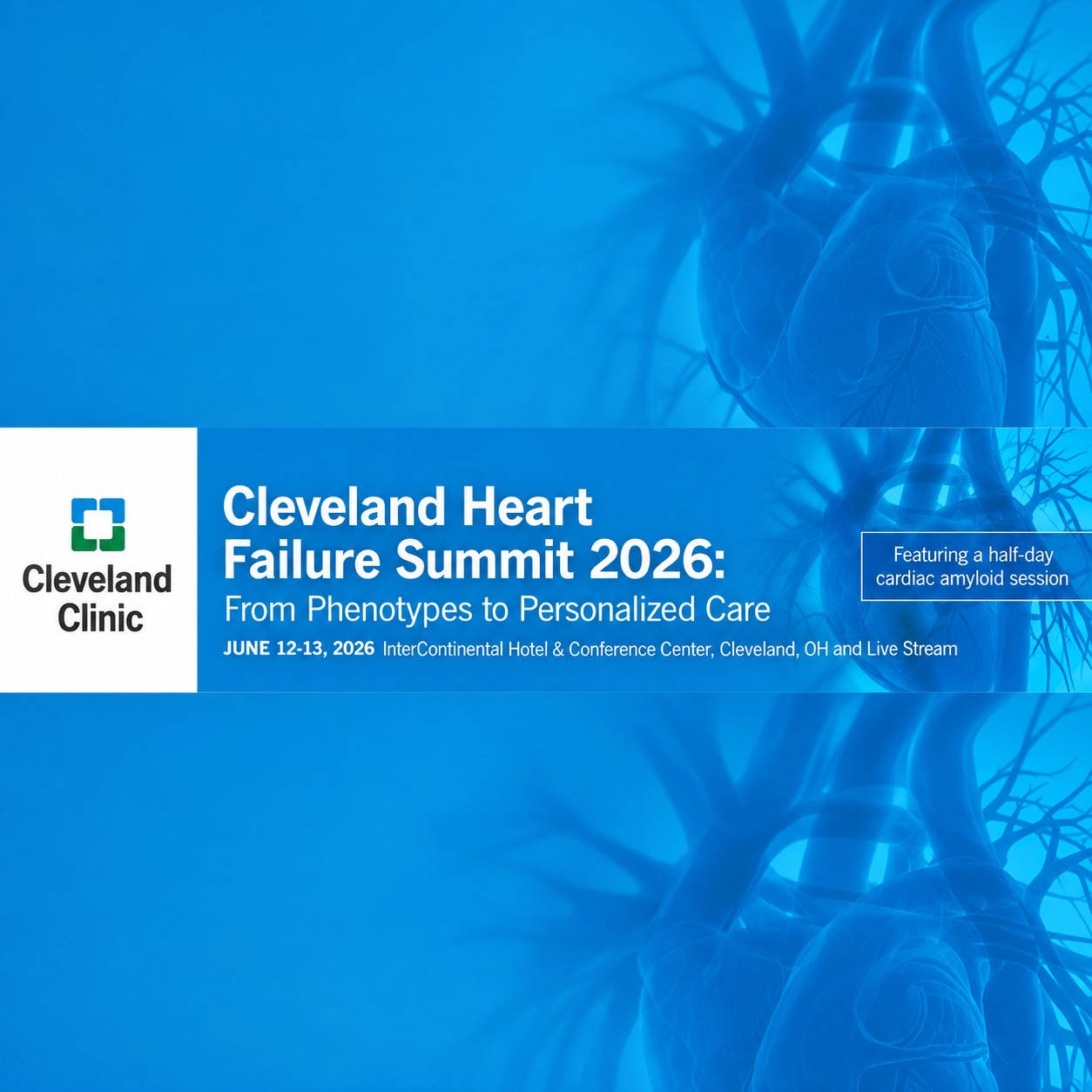
Cleveland Clinic Heart Failure Summit: Expanding the Frontiers of Contemporary Team Management 2026
Advanced Heart Failure, Cardiomyopathy, Precision Medicine & Contemporary Team-Based Care
Stay current with the rapidly evolving field of heart failure and cardiomyopathy with the Cleveland Clinic Heart Failure Summit: Expanding the Frontiers of Contemporary Team Management 2026.
Held June 12–13, 2026, this comprehensive educational program brings together leading experts to examine the latest advances in heart failure management, cardiomyopathies, precision medicine, metabolic disease, mechanical circulatory support, and emerging cardiovascular technologies.
The program is designed to provide practical, evidence-based strategies that clinicians can apply to the diagnosis and management of patients across the full spectrum of heart failure.
Course Details
- Course: Cleveland Clinic Heart Failure Summit: Expanding the Frontiers of Contemporary Team Management
- Year: 2026
- Dates: June 12–13, 2026
- Format: Educational Video Program
- Specialties: Cardiology, Internal Medicine, Heart Failure
- Focus: Heart Failure, Cardiomyopathy, Precision Medicine & Advanced Cardiovascular Care
Course Overview
Heart failure management continues to evolve rapidly as new pharmacologic therapies, devices, imaging technologies, metabolic interventions, genetic discoveries, and advanced mechanical support strategies transform clinical practice.
The Cleveland Clinic Heart Failure Summit 2026 provides an expert-led review of contemporary approaches to patients with HFrEF and HFpEF, while addressing complex cardiovascular conditions such as cardiogenic shock, cardiac amyloidosis, genetic and inflammatory cardiomyopathies, and advanced heart failure.
The program emphasizes the integration of genetic, imaging, metabolic, and phenotypic information into individualized treatment plans. It also explores modern systems of care, remote monitoring, population-health strategies, and equitable access to advanced heart failure therapies.
Participants will gain practical insights into guideline-directed medical therapy, emerging clinical evidence, mechanical circulatory support, ECMO, LVAD management, heart transplantation, artificial intelligence, gene therapy, regenerative medicine, and novel diagnostic technologies.
Key Topics Covered
Heart Failure & Guideline-Directed Medical Therapy
Explore contemporary strategies for managing patients with:
- HFrEF
- HFpEF
- Chronic heart failure
- Advanced heart failure
- Complex heart failure phenotypes
- Obesity and metabolic disease associated with heart failure
Review the latest evidence supporting guideline-directed medical therapy (GDMT) and the incorporation of newer therapies into everyday clinical decision-making.
Precision Medicine in Heart Failure
Learn how precision medicine can improve individualized heart failure care through integration of:
- Genetic information
- Cardiac imaging
- Metabolic characteristics
- Clinical phenotype
- Risk stratification
- Emerging biomarkers and diagnostics
The program highlights how these elements can be incorporated into personalized treatment strategies across the ejection-fraction spectrum.
Cardiomyopathies
Explore contemporary approaches to complex cardiomyopathies, including:
- Genetic cardiomyopathies
- Inflammatory cardiomyopathies
- Metabolic cardiomyopathies
- Cardiac amyloidosis
- Advanced heart failure associated with cardiomyopathy
The course emphasizes improved recognition, diagnosis, risk stratification, and individualized management.
Cardiac Amyloidosis
Review advances in the diagnosis and management of cardiac amyloidosis, including the role of modern diagnostic approaches and emerging therapies.
Topics include:
- Early detection
- Risk stratification
- Imaging
- Genetic and phenotypic assessment
- Personalized treatment
- Emerging therapeutic approaches
Cardiogenic Shock & Advanced Critical Care
Gain practical insights into the management of patients with severe cardiovascular decompensation.
Topics include:
- Cardiogenic shock
- Temporary mechanical circulatory support
- Durable mechanical circulatory support
- ECMO configurations
- Antithrombotic strategies
- Advanced heart failure referral
- Heart transplantation evaluation
Mechanical Circulatory Support
Review contemporary strategies for selecting and managing mechanical support for patients with advanced heart failure.
Topics include:
- Temporary mechanical circulatory support
- Durable mechanical circulatory support
- LVAD therapy
- ECMO
- Patient selection
- Complication management
- Antithrombotic considerations
- Advanced heart failure pathways
Systems of Care & Team Management
The program extends beyond individual therapies to address modern systems-based management of complex heart failure.
Explore:
- Cardio-kidney-metabolic (CKM) care models
- Population-health strategies
- Remote monitoring
- Multidisciplinary heart failure teams
- Advanced therapy referral pathways
- Equitable access to advanced therapies
- Coordinated care for complex patients
Emerging Technologies & Future Innovations
Discover how rapidly developing technologies may transform cardiovascular care.
Key areas include:
- Artificial intelligence
- Gene therapy
- Regenerative therapies
- Novel diagnostic technologies
- Remote monitoring
- Precision medicine
- Advanced imaging
- Risk prediction
- Personalized cardiovascular care
Learning Objectives
After completing this educational program, learners should be able to:
- Apply precision medicine principles to the evaluation and management of patients with heart failure across the EF spectrum.
- Incorporate genetic, imaging, metabolic, and phenotypic information into individualized heart failure care plans.
- Integrate contemporary evidence since the 2022 guidelines into clinical decision-making for GDMT, devices, advanced therapies, and obesity/metabolic treatments.
- Optimize care systems for patients with complex heart failure.
- Implement CKM models and population-health strategies.
- Utilize remote monitoring strategies for appropriate heart failure patients.
- Improve equitable access to advanced heart failure therapies.
- Select appropriate temporary and durable mechanical circulatory support.
- Understand contemporary ECMO configurations.
- Apply evolving antithrombotic strategies in advanced heart failure.
- Understand emerging allocation strategies associated with LVAD and heart transplantation.
- Recognize the potential applications of artificial intelligence in heart failure care.
- Evaluate emerging gene and regenerative therapies.
- Utilize novel diagnostic approaches to improve early detection and risk stratification.
- Apply emerging technologies to the personalized treatment of cardiomyopathies and cardiac amyloidosis.
Who Should Attend?
This educational program is directed toward healthcare professionals involved in the diagnosis and management of patients with heart failure and cardiovascular disease.
Best For
- Cardiologists
- Internal Medicine Physicians
- Heart Failure Specialists
- Advanced Heart Failure Physicians
- Physician Assistants
- Nurse Practitioners
- Nurses
- Other Healthcare Professionals involved in heart failure care
Why Choose This Course?
The Cleveland Clinic Heart Failure Summit 2026 provides a focused update on some of the most rapidly changing areas in contemporary cardiovascular medicine.
The program connects clinical evidence with practical patient management, covering everything from guideline-directed therapy and precision medicine to cardiogenic shock, mechanical circulatory support, transplantation, and emerging technologies.
It is particularly valuable for clinicians seeking to strengthen their approach to patients with complex, advanced, or difficult-to-manage heart failure and cardiomyopathy.
Major Clinical Areas
- HFrEF
- HFpEF
- Advanced Heart Failure
- Cardiomyopathy
- Genetic Cardiomyopathies
- Inflammatory Cardiomyopathies
- Cardiac Amyloidosis
- Cardiogenic Shock
- Mechanical Circulatory Support
- ECMO
- LVAD
- Heart Transplantation
- Cardio-Kidney-Metabolic Disease
- Obesity & Heart Failure
- Precision Medicine
- Artificial Intelligence
- Gene Therapy
- Regenerative Medicine
- Remote Monitoring
- Advanced Cardiovascular Imaging
- Risk Stratification
- Multidisciplinary Heart Failure Care
Educational Benefits
By completing this program, learners can strengthen their ability to:
- Individualize heart failure treatment.
- Apply contemporary GDMT.
- Recognize advanced heart failure earlier.
- Evaluate complex cardiomyopathies.
- Improve diagnosis of cardiac amyloidosis.
- Manage cardiogenic shock.
- Select appropriate mechanical circulatory support.
- Understand ECMO strategies.
- Optimize LVAD and transplant pathways.
- Incorporate metabolic and genetic information into clinical decisions.
- Evaluate emerging AI applications.
- Understand the future role of gene and regenerative therapies.
- Develop coordinated, multidisciplinary approaches to complex heart failure.
Target Audience
The course is directed toward physicians and healthcare professionals with an interest in treating and managing patients with heart failure.
Best For
Cardiologists and Internal Medicine Physicians, particularly those involved in heart failure, cardiomyopathy, advanced cardiovascular care, and multidisciplinary heart failure management.
+ Topics:
- 01 GDMT in 2026 Beyond the Guidelines and into Practice
- 02 Towards Precision Medicine with Cardiac MRI for DCM
- 03 Genetic Testing What Every HF Clinician Needs to Know
- 04 Cardiac Sarcoidosis Across the EF Spectrum
- 05 Cardio-Oncology in the Advanced HF Clinic
- 06 Session 1 HFrEF, Genetic and Inflammatory Cardiomyopathy Q&A
- 07 CKM (cardio-kidney-metabolic) Care Models and Practical Implementation
- 08 Diet and Exercise as Therapeutic Interventions for HFpEF
- 09 Sex Differences in HFpEF Development and Management
- 10 Ambulatory PA Monitoring Who, When, How 11 When GDMT Isn’t Enough_ Recognizing Advanced HFrEF Before Its Too Late
- 12 Session 2 HF and Metabolic Health Q&A
- 13 HFrEF in the Device Era_ Rise of the Machines
- 14 The Promise of AI in HF From Risk Prediction to Workflow Integration
- 15 Gene Therapies The Future of HF Personalized Therapy
- 16 Implications of a CD36 Genetic Variant as a Cause of Cardiomyopathy
- 17 Metabolic Health as a Therapeutic Target for HFrEF
- 18 Session 3 Future Horizons in HF and the Cardiomyopathies Q&A
- 19 Ventricular Assist Devices 101
- 20 Heart Transplantation 101
- 21 Challenging Cases in GDMT Management
- 22 Diuresis Pathways Across the Spectrum of Care
- 23 Breakout Session 2 – Top Five Trials of 2025-26 Q&A
- 24 DIGIT-HF
- 25 VICTOR
- 26 SUMMIT and substudies
- 27 FINEARTS-HF and substudies, RE-DEFINE-HF
- 28 Neuregulin and Other Regenerative Pathways in HFrEF
- 30 Equitable Heart Failure Care in a CKM World
- 31 HF Population Health From Individual Patients to Networks of Care
- 32 Reframing HF_ Treating and Preventing the Syndrome, Its Causes, and Comorbid Conditions
- 33 Session 1 Heart Failure at Scale Q&A
- 34 Cardiogenic Shock in 2026 From Guidelines to Bedside
- 35 Precision Temporary MCS Devices When, How, and For Whom
- 36 ECMO Cannulation Strategy_ VA, VAV, LAVA and more
- 37 Personalizing Care for LVAD Recipients
- 38 Heart Allocation by Continuous Distribution Are We Nearly There Yet
- 39 Session 2 Shock and Advanced Therapies Q&A
- 40 Structural Which Patients with AS and HFrEF Benefit Most from TAVR
- 41 EP Which Patients with AF Most Benefit from Ablation
- 42 Surgery Which Patients with HF can Undergo CABG and Valve Surgery
- 43 AI in Action Practical Tools for the Heart Failure Clinician
- 44 New Insights Through Imaging and Tracers
- 45 Evolutions in TTR Therapies
- 46 Gene editing and TTR removal
- 47 AL Amyloid Conundrums (Case Based)
- 48 Educating Patients on an Amyloid Diagnosis
- 49 Amyloidosis and the Musculoskeletal System
- 50 Cardiac Amyloid Session Q&A
- Friday Session 1 – Updates in HF Epidemiology and Population Health
- Friday Session 2 HFrEF and EP Innovations
- Friday Session 3 – HFpEF and Pulmonary Hypertension
- Friday Session 4A- Meet the Clinical Trialists Concurrent Session
- Saturday Session 1- Cardiomyopathies amyloid, HCM, Sarcoid and HFrEF
- Saturday Session 2- MCS and TX
- Saturday Session 3- Cardiogenic shock and critical care