
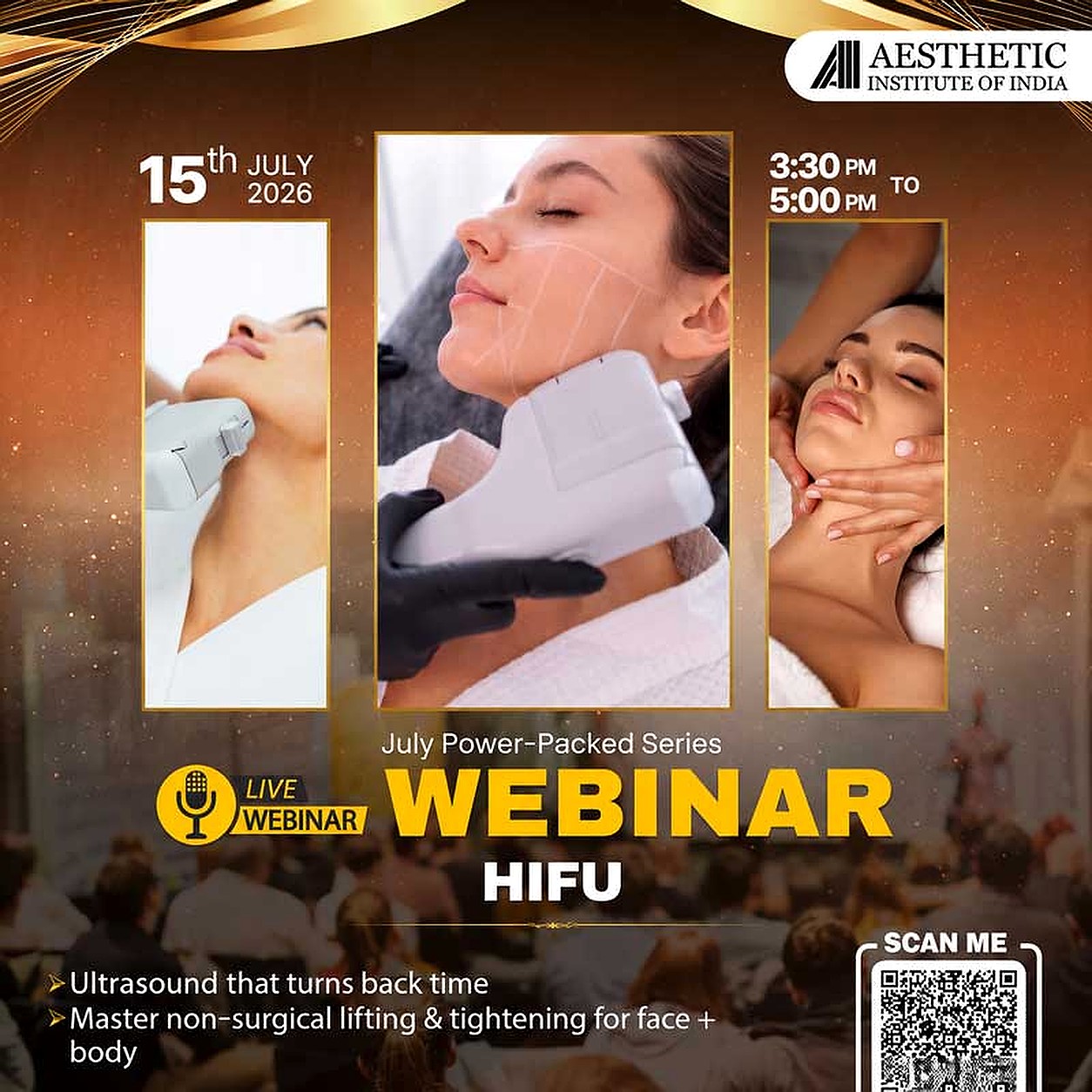
Dr. Mridu Miglani’s HIFU Webinar 2026


$70.00
This Product is shared via google drive download link, So please share your correct Gmail id while placing the order .Please note that there are no CME points or certificate associated with this course Samples for Courses Can be found here : Free Samples Here!
Dr. Mridu Miglani’s HIFU Webinar 2026
High-Intensity Focused Ultrasound • Facial Rejuvenation • Skin Tightening • Jawline & Neck Treatment
Develop a more scientific and patient-centered understanding of High-Intensity Focused Ultrasound (HIFU) with Dr. Mridu Miglani’s HIFU Webinar 2026.
This specialized aesthetic medicine webinar focuses on the clinical principles behind non-surgical facial and neck rejuvenation using HIFU, including technology fundamentals, patient assessment, anatomical considerations, treatment-area selection, treatment-depth planning, energy concepts, expected outcomes, safety, and complication prevention.
Rather than approaching HIFU as a device with standardized settings for every patient, the program emphasizes individualized clinical planning based on:
- Facial anatomy
- Skin thickness
- Subcutaneous tissue
- Degree of laxity
- Fat distribution
- Treatment area
- Patient age
- Previous aesthetic treatments
- Treatment goals
- Device limitations
- Patient expectations
The aim is to help practitioners understand where HIFU may be appropriate, where its limitations lie, and how patient selection and anatomical assessment influence both treatment safety and outcomes.
Course Details
- Course: Dr. Mridu Miglani’s HIFU Webinar
- Year: 2026
- Instructor: Dr. Mridu Miglani
- Specialty: Aesthetic Medicine / Facial Rejuvenation
- Primary Technology: High-Intensity Focused Ultrasound – HIFU
- Focus Areas: Face / Jawline / Submental Region / Neck
- Format: Digital Educational Webinar
- Delivery: Google Drive
- Language: English
- CME / Certificate: Not included with the MedicalAmboss digital product
What Is HIFU?
HIFU stands for High-Intensity Focused Ultrasound.
The technology directs focused acoustic energy toward selected tissue depths beneath the skin, producing controlled thermal effects in the targeted tissue without surgical incisions.
The resulting tissue response may contribute to:
- Initial collagen contraction
- Tissue-repair signaling
- Collagen remodeling
- Elastin remodeling
- Progressive improvement in skin firmness
- Non-surgical tissue tightening
Unlike diagnostic ultrasound, HIFU is designed to deliver therapeutic energy rather than simply produce an image.
HIFU for Facial Rejuvenation
In aesthetic medicine, HIFU is commonly considered for patients seeking non-surgical improvement in areas such as:
- Lower face
- Jawline
- Submental region
- Neck
- Selected areas of facial laxity
Appropriate outcomes depend on multiple variables, including:
Patient Selection + Anatomy + Treatment Depth + Energy + Number of Lines + Technique + Device Characteristics
The webinar emphasizes that a single preset protocol should not automatically be applied to every patient.
HIFU Is Not a Surgical Facelift
An important component of patient counseling is explaining the limitations of non-surgical energy-based treatments.
HIFU should not be presented as a universal replacement for facelift surgery.
It may be more appropriate for selected patients with:
- Mild skin laxity
- Mild-to-moderate tissue laxity
- Early loss of jawline definition
- Early neck laxity
- Realistic expectations
- Preference for non-surgical treatment
Patients with substantial skin and deep-tissue laxity may require a different treatment strategy.
About the Instructor – Dr. Mridu Miglani
Dr. Mridu Miglani is active in facial aesthetics, cosmetic dentistry, aesthetic education, and non-surgical cosmetic procedures.
She is associated with:
- Smiling Faces Dentistry & Aesthetics
- Aesthetic Institute of India
- Facial aesthetic education
- Cosmetic and non-surgical aesthetic procedures
Her educational work includes the practical application of aesthetic treatments and translating scientific principles into clinically relevant treatment planning.
Proposed Educational Content Structure
Important Note
A complete official lesson-by-lesson syllabus for this specific HIFU webinar has not been publicly published.
The following sections represent a structured educational outline based on the webinar subject and the content currently described for the product. They should not be presented as official lecture titles unless verified from the actual webinar files.
1. Scientific Principles of HIFU
A foundational understanding of HIFU technology is essential before learning treatment protocols.
Key Concepts
- High-Intensity Focused Ultrasound
- Ultrasound energy generation
- Acoustic energy transmission
- Focusing energy at specific tissue depths
- Controlled thermal coagulation points
- Tissue response to thermal energy
- Collagen contraction
- Neocollagenesis
- Collagen remodeling
- Elastin remodeling
- Progressive treatment response
HIFU vs. Other Energy-Based Treatments
Practitioners should understand that HIFU is not interchangeable with:
- Radiofrequency
- RF microneedling
- Laser resurfacing
- IPL
- Ultrasound imaging
- Surgical lifting
Each modality has different:
- Mechanisms
- Tissue targets
- Treatment depths
- Indications
- Limitations
- Risk profiles
Treatment selection should be based on the patient’s actual clinical needs.
2. Applied Anatomy for HIFU
Safe HIFU treatment requires a working knowledge of facial and neck anatomy.
Topics Include
- Skin layers
- Subcutaneous tissue
- Facial fat compartments
- Fascial layers
- Muscle
- Bone
- Nerves
- Vascular structures
- Parotid region
- Jawline anatomy
- Submental anatomy
- Neck anatomy
Anatomical Assessment Before Treatment
Before treatment, the practitioner should understand:
- What tissue is being targeted?
- What lies beneath the target tissue?
- How thick is the tissue?
- Is there adequate distance from bone?
- Are sensitive structures nearby?
- Is the patient’s anatomy symmetrical?
- Is there sufficient laxity to justify treatment?
Anatomical assessment should guide the treatment plan rather than relying solely on preset device parameters.
3. Patient Assessment
Successful HIFU begins before the device is activated.
A structured consultation should include:
- Medical history
- Previous cosmetic procedures
- Previous fillers
- Previous Botulinum Toxin treatments
- Previous energy-based procedures
- Skin quality
- Skin thickness
- Degree of laxity
- Fat distribution
- Facial proportions
- Facial asymmetry
- Jawline assessment
- Submental assessment
- Neck assessment
- Patient goals
- Expectations
Patient Photography
Standardized photographs can help document:
- Baseline laxity
- Facial symmetry
- Jawline definition
- Submental contour
- Neck appearance
and allow more objective comparison during follow-up.
4. Patient Selection for HIFU
Appropriate candidate selection is one of the most important determinants of outcome.
Potential candidates may include selected patients with:
- Mild facial laxity
- Mild-to-moderate tissue laxity
- Reduced skin firmness
- Early lower-face laxity
- Reduced jawline definition
- Submental skin laxity
- Early neck laxity
- Preference for non-surgical rejuvenation
- Realistic expectations
Poor Candidate Selection
HIFU may provide disappointing outcomes when used in patients whose clinical problem is not well suited to the technology.
Examples may include patients with:
- Severe skin laxity
- Significant deep-tissue descent
- Expectations equivalent to surgical lifting
- Anatomical conditions incompatible with treatment
- Important contraindications
- Unrealistic expectations
Recognizing when not to perform a treatment is part of appropriate aesthetic practice.
5. Contraindications & Precautions
Clinical screening should consider potential contraindications and precautions before treatment.
Important areas for assessment include:
- Active infection
- Open wounds
- Significant inflammation
- Healing disorders
- Relevant implants or devices
- Coagulation problems
- Significant medical disease
- Medication history
- Recent aesthetic procedures
- Pregnancy-related considerations
- Anatomical restrictions
- Device-specific contraindications
The manufacturer’s specific instructions for the HIFU system being used should always be reviewed.
6. HIFU Cartridge & Treatment Depth Selection
Different cartridges are designed to deliver energy at different depths.
Treatment depth should be selected according to:
- Anatomical region
- Tissue thickness
- Target structure
- Subcutaneous fat
- Skin quality
- Facial anatomy
- Device specifications
Why Treatment Depth Matters
Treating too superficially or too deeply may reduce effectiveness or increase risk.
The practitioner should understand:
Target Layer → Appropriate Cartridge → Tissue Thickness → Energy Selection
rather than choosing depth arbitrarily.
7. Energy Settings
Energy should not automatically be maximized.
Treatment parameters may require adjustment according to:
- Treatment zone
- Tissue thickness
- Patient tolerance
- Device
- Cartridge
- Previous treatment
- Clinical endpoint
Conservative Treatment Planning
Higher energy does not necessarily mean a better result.
Excessive treatment can increase:
- Pain
- Swelling
- Tissue irritation
- Risk of thermal injury
- Risk to sensitive structures
- Unwanted tissue changes
The objective should be appropriate energy, not maximum energy.
8. Treatment Lines & Density
Planning the number and distribution of HIFU lines is another important component of treatment.
Considerations Include
- Number of lines
- Spacing
- Distribution
- Treatment coverage
- Avoiding excessive overlap
- Avoiding undertreatment
- Symmetry
- Anatomical boundaries
Treatment settings should be documented for future comparison and repeat procedures.
9. Facial Mapping & Treatment Planning
Treatment should be planned before energy delivery.
A structured workflow may include:
Assessment → Photography → Facial Mapping → Risk-Zone Identification → Depth Selection → Energy Planning → Treatment
Facial Marking
Potential areas to define before treatment include:
- Lower face
- Jawline
- Submental region
- Neck
- Areas to avoid
- Bony prominences
- Sensitive structures
Treatment mapping should reflect individual anatomy rather than using an identical template for every patient.
10. HIFU for the Lower Face
Lower-face HIFU may be considered for selected patients with early tissue laxity.
Treatment planning should account for:
- Facial shape
- Skin thickness
- Fat volume
- Tissue laxity
- Jawline anatomy
- Symmetry
- Sensitive structures
Lower-Face Treatment Goals
Potential treatment goals may include:
- Improvement in skin firmness
- Improvement in early laxity
- Better definition of the lower-face contour
- Gradual non-surgical rejuvenation
Results should be described conservatively and realistically.
11. HIFU for the Jawline
Jawline treatment is a common area of interest in aesthetic HIFU.
Assessment should determine whether poor definition results primarily from:
- Skin laxity
- Subcutaneous fat
- Skeletal anatomy
- Muscle
- Tissue descent
- Combination of factors
HIFU may not be the ideal solution for every cause of poor jawline definition.
12. HIFU for the Submental Area
The submental area requires distinction between:
Skin Laxity vs. Fat Accumulation
These are not identical clinical problems.
Assessment May Include
- Submental fat
- Skin thickness
- Skin laxity
- Jawline contour
- Neck anatomy
- Treatment depth
- Patient expectations
Correct diagnosis should precede device selection.
13. HIFU for the Neck
Neck treatment requires careful anatomical assessment.
Important considerations include:
- Skin quality
- Tissue thickness
- Neck laxity
- Sensitive structures
- Treatment boundaries
- Appropriate depth
- Conservative energy
- Coordination with lower-face treatment
The neck should not simply receive the same settings used on the face.
14. HIFU & Collagen Remodeling
One reason HIFU outcomes develop gradually is that the desired tissue response involves remodeling over time.
Potential stages include:
Thermal Effect → Tissue Response → Collagen Contraction → Remodeling → Progressive Clinical Change
Patients should be counseled that treatment does not necessarily produce an immediate final result.
15. Pain Management & Patient Tolerance
HIFU may cause discomfort during energy delivery.
Clinical management may include:
- Preparing the patient
- Explaining expected sensations
- Adjusting energy appropriately
- Monitoring tolerance
- Treating cautiously around sensitive areas
- Avoiding unnecessary energy escalation
- Maintaining communication during treatment
Significant or unusual pain should not simply be ignored.
16. Safety & Complication Prevention
Safety depends on several interconnected factors:
Patient Selection + Anatomy + Device Knowledge + Correct Depth + Appropriate Energy + Technique
Potential Treatment Reactions
Patients may experience temporary:
- Redness
- Swelling
- Tenderness
- Sensitivity
- Discomfort
- Bruising
More significant complications are possible when treatment is inappropriate or energy is delivered incorrectly.
Complications to Understand
Clinicians using HIFU should understand the possibility of:
- Thermal injury
- Significant pain
- Nerve-related symptoms
- Unwanted tissue effects
- Asymmetry
- Volume changes
- Persistent sensitivity
Early recognition and appropriate management are essential.
17. Post-HIFU Care
After treatment, patients should receive appropriate aftercare instructions.
Follow-Up May Include
- Immediate skin-care guidance
- Explanation of temporary side effects
- Monitoring recovery
- Avoiding unnecessary manipulation
- Follow-up photography
- Outcome assessment
- Patient satisfaction assessment
- Determining whether retreatment is appropriate
Avoiding Premature Retreatment
Because collagen remodeling occurs gradually, repeating treatment too quickly may not allow sufficient time to assess the outcome.
Treatment intervals should follow:
- Clinical response
- Device guidance
- Patient factors
- Manufacturer recommendations
18. HIFU for Body Treatments
Certain HIFU technologies may also be used for selected body applications.
Practitioners should understand the difference between:
- Skin tightening
- Local contour modification
- Fat-focused treatment
- Weight loss
HIFU body contouring should not be marketed as a treatment for obesity or general weight loss.
19. Combining HIFU with Other Aesthetic Treatments
HIFU may be considered as one part of a broader rejuvenation strategy.
Potential complementary modalities may include:
- Dermal fillers
- Botulinum Toxin
- Skin boosters
- PRP
- Microneedling
- Radiofrequency
- Laser treatments
- Chemical resurfacing
- Medical skincare
Combination Treatment Planning
Using more treatments does not automatically produce better results.
Combination protocols require attention to:
- Treatment sequence
- Treatment intervals
- Tissue response
- Previous procedures
- Target anatomical layer
- Recovery
- Complication risk
The treatment plan should be based on the patient’s needs rather than the number of available procedures.
20. HIFU vs. Surgical Facelift
HIFU and facelift surgery address different levels of aesthetic concern.
HIFU
- Non-surgical
- No surgical incision
- Gradual results
- Selected mild-to-moderate laxity
- Less structural correction
Surgical Facelift
- Surgical procedure
- Greater structural repositioning
- More appropriate for significant laxity in selected patients
- Different recovery and risk profile
Physicians should avoid promising surgical-level results from non-surgical HIFU.
Major Topics Covered
- HIFU
- High-Intensity Focused Ultrasound
- HIFU Facial Rejuvenation
- HIFU Skin Tightening
- HIFU Face Treatment
- HIFU Neck Treatment
- HIFU Jawline Treatment
- HIFU Submental Treatment
- Non-Surgical Facelift
- Non-Surgical Skin Tightening
- Collagen Remodeling
- Neocollagenesis
- Facial Anatomy
- Facial Laxity
- Neck Laxity
- Patient Selection
- HIFU Contraindications
- HIFU Cartridges
- HIFU Treatment Depth
- HIFU Energy Settings
- Treatment-Line Planning
- Facial Mapping
- Aesthetic Treatment Planning
- HIFU Safety
- HIFU Complications
- HIFU Aftercare
- HIFU Body Contouring
- Combination Aesthetic Treatments
- Energy-Based Devices
- Aesthetic Medicine
- Facial Rejuvenation
Who Should Take This Course?
Dr. Mridu Miglani’s HIFU Webinar 2026 may be particularly relevant for:
- Dermatologists
- Plastic Surgeons
- Facial Plastic Surgeons
- Aesthetic Medicine Physicians
- Cosmetic Physicians
- Physicians working in aesthetic clinics
- Physicians using HIFU devices
- Physicians working with energy-based devices
- Practitioners interested in non-surgical facial rejuvenation
- Clinicians seeking better HIFU patient selection
- Physicians seeking to improve treatment planning and safety
Appropriate professional licensing and device-specific training remain necessary before performing HIFU clinically.
Why This Webinar Is Useful
The main strength of the program is its shift from a device-centered approach toward a patient-centered treatment strategy.
A structured HIFU workflow can be summarized as:
Patient Assessment → Anatomy → Diagnosis → Candidate Selection → Treatment Area → Depth → Energy → Line Planning → Treatment → Follow-Up
The webinar can help practitioners:
- Understand HIFU technology
- Improve patient assessment
- Improve patient selection
- Recognize treatment limitations
- Review facial and neck anatomy
- Understand cartridge depth concepts
- Understand energy selection principles
- Improve treatment-line planning
- Recognize anatomical risk areas
- Improve complication awareness
- Manage patient expectations
- Integrate HIFU into personalized rejuvenation plans
Important Clinical Safety Note
HIFU devices differ considerably in:
- Technology
- Cartridge configuration
- Energy output
- Treatment depth
- Calibration
- Software
- Safety requirements
Educational principles from a general webinar should therefore not replace device-specific training or the manufacturer’s instructions for use.
Practitioners should follow:
- Professional licensing requirements
- Local regulations
- Device-specific training
- Manufacturer instructions
- Appropriate medical safety standards
before performing treatments.
Product / Delivery Information
- Product: Dr. Mridu Miglani’s HIFU Webinar 2026
- Instructor: Dr. Mridu Miglani
- Year: 2026
- Specialty: Aesthetic Medicine
- Topic: HIFU / Non-Surgical Facial & Neck Rejuvenation
- Format: Digital Educational Webinar
- Delivery: Google Drive
- CME / Certificate: Not included with the MedicalAmboss product
4. Short Description
Dr. Mridu Miglani’s HIFU Webinar 2026 is a specialized aesthetic medicine program focused on High-Intensity Focused Ultrasound (HIFU) for non-surgical facial and neck rejuvenation.
The webinar explores HIFU technology, collagen remodeling, facial anatomy, patient assessment, candidate selection, treatment depths, energy concepts, jawline and submental treatment, neck rejuvenation, safety, complications, aftercare, and individualized treatment planning.
Ideal for physicians and aesthetic practitioners seeking a more scientific, anatomy-based and patient-centered approach to HIFU.
Year: 2026
Instructor: Dr. Mridu Miglani
Delivery: Google Drive
CME / Certificate: Not included
Related products

Plastic Surgery
South American Plastic Surgery Breast & Body Experts Cancun 2020

Plastic Surgery
Istanbul Live Regenerative Surgery Multispecialty Course 2022



ENT / Otolaryngology

DENTAL
Sinus Grafting for Implant Reconstruction (Pikos Online MasterClass Series) – Michael A. Pikos

Plastic Surgery