11th All in One Rhinoplasty & Face Congress 2026
Course Introduction
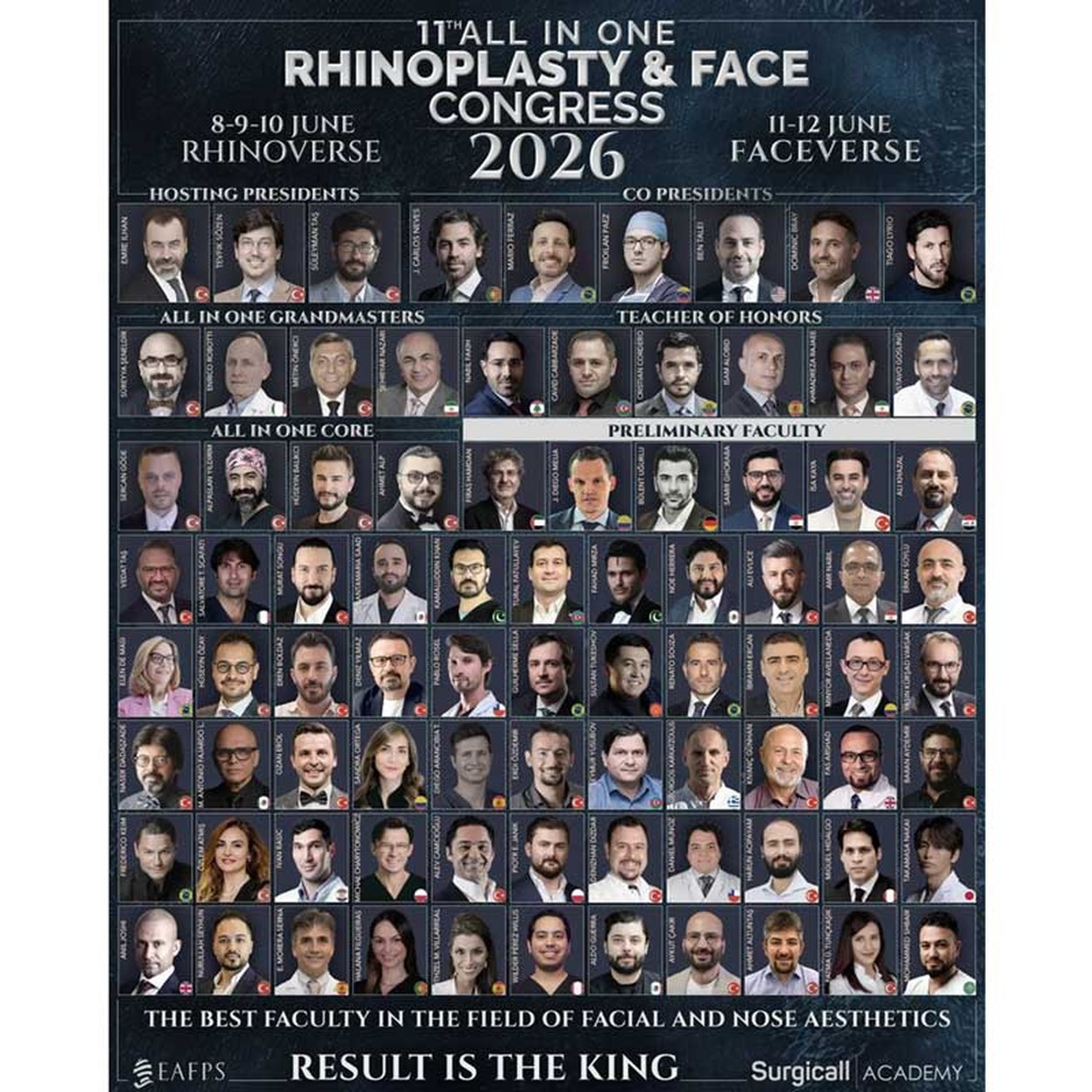
The 11th All in One Rhinoplasty & Face Congress 2026 is an international educational congress focused on advanced rhinoplasty and facial aesthetic surgery, bringing together a comprehensive five-day scientific program covering advanced nasal surgery and facial rejuvenation.

The 11th edition of the congress was held in Istanbul from June 8–12, 2026. In this edition, the two educational programs, Rhinoverse and Faceverse, were presented together for the first time as a unified congress, featuring more than 100 international speakers in the scientific program.
The program consisted of three days of advanced rhinoplasty education followed by two days dedicated to facial surgery and aesthetics:
- June 8–10: Rhinoverse
- June 11–12: Faceverse
This educational collection is designed for physicians who want to explore the latest perspectives, techniques, and approaches from international surgeons in the fields of rhinoplasty and Facial Aesthetics.
International Rhinoplasty Congress, Live Surgery, and Facial Rejuvenation Educational Collection in Istanbul
About the Congress
The All in One Rhinoplasty Congress is one of the educational programs organized by Surgicall Academy in the field of rhinoplasty. In 2026, the addition of Faceverse expanded the scientific scope of the event from rhinoplasty to a broader range of facial surgery and rejuvenation techniques.
According to the official organizer’s description, the event was held under the theme “Two Worlds, One Stage”, with the goal of creating a shared platform for exchanging experiences among rhinoplasty surgeons, facial plastic surgeons, and facial rejuvenation specialists.
The scientific program included a combination of:
- Specialized lectures
- Presentations of innovative surgical approaches
- Live surgery demonstrations
- Experience sharing among international surgeons
- Discussion of different treatment philosophies
- Review of advanced rhinoplasty techniques
- Exploration of emerging approaches in Facial Aesthetics
The exact number of videos and the final duration of the educational version of the congress are not specified in the publicly available official information.
Rhinoverse
The Rhinoverse section took place on June 8, 9, and 10 and focused on advanced rhinoplasty concepts, live surgeries, and contemporary approaches to the planning and performance of nasal surgery.
This section is suitable for surgeons who want to examine different rhinoplasty techniques from the perspectives of multiple experts and develop a better understanding of the differences between Structural, Preservation, and Hybrid approaches.
Topics that may be explored within such a program include:
- Preoperative rhinoplasty assessment
- Developing an individualized surgical plan
- Management of the nasal dorsum
- Septal correction and complex deviations
- Tip shaping and structural support
- Primary rhinoplasty
- Revision and secondary rhinoplasty
- Management of thick and thin skin
- Use of cartilage grafts
- Prevention and management of complications
- Achieving natural and harmonious results
For another collection focused on live nasal surgery, the Robotic Rhinoplasty course may also be a relevant resource.
Live Rhinoplasty Surgery Training
One of the key features of the Rhinoverse section was the use of Live Surgery to demonstrate surgical decision-making and the execution of techniques in a real operative setting. The official congress presentation also emphasizes advanced rhinoplasty concepts and live surgical procedures.
Observing a complete surgical procedure can help physicians better understand the relationship between the different stages of surgery, including:
- Assessment of the patient’s anatomy
- Selection of an open or closed approach
- Planning of the dorsum and septum
- Selection of appropriate tip maneuvers
- Decision-making regarding the need for grafts
- Maintaining symmetry throughout the procedure
- Modifying the surgical plan based on intraoperative findings
- Assessing the result before closing the incisions
This educational structure does not simply demonstrate the final result; it also provides insight into the surgeon’s decision-making process throughout the operation.
Different Rhinoplasty Approaches
One of the advantages of international surgical congresses is the opportunity to compare the perspectives and techniques of multiple surgeons. In rhinoplasty, applying a single technique to every patient is not appropriate; the surgical approach should be selected according to the patient’s anatomy, skin quality, septal condition, and treatment objectives.
Approaches commonly discussed in modern rhinoplasty include:
- Structural Rhinoplasty
- Preservation Rhinoplasty
- Hybrid Rhinoplasty
- Primary Rhinoplasty
- Revision Rhinoplasty
- Open Rhinoplasty
- Closed Rhinoplasty
- Ultrasonic Rhinoplasty
- Cartilage Grafting
- Functional Rhinoplasty
The value of such a program lies in allowing participants to compare different surgical philosophies and better understand the rationale behind the selection of each technique.
Management of Complex Rhinoplasty Cases
In challenging cases, surgeons may encounter multiple problems, including severe deviation, septal weakness, cartilage deficiency, previous surgical scarring, or dorsal deformity.
Assessment of these patients should include consideration of:
- Number of previous surgeries
- Condition of the septal cartilage
- Skin and soft-tissue quality
- Presence of functional breathing problems
- Osseous and cartilaginous asymmetry
- Nasal valve weakness
- Condition of the nasal tip and base
- Potential need for auricular or costal cartilage
- Patient expectations
- Anticipated treatment limitations
Congress-based educational programs allow physicians to compare how different surgeons approach similar complex cases and evaluate alternative management strategies.
Faceverse
The Faceverse section took place on June 11 and 12 and focused on Facial Aesthetics, contemporary facial rejuvenation approaches, and experience sharing among international specialists.
This section approaches facial rejuvenation as a comprehensive treatment plan. Proper patient assessment should not be limited to a single anatomical area; instead, the relationship between the eyebrows, eyelids, midface, jawline, and neck should be considered.
Topics associated with Faceverse may include:
- Surgical anatomy of the face and neck
- Assessment of facial aging patterns
- Facelift and neck lift
- SMAS and Deep Plane techniques
- Midface rejuvenation
- Jawline contouring
- Eyelid surgery
- Brow and temporal lifting
- Facial fat grafting
- Adjunctive rejuvenation procedures
- Prevention of unnatural results
- Individualized treatment planning
Facelift and Neck Lift
An important aspect of facial aesthetic surgery is the coordinated correction of laxity involving the midface, lower face, jawline, and neck.
Before selecting a technique, the surgeon should assess:
- Degree of skin laxity
- Position of the deeper tissues
- Condition of the SMAS
- Platysmal bands
- Submental fat
- Midface volume loss
- Chin and jawline anatomy
- Skin quality
- Previous surgical or injectable treatments
- Patient’s expected outcome
Contemporary facelift techniques increasingly focus on addressing deeper anatomical structures and reducing direct tension on the skin. This approach may help create a more natural contour and minimize visible signs of surgery.
Deep Plane and Management of Deep Tissues
In a Deep Plane Facelift, tissue release and repositioning are performed at a deeper anatomical level than the skin. Proper execution requires a detailed understanding of the retaining ligaments, facial nerve pathways, SMAS, and the anatomical relationships between the structures of the face and neck.
Important considerations in this area include:
- Selecting the appropriate entry point into the Deep Plane
- Releasing the retaining ligaments
- Preserving the facial nerve branches
- Determining the appropriate vector of tissue repositioning
- Correcting the midface and jowls
- Creating a natural jawline
- Managing the neck and platysma
- Stabilizing the deeper tissues
- Controlled skin excision
- Tension-free incision closure
The Importance of Surgical Perspectives and Experience Sharing
The All in One Rhinoplasty & Face Congress is not limited to teaching a single technique or surgical philosophy. The participation of more than 100 speakers provides an opportunity to compare different philosophies, experiences, and treatment approaches.
This diversity of perspectives can help participants:
- Compare the advantages and limitations of different techniques
- Develop individualized treatment plans
- Become familiar with approaches used by international surgeons
- Learn from reported errors and complications
- Better understand the rationale behind surgical technique selection
- Explore the relationship between nasal surgery and overall facial harmony
The Relationship Between Rhinoplasty and Overall Facial Aesthetics
The outcome of rhinoplasty should be assessed in relation to the other facial features. Reducing or reshaping the nose without considering the forehead, lips, chin, and jawline may not improve overall facial harmony.
During comprehensive patient assessment, the surgeon should consider:
- Forehead height and contour
- Radix position
- Nasal tip projection
- Nasolabial angle
- Upper-lip length
- Chin shape and projection
- Jawline
- Overall facial symmetry
- Gender- and ethnicity-related characteristics
- Patient goals and expectations
Combining Rhinoverse and Faceverse within a single congress provides an opportunity to consider the nose as part of the overall facial structure and aesthetic balance.
Online Participation
The availability of an online version allows physicians who were unable to attend the event in Istanbul to access the scientific content. However, the number and duration of videos included in the final product should be recorded according to the actual files available in the Simabaan package.
Who Is This Course For?
This educational collection is suitable for:
- Plastic and aesthetic surgeons
- Otolaryngologists (ENT specialists)
- Facial aesthetic surgeons
- Oral and maxillofacial surgeons
- Rhinoplasty fellows
- Facial Plastic Surgery fellows
- Surgeons performing primary rhinoplasty
- Surgeons performing revision rhinoplasty
- Physicians performing Facelift and Neck Lift procedures
- Senior residents in relevant specialties
- Physicians interested in nasal and facial harmony
- Surgeons interested in comparing international surgical techniques
Course Benefits
Key benefits of this educational collection include:
- Five days of scientific education
- Combination of Rhinoverse and Faceverse
- Participation of more than 100 speakers
- Coverage of rhinoplasty and facial aesthetic surgery
- Advanced rhinoplasty concepts
- Live surgery demonstrations
- Exposure to international surgical perspectives
- Review of contemporary Facial Aesthetics approaches
- Comparison of different surgical philosophies
- Focus on the relationship between the nose and overall facial harmony
- Suitable for plastic surgeons and ENT specialists
- Online educational access provided by the organizer
- Focus on science, artistry, and innovation in facial surgery
- Suitable for updating and expanding surgical knowledge
Conclusion
The 11th All in One Rhinoplasty & Face Congress 2026 is a comprehensive educational program covering rhinoplasty and facial rejuvenation within a unified scientific event.

The congress was held in Istanbul from June 8–12, 2026, and included three days of Rhinoverse followed by two days of Faceverse. With more than 100 speakers and a combination of scientific lectures and live surgical demonstrations, the program provides an opportunity to explore diverse surgical perspectives and techniques.
The integration of rhinoplasty, Facial Aesthetics, and comprehensive facial harmony assessment makes this educational collection a valuable resource for plastic surgeons, ENT specialists, and physicians involved in facial aesthetic surgery.