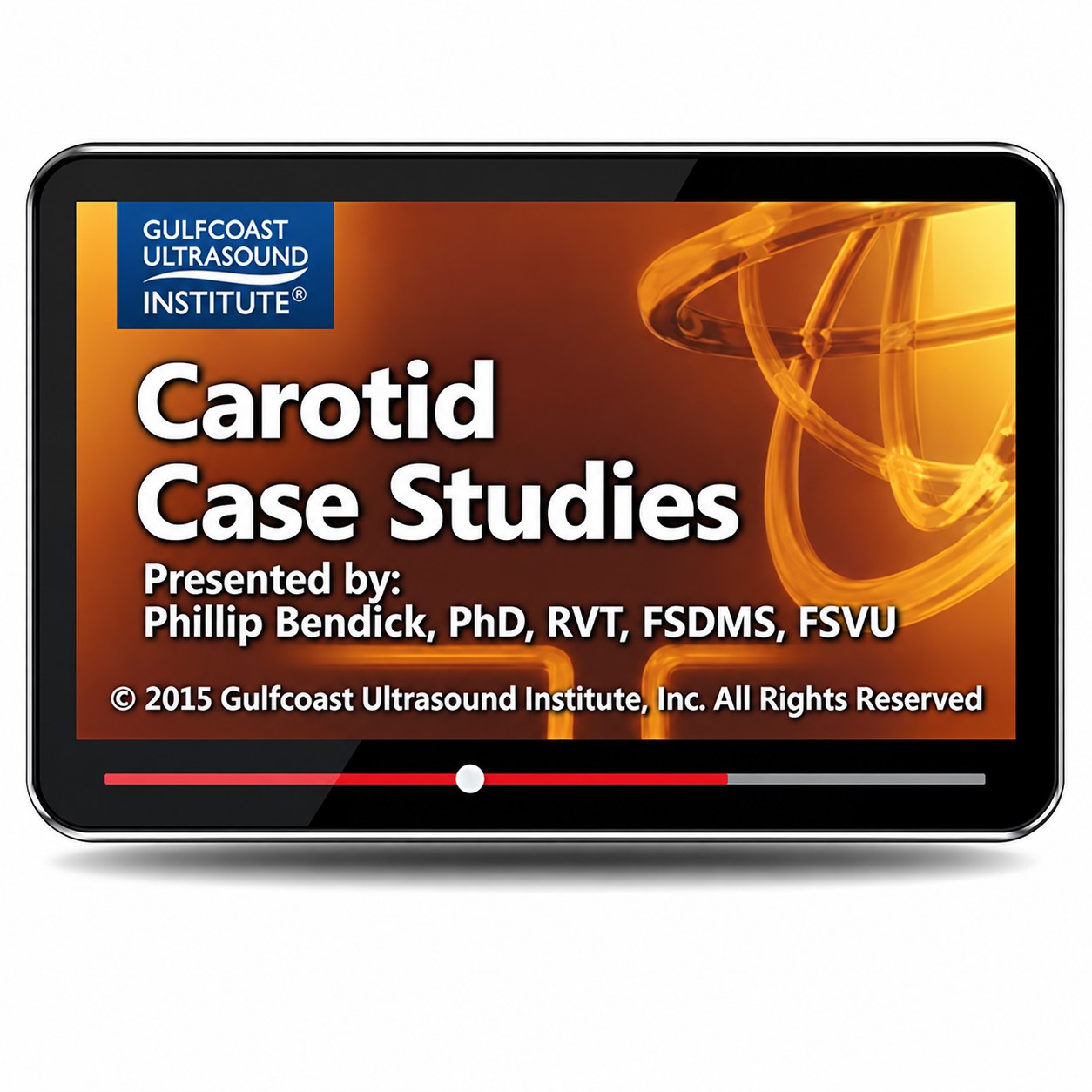
Gulfcoast Ultrasound: Carotid Case Studies (Videos + PDFs)
Advanced Case-Based Training in Carotid Duplex Ultrasound Interpretation
Overview
Gulfcoast Ultrasound Institute – Carotid Case Studies is an advanced vascular ultrasound educational program designed to strengthen diagnostic skills through real-world carotid duplex ultrasound cases. The course focuses on practical interpretation of carotid examinations, helping clinicians and sonographers recognize normal findings, identify varying degrees of carotid artery stenosis, evaluate carotid stents, detect vessel occlusion, and avoid common diagnostic pitfalls.
Using a case-based approach, participants learn how to apply established carotid stenosis criteria to actual patient studies and develop confidence in interpreting challenging cerebrovascular examinations. The curriculum emphasizes the integration of grayscale imaging, color Doppler, spectral Doppler analysis, and hemodynamic principles to accurately assess carotid artery disease and stroke risk. Carotid duplex ultrasound remains the primary noninvasive imaging modality for evaluating carotid stenosis and cerebrovascular disease.
Course Specifications
Format
- Video Lectures
- PDF Course Materials
- Case-Based Learning
- Vascular Ultrasound Education
Educational Level
Intermediate to Advanced
Provider
Gulfcoast Ultrasound Institute
Learning Objectives
Upon completion of this course, participants should be able to:
- Recognize normal carotid ultrasound anatomy and Doppler findings.
- Apply carotid stenosis grading criteria accurately.
- Differentiate moderate from severe carotid artery stenosis.
- Identify near occlusion and trickle-flow states.
- Recognize complete carotid artery occlusion.
- Evaluate carotid artery stents using duplex ultrasound.
- Interpret complex carotid Doppler waveforms.
- Identify common diagnostic pitfalls and artifacts.
- Improve reporting accuracy and clinical decision-making.
- Enhance stroke risk assessment through vascular ultrasound interpretation.
Course Curriculum
Normal Examination Overview
The course begins with a review of normal carotid duplex ultrasound findings.
Topics Include
- Common Carotid Artery (CCA)
- Internal Carotid Artery (ICA)
- External Carotid Artery (ECA)
- Normal Spectral Doppler Waveforms
- Normal Flow Velocities
- Carotid Anatomy Review
Understanding normal findings provides the foundation for identifying pathology.
Carotid Stenosis Criteria
A detailed review of the diagnostic criteria used to classify carotid artery disease.
Topics Include
- Peak Systolic Velocity (PSV)
- End-Diastolic Velocity (EDV)
- ICA/CCA Ratios
- Velocity Thresholds
- Hemodynamic Correlation
Participants learn how Doppler velocity measurements correlate with stenosis severity and clinical risk.
Moderate and Severe Carotid Stenosis
Real patient cases demonstrate the spectrum of carotid artery narrowing.
Topics Include
- Moderate ICA Stenosis
- Severe ICA Stenosis
- Plaque Morphology
- Flow Acceleration
- Post-Stenotic Turbulence
- Clinical Significance
Case reviews highlight the sonographic differences between varying levels of disease severity.
Trickle Flow
One of the most challenging vascular ultrasound findings.
Topics Include
- Near Occlusion
- Extremely Low Flow States
- High-Grade Stenosis
- Doppler Optimization Techniques
- Diagnostic Challenges
Participants learn how to distinguish residual flow from complete occlusion and avoid misclassification.
Carotid Occlusion
Recognition of complete arterial occlusion is critical for patient management.
Topics Include
- Total Internal Carotid Artery Occlusion
- Absence of Flow Signals
- Collateral Circulation
- Doppler Characteristics
- Pitfalls in Occlusion Diagnosis
The course emphasizes proper scanning techniques to confirm occlusion and avoid false-positive findings.
Carotid Stent Evaluation
Specialized instruction on post-intervention surveillance.
Topics Include
- Carotid Artery Stenting
- Stent Imaging Techniques
- In-Stent Restenosis
- Velocity Interpretation After Stenting
- Follow-Up Protocols
Participants learn how Doppler velocities may differ within stented arteries and how to interpret findings appropriately.
Diagnostic Pitfalls
A major component of the course focuses on avoiding common interpretation errors.
Topics Include
- Calcified Plaque Shadowing
- Vessel Tortuosity
- Improper Doppler Angle Correction
- Contralateral Disease Effects
- Near Occlusion Misinterpretation
- Technical Artifacts
These lessons help improve diagnostic accuracy and reporting consistency.
Case-Based Learning Approach
Unlike purely theoretical courses, this program emphasizes practical learning through:
Real Clinical Cases
- Normal Studies
- Moderate Stenosis
- Severe Stenosis
- Near Occlusion
- Complete Occlusion
- Stent Surveillance Cases
Participants learn how to approach carotid ultrasound interpretation systematically and confidently.
Clinical Applications
Stroke Prevention
Early identification of significant carotid disease can guide medical and surgical interventions.
Surgical Planning
Supports decisions regarding:
- Carotid Endarterectomy (CEA)
- Carotid Artery Stenting (CAS)
Follow-Up Imaging
Used for:
- Post-Procedure Surveillance
- Disease Progression Monitoring
- High-Risk Patient Evaluation
Educational Features
Practical Interpretation Focus
Emphasizes real-world carotid ultrasound interpretation rather than theory alone.
Expert Case Review
Provides exposure to a wide variety of normal and abnormal vascular studies.
Registry Preparation Value
Useful for professionals preparing for vascular ultrasound certification examinations.
Stroke-Oriented Learning
Focuses on findings that directly influence cerebrovascular risk assessment and patient management.
Target Audience
Physicians
- Vascular Surgeons
- Cardiologists
- Neurologists
- Radiologists
- Vascular Medicine Specialists
Sonographers
- Registered Vascular Technologists (RVT)
- Vascular Sonographers
- Diagnostic Medical Sonographers
Advanced Practice Providers
- Physician Assistants
- Nurse Practitioners
Trainees
- Vascular Fellows
- Cardiology Fellows
- Radiology Residents
Why This Course Stands Out
Real Case-Based Education
Provides hands-on exposure to common and challenging carotid ultrasound findings.
Comprehensive Disease Spectrum
Covers normal examinations, stenosis, near occlusion, complete occlusion, and stent surveillance.
Diagnostic Accuracy Focus
Highlights common pitfalls that frequently lead to interpretation errors.
Expert Vascular Ultrasound Training
Developed by Gulfcoast Ultrasound Institute, a recognized leader in ultrasound education.
Ideal for Clinical Practice and Registry Preparation
Supports both everyday vascular laboratory work and professional certification preparation.