
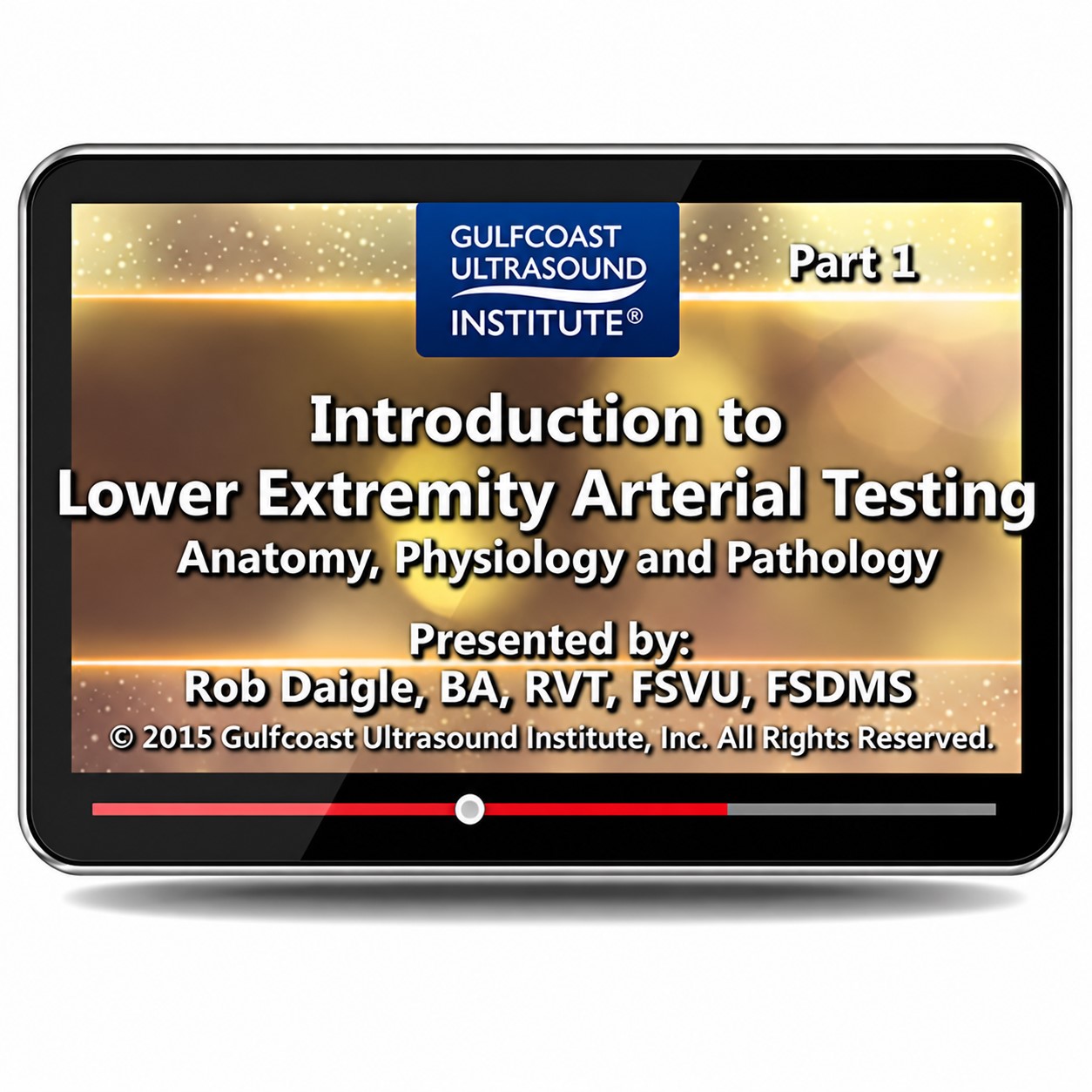
Gulfcoast Introduction to Lower Extremity Arterial Testing (Videos+PDFs)
Original price was: $600.00.$15.00Current price is: $15.00.
This Product is shared via google drive download link, So please share your correct Gmail id while placing the order .Please note that there are no CME points or certificate associated with this course
Contact me
Samples for Courses Can be found here : Free Samples Here!
Gulfcoast Introduction to Lower Extremity Arterial Testing (Videos + PDFs)
Fundamental Training in Peripheral Arterial Disease Assessment and Noninvasive Vascular Testing
Overview
Gulfcoast Introduction to Lower Extremity Arterial Testing is a practical vascular ultrasound training program developed by the Gulfcoast Ultrasound Institute. This course introduces the essential principles, protocols, and interpretation techniques used in noninvasive lower extremity arterial testing for the diagnosis and evaluation of peripheral arterial disease (PAD).
Designed for vascular sonographers, physicians, vascular technologists, and healthcare professionals involved in vascular diagnostics, the course provides a step-by-step introduction to physiologic arterial testing and hemodynamic assessment of lower extremity circulation.
Participants learn how to perform and interpret ankle-brachial indices (ABI), segmental pressures, Doppler waveform analysis, pulse volume recordings (PVR), and exercise testing while understanding their role in diagnosing arterial insufficiency and localizing vascular disease.
Course Specifications
Format
- Video Lectures
- PDF Course Materials
- On-Demand Learning
Educational Level
Beginner to Intermediate
Specialty
Vascular Ultrasound & Noninvasive Vascular Testing
Provider
Gulfcoast Ultrasound Institute
Learning Objectives
Upon completion of this course, participants should be able to:
- Understand the physiology of lower extremity arterial circulation.
- Perform noninvasive arterial testing procedures accurately.
- Measure and interpret ankle-brachial indices.
- Analyze Doppler waveforms and pulse volume recordings.
- Identify peripheral arterial disease and assess severity.
- Localize arterial occlusive disease using physiologic testing.
- Recognize limitations and pitfalls of vascular testing.
- Improve diagnostic confidence in vascular laboratory practice.
Core Topics Covered
Peripheral Arterial Disease (PAD)
Topics Include
- Pathophysiology of PAD
- Risk Factors
- Claudication
- Critical Limb Ischemia
- Vascular Symptoms
- Clinical Correlation
Participants learn how physiologic testing assists in the diagnosis and management of arterial disease.
Ankle-Brachial Index (ABI)
Topics Include
- ABI Technique
- Equipment Setup
- Normal and Abnormal Values
- Severity Classification
- Interpretation Guidelines
- Clinical Applications
Special emphasis is placed on the ABI as a frontline screening tool for peripheral arterial disease.
Segmental Pressure Testing
Topics Include
- Pressure Measurement Techniques
- Segmental Pressure Gradients
- Disease Localization
- Interpretation Strategies
Participants learn to identify the level of arterial obstruction through pressure analysis.
Doppler Waveform Analysis
Topics Include
- Continuous Wave Doppler
- Triphasic Waveforms
- Biphasic Waveforms
- Monophasic Waveforms
- Hemodynamic Significance
Understanding waveform morphology is a key component of arterial testing interpretation.
Pulse Volume Recordings (PVR)
Topics Include
- PVR Acquisition
- Waveform Characteristics
- Normal Findings
- Abnormal Findings
- Severity Assessment
PVR studies help evaluate arterial flow independent of calcified vessels.
Exercise Testing
Topics Include
- Exercise ABI Protocols
- Claudication Evaluation
- Post-Exercise Pressure Measurements
- Functional Assessment
Exercise testing improves detection of mild or occult peripheral arterial disease.
Disease Localization
Topics Include
- Aortoiliac Disease
- Femoropopliteal Disease
- Tibial Artery Disease
- Multilevel Occlusive Disease
Participants learn how physiologic testing helps determine the anatomical location of disease.
Vascular Laboratory Fundamentals
Topics Include
- Patient Preparation
- Examination Protocols
- Quality Assurance
- Documentation Standards
- Reporting Principles
Case-Based Interpretation
Clinical examples demonstrate:
- Normal Arterial Studies
- Mild PAD
- Moderate PAD
- Severe PAD
- Critical Limb Ischemia
- Common Diagnostic Pitfalls
Educational Features
Practical Clinical Approach
Focuses on techniques commonly performed in vascular laboratories.
Beginner-Friendly Curriculum
Ideal for professionals entering the field of vascular diagnostics.
Registry Preparation Support
Provides foundational knowledge useful for RVT, RPVI, and vascular registry examinations.
Real-World Application
Emphasizes interpretation skills applicable to daily clinical practice.
Target Audience
Physicians
- Cardiologists
- Vascular Surgeons
- Vascular Medicine Specialists
- Interventional Radiologists
- Internal Medicine Physicians
Sonographers
- Vascular Sonographers
- Diagnostic Medical Sonographers
- Ultrasound Technologists
Allied Health Professionals
- Vascular Technologists
- Physician Assistants
- Nurses
Trainees
- Residents
- Fellows
- Students Preparing for Vascular Registries
Why This Course Stands Out
- Excellent introduction to lower extremity arterial testing.
- Covers all essential physiologic vascular laboratory studies.
- Strong emphasis on interpretation and clinical relevance.
- Useful for both beginners and registry candidates.
- Developed by one of the leading ultrasound education providers.
Topics/Speaker:
- Lower Extremity Arterial Anatomy and Physiology
- Indirect Arterial Testing Methods
- Pulse Volume Recording
- Segmental Pressures
- ABI – Ankle Brachial Index
- Photo-Plethysmography
- Diagnostic Criteria for Lower Extremity Disease
- Duplex/Color Evaluation of the Lower Extremities
Related products
Cardiology

Medical Accounts
Medical Accounts
Cardiology
Internal Medicine

Internal Medicine

Internal Medicine
Critical Care - Emergency medicine