
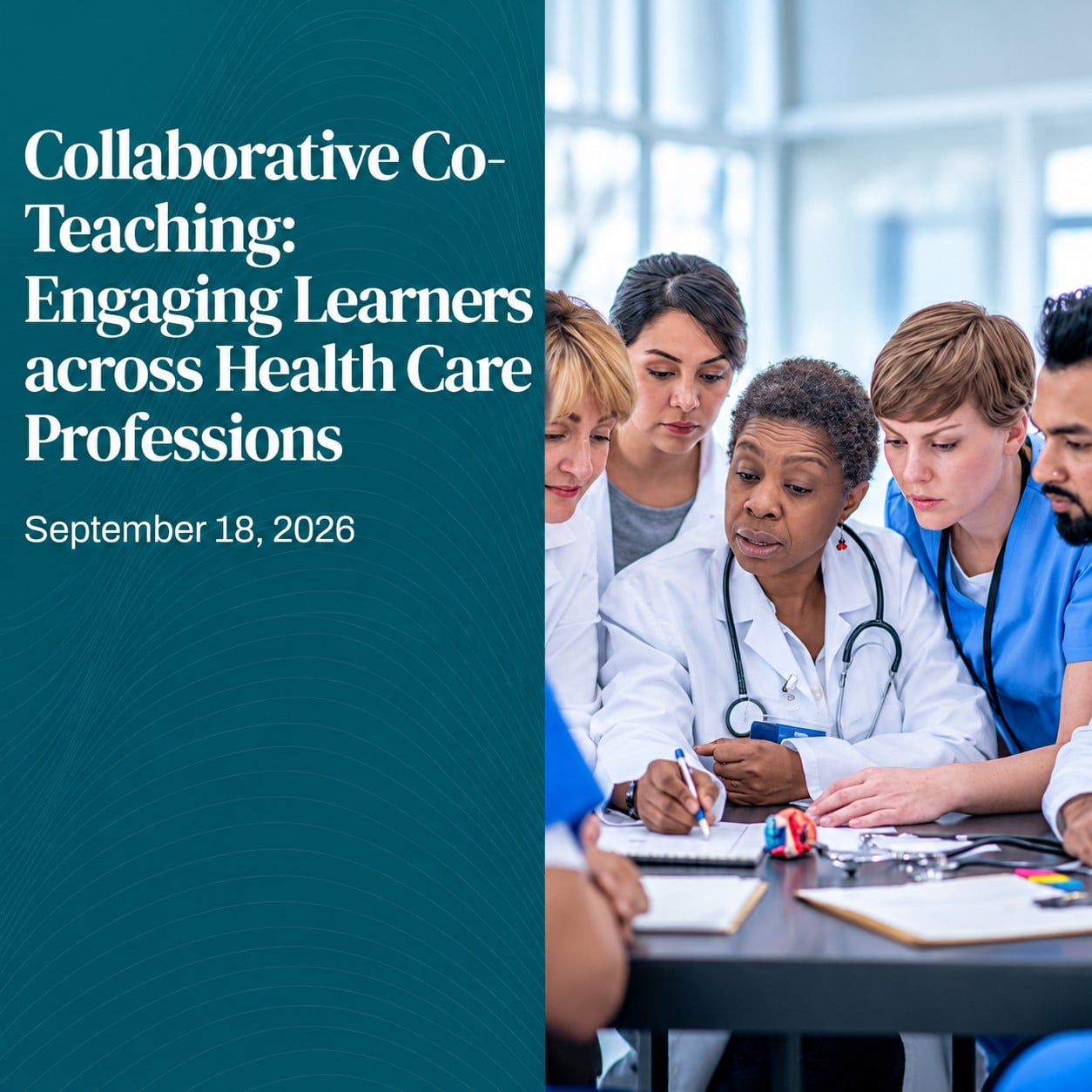
Harvard Collaborative Co-Teaching Engaging Learners across Health Care Professions 2026
$40.00
Explore interprofessional teaching through collaborative lesson planning, active learning, rehearsal, and practical implementation guidance. This 2026 Harvard and Brigham and Women’s Hospital program includes teaching demonstrations drawn from clinical care and patient safety. The published agenda includes concurrent breakout choices, whose listing does not confirm recording coverage.
Delivery Information: This Product is shared via google drive download link. Please use your correct Gmail address at checkout.
Please note: there are no CME points or certificate associated with this course.
Samples for Courses Can be found here: Free Samples Here!
Collaborative Co-Teaching explores how educators from different health professions can plan and deliver effective sessions together. Developed at Brigham and Women’s Hospital, the September 2026 program focuses on complementary expertise, active learning, and rehearsal. It combines teaching frameworks with examples drawn from clinical care, including prescribing, infection prevention, patient safety, communication, and hospital teamwork. Institutional experience from the VA Bedford Healthcare System and practical implementation sessions address how to establish a co-teaching initiative. The course is intended for physicians, nurses, pharmacists, allied health professionals, and other clinical educators who want to strengthen learner participation and coordinate teaching across professional roles.
Official Learning Objectives
Upon completion of the original educational activity, participants should be better able to:
- Design an effective collaborative co-teaching session by incorporating complementary expertise from different healthcare professions.
- Apply interactive educational methods and evidence-based content to create efficient, engaging, and effective learning experiences.
- Recognize the essential role of rehearsals in preparing healthcare educators to deliver successful collaborative teaching sessions.
Course Directors
The official 2026 Harvard Medical School program identifies four course directors.
Helen M. Shields, MD
Professor of Medicine, Harvard Medical School.
Physician, Gastroenterology, Brigham and Women’s Hospital.
Christine Smith, MSN, RN, PCCN
Clinical Educator, Brigham and Women’s Hospital.
Marina Zambrotta, MD, MEd
Clinical Assistant Professor of Medicine, Brown University Health.
William Martin Doyle, MD, MPH
Instructor in Medicine, Harvard Medical School and Brigham and Women’s Hospital.
The educational program includes additional faculty representing medicine, nursing, pharmacy, physical therapy, simulation education, and allied healthcare disciplines.
Program and recording scope: The agenda describes the September 18, 2026 live online course; all times are Eastern Time. Each afternoon breakout period offered five concurrent choices. Repeated titles and agenda entries do not establish distinct recordings or coverage of every alternative. The original listing’s Topics, including additional Nurse Doctor Co-Teaching items, are retained below; the supplied recording and document inventory is not independently verified. Harvard registration, live participation, faculty Q&A, learning-platform accounts, and publisher-hosted recording access are not included. The provider’s selected-recording access period of up to nine months applied to registered participants. The original description reports inconsistent accreditation totals; no CME, MOC points, contact hours, or certificates are included with these files.
Original Program and Faculty
Morning Educational Program
1. Opening Remarks
Time: 8:00 AM – 8:10 AM
Faculty:
- Helen Shields
- William Martin-Doyle
2. Genesis of RN-MD Co-Teaching Project
Time: 8:10 AM – 8:30 AM
Faculty: Marina Zambrotta
3. Introduction to Co-Teaching
Time: 8:30 AM – 9:30 AM
Faculty:
- James Honan
- Noah Heller
Morning Break
Time: 9:30 AM – 9:40 AM
4. How We Did It – The VA Bedford Healthcare System Experience
Time: 9:40 AM – 10:10 AM
Faculty: Jim Meisel
5. Techniques for Active and Engaging Teaching
Time: 10:10 AM – 11:15 AM
Faculty: Marina Zambrotta
6. A Framework for Structured and Effective Co-Teaching Sessions
Time: 11:15 AM – 12:00 PM
Faculty:
- Helen Shields
- Marina Zambrotta
Lunch Break
Time: 12:00 PM – 1:00 PM
Breakout Group A
Time: 1:00 PM – 1:45 PM
A1. Alcohol Withdrawal and CIWA-AR Scale
Faculty:
- William Martin-Doyle
- Mary Hardiman
A2. Age-Friendly Prescribing: Less Is More
Faculty:
- Ashmeet Bhatia
- Chelsea Hawley
A3. Arterial Blood Gases
Faculty:
- Marliyatou Diallo
- Helen Shields
A4. De-escalating and Addressing Incivility and Bullying in the Hospital through Simulation Techniques
Faculty:
- Christine Smith
- Eric Nohelty
A5. The Chief Nursing Officer’s (CNO) and Chief Medical Officer’s (CMO) Dyad Approach to Improving Quality Outcomes
Faculty:
- Julia Mason
- Simon Talbot
Break
Time: 1:45 PM – 2:00 PM
Breakout Group B
Time: 2:00 PM – 2:45 PM
B1. Arterial Blood Gases
Faculty:
- Marliyatou Diallo
- Helen Shields
B2. Catch My Flow: Fun Facts about CAUTIs
Faculty:
- Ewa Grudzinski
- Alexander Carbo
B3. The Agony and Ecstasy of Telemetry Alarms
Faculty:
- Bram Wispelwey
- Stephanie Bartelt
B4. Don’t Let Them Drop: An Interprofessional Dive into Fall Prevention in Older Adults
Faculty:
- Lionel Lim
- Amanda Naughton
- Danielle Davila
- Priscilla Kim
B5. Approach to Upper GI and Variceal Bleeders
Faculty:
- Anne Liu
- Gina Morrissy
Break
Time: 2:45 PM – 3:00 PM
Breakout Group C
Time: 3:00 PM – 3:45 PM
C1. Clostridioides difficile: Nuances of Diagnosis and Complex Therapeutic Decisions in the Hospitalized Patient
Faculty:
- Kety FlorGomes
- Helen Shields
C2. Approach to Upper GI and Variceal Bleeders
Faculty:
- Anne Liu
- Gina Morrissy
C3. Don’t Break Any Bones about It – Osteoporosis Doesn’t Discriminate: Time to Screen Both Men and Women
Faculty:
- Amanda Naughton
- Lionel Lim
C4. Medical Interpreters as Partners in Patient Care
Faculty:
- Rosa Terrance
- Yilu Ma
- Irene Yeh
C5. Protecting Patients from Pressure Injuries
Faculty:
- Ewa Grudzinski
- Marina Pavia
Break
Time: 3:45 PM – 4:00 PM
7. Keynote Address
Time: 4:00 PM – 4:10 PM
Faculty: Lisa Rosenbaum
8. Partnering for Success: A Look behind the Scenes in the Past, Present and Future
Time: 4:10 PM – 4:30 PM
Faculty:
- Helen Shields
- Christine Smith
- Ewa Grudzinski
9. Implementation Strategies: Tips for Success!
Time: 4:30 PM – 5:00 PM
Faculty:
- Helen Shields
- William Martin-Doyle
- Christine Smith
- Jim Meisel
- Marina Zambrotta
- Topics:
-
A Framework for Structured and Effective Co-Teaching Sessions
-
A1 Collaborative Co-Teaching – Alcohol Withdrawal and CIWA-Ar Scale
-
A2 Collaborative Co-Teaching – Age-Friendly Prescribing – Less is More
-
A3 Collaborative Co-Teaching – Arterial Blood Gases
-
A4 Collaborative Co-Teaching – De-escalating and Addressing Incivility and Bullying in the Hospital through Simulation Techniques
-
A5 Collaborative Co-Teaching – The Chief Nursing Officer’s (CNO) and Chief Medical Officer’s (CMO) Dyad Approach to Improving Quality Outcomes
-
B1 Collaborative Co-Teaching – Arterial Blood Gases
-
B2 Collaborative Co-Teaching – Catch My Flow – Fun Facts about CAUTI’s
-
B3 Collaborative Co-Teaching – The Agony and Ecstasy of Telemetry Alarms
-
B4 Collaborative Co-Teaching – Don’t Let Them Drop – An Interprofessional Dive into Fall Prevention in Older Adults
-
B5 Collaborative Co-Teaching – Approach to Upper GI and Variceal Bleeders
-
C1 Collaborative Co-Teaching – Clostridioides difficile – Nuances of Diagnosis and Complex Therapeutic Decisions in the Hospitalized Patient
-
C2 Collaborative Co-Teaching – Approach to Upper GI and Variceal Bleeders
-
C3 Collaborative Co-Teaching – Don’t Break Any Bones about It-Osteoporosis Doesn’t Discriminate – Time to Screen Both Men and Women
-
C4 Collaborative Co-Teaching – Medical Interpreters as Partners in Patient Care
-
C5 Collaborative Co-Teaching – Protecting Patients from Pressure Injuries
-
Genesis of RN-MD Co-Teaching Project
-
How We Did It. The VA Bedford Healthcare System Experience 2026
-
Implementation Strategies – Tips for Success!
-
Introduction to Co-Teaching
-
Key Note Address
-
Nurse Doctor Co-Teaching Arterial Blood Gases
-
Nurse Doctor Co-Teaching Catch My Flow What You Need to Know About CAUTIs
-
Nurse Doctor Co-Teaching CIWA Scale
-
Nurse Doctor Co-Teaching H. Pylori
-
Nurse Doctor Co-Teaching Interruptions on the Medical Unit
-
Nurse Doctor Co-Teaching Mastering Opioid Withdrawal with COWS
-
Nurse Doctor Co-Teaching The Agony and Ecstasy of Telemetry Alarms
-
Nurse Doctor Co-Teaching The Ins and Outs of HYPONATREMIA
-
Nurse Doctor Co-Teaching Tres Difficile
-
Nurse Doctor Co-Teaching Venous Thromboembolism on GMS Can we make a difference
-
Opening Remarks
-
Partnering for Success – A Look behind the Scenes in the Past and Present and Future
-
Techniques for Active and Engaging Teaching
-
Related products
Critical Care - Emergency medicine
Internal Medicine
Critical Care - Emergency medicine
Critical Care - Emergency medicine
Critical Care - Emergency medicine

USMLE / kaplan and Board Review
Uworld USMLE COMLEX Level 1 Qbank, Updated Jan 2023, System- and Subject-wise (PDF)
Internal Medicine