
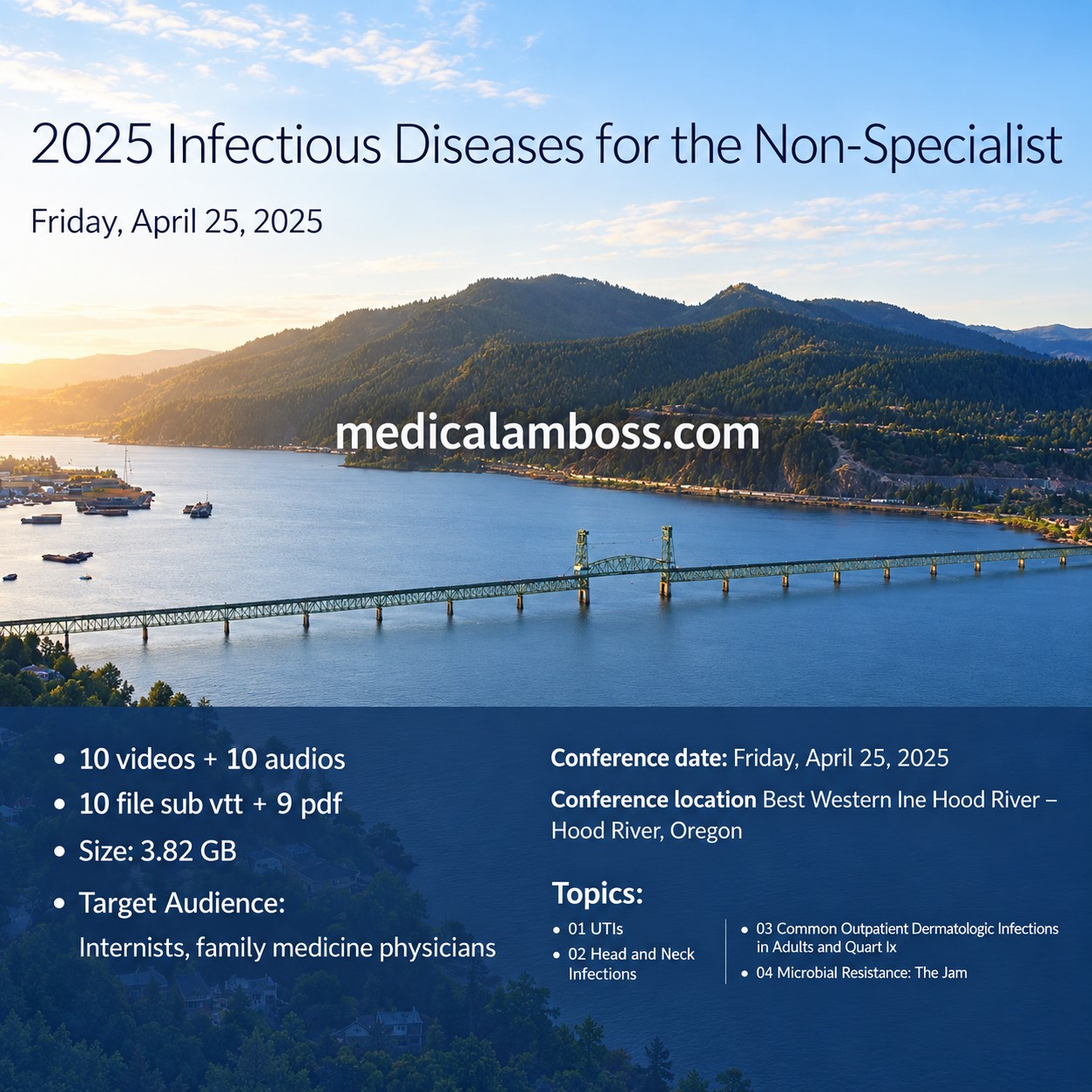
Infectious Diseases for the Non-Specialist 2025
Original price was: $235.00.$25.00Current price is: $25.00.
This Product is shared via google drive download link, So please share your correct Gmail id while placing the order .Please note that there are no CME points or certificate associated with this course Samples for Courses Can be found here : Free Samples Here!Include
Include: 10 videos + 10 audios + 10 file sub vtt + 9 pdf, size: 3.82 GB
Infectious Diseases for the Non-Specialist 2025
Practical Infectious Disease Management for Primary Care & Frontline Clinicians
The Infectious Diseases for the Non-Specialist 2025 course from Oregon Health & Science University (OHSU) is a practical, case-based educational program designed to help frontline healthcare professionals confidently diagnose, manage, and prevent infectious diseases encountered in everyday clinical practice. Focused on real-world decision-making, this course bridges the gap between infectious disease specialty knowledge and routine outpatient and inpatient care.
Through expert-led lectures, interactive case discussions, and evidence-based clinical guidance, participants gain practical skills in antimicrobial stewardship, infection diagnosis, preventive medicine, vaccination strategies, sexually transmitted infections, viral hepatitis, and management of both common and complex infectious diseases.
The curriculum emphasizes immediate clinical applicability, helping clinicians improve diagnostic accuracy, optimize antimicrobial use, and deliver high-quality evidence-based care across diverse patient populations.
Product Details
- Format: 10 Video Lectures + 10 Audio Files + 10 Subtitle Files (.VTT) + 9 PDF Presentations
- Total Size: 3.82 GB
- Course Date: April 25, 2025
- Location: Best Western Plus Hood River Inn, Oregon
- Access: On-Demand
- Level: Primary Care to Intermediate
Program Overview
Infectious diseases remain one of the most common reasons patients seek medical care. Clinicians frequently face challenges involving antimicrobial selection, diagnostic uncertainty, emerging pathogens, vaccination recommendations, and complex infections that require timely intervention.
This course provides practical updates on:
- Antibiotic stewardship
- Urinary tract infections (UTIs)
- Respiratory infections
- Skin and soft tissue infections
- Sepsis
- Endocarditis
- Osteomyelitis
- Hepatitis B and C
- Sexually transmitted infections (STIs)
- PrEP and Doxy-PEP
- Water-borne illnesses
- Influenza and emerging viral infections
- Preventive infectious disease strategies
Participants gain actionable knowledge that can be immediately implemented in clinical practice.
Learning Objectives
Upon completion of this course, participants will be able to:
- Apply antimicrobial stewardship principles in outpatient and inpatient settings.
- Select appropriate antibiotic therapies based on current guidelines.
- Diagnose and manage common infectious diseases.
- Recognize and treat serious infections such as sepsis and endocarditis.
- Implement screening and management strategies for viral hepatitis.
- Utilize preventive interventions including vaccination, PrEP, and Doxy-PEP.
- Interpret laboratory results and diagnostic testing effectively.
- Incorporate evidence-based infectious disease practices into routine patient care.
Core Topics Covered
Antibiotic Stewardship
A major focus of the course is the responsible use of antimicrobial therapy.
Topics include:
- Appropriate antibiotic selection
- Antimicrobial resistance prevention
- Evidence-based prescribing
- De-escalation strategies
- Outpatient stewardship programs
- Reducing unnecessary antibiotic exposure
Faculty provide practical prescribing frameworks applicable to daily practice.
Urinary Tract Infections (UTIs)
Sessions review:
- Diagnosis of uncomplicated and complicated UTIs
- Antibiotic selection
- Recurrent infections
- Resistance considerations
- Outpatient management strategies
Clinicians learn current guideline-based approaches to treatment.
Respiratory Infections
Participants explore modern management of:
- Influenza
- Community-acquired pneumonia
- Viral respiratory infections
- Emerging influenza variants
- Diagnostic testing strategies
Special emphasis is placed on distinguishing viral from bacterial infections.
Skin & Soft Tissue Infections
Topics include:
- Cellulitis
- Abscess management
- Dermatologic infections
- Antibiotic selection
- Outpatient treatment protocols
Clinical cases help reinforce practical decision-making.
Sepsis & Bloodstream Infections
Advanced sessions cover:
- Early sepsis recognition
- Diagnostic evaluation
- Blood culture interpretation
- Initial antimicrobial therapy
- Escalation and de-escalation strategies
Participants review current evidence-based approaches to serious infections.
Endocarditis & Osteomyelitis
The course examines:
- Diagnostic criteria
- Imaging strategies
- Antimicrobial management
- Long-term treatment considerations
- Multidisciplinary care approaches
Faculty discuss common clinical challenges and management pearls.
Hepatitis B & Hepatitis C
Dedicated lectures review:
- Screening recommendations
- Diagnostic evaluation
- Treatment advances
- Monitoring protocols
- Prevention strategies
Participants gain updates on evolving management standards.
Sexually Transmitted Infections (STIs)
Topics include:
- STI screening
- Gonorrhea and chlamydia management
- Syphilis updates
- HIV prevention strategies
- Emerging treatment recommendations
Current guideline-based approaches are emphasized.
PrEP & Doxy-PEP
Participants receive updates on:
- HIV pre-exposure prophylaxis (PrEP)
- Doxycycline post-exposure prophylaxis (Doxy-PEP)
- Patient selection
- Monitoring protocols
- Risk reduction strategies
These sessions address rapidly evolving preventive care practices.
Emerging & Environmental Infections
The course reviews:
- Water-borne illnesses
- Emerging pathogens
- Bird flu and influenza variants
- Public health considerations
- Travel-related infections
Faculty discuss practical approaches to uncommon but clinically important infections.
Preventive Infectious Disease Medicine
Important prevention topics include:
- Adult immunization updates
- Vaccine recommendations
- Infection prevention strategies
- Screening programs
- Population health approaches
Participants learn how preventive care can reduce infectious disease burden.
Educational Features
✔ Practical Case-Based Learning
✔ Primary Care Focused Infectious Disease Updates
✔ Antibiotic Stewardship Training
✔ Sepsis & Serious Infection Management
✔ STI & HIV Prevention Updates
✔ Hepatitis B & C Screening Strategies
✔ Vaccination & Preventive Medicine Guidance
✔ Evidence-Based Clinical Algorithms
Target Audience
This course is ideal for:
- Internal Medicine Physicians
- Family Medicine Physicians
- Primary Care Physicians
- Nurse Practitioners
- Physician Assistants
- Hospitalists
- Urgent Care Providers
- Emergency Medicine Clinicians
- Advanced Practice Providers
- Medical Trainees
Why This Course Stands Out
✔ Designed specifically for non-infectious disease specialists
✔ Strong emphasis on practical clinical management
✔ Covers both outpatient and inpatient infections
✔ Includes current stewardship recommendations
✔ Updates on PrEP, Doxy-PEP, and STI prevention
✔ Focuses on real-world clinical decision-making
✔ Immediate applicability to primary care practice
✔ Evidence-based and guideline-driven content
Clinical & Educational Value
The Infectious Diseases for the Non-Specialist 2025 course provides clinicians with a practical and comprehensive update on infectious disease management. Through case-based learning and evidence-based guidance, participants strengthen their ability to diagnose infections accurately, prescribe antibiotics responsibly, implement preventive strategies, and improve outcomes across a broad range of common and complex infectious diseases.
Related products
Critical Care - Emergency medicine
40th ISICEM International Symposium on Intensive Care & Emergency Medicine 2021
Critical Care - Emergency medicine
Critical Care - Emergency medicine

Medical Accounts
Critical Care - Emergency medicine
The Brigham Board Review in Infectious Diseases Brigham and Women’s Hospital Board Review

Critical Care - Emergency medicine
Critical Care - Emergency medicine