
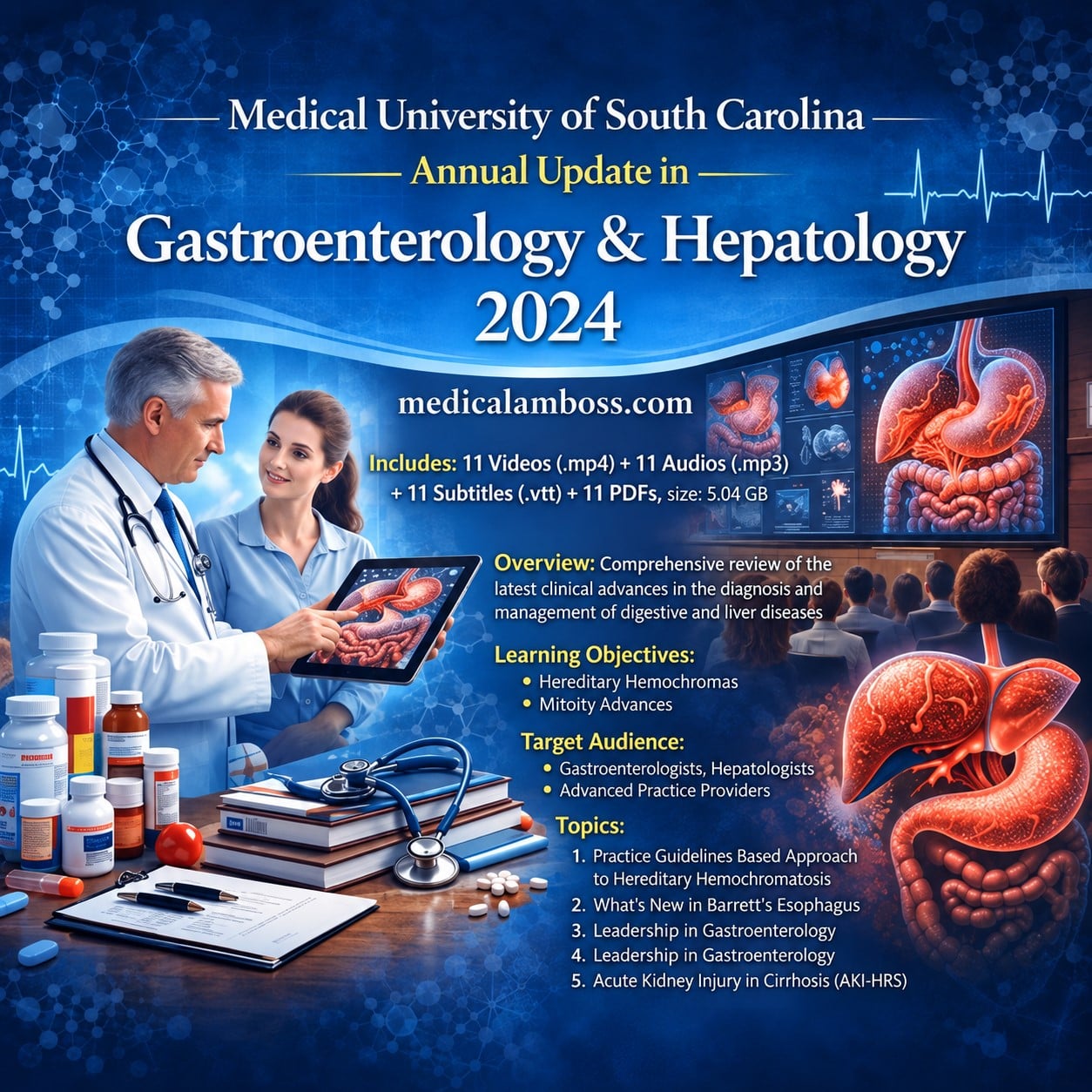
Medical University of South Carolina Annual Update in Gastroenterology & Hepatology 2024
Original price was: $150.00.$15.00Current price is: $15.00.
This Product is shared via google drive download link, So please share your correct Gmail id while placing the order .Please note that there are no CME points or certificate associated with this course Samples for Courses Can be found here : Free Samples Here!Include
Include: 11 Videos (.mp4) + 11 Audios (.mp3) + 11 Subtitles (.vtt) + 11 PDFs, size: 5.04 GB
Medical University of South Carolina Annual Update in Gastroenterology & Hepatology 2024
Advanced Clinical Updates in Gastroenterology, Hepatology & Digestive Diseases
The Medical University of South Carolina (MUSC) Annual Update in Gastroenterology & Hepatology 2024 provides a comprehensive review of the latest evidence-based advances in digestive and liver diseases. Designed for practicing gastroenterologists, hepatologists, and advanced practice providers, this program delivers practical clinical updates that can be immediately integrated into patient care.
Through expert-led lectures and case-based discussions, participants gain valuable insights into the diagnosis, management, and prevention of complex gastrointestinal and hepatobiliary disorders. The curriculum highlights current clinical guidelines, emerging diagnostic technologies, quality improvement initiatives, and evolving therapeutic strategies across a broad spectrum of GI and liver conditions.
Special emphasis is placed on hereditary liver diseases, cirrhosis complications, Barrett’s esophagus, inflammatory bowel disease, gastrointestinal bleeding, microbiome science, and advances in endoscopic practice.
Product Details
- Format: 11 Videos (.MP4) + 11 Audios (.MP3) + 11 Subtitle Files (.VTT) + 11 PDFs
- Total Size: 5.04 GB
- Course Year: 2024
- Access: On-Demand
- Level: Intermediate to Advanced
Program Overview
This educational program offers an up-to-date review of important developments in gastroenterology and hepatology, focusing on practical strategies to improve patient outcomes and optimize clinical decision-making.
Topics include:
- Hepatology updates
- Hereditary hemochromatosis
- Primary biliary cholangitis (PBC)
- Barrett’s esophagus
- Small bowel bleeding
- Endoscopy quality improvement
- Inflammatory bowel disease (IBD)
- Small intestinal bacterial overgrowth (SIBO)
- Irritable bowel syndrome (IBS)
- Cirrhosis complications
- Cardiorenal syndromes
- Intestinal ultrasound
- Microbiome-based medicine
Participants gain evidence-based knowledge applicable to both academic and community practice settings.
Learning Objectives
Upon completion of this activity, participants will be able to:
- Apply current clinical guidelines for hereditary hemochromatosis management.
- Implement evidence-based treatment strategies for primary biliary cholangitis.
- Evaluate modern endoscopy training and quality improvement initiatives.
- Integrate new approaches to Barrett’s esophagus surveillance and treatment.
- Diagnose and manage small bowel arteriovenous malformation (AVM) bleeding.
- Recognize and treat cardiac and renal complications associated with chronic liver disease.
- Assess the role of the gut microbiome in SIBO and IBS.
- Utilize intestinal ultrasound in inflammatory bowel disease management.
- Incorporate recent advances in gastroenterology and hepatology into clinical practice.
Core Topics Covered
Hepatology Updates
A major focus of the course is the management of chronic liver disease and hepatobiliary disorders.
Topics include:
- Hereditary hemochromatosis
- Primary biliary cholangitis (PBC)
- Cirrhosis management
- Liver disease complications
- Hepatology guideline updates
- Evidence-based treatment approaches
Faculty review current standards and emerging therapies.
Hereditary Hemochromatosis
Participants learn practical approaches to:
- Early diagnosis
- Genetic evaluation
- Iron overload assessment
- Therapeutic phlebotomy
- Long-term monitoring
- Prevention of organ complications
The course highlights updated recommendations and best practices.
Primary Biliary Cholangitis (PBC)
Sessions focus on:
- Diagnostic criteria
- Risk stratification
- Ursodeoxycholic acid therapy
- Second-line treatment options
- Monitoring disease progression
- Management of advanced disease
Current clinical guidelines are reviewed in detail.
Barrett’s Esophagus
Dedicated lectures examine:
- Screening recommendations
- Surveillance strategies
- Dysplasia management
- Endoscopic eradication therapies
- Risk reduction approaches
Participants gain practical guidance on optimizing patient care.
Small Bowel AVM Bleeding
Topics include:
- Evaluation of obscure GI bleeding
- Small bowel vascular lesions
- Capsule endoscopy
- Deep enteroscopy
- Endoscopic treatment techniques
- Long-term management
Faculty discuss challenging diagnostic and therapeutic scenarios.
Endoscopy Training & Quality Improvement
The conference reviews:
- Modern endoscopy education
- Competency assessment
- Quality metrics
- Procedure optimization
- Patient safety initiatives
- Quality improvement frameworks
These sessions emphasize excellence in procedural gastroenterology.
Cirrhosis & Cardiorenal Complications
Participants explore:
- Portal hypertension
- Hepatorenal syndrome
- Cardiac dysfunction in cirrhosis
- Volume management
- Renal protection strategies
- Advanced liver disease monitoring
Clinical management strategies are reviewed through real-world cases.
Microbiome, SIBO & IBS
A dedicated section examines:
- Gut microbiome science
- Small intestinal bacterial overgrowth (SIBO)
- Irritable bowel syndrome (IBS)
- Diagnostic testing
- Therapeutic interventions
- Emerging microbiome therapies
The course highlights the growing clinical significance of microbiome research.
Inflammatory Bowel Disease & Intestinal Ultrasound
Topics include:
- Crohn’s disease
- Ulcerative colitis
- Intestinal ultrasound techniques
- Disease monitoring
- Noninvasive assessment
- Integration into IBD clinics
Faculty discuss how ultrasound is transforming IBD management.
Educational Features
✔ Comprehensive Gastroenterology & Hepatology Review
✔ Evidence-Based Clinical Updates
✔ Barrett’s Esophagus Management
✔ Cirrhosis & Liver Disease Complications
✔ Microbiome & SIBO Insights
✔ Intestinal Ultrasound Education
✔ Endoscopy Quality Improvement Strategies
✔ Practical Case-Based Learning
Target Audience
This course is ideal for:
- Gastroenterologists
- Hepatologists
- Advanced Practice Providers
- Internal Medicine Physicians
- GI Fellows
- Hepatology Fellows
- Physician Assistants
- Nurse Practitioners
- Digestive Disease Specialists
Why This Course Stands Out
✔ Comprehensive review of both GI and liver diseases
✔ Strong focus on evidence-based clinical practice
✔ Covers emerging technologies such as intestinal ultrasound
✔ Practical management strategies for complex hepatology cases
✔ Reviews evolving microbiome science and applications
✔ Addresses endoscopy quality and training innovations
✔ Relevant to both academic and community clinicians
✔ Designed for immediate clinical implementation
Clinical & Educational Value
The Medical University of South Carolina Annual Update in Gastroenterology & Hepatology 2024 provides a practical and comprehensive review of contemporary digestive and liver disease management. Through expert instruction and evidence-based updates, participants strengthen their ability to diagnose, monitor, and treat a wide range of gastrointestinal and hepatobiliary disorders while improving patient outcomes through modern clinical practice.
Topics
-
Practice Guidelines Based Approach to Hereditary Hemochromatosis
-
Updates in Diagnosis and Management of Small Bowel AVM Bleeding
-
What’s New in Barrett’s Esophagus
-
Leadership in Gastroenterology
-
Acute Kidney Injury in Cirrhosis (AKI HRS) – The Known and Unknown
-
Enhancing Endoscopic Quality – Training Modalities to Optimize Skills Among Fellows
-
Advances in Neurogastroenterology Motility for the Clinician
-
Characterizing the Microbiome in SIBO and IBS
-
Cardiac Complications of Chronic Liver Disease
-
Primary Biliary Cholangitis – State of the Art in 2024
-
Role of Intestinal Ultrasound in IBD Clinic
Related products

Critical Care - Emergency medicine
Critical Care - Emergency medicine
The Brigham Board Review in Infectious Diseases Brigham and Women’s Hospital Board Review
Family medicine
Critical Care - Emergency medicine

Internal Medicine

Internal Medicine

Medical Accounts