
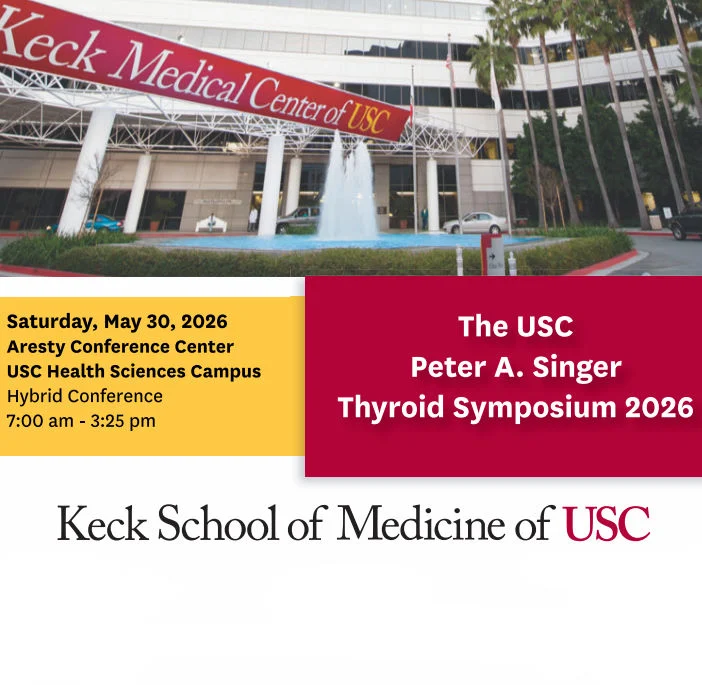
Keck USC The USC Peter A. Singer Thyroid Symposium 2026
$25.00
USC Thyroid Symposium 2026 reviews Graves’ disease, thyroid emergencies, imaging and thyroid cancer management.
Delivery Information: This Product is shared via google drive download link. Please use your correct Gmail address at checkout.
Please note: there are no CME points or certificate associated with this course.
Samples for Courses Can be found here: Free Samples Here!
MedicalAmboss File Scope: This listing describes the educational subject matter for reference. Provider registration, live attendance, streaming-platform access, CME or other credit, certificates, memberships, apps, accounts, and publisher-hosted extras are not included unless they are explicitly listed as store files. MedicalAmboss.
USC Peter A. Singer Thyroid Symposium 2026
The USC Peter A. Singer Thyroid Symposium 2026 | Thyroid Disease, Graves’ Disease, Thyroid Cancer, Imaging, Hyperparathyroidism & Thyroid Emergencies CME
The USC Peter A. Singer Thyroid Symposium 2026, presented by Keck School of Medicine of USC, provides an evidence-based clinical update on the rapidly evolving diagnosis and management of thyroid disorders.
Designed for endocrinologists, surgeons, primary care clinicians, advanced practice providers, and other healthcare professionals involved in thyroid care, this symposium focuses on translating current guidelines and emerging evidence into practical decision-making for both common and challenging endocrine cases.
Through didactic presentations, expert discussions, panel sessions, and audience-focused clinical questions, the program examines contemporary approaches to thyroid dysfunction, Graves’ disease, thyroid emergencies, thyroid imaging, thyroid cancer, hyperparathyroidism, and medication-induced thyroid disease.
The 2026 symposium also emphasizes individualized clinical decision-making, including appropriate diagnostic testing, interpretation of laboratory and imaging findings, long-term treatment strategies, and right-sizing thyroid cancer evaluation—particularly in older patients.
Course Details
- Course: The USC Peter A. Singer Thyroid Symposium 2026
- Provider: Keck School of Medicine of USC
- Date: May 30, 2026
- Format: Hybrid educational symposium
- Specialty Focus: Endocrinology, Thyroid Disease, Endocrine Surgery, Head and Neck Surgery, Thyroid Oncology, Nuclear Medicine and Primary Care
- Educational Approach: Didactic presentations, expert panel discussions, clinical scenarios and audience questions
Target Audience
This educational program is intended for healthcare professionals involved in the diagnosis and management of thyroid and endocrine disorders, including:
- Endocrinologists
- Endocrine Surgeons
- Otolaryngologists and Head and Neck Surgeons
- Primary Care Physicians
- Advanced Practice Providers
- Medical Oncologists
- Radiologists
- Nuclear Medicine Specialists
- Hospitalists
- Geriatricians
- Obstetricians and Gynecologists
- Maternal-Fetal Medicine Specialists
- Fellows and Residents
- Allied Health Professionals involved in thyroid care
The symposium is particularly valuable for clinicians seeking updated guidance on complex thyroid disease, modern diagnostic strategies, imaging selection, thyroid cancer assessment and evidence-based treatment decisions.
Program Overview
Clinical management of thyroid disorders continues to evolve as new guidelines, diagnostic technologies and therapeutic strategies become available.
The USC Peter A. Singer Thyroid Symposium 2026 provides clinicians with a focused review of important developments in modern thyroid medicine while emphasizing practical strategies that can be incorporated into everyday patient care.
A central component of the program is the interpretation and application of evolving recommendations for thyroid disease. Participants examine how updated guidelines can influence diagnostic testing, imaging selection, treatment decisions and long-term follow-up.
The symposium also addresses several challenging areas of endocrine practice, including recognition and treatment of thyroid emergencies, the expanding role of long-term methimazole therapy in Graves’ disease, interpretation of biochemical and imaging findings in hyperparathyroidism and thyroid cancer, and identification of medications capable of producing clinically significant thyroid dysfunction.
Special attention is given to achieving an appropriate balance between comprehensive evaluation and avoiding unnecessary intervention, including individualized assessment of thyroid cancer in older patients.
Learning Objectives
By the end of the course, participants will be able to:
- Integrate new and modified recommendations from current guidelines for various thyroid conditions.
- Distinguish the diagnostic criteria and interventions for thyroid emergencies.
- Examine the evidence for treatment of Graves’ disease with long-term methimazole therapy.
- Assess blood test and imaging results to inform treatment decisions for hyperparathyroidism and thyroid cancer.
- Identify medication causes of thyroid dysfunction.
Key Clinical Focus Areas
Current Thyroid Guidelines
Review new and modified recommendations affecting the evaluation and management of patients with thyroid disorders and consider how updated guidance can be incorporated into clinical practice.
Thyroid Emergencies
Recognize important diagnostic criteria for severe and potentially life-threatening thyroid disorders and understand appropriate interventions in urgent clinical situations.
Graves’ Disease and Long-Term Methimazole Therapy
Examine current evidence surrounding prolonged methimazole treatment for Graves’ disease and its potential role in selected patients requiring long-term management.
Thyroid Imaging
Evaluate the appropriate use of imaging modalities in thyroid disease and integrate imaging results with biochemical and clinical findings when developing patient-specific management strategies.
Thyroid Cancer Assessment
Explore contemporary approaches to evaluating thyroid cancer, including strategies for tailoring assessment and intervention according to patient characteristics and clinical risk.
Thyroid Cancer in Older Adults
Consider how age, comorbidities, tumor characteristics and competing health risks may influence diagnostic intensity and treatment planning in older patients.
Hyperparathyroidism
Assess laboratory testing and imaging findings relevant to patients with hyperparathyroidism and use these results to support appropriate clinical management.
Medication-Induced Thyroid Dysfunction
Identify medications capable of causing or altering thyroid dysfunction and understand their implications for thyroid function testing, diagnosis and treatment.
Major Topics Covered
Major clinical themes addressed in The USC Peter A. Singer Thyroid Symposium 2026 include:
- Updated thyroid disease guidelines
- Modern thyroid disease management
- Thyroid function testing
- Thyroid imaging selection
- Thyroid emergencies
- Graves’ disease
- Long-term methimazole therapy
- Hyperthyroidism
- Medication-induced thyroid dysfunction
- Hyperparathyroidism
- Interpretation of biochemical testing
- Endocrine imaging
- Thyroid nodules
- Thyroid cancer assessment
- Thyroid cancer in older adults
- Risk-based thyroid cancer evaluation
- Personalized thyroid disease management
- Multidisciplinary thyroid care
Why This Symposium Is Relevant
Thyroid disorders are among the most frequently encountered endocrine conditions, yet their evaluation and treatment can become increasingly complex as diagnostic technologies, treatment options and clinical recommendations evolve.
The USC Peter A. Singer Thyroid Symposium 2026 addresses this challenge by emphasizing clinically applicable evidence rather than isolated theoretical concepts.
The program is particularly relevant for professionals managing patients with:
- Hyperthyroidism and Graves’ disease
- Suspected thyroid emergencies
- Thyroid nodules
- Thyroid malignancies
- Abnormal thyroid function tests
- Medication-associated thyroid abnormalities
- Hyperparathyroidism
- Complex or uncertain imaging findings
The multidisciplinary perspective also makes the symposium useful for clinicians working across endocrinology, surgery, oncology, radiology, nuclear medicine and primary care.
Short Description
The Keck USC The USC Peter A. Singer Thyroid Symposium 2026 provides an evidence-based update on modern thyroid disease management. Topics include current thyroid guidelines, thyroid emergencies, Graves’ disease and long-term methimazole therapy, thyroid imaging, hyperparathyroidism, medication-induced thyroid dysfunction and individualized thyroid cancer assessment.
Topics
-
Morning Session I (Moderators: Trevor E. Angell, MD and Caroline T. Nguyen, MD)
-
Thyroid and Pregnancy Guidelines: What’s New in the 2026 ATA Recommendations (Caroline T. Nguyen, MD)
-
Playing the Long Game: Using Extended Methimazole Therapy for Graves’ Disease (Omar El Kawkgi, MD)
-
Questions and Answers with the Speakers
-
Inpatient Essentials: Thyroid Management in the Hospital from Coma to Storm (Trevor E. Angell, MD)
-
Is a Medication Causing It? Drug-Thyroid Interactions and Adverse Reactions (Julie Chen, MD)
-
Questions and Answers with the Speakers
-
-
Break
-
Morning Session II (Moderators: Caroline T. Nguyen, MD and Trevor E. Angell, MD)
-
Thyroid Nodule Guidelines: What’s New in the 2026 ATA Recommendations (Sara Mayson, MD)
-
From Interpretation to Intervention: Optimizing Parathyroid Surgery (Kevin T. Brumund, MD)
-
Questions and Answers with the Speakers
-
-
Lunch
-
Afternoon Session III (Moderators: Trevor E. Angell, MD and Caroline T. Nguyen, MD)
-
Thyroid Cancer Guidelines: What’s New in the 2026 ATA Recommendations (Gregory A. Brent, MD)
-
Overtreatment Dilemma: Thyroid Nodules and Cancer in Older Patients (Maria Papaleontiou, MD)
-
Imaging for Thyroid Cancer – When and What to Get? (Andrew G. Gianoukakis, MD)
-
Questions and Answers with the Speakers
-
On the Hot Seat: Finding Practical Answers to Challenging Thyroid Cases for the Panel (Caroline T. Nguyen, MD and Trevor E. Angell, MD)
-
Related products

Endocrine and Nutrition
Endocrine and Nutrition
Harvard Fifty-Ninth Annual Update Obstetrics and Gynecology 2023
Internal Medicine
Harvard Updates in General Internal Medicine for Specialists 2022

Endocrine and Nutrition

Endocrine and Nutrition
Master Course Carotid and Vertebral Arteries (ABC Vascular) (Videos, Slides & Quizzes)
Nephrology / Urology
Endocrine and Nutrition