
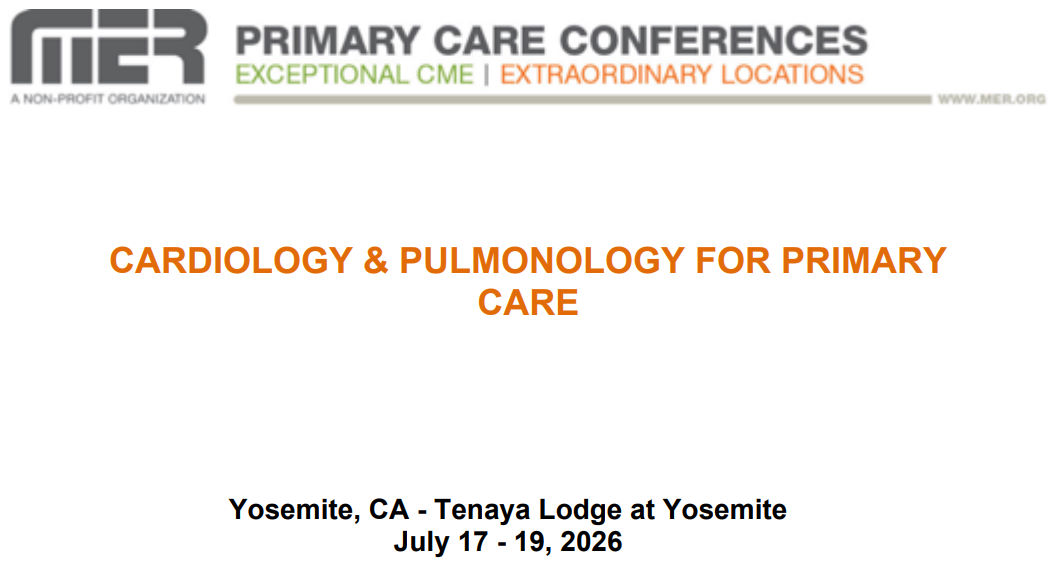
MER Primary Care Conferences Cardiology & Pulmonology for Primary Care Jul 17-19, 2026
Original price was: $1,095.00.$100.00Current price is: $100.00.
Review coronary disease, ECG interpretation, heart failure, asthma, COPD and related topics from the July 17–19, 2026 MER primary care meeting.
Delivery Information: This Product is shared via google drive download link. Please use your correct Gmail address at checkout.
Please note: there are no CME points or certificate associated with this course.
Samples for Courses Can be found here: Free Samples Here!
MER Cardiology & Pulmonology for Primary Care 2026
The MER Cardiology & Pulmonology for Primary Care 2026 program provides a practical, evidence-based review of common cardiovascular and respiratory conditions encountered in primary care.
Organized by Medical Education Resources (MER), the original conference was held from July 17–19, 2026, at Tenaya Lodge at Yosemite in California.
The curriculum integrates contemporary cardiology and pulmonology with clinically relevant topics including coronary artery disease, ECG interpretation, acute chest pain, cardiovascular prevention, heart failure, hypertension, asthma, COPD, respiratory infections, pulmonary nodules, lung cancer, type 2 diabetes, obesity, and associated cardiovascular complications.
Course Details
The topic overview refers to the original meeting, using the official MER agenda dated June 8, 2026 as a reference. Credit figures below describe the original live event, not this store product. Purchase does not include CME points, a certificate, conference registration or a publisher account. The agenda does not establish the completeness or format of the delivered files.
- Provider: Medical Education Resources (MER)
- Official Course: Cardiology & Pulmonology for Primary Care
- Year: 2026
- Original Conference Dates: July 17–19, 2026
- Original Venue: Tenaya Lodge at Yosemite
- Location: Yosemite, California, USA
- Original MER Listing: 12 Credit Hours
- Original ANCC Listing: 5.50 Pharmacotherapeutic Contact Hours
- Primary Areas: Cardiology, Pulmonology & Primary Care
- Format: Clinical Medical Education
Who Should Attend?
This program is targeted to office-based primary care providers and other healthcare professionals seeking practical updates in cardiovascular and respiratory medicine.
Best For
- Primary Care Physicians
- Internal Medicine Physicians
- Family Medicine Physicians
- Cardiologists
- Pulmonologists
- Endocrinologists
- Nurse Practitioners
- Physician Assistants
- Healthcare professionals managing cardiovascular and pulmonary disease
Cardiology
Suspected Coronary Artery Disease
Review a structured approach to the evaluation of patients with suspected coronary artery disease (CAD).
Topics include:
- Cardiovascular risk assessment
- Chest pain evaluation
- Clinical probability
- Appropriate diagnostic testing
- Test selection
- ECG
- Stress testing
- Cardiac imaging
- Referral considerations
The course emphasizes choosing the appropriate cardiovascular evaluation based on symptoms and individual patient risk.
ECG / EKG Interpretation
Review best practices for reading and interpreting electrocardiograms.
Topics include:
- Systematic ECG interpretation
- Heart rate
- Rhythm
- Cardiac axis
- Intervals
- Conduction abnormalities
- Ischemic changes
- Arrhythmias
- Common ECG patterns
This section helps clinicians strengthen practical ECG interpretation skills for everyday primary care.
Acute Chest Pain
Develop a practical approach to patients presenting with acute chest pain.
Topics include:
- Differential diagnosis
- Acute coronary syndrome
- Risk stratification
- Initial diagnostic testing
- ECG interpretation
- Biomarkers
- Drug therapy
- Identification of high-risk patients
- Appropriate referral and emergency management
Cardiovascular Disease Prevention
Review evidence-based strategies for preventing coronary artery disease.
Topics include:
- Lifestyle modification
- Exercise
- Nutrition
- Smoking cessation
- Lipid management
- Cholesterol guidelines
- Statin therapy
- Cardiovascular risk assessment
- Primary prevention
Heart Failure
Review contemporary treatment strategies for heart failure.
Topics include:
- Heart failure diagnosis
- HFrEF
- HFpEF
- Guideline-directed medical therapy
- Volume management
- Patient monitoring
- Cardiovascular risk reduction
- Multidisciplinary management
Hypertension
Review current concepts in the diagnosis and management of hypertension.
Topics include:
- Accurate blood pressure measurement
- Hypertension diagnosis
- Cardiovascular risk
- Lifestyle modification
- Treatment thresholds
- Blood pressure goals
- Pharmacologic therapy
- Combination treatment
- Resistant hypertension
Cardiovascular Disease & Type 2 Diabetes
Review cardiovascular complications associated with type 2 diabetes mellitus.
Topics include:
- Atherosclerotic cardiovascular disease
- Heart failure
- Cardiovascular risk assessment
- Diabetic cardiovascular complications
- Risk-factor modification
- Contemporary pharmacologic strategies
- Cardiorenal risk reduction
Obesity & Cardiovascular Disease
Review the relationship between obesity and cardiovascular disease.
Topics include:
- Cardiovascular risk
- Hypertension
- Dyslipidemia
- Insulin resistance
- Type 2 diabetes
- Heart failure
- Lifestyle intervention
- Weight-management considerations
Pulmonology
Asthma
Review current approaches to the diagnosis and management of asthma.
Topics include:
- Clinical presentation
- Pulmonary function testing
- Asthma severity
- Asthma control
- Inhaled therapies
- Controller medications
- Acute exacerbations
- Patient education
- Monitoring
Respiratory Tract Infections
Develop treatment strategies based on current evidence for commonly encountered respiratory infections.
Topics include:
- Upper respiratory infections
- Bronchitis
- Pneumonia
- Appropriate antimicrobial use
- Supportive treatment
- Risk assessment
- Diagnostic testing
- Outpatient versus inpatient management
COPD
Review contemporary management of chronic obstructive pulmonary disease.
Topics include:
- COPD diagnosis
- Spirometry
- Disease severity
- Smoking cessation
- Bronchodilator therapy
- Inhaled medications
- Exacerbation prevention
- Pulmonary rehabilitation
- Vaccination
- Long-term management
Pulmonary Nodules
Review current strategies for evaluating patients with pulmonary nodules.
Topics include:
- Incidental pulmonary nodules
- Risk assessment
- Imaging characteristics
- Nodule size
- Surveillance
- Follow-up imaging
- Identification of high-risk lesions
- Referral considerations
Lung Cancer
Review current approaches to lung cancer screening, diagnosis, and treatment planning.
Topics include:
- Lung cancer risk factors
- Screening eligibility
- Low-dose CT screening
- Pulmonary nodules
- Diagnostic evaluation
- Referral
- Treatment considerations
- Multidisciplinary care
Learning Objectives
Upon completion of this program, participants should be better able to:
- Describe the work-up, risk assessment, and test selection for patients with suspected coronary artery disease.
- Apply best practices for reading and interpreting ECGs.
- Describe current diagnostic approaches and pharmacologic treatment of patients presenting with acute chest pain.
- Implement lifestyle changes and lipid and cholesterol recommendations for prevention of coronary artery disease.
- Diagnose and manage patients with asthma.
- Develop evidence-based treatment strategies for common respiratory infections.
- Describe current therapeutic approaches to COPD.
- Discuss diagnostic and screening strategies for pulmonary nodules and lung cancer.
- Implement contemporary evidence-based treatment strategies for heart failure.
- Explain current concepts in the diagnosis and treatment of hypertension.
- Identify and manage cardiovascular complications associated with type 2 diabetes.
- Discuss cardiovascular complications associated with obesity.
- Integrate cardiovascular and pulmonary assessment into primary care decision-making.
Related products
Endocrine and Nutrition

Endocrine and Nutrition
Endocrine and Nutrition
Internal Medicine
Endocrine and Nutrition
Harvard Fifty-Ninth Annual Update Obstetrics and Gynecology 2023
Endocrine and Nutrition
Nephrology / Urology

Internal Medicine