
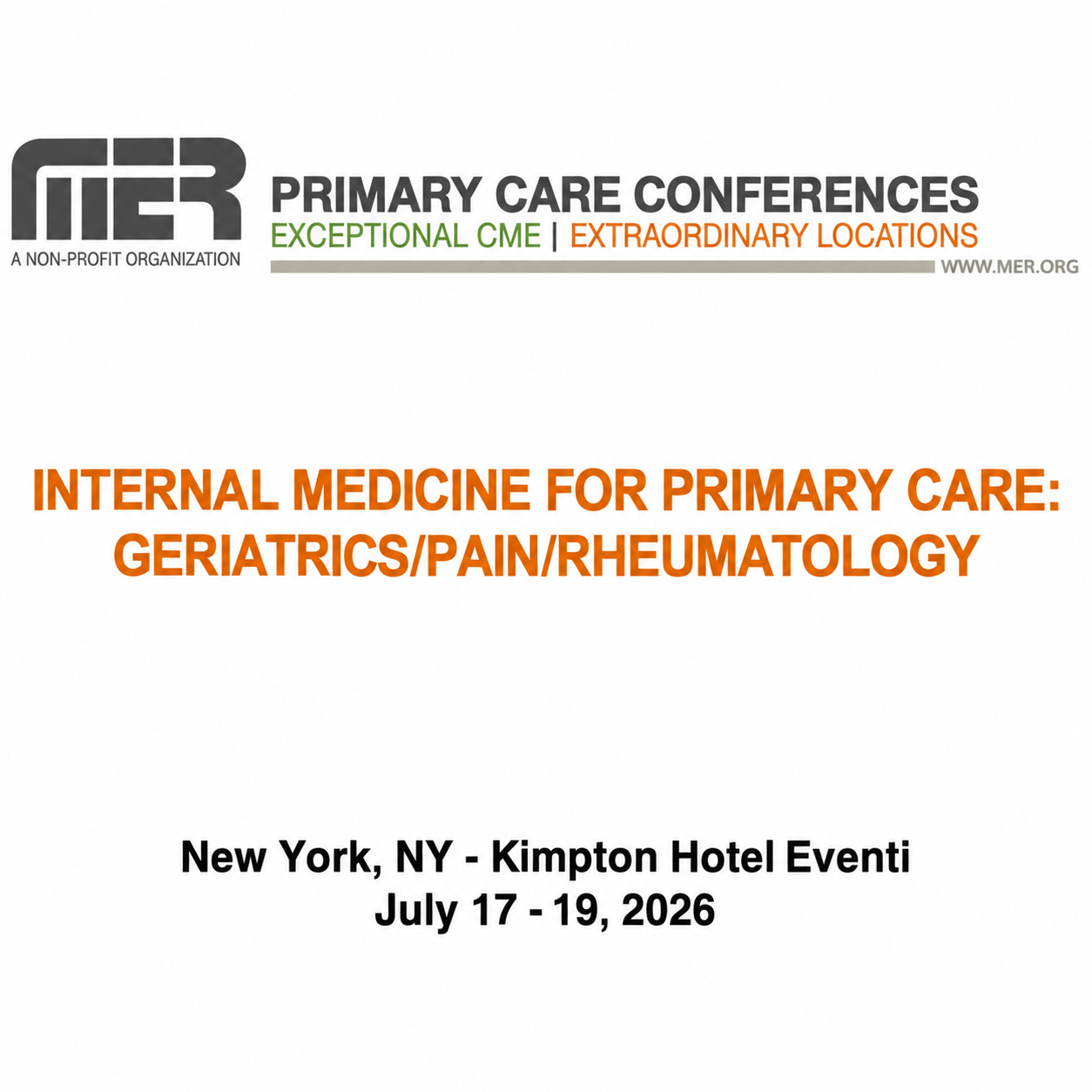
MER Primary Care Conferences Internal Medicine for Primary Care Geri Pain Rheum Jul 17-19, 2026
$110.00
MER Geri Pain Rheum 2026 covers geriatrics, chronic pain and rheumatology topics for primary care study, including assessment and treatment planning.
Delivery Information: This Product is shared via google drive download link. Please use your correct Gmail address at checkout.
Please note: there are no CME points or certificate associated with this course.
Samples for Courses Can be found here: Free Samples Here!
MER Internal Medicine for Primary Care: Geriatrics, Pain & Rheumatology 2026
MER Geri Pain Rheum 2026 brings together geriatrics, pain medicine and rheumatology for primary care study. The subject overview below relates to the July 17–19, 2026 MER meeting; it is not a verified inventory of every supplied file.
Organized by Medical Education Resources (MER), the original conference was held from July 17–19, 2026, at the Kimpton Hotel Eventi in New York, NY.
The program integrates clinically relevant updates in geriatric medicine, pain management, and rheumatology, with emphasis on evidence-based assessment, diagnosis, treatment, medication selection, functional improvement, and long-term patient management.
Course Details
- Provider: Medical Education Resources (MER)
- Course: Internal Medicine for Primary Care: Geri/Pain/Rheum
- Year: 2026
- Original Conference Dates: July 17–19, 2026
- Location: Kimpton Hotel Eventi, New York, NY
- Specialties: Internal Medicine, Geriatrics, Pain Medicine, Rheumatology
- Format: Primary Care Medical Education
- Primary Focus: Practical Evidence-Based Clinical Updates
Who Should Attend?
This program is targeted to office-based primary care providers and other healthcare professionals seeking clinically relevant updates in geriatrics, pain medicine, and rheumatology.
Best For
- Primary Care Physicians
- Internal Medicine Physicians
- Family Medicine Physicians
- Geriatricians
- Pain Management Specialists
- Rheumatologists
- Nurse Practitioners
- Physician Assistants
- Healthcare professionals caring for older adults and patients with chronic musculoskeletal pain
Geriatric Medicine
Comprehensive Geriatric Assessment
Review a structured approach to identifying important medical, functional, cognitive, and social concerns in older adults.
Clinical considerations include:
- Functional status
- Mobility
- Frailty
- Cognitive function
- Medication review
- Fall risk
- Comorbid disease
- Social support
- Patient safety
Heart Failure in Older Adults
Review evidence-based assessment and management strategies for:
- Heart failure with reduced ejection fraction
- Heart failure with preserved ejection fraction
- Clinical assessment
- Volume status
- Guideline-directed treatment
- Medication management
- Functional status
- Coordination with cardiology
Lower Urinary Tract Symptoms & Urinary Incontinence
Review common lower urinary tract symptoms that may progress to urinary incontinence.
Topics include:
- Urinary urgency
- Frequency
- Nocturia
- Incontinence
- Clinical assessment
- Contributing medications
- Initial treatment options
- Referral considerations
Cognitive Impairment, Dementia & Alzheimer’s Disease
Review approaches to the diagnosis and management of:
- Mild cognitive impairment
- Dementia
- Alzheimer’s disease
- Progressive cognitive decline
Topics include:
- Cognitive screening
- Differential diagnosis
- Clinical evaluation
- Treatment options
- Functional assessment
- Patient safety
- Caregiver support
- Long-term management
Pain Management
Low Back Pain
Review evidence-based non-surgical treatment approaches for patients with low back pain.
Topics include:
- Clinical evaluation
- Identification of red flags
- Mechanical low back pain
- Activity modification
- Physical therapy
- Exercise
- Functional rehabilitation
- Conservative management strategies
Fibromyalgia
Review current approaches to the treatment of fibromyalgia.
Topics include:
- Clinical diagnosis
- Chronic widespread pain
- Fatigue
- Sleep disturbance
- Pharmacologic treatment
- Medication adverse-effect profiles
- Exercise
- Non-pharmacologic treatment
- Long-term management
Opioid Pain Management
Review principles for developing appropriate opioid treatment strategies when opioid therapy is clinically indicated.
Topics include:
- Patient selection
- Risk-benefit assessment
- Treatment goals
- Safe prescribing
- Medication monitoring
- Adverse effects
- Risk mitigation
- Ongoing reassessment
- Integration with non-opioid therapies
Rheumatology
Osteoarthritis
Review current evidence for the management of osteoarthritis.
Topics include:
- Clinical diagnosis
- Joint assessment
- Exercise
- Weight management
- Physical therapy
- Pharmacologic treatment
- Pain management
- Functional improvement
Inflammatory Arthritis
Develop a structured differential diagnosis for patients presenting with inflammatory joint disease.
Topics include:
- Joint distribution
- Morning stiffness
- Joint swelling
- Systemic symptoms
- Laboratory evaluation
- Inflammatory markers
- Autoantibody testing
- Differential diagnosis
- Referral considerations
Osteoporosis
Review the benefits and potential risks of bisphosphonate therapy.
Topics include:
- Osteoporosis diagnosis
- Fracture-risk assessment
- Bone mineral density
- Indications for treatment
- Bisphosphonate therapy
- Treatment duration
- Potential adverse effects
- Monitoring
Gout
Review the diagnosis and treatment of gout.
Topics include:
- Hyperuricemia
- Acute gout attacks
- Crystal arthritis
- Diagnostic evaluation
- Acute treatment
- Urate-lowering therapy
- Lifestyle considerations
- Prevention of recurrence
Pseudogout
Review clinical assessment and treatment of calcium pyrophosphate deposition disease (CPPD).
Topics include:
- Acute crystal arthritis
- Differential diagnosis
- Joint involvement
- Diagnostic evaluation
- Treatment
- Recurrent disease management
Learning Objectives
Upon completion of this program, participants should be better able to:
- Utilize a comprehensive geriatric assessment to identify potential issues in older patients.
- Describe evidence-based assessment and treatment plans for heart failure with reduced and preserved ejection fraction.
- Review common lower urinary tract symptoms and initiate appropriate treatment strategies.
- Diagnose and treat cognitive impairment, dementia, and Alzheimer’s disease.
- Utilize current evidence to develop treatment strategies for osteoarthritis.
- Describe the benefits of activity modification and physical therapy in low back pain.
- Compare the benefits and adverse-effect profiles of pharmacologic treatment options for fibromyalgia.
- Develop appropriate opioid pain-management strategies.
- Describe the differential diagnosis of inflammatory arthritis based on clinical presentation and laboratory evaluation.
- Identify the risks and benefits of bisphosphonate therapy for osteoporosis.
- Diagnose and treat gout and pseudogout.
- Integrate principles of geriatrics, pain medicine, and rheumatology into primary care practice.
Why This Course Is Valuable
The MER Internal Medicine for Primary Care: Geriatrics, Pain & Rheumatology 2026 program brings together three highly interconnected areas of everyday primary care.
Many patients—particularly older adults—present with overlapping conditions involving:
Cognitive Decline → Multimorbidity → Osteoarthritis → Chronic Pain → Functional Limitation → Polypharmacy
The course helps clinicians develop practical strategies for assessing and managing these complex patients while integrating contemporary approaches to geriatrics, musculoskeletal medicine, chronic pain, and rheumatic disease.
Delivery and Course Access
This MedicalAmboss listing provides digital study material through a Google Drive download link. No CME points, certificate, conference registration or official MER account are included.
Original event details are available in the MER conference listing.
Related products

USMLE / kaplan and Board Review
Uworld USMLE COMLEX Level 1 Qbank, Updated Jan 2023, System- and Subject-wise (PDF)
Critical Care - Emergency medicine
International Symposium on Intensive Care & Emergency Medicine ( ISICEM ) 2020

Internal Medicine
Critical Care - Emergency medicine

Medical Accounts

Critical Care - Emergency medicine
Critical Care - Emergency medicine

Critical Care - Emergency medicine