
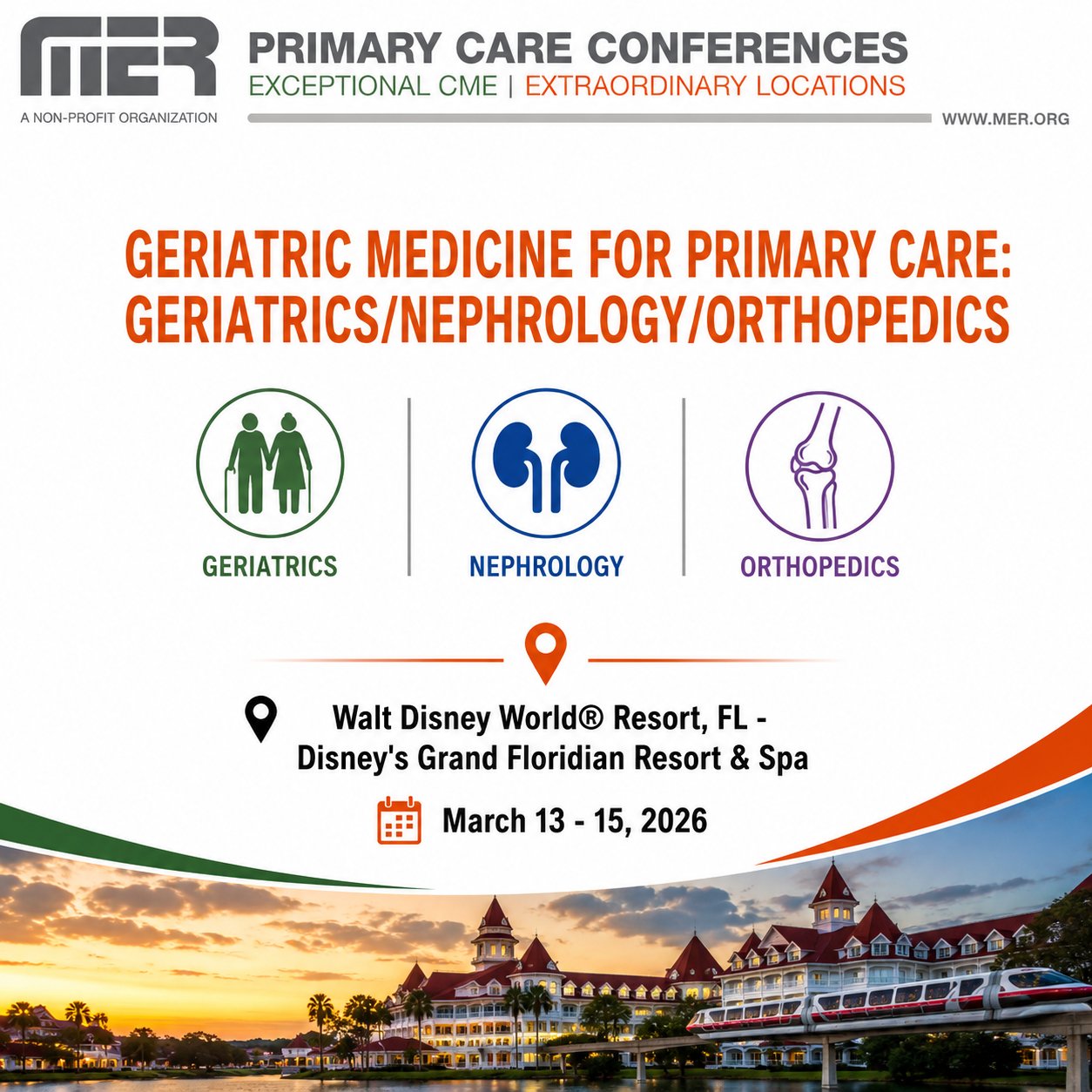
MER Primary Care Conferences Geriatric Medicine for Primary Care Geri Nephro Ortho Mar 13-15, 2026

Original price was: $900.00.$100.00Current price is: $100.00.
This Product is shared via google drive download link, So please share your correct Gmail id while placing the order .Please note that there are no CME points or certificate associated with this course Samples for Courses Can be found here : Free Samples Here!
MER Primary Care Conferences Geriatric Medicine for Primary Care: Geriatrics, Nephrology & Orthopedics 2026
Comprehensive Updates in Geriatric Care, Kidney Disease & Musculoskeletal Medicine for Primary Care
The MER Primary Care Conferences Geriatric Medicine for Primary Care: Geriatrics, Nephrology & Orthopedics 2026 course delivers a practical, evidence-based review of common conditions affecting older adults, with a special focus on geriatric medicine, chronic kidney disease, electrolyte disorders, musculoskeletal conditions, arthritis, falls, and orthopedic injuries. Designed for primary care clinicians, this conference provides up-to-date clinical strategies that can be immediately applied in outpatient practice.
Held at the Walt Disney World® Resort, Florida, this three-day educational program combines expert-led lectures, case-based learning, and evidence-based recommendations to help clinicians improve outcomes for aging patients and individuals with renal and orthopedic disorders.
Course Overview
As the population continues to age, primary care providers increasingly manage complex patients with multiple chronic conditions involving mobility, kidney function, bone health, and musculoskeletal disorders. This conference focuses on practical approaches to diagnosing, treating, and preventing common conditions seen in geriatric and primary care settings.
Participants will gain valuable insights into arthritis management, osteoporosis, gait disorders, chronic kidney disease, electrolyte abnormalities, nephrotoxicity prevention, and orthopedic injuries affecting older adults.
Learning Objectives
Upon completion of this activity, participants will be able to:
- Evaluate and manage common musculoskeletal disorders in elderly patients.
- Assess and treat acute and chronic pain syndromes affecting older adults.
- Discuss the benefits and risks of pharmacologic therapies used for arthritis management.
- Interpret bone scans and assess fracture risk.
- Identify and manage gait abnormalities and fall risk factors.
- Diagnose and treat shoulder injuries in primary care practice.
- Evaluate wrist, hand, and finger injuries.
- Review knee anatomy and common knee disorders.
- Diagnose chronic foot and ankle injuries and pain syndromes.
- Understand the pathophysiology and management of common electrolyte disorders.
- Diagnose and manage chronic kidney disease-related bone disease.
- Recognize cardiovascular complications associated with CKD.
- Evaluate causes of hematuria and proteinuria.
- Identify medications and over-the-counter products that may contribute to nephrotoxicity.
Key Topics Covered
Geriatric Medicine
Participants review:
- Healthy aging strategies
- Fall prevention
- Gait assessment
- Functional decline
- Mobility disorders
- Pain management in older adults
- Polypharmacy considerations
The course emphasizes practical approaches for improving quality of life and maintaining independence in aging patients.
Orthopedic Medicine
Topics include:
Arthritis Management
- Osteoarthritis diagnosis
- Pharmacologic treatment options
- Non-pharmacologic therapies
- Risk-benefit assessment of medications
Shoulder Disorders
- Rotator cuff injuries
- Impingement syndromes
- Frozen shoulder
- Treatment strategies
Hand & Wrist Injuries
- Tendon injuries
- Fractures
- Overuse syndromes
- Degenerative conditions
Knee Disorders
- Anatomy and biomechanics
- Degenerative joint disease
- Meniscal injuries
- Conservative treatment approaches
Foot & Ankle Disorders
- Chronic pain syndromes
- Tendinopathies
- Common injuries
- Functional rehabilitation
Fall Prevention & Gait Disorders
Participants learn:
- Assessment of gait abnormalities
- Balance evaluation
- Fall risk stratification
- Prevention strategies
- Rehabilitation approaches
Special emphasis is placed on reducing morbidity associated with falls in older adults.
Bone Health & Osteoporosis
Coverage includes:
- Bone density assessment
- Osteoporosis screening
- Fracture prevention
- Bone scan interpretation
- Metabolic bone disease
Clinicians gain practical strategies for preserving skeletal health in aging populations.
Nephrology for Primary Care
Sessions focus on:
Chronic Kidney Disease (CKD)
- CKD diagnosis and staging
- Disease progression prevention
- Monitoring strategies
- Referral considerations
Electrolyte Disorders
- Hyponatremia
- Hypernatremia
- Potassium disorders
- Calcium abnormalities
- Magnesium disturbances
CKD-Related Bone Disease
- Mineral metabolism disorders
- Cardiovascular consequences
- Prevention strategies
- Evidence-based management
Hematuria & Proteinuria
- Diagnostic evaluation
- Differential diagnosis
- Laboratory interpretation
- Referral indications
Nephrotoxicity Prevention
Participants learn to identify:
- NSAIDs
- Herbal supplements
- OTC medications
- Contrast-induced nephropathy risks
- Medication-related kidney injury
Educational Features
✔ Evidence-Based Clinical Updates
✔ Practical Geriatric Care Strategies
✔ Orthopedic Evaluation Techniques
✔ Nephrology Essentials for Primary Care
✔ Case-Based Learning
✔ Fall Prevention Strategies
✔ CKD Management Updates
✔ Immediate Clinical Application
Target Audience
This course is ideal for:
- Primary Care Physicians
- Family Medicine Physicians
- Internal Medicine Physicians
- Geriatricians
- Orthopedic Physicians
- Nephrologists
- Nurse Practitioners
- Physician Assistants
- Residents & Fellows
- Other Healthcare Professionals Caring for Older Adults
Why This Course Stands Out
✔ Combines geriatrics, nephrology, and orthopedics into one practical program
✔ Focuses on conditions commonly encountered in primary care
✔ Evidence-based management of elderly patients
✔ Comprehensive review of CKD and electrolyte disorders
✔ Practical guidance for musculoskeletal injuries and arthritis
✔ Strong emphasis on fall prevention and functional mobility
✔ Designed for immediate implementation in clinical practice
✔ Relevant to both outpatient and long-term care settings
Clinical Value
The MER Primary Care Conferences Geriatric Medicine for Primary Care: Geriatrics, Nephrology & Orthopedics 2026 course provides a comprehensive review of the most important clinical issues affecting older adults. Covering musculoskeletal disorders, chronic kidney disease, electrolyte abnormalities, osteoporosis, gait disorders, falls, and orthopedic injuries, this program equips clinicians with practical tools to improve patient outcomes and enhance quality of care in everyday practice.
4. Topics
-
Common Musculoskeletal Problems in the Elderly (Geriatrics): Discuss strategies to minimize musculoskeletal problems in the elderly patient population.
-
Update in Pharmacology for Arthritis in the Older Adult (Geriatrics): Review risks and benefits of traditional NSAIDs and cox-2 inhibitors; analgesics (narcotics and tramadol) and acetaminophen.
-
Osteoporosis in the Older Adult (Geriatrics): Review the epidemiology and pathophysiology of osteoporosis along with interpretation of DEXA scans and FRAX risk assessment; up-to-date therapeutic options.
-
The Shoulder: Anatomy, Common Injuries, and Exam Techniques (Orthopedics): Rotator cuff syndrome; impingement, frozen shoulder; subacromail bursitis; bicipital tendonitis; A-C joint disease.
-
Wrist, Hand, and Fingers (Orthopedics): Carpal tunnel, CMC arthritis thumb, ganglion cyst, trigger finger, de Quervains disease.
-
The Knee: Anatomy, Common Injuries, and Exam Techniques (Orthopedics): ACL, meniscus, MRI; common sports injuries; osteoarthritis and hyaluronan; bursitis: prepatellar, pesanserine; baker’s cyst; joint injection/X-ray interpretation; pediatrics.
-
Ankle and Foot (Orthopedics): This presentation will address a series of common acute and chronic injuries and pain syndromes to the foot and ankle as they would present in the primary care setting. The focus will be on developing a working differential diagnosis based on the historical mechanism of injury and exam findings.
-
Geriatric Gait Disorders & Falls (Geriatrics): Diagnosing problems associated with gait abnormalities; considering causes and prevention of falls; exercise training, aerobics, balance training, resistance.
-
Primary Care Primer on Electrolytes (Nephrology): Electrolyte and acid-base disorders are common findings in clinical practice. They can arise from genetic and acquired diseases and can be associated with commonly prescribed medications. This case-based lecture focuses on the disturbances in and interactions between serum sodium, potassium, and bicarbonate. It reviews the pathophysiology, diagnosis and management of these common imbalances.
-
Kidney, Heart, and Bone: A Challenging Trifecta in CKD (Nephrology): Cardiovascular calcifications are highly prevalent in patients with chronic kidney disease and contribute to morbidity and mortality. This case-based lecture introduces the complex pathophysiologic changes occurring in the bony tissue and their contribution to vascular calcifications. Early recognition of this disorder and management of calcium, phosphorus, vitamin D and parathyroid hormone imbalances are key components of CKD care.
-
Proteinuria, Hematuria, and Diabetic Kidney Disease (Nephrology): Proteinuria, and hematuria are two of the most common abnormalities in routine urinalysis that require further evaluation. There is a broad spectrum of diseases that can give rise to blood and protein in the urine ranging from benign to rapidly progressive kidney failure. This case-based presentation discusses the detection, diagnosis and general management principles of these findings. It also focuses on updates in diabetic kidney disease and when to refer to a specialist.
-
Pain Management and Kidney Disease: From Prescription to Over-the-Counter (Nephrology): Pain management in patients with kidney diseases presents unique challenges for the prescribing provider. The clinical situation can be complicated by the use of over-the-counter and herbal preparations. This case-based presentation discusses principles of pain management and several preparations and compounds that have been identified to possess significant nephrotoxic properties.
Related products

Internal Medicine
Critical Care - Emergency medicine
International Symposium on Intensive Care & Emergency Medicine ( ISICEM ) 2020

USMLE / kaplan and Board Review
Uworld USMLE COMLEX Level 1 Qbank, Updated Jan 2023, System- and Subject-wise (PDF)
Critical Care - Emergency medicine
40th ISICEM International Symposium on Intensive Care & Emergency Medicine 2021
Internal Medicine
Critical Care - Emergency medicine
Critical Care - Emergency medicine
Critical Care - Emergency medicine