
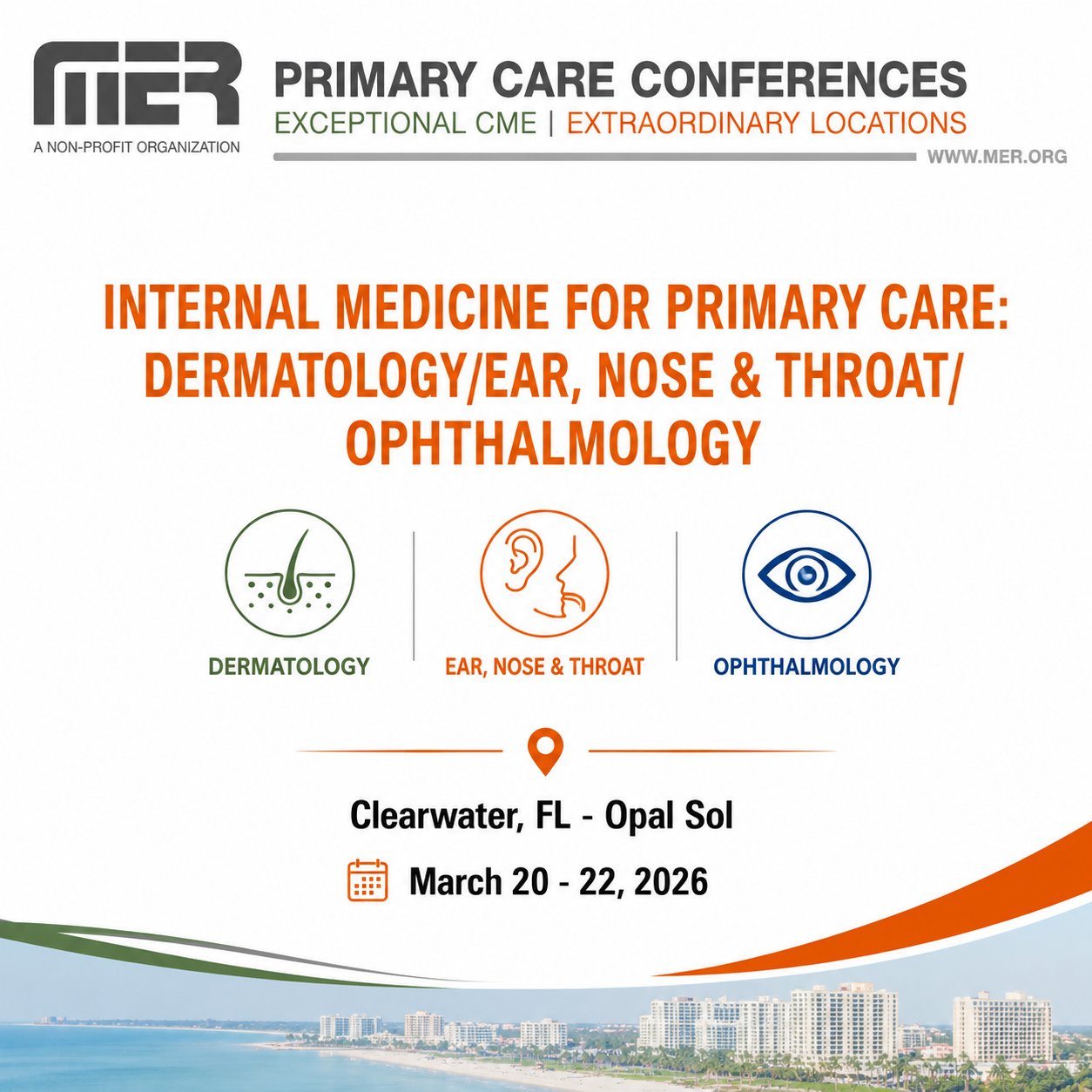
MER Primary Care Conferences Internal Medicine for Primary Care Derm ENT Ophth Mar 20-22, 2026
Original price was: $1,495.00.$100.00Current price is: $100.00.
This Product is shared via google drive download link, So please share your correct Gmail id while placing the order .Please note that there are no CME points or certificate associated with this course Samples for Courses Can be found here : Free Samples Here!
MER Primary Care Conferences Internal Medicine for Primary Care: Dermatology, ENT & Ophthalmology 2026 (Videos + PDFs)
Comprehensive Primary Care Updates in Dermatology, Ear, Nose & Throat, and Ophthalmology
Expand your clinical expertise with MER Primary Care Conferences – Internal Medicine for Primary Care: Dermatology, Ear, Nose & Throat (ENT) & Ophthalmology 2026, a comprehensive continuing medical education (CME) program developed by Medical Education Resources (MER). This evidence-based conference delivers practical, specialty-focused updates designed specifically for primary care clinicians managing common dermatologic, ENT, and ophthalmologic conditions encountered in everyday practice.
Held March 20–22, 2026, at the Opal Sol Resort in Clearwater, Florida, this multidisciplinary conference combines expert lectures, evidence-based recommendations, and case-based discussions to help clinicians confidently diagnose, manage, and appropriately refer patients with skin diseases, eye disorders, hearing complaints, sinus conditions, and head and neck abnormalities.
Designed for busy office-based providers, the course emphasizes practical diagnostic strategies, updated treatment recommendations, and guideline-driven management that can be immediately applied in outpatient practice.
Product Details
- Course: Internal Medicine for Primary Care: Dermatology, ENT & Ophthalmology
- Provider: Medical Education Resources (MER)
- Conference Date: March 20–22, 2026
- Location: Opal Sol Resort, Clearwater, Florida
- Format: Videos + PDFs
- Language: English
- Educational Level: Intermediate
Course Overview
Primary care clinicians evaluate a wide variety of dermatologic, otolaryngologic, and ophthalmologic complaints every day. Early recognition of serious disease, appropriate treatment selection, and timely referral can significantly improve patient outcomes while avoiding unnecessary testing and specialist consultations.
MER Internal Medicine for Primary Care: Dermatology, ENT & Ophthalmology 2026 provides an evidence-based review of the most common and clinically important disorders affecting the skin, eyes, ears, nose, and throat. Participants will review practical diagnostic algorithms, current therapeutic recommendations, and referral criteria for conditions frequently encountered in outpatient medicine.
The curriculum focuses on real-world clinical decision-making and equips healthcare professionals with updated knowledge that enhances confidence when managing both routine and urgent presentations.
Course Highlights
- Primary care dermatology
- ENT updates
- Ophthalmology for primary care
- Skin cancer recognition
- Dermatitis management
- Acne treatment
- Fungal skin infections
- Nail disorders
- Neck mass evaluation
- Sinusitis management
- Hearing loss assessment
- Dry eye management
- Red eye evaluation
- Ophthalmic emergencies
- Clinical examination techniques
- Evidence-based primary care
What You’ll Learn
After completing this course, participants will be able to:
- Differentiate common inflammatory skin disorders using evidence-based diagnostic approaches.
- Diagnose and manage acne, fungal infections, nail disorders, and precancerous skin lesions.
- Identify suspicious skin cancers requiring biopsy or dermatology referral.
- Evaluate patients presenting with neck masses and determine appropriate imaging or ENT referral.
- Apply updated recommendations for managing sinusitis and allergic rhinitis.
- Differentiate conductive and sensorineural hearing loss using clinical assessment.
- Perform a systematic evaluation of patients with red eye and dry eye complaints.
- Recognize ophthalmic emergencies requiring urgent intervention or specialist referral.
- Improve clinical decision-making using practical examination techniques and guideline-directed care.
Comprehensive Topics Covered
Dermatology
Review common inflammatory skin disorders including atopic dermatitis, allergic contact dermatitis, irritant dermatitis, and nummular dermatitis. Learn current approaches to acne, fungal skin infections, nail disorders, benign skin lesions, and early recognition of skin cancers.
Skin Cancer Recognition
Strengthen your ability to identify precancerous lesions, basal cell carcinoma, squamous cell carcinoma, melanoma, and other cutaneous malignancies requiring prompt diagnosis and referral.
Ear, Nose & Throat (ENT)
Develop practical strategies for evaluating neck masses, sinus disease, allergic rhinitis, hearing loss, and common ENT infections encountered in outpatient primary care.
Sinus & Nasal Disorders
Review evidence-based management of acute and chronic sinusitis, antimicrobial selection, allergic pathways, nasal inflammation, and indications for imaging or specialist referral.
Hearing Disorders
Differentiate sensorineural and conductive hearing loss while understanding appropriate diagnostic evaluation, referral pathways, and management strategies.
Ophthalmology
Learn a systematic approach to evaluating patients presenting with red eye, dry eye syndrome, ocular inflammation, vision complaints, and common ophthalmologic disorders seen in primary care.
Ophthalmic Emergencies
Identify urgent eye conditions including circulatory disorders, vision-threatening diseases, and ophthalmologic emergencies that require immediate referral and treatment.
Clinical Examination Skills
Review practical examination techniques that improve diagnostic accuracy when evaluating dermatologic, ENT, and ophthalmologic complaints in the primary care setting.
Learning Objectives
Upon completion of this educational activity, participants will be able to:
- Differentiate common inflammatory and infectious dermatologic conditions.
- Diagnose and manage common skin infections, acne, and skin tumors.
- Evaluate neck masses and determine appropriate referral strategies.
- Apply evidence-based treatment for sinusitis and allergic ENT disorders.
- Distinguish conductive from sensorineural hearing loss.
- Perform comprehensive evaluation of patients presenting with red eye and dry eye.
- Recognize ophthalmologic emergencies requiring urgent intervention.
- Improve patient outcomes through evidence-based multidisciplinary primary care.
Educational Features
- Expert MER Faculty
- Case-Based Clinical Discussions
- Practical Primary Care Updates
- Evidence-Based Guidelines
- Dermatology Review
- ENT Clinical Updates
- Ophthalmology Essentials
- Diagnostic Algorithms
- Treatment Recommendations
- On-Demand Videos and PDFs
Why This Course Stands Out
Unlike specialty-focused conferences that primarily target subspecialists, MER Internal Medicine for Primary Care: Dermatology, ENT & Ophthalmology 2026 is specifically designed for office-based clinicians. The program emphasizes common clinical presentations, practical diagnostic approaches, and evidence-based treatment strategies that primary care providers can immediately incorporate into daily practice. Its multidisciplinary format allows clinicians to strengthen knowledge across three high-volume specialties while improving patient care and referral decisions.
Target Audience
This educational activity is ideal for:
- Internal Medicine Physicians
- Primary Care Physicians
- Family Medicine Physicians
- General Practitioners
- Hospitalists
- Dermatologists
- Otolaryngologists (ENT Physicians)
- Ophthalmologists
- Nurse Practitioners (NPs)
- Physician Assistants (PAs)
- Internal Medicine Residents
- Family Medicine Residents
- Healthcare Professionals involved in outpatient primary care
Why Choose This Course?
Whether you routinely evaluate skin disorders, eye complaints, sinus disease, or hearing problems in your clinical practice, MER Primary Care Conferences – Internal Medicine for Primary Care: Dermatology, ENT & Ophthalmology 2026 provides practical, evidence-based education designed to improve diagnostic accuracy, optimize treatment decisions, and enhance patient outcomes. Through expert-led instruction and clinically focused discussions, this program equips clinicians with the latest recommendations across three of the most frequently encountered specialties in primary care.
4. Topics
Dermatology
-
Dermatitis: Overview of the causes and forms of skin irritants; Contact, atopic, irritant, nummular, seborrheic and exfoliative; Treatment of blistering, oozing, crusting and flaking; Diagnostic principles and management strategies.
-
Fungal Infections of the Skin: Dermatophytes, tinea versicolor, candidiasis; Selected deep fungal infections; Onycholysis; Drug induced nail changes; paronychia, koilonychia, nail discolorations, tumors of the nail; Fungal infections diagnosis and management; Overview and comparison of antifungal treatment options.
-
Acne and Acneiform Eruptions: Identification of noninflammatory open or closed comedones and inflammatory lesions; Determination of treatment therapies based on acne grading scale; Bacterial folliculitis, drug-induced acne, hidradenitis suppurativa, miliaria, perioral dermatits, pseudofolliculitis barbae, rosacea, seborrheic dermatitis; Topical and systemic therapy.
-
Premalignant and Malignant Skin Tumors: Recognition of precursors of malignancies; Excisional and punch biopsies; Actinic keratosis, Bowen’s disease, squamous cell carcinoma, basal cell carcinoma, melanoma and other selected tumors; Risk reduction education.
Ear, Nose & Throat (ENT)
-
Evaluation of the Neck Mass: Patients presenting with masses in the neck are challenging and worrisome. The diagnostic and therapeutic process is described. A method for evaluating the mass, guidance on when imaging studies are indicated, and when immediate or routine referral to ENT becomes appropriate is discussed.
-
Antimicrobial Therapy in Treating Sinusitis: Symptoms, signs and examination findings helpful in diagnosing sinusitis are outlined. When to use systemic and topical agents as well as emerging resistance to these agents is discussed. Imaging studies and proper referral to specialists is described with clarity.
-
Allergic Rhinitis: The lecture will focus on a review of the basic allergic pathways that affect the body. Special emphasis will be given to the nasal and sinus regions, with discussion to include diagnostic testing and modes of treatment, including avoidance, pharmacotherapy and immunotherapy.
-
A Primary Care Approach to Sudden Hearing Loss: When a patient presents with sudden hearing loss, accurate differentiation of sensorineural versus conductive loss is essential. Techniques to make that differentiation, testing and treatment strategies will be discussed; Urgent treatment and when to render for audiometric testing and ENT referral will be outlined.
Ophthalmology
-
Dry Eye: The role of age, hormone levels and environmental factors in producing dry eyes; Differentiating and understanding triggers of dry eye disease; The ocular role in photophobia and migraine; Overview of treatment options.
-
Approach to the Patient with Red Eye: The red eye is one of the primary patient complaints in primary care. Lecture will explore the many facets of this common presentation with attention to the various entities it might represent. Treatment and diagnostic methods for acute conjunctivitis will be the primary focus.
-
Ophthalmic Manifestations of Systemic Diseases: In this talk we will explore the variety of ways that examination of the eye can impact the diagnosis, treatment and clinical decision making for patients seen on a daily basis in primary care offices. We will discuss vascular, hematologic, respiratory and autoimmune conditions with attention to the ways in which a patients’ care can be positively influenced by taking into account the information available from visual system analysis and monitoring.
-
A Primary Care Primer on Ophthalmic Emergencies: Decreased vision, eye pain, red eye: what is an emergency in ophthalmology? Discussion of evaluation and management of these complaints in a primary care setting.
Related products

Medical Accounts
Critical Care - Emergency medicine

Critical Care - Emergency medicine
Medical Accounts

Family medicine
Critical Care - Emergency medicine
2022 ISICEM International Symposium on Intensive Care & Emergency Medicine
Critical Care - Emergency medicine