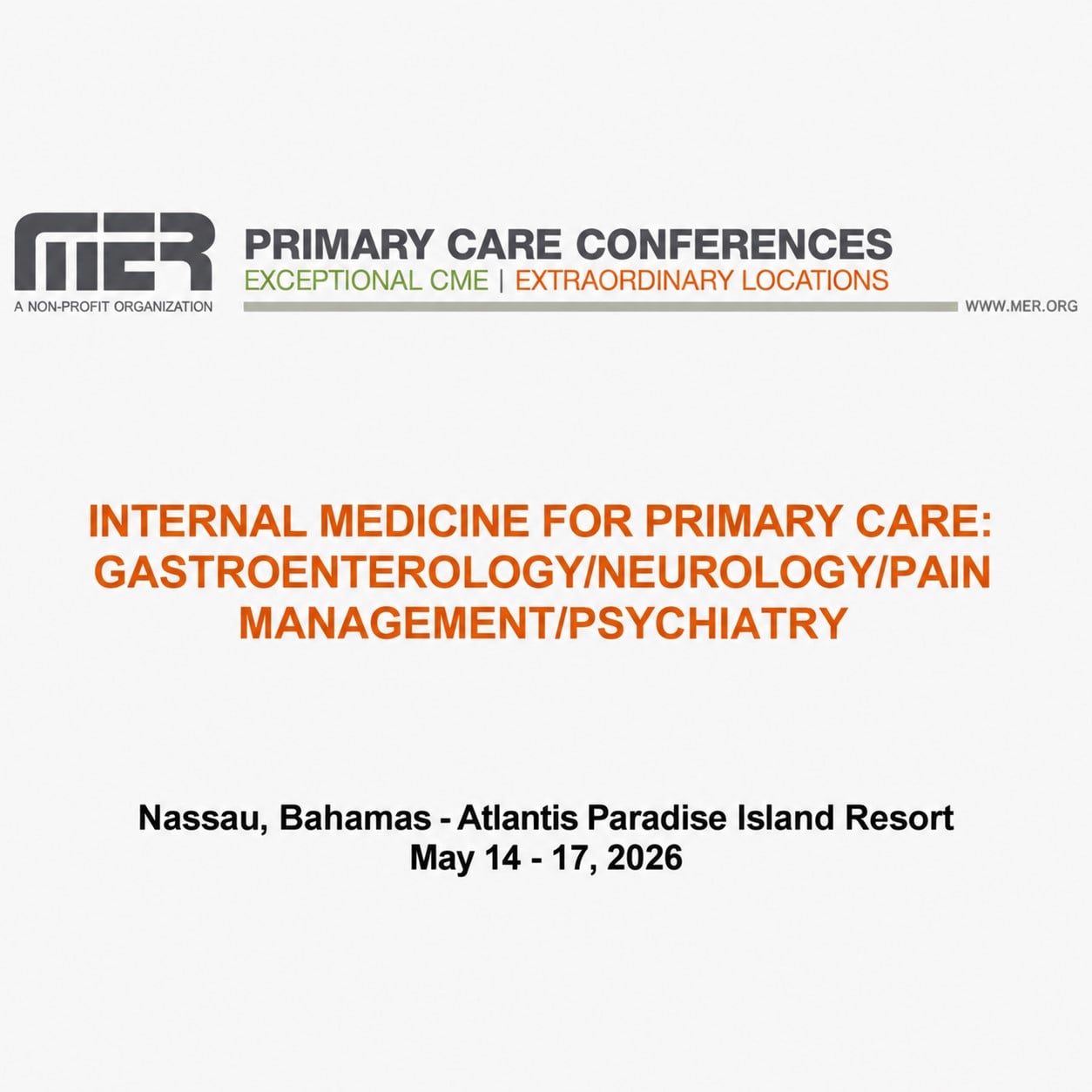
MER Primary Care Conferences Internal Medicine for Primary Care Gastro Neuro Pain Psych May 14-17, 2026


$120.00
Primary care educational materials covering gastroenterology, neurology, pain management and psychiatry.
Delivery Information: This Product is shared via google drive download link. Please use your correct Gmail address at checkout.
Please note: there are no CME points or certificate associated with this course.
Samples for Courses Can be found here: Free Samples Here!
MER Primary Care Conferences – Internal Medicine for Primary Care: Gastroenterology • Neurology • Pain Management • Psychiatry 2026 (Videos)
Comprehensive Primary Care Updates in Gastroenterology, Neurology, Pain Medicine, Psychiatry, Evidence-Based Internal Medicine & Multidisciplinary Patient Care
Stay current with the latest evidence-based advances in primary care medicine through the MER Primary Care Conferences – Internal Medicine for Primary Care: Gastroenterology • Neurology • Pain Management • Psychiatry 2026. Developed by Medical Education Resources (MER), this comprehensive educational program presents practical clinical updates across four essential specialties that primary care clinicians encounter daily.
Held May 14–17, 2026, at the Atlantis Paradise Island Resort, Nassau, Bahamas, this multidisciplinary educational conference combines expert-led lectures, guideline updates, clinical case discussions, and evidence-based treatment strategies to help clinicians improve diagnostic accuracy, optimize therapeutic decision-making, and deliver high-quality patient-centered care.
Designed specifically for internists, family physicians, hospital-based primary care providers, and advanced practice clinicians, this course bridges the gap between rapidly evolving specialty knowledge and everyday outpatient internal medicine practice.
Product Details
- Course: MER Primary Care Conferences – Internal Medicine for Primary Care: Gastroenterology • Neurology • Pain Management • Psychiatry 2026
- Provider: Medical Education Resources (MER)
- Conference Dates: May 14–17, 2026
- Location: Atlantis Paradise Island Resort, Nassau, Bahamas
- Format: Videos
- Language: English
- Educational Level: Intermediate to Advanced
- Learning Format: Expert Lectures, Case-Based Discussions, Evidence-Based Reviews, Clinical Practice Updates
Course Overview
Primary care physicians are increasingly responsible for diagnosing and managing complex gastrointestinal, neurological, psychiatric, and chronic pain conditions before specialist referral. Rapid advances in clinical guidelines, pharmacologic therapies, diagnostic testing, and multidisciplinary care require clinicians to remain current across multiple specialties while maintaining a comprehensive patient-centered approach.
The MER Internal Medicine for Primary Care 2026 conference provides an integrated review of common and high-impact disorders encountered in everyday clinical practice. Nationally recognized faculty present practical approaches to neurological evaluation, gastrointestinal disease management, chronic pain treatment, psychiatric disorders, preventive medicine, and evidence-based pharmacotherapy.
Through real-world clinical cases and guideline-driven instruction, participants learn practical strategies that improve patient safety, diagnostic confidence, and long-term clinical outcomes across diverse primary care settings.
What You’ll Learn
After completing this course, participants will be able to:
- Differentiate neurologic weakness from nonspecific clinical symptoms using history and physical examination.
- Apply current evidence-based therapies for Alzheimer’s disease, Parkinson’s disease, headaches, and cerebrovascular disorders.
- Diagnose and manage chronic pain using multimodal pharmacologic and non-pharmacologic approaches.
- Develop safe opioid prescribing and pain management strategies.
- Implement updated recommendations for colorectal cancer screening and lower gastrointestinal bleeding.
- Recognize patients at increased risk for pancreatic cancer and recurrent pancreatitis.
- Diagnose and treat anxiety disorders, depression, bipolar disorder, and substance use disorders.
- Integrate multidisciplinary management strategies into everyday primary care practice.
Comprehensive Topics Covered
Gastroenterology
Strengthen evidence-based management of common gastrointestinal disorders.
Topics include:
- Lower gastrointestinal bleeding
- Colorectal cancer screening
- Colonoscopy surveillance
- Pancreatitis
- Recurrent pancreatitis prevention
- Pancreatic cancer risk assessment
- Gastrointestinal disease management
Faculty review current diagnostic algorithms and guideline-directed treatment recommendations for common GI conditions.
Neurology
Improve recognition and treatment of neurological disorders encountered in primary care.
Topics include:
- Neurological weakness
- Parkinson’s disease
- Movement disorders
- Alzheimer’s disease
- Dementia
- Stroke prevention
- Cerebrovascular disorders
Participants develop practical diagnostic skills applicable to daily outpatient practice.
Headache Medicine
Review evidence-based approaches to headache diagnosis and management.
Topics include:
- Migraine
- Tension headache
- Secondary headaches
- Differential diagnosis
- Preventive therapy
- Acute migraine treatment
- Chronic headache management
Pain Medicine
Enhance management of acute and chronic pain.
Topics include:
- Chronic pain
- Multimodal analgesia
- Non-opioid therapies
- Opioid stewardship
- Pain assessment
- Musculoskeletal pain
- Functional pain disorders
Faculty discuss balanced, evidence-based strategies that improve pain control while minimizing treatment-related risks.
Opioid Management
Optimize safe prescribing practices.
Topics include:
- Opioid prescribing
- Opioid safety
- Risk assessment
- Monitoring
- Dose optimization
- Opioid alternatives
- Responsible pain management
Psychiatry in Primary Care
Strengthen diagnosis and treatment of common psychiatric disorders.
Topics include:
- Anxiety disorders
- Depression
- Bipolar disorder
- Mood disorders
- Substance use disorders
- Behavioral health
- Mental health screening
Substance Use Disorders
Improve recognition and comprehensive management.
Topics include:
- Substance use disorder
- Addiction medicine
- Screening tools
- Behavioral interventions
- Medication-assisted treatment
- Relapse prevention
- Long-term recovery
Preventive Internal Medicine
Apply preventive strategies to improve long-term health outcomes.
Topics include:
- Preventive medicine
- Cancer screening
- Lifestyle modification
- Risk factor reduction
- Early diagnosis
- Population health
- Evidence-based prevention
Pharmacologic & Non-Pharmacologic Therapy
Develop individualized treatment strategies.
Topics include:
- Evidence-based pharmacotherapy
- Lifestyle interventions
- Behavioral therapy
- Patient education
- Shared decision-making
- Multidisciplinary management
- Individualized treatment plans
Integrated Primary Care
Coordinate multidisciplinary patient care effectively.
Topics include:
- Internal medicine
- Primary care
- Care coordination
- Clinical decision-making
- Chronic disease management
- Multisystem disorders
- Evidence-based practice
Learning Objectives
Upon completion of this educational activity, participants will be able to:
- Utilize comprehensive history taking and physical examination to distinguish true neurological weakness from nonspecific symptoms.
- Apply evidence-based management strategies for Alzheimer’s disease, Parkinson’s disease, movement disorders, headaches, migraines, and cerebrovascular disease.
- Implement pharmacologic and non-pharmacologic approaches for chronic pain management while developing safe opioid prescribing strategies.
- Apply current recommendations for lower gastrointestinal bleeding, colorectal cancer screening, surveillance colonoscopy, pancreatitis prevention, and pancreatic cancer risk assessment.
- Diagnose and manage anxiety disorders, depression, bipolar disorder, and substance use disorders using current clinical guidelines.
- Integrate multidisciplinary, evidence-based treatment strategies into everyday primary care practice.
Educational Highlights
- Internal Medicine
- Primary Care
- Gastroenterology
- Neurology
- Pain Management
- Psychiatry
- Alzheimer’s Disease
- Parkinson’s Disease
- Headache Medicine
- Migraine
- Stroke Prevention
- Chronic Pain
- Opioid Stewardship
- Colorectal Cancer Screening
- Pancreatitis
- Pancreatic Cancer
- Anxiety Disorders
- Depression
- Substance Use Disorders
Why This Course Stands Out
The MER Primary Care Conferences – Internal Medicine for Primary Care 2026 offers a uniquely integrated educational experience by combining four essential medical specialties into one comprehensive primary care curriculum. Rather than presenting isolated specialty updates, the program focuses on practical, office-based management of the conditions primary care clinicians encounter most frequently. Its emphasis on evidence-based medicine, multidisciplinary care, guideline implementation, and immediately applicable clinical decision-making makes it an outstanding educational resource for modern internal medicine and primary care practice.
Target Audience
This educational activity is ideal for:
- Internists
- Primary Care Physicians
- Family Medicine Physicians
- Gastroenterologists
- Neurologists
- Pain Management Specialists
- Psychiatrists
- Hospitalists
- General Practitioners
- Nurse Practitioners
- Physician Assistants
- Internal Medicine Residents
- Family Medicine Residents
- Advanced Practice Providers
- Healthcare Professionals seeking comprehensive primary care updates
Why Choose This Course?
Whether you practice internal medicine, family medicine, gastroenterology, neurology, pain medicine, or behavioral health, the MER Primary Care Conferences – Internal Medicine for Primary Care 2026 provides an outstanding multidisciplinary review of the latest evidence-based clinical practice. Through expert-led lectures, practical case discussions, and guideline-focused education, participants gain the confidence to diagnose common disorders earlier, personalize treatment strategies, improve chronic disease management, and deliver comprehensive, patient-centered care across a broad range of medical conditions.
4. Topics
Thursday, May 14, 2026
-
Neurology – Evaluating Weakness: Using the history and physical examination to distinguish weakness from non-specific symptoms; characteristics of neurological diseases that produce weakness; presentations of representative diseases of the nervous system.
-
Neurology – Alzheimer’s & Other Dementias: Definition; statistics; neurological changes of normal aging; pathology; etiological theories; vascular dementias; investigations; social issues; symptomatic treatment; research therapies.
-
Neurology – Parkinson’s Disease & Other Movement Disorders: Epidemiology; cardinal features; secondary features; pathology; neurochemistry; differential diagnosis; treatment; complication; other movement disorders; neuroleptic- induced movement disorders; chorea.
-
Pain – Chronic Pain Management Options for Primary Care: Treatment of common chronic pain conditions including chronic low back pain and neuropathic pain.
-
Pain – Office Procedures for Pain: Behavioral and lifestyle modifications; Medications overview; Interventional therapies; Opioids and cannabinoids overview.
Friday, May 15, 2026
-
Pain – Headaches & Migraines: Basic headache mechanisms; headache history: characteristics, precipitating factors, medical conditions; migraine: common tension, classic, treatment, complicated, cluster, sinus; trigeminal neuralgia; Giant Cell Arteritis; brain tumor; subarachnoid hemorrhage; emergency room treatment.
-
Pain – Opioid Pharmacologic Options in Chronic Pain Management: Overall safety and efficacy; Selecting and monitoring patients; Pain contracts; Regulatory issues; Urine drug testing.
-
Neurology – Cerebrovascular Disorders: Epidemiology; identifying the high-risk patient; treatment effects; transient neurological deficit: carotid, vertebrobasilar; non-specific cerebral symptoms; migraines vs. TIA; treatment options.
-
Gastroenterology – Management of Lower GI Bleeding- From Occult to Massive: The correct use and interpretation of tests for occult blood in the stool will be discussed in relation to lower GI bleeding; focus on the utility of different diagnostic and management approached to the spectrum of patients presenting with hematochezia.
-
Gastroenterology – Colorectal Cancer Screening and Surveillance: Reviews the most recent recommendations for CRC screening in the general population at average risk for CRC.
Saturday, May 16, 2026
-
Gastroenterology – Acute Pancreatitis: Etiology and Management: Recognition of acute and chronic pancreatitis; The etiology of pancreatitis and determination of next steps in management; Discussion of complications of pancreatitis and how to counsel patients on how to prevent recurrence of pancreatitis.
-
Gastroenterology – Pancreas Cancer Screening: Determination of who qualifies for pancreas cancer screening and how to refer for pancreas cancer screening; Discussion of the importance of the family history and genetic counseling; Discussion of how pancreas screening is accomplished.
-
Psychiatry – Anxiety Disorders: The nature of anxiety; Generalized anxiety disorder, panic disorder, social anxiety disorder and post-traumatic stress disorder; etiology and diagnosis; Co-occurring conditions; Treatment options for these disabling conditions.
-
Psychiatry – Depressive Disorders: History taking, diagnosis and treatment of depression across the lifespan; pharmacologic and non-pharmacologic treatment options; rational polypharmacy.
Sunday, May 17, 2026
-
Psychiatry – Substance Use Disorders: Substance abuse history-taking to encourage patient honesty; Accurate diagnosis; Use of screening tools; Brief intervention; Recovery and treatment options; Motivational interviewing; Family symptoms and codependency.
-
Psychiatry – Bipolar Spectrum Disorders: Bipolar spectrum disorders in adults as compared to youth; Comprehensive history-taking; Differential diagnosis; Co-occurring psychiatric and medical conditions; Phase specific treatment considerations and interventions.
Related products

Internal Medicine

USMLE / kaplan and Board Review
Uworld USMLE COMLEX Level 1 Qbank, Updated Jan 2023, System- and Subject-wise (PDF)

Critical Care - Emergency medicine

Critical Care - Emergency medicine
The Brigham Board Review in Infectious Diseases Brigham and Women’s Hospital Board Review
Critical Care - Emergency medicine

Internal Medicine
Critical Care - Emergency medicine
International Symposium on Intensive Care & Emergency Medicine ( ISICEM ) 2020