
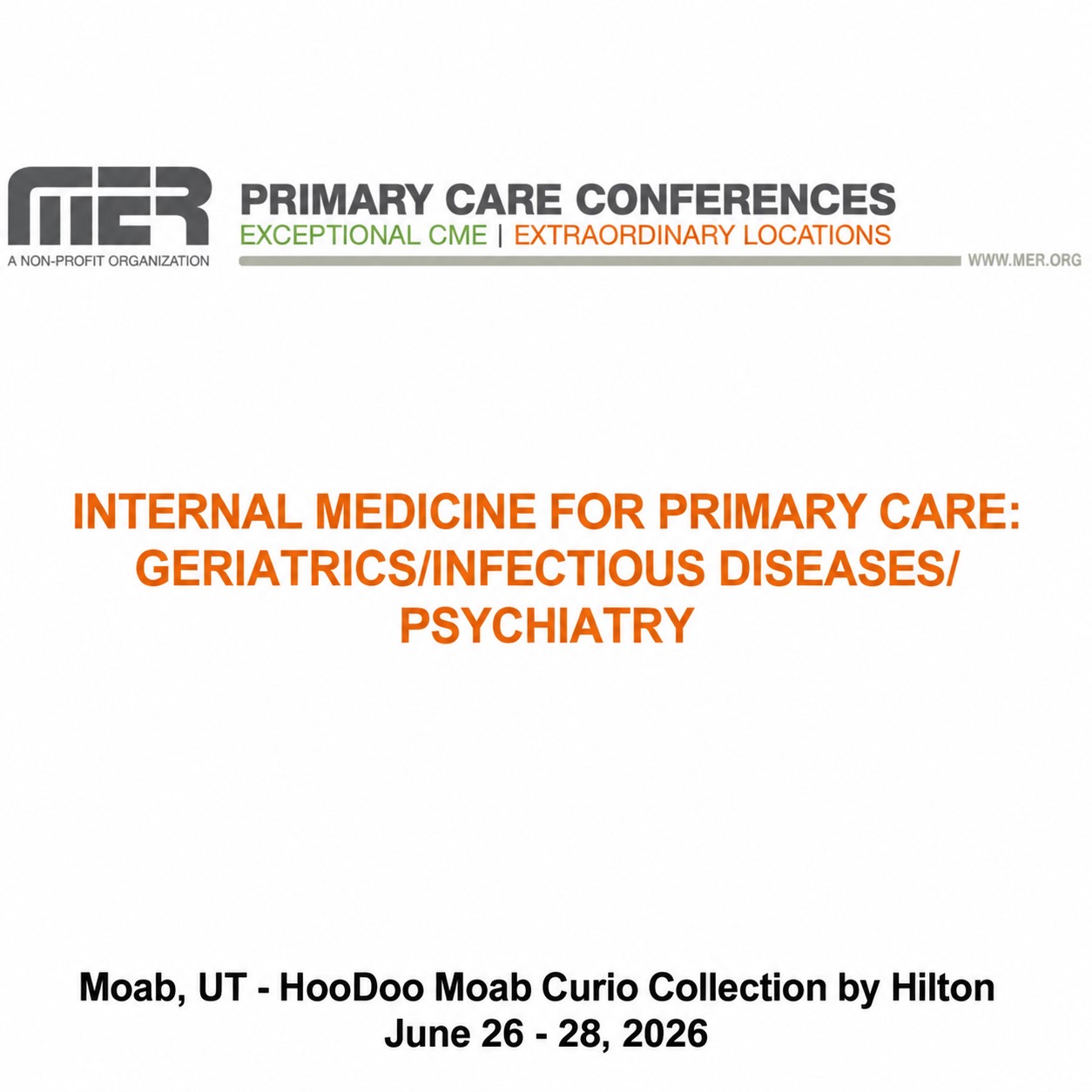
MER Primary Care Conferences Internal Medicine for Primary Care Geri ID Psych Jun 26-28, 2026

$100.00
This Product is shared via google drive download link, So please share your correct Gmail id while placing the order .Please note that there are no CME points or certificate associated with this course Samples for Courses Can be found here : Free Samples Here!
EXPRESS DISCOVER PayPal
MER Internal Medicine for Primary Care: Geri/ID/Psych 2026
Geriatrics • Infectious Diseases • Psychiatry
June 26–28, 2026 | Moab, Utah
Build practical knowledge across three important areas of adult primary care with MER Internal Medicine for Primary Care: Geri/ID/Psych 2026, organized by Medical Education Resources (MER).
The original conference was held June 26–28, 2026, at the HooDoo Moab Curio Collection by Hilton in Moab, Utah.
This focused three-day program combines clinically relevant updates in:
- Geriatric medicine
- Infectious diseases
- Psychiatry
- Internal medicine
- Primary care
Major topics include:
- Comprehensive geriatric assessment
- Medication use in older adults
- Age-related pharmacokinetic and pharmacodynamic changes
- Benign prostatic hyperplasia
- Lower urinary tract symptoms
- Urinary incontinence
- Alzheimer’s disease
- Other dementias
- Behavioral disturbances in dementia
- Non-pharmacologic dementia management
- Adult ADHD
- Substance use disorders
- Depression
- Suicide-risk assessment
- Psychopharmacology
- Treatment-resistant depression
- Skin and soft-tissue infections
- Gastrointestinal infections
- Clostridioides difficile
- Respiratory tract infections
- Pneumonia
- Bronchitis
- Multidrug-resistant pathogens
- Urinary tract infections
- Genitourinary infections
- Selected sexually transmitted infections
The curriculum is especially useful for clinicians who regularly care for older adults and patients with overlapping medical, infectious, cognitive, behavioral, and psychiatric conditions.
Course Details
- Course: Internal Medicine for Primary Care: Geri/ID/Psych
- Provider: Medical Education Resources – MER
- Year: 2026
- Dates: June 26–28, 2026
- Duration: 3 Days
- Venue: HooDoo Moab Curio Collection by Hilton
- Location: Moab, Utah, USA
- Primary Focus: Internal Medicine / Primary Care
- Specialties: Geriatrics / Infectious Diseases / Psychiatry
- Original Live Activity: 12 Credit Hours
- Original Pharmacotherapeutic Content: 5.75 ANCC Pharmacotherapeutic Contact Hours
- MedicalAmboss Delivery: Google Drive
- CME / Certificate with MedicalAmboss: Not Included
- Language: English
Course Overview
Modern primary care frequently requires clinicians to manage problems from several specialties during a single encounter.
An older patient may simultaneously have:
- Polypharmacy
- Cognitive decline
- Urinary symptoms
- Depression
- Behavioral changes
- Infection
- Functional impairment
Similarly, an adult presenting with fatigue or poor concentration may require a differential involving:
- Depression
- ADHD
- Substance use
- Medication effects
- Medical disease
This MER program provides a practical approach to these overlapping issues.
A useful clinical framework is:
Identify the Problem → Assess Severity → Build Differential → Select Appropriate Testing → Treat → Monitor → Refer When Needed
Learning Objectives
Upon completion of the original educational activity, participants should be better able to:
- Review the epidemiology and microbiology of skin and soft-tissue infections.
- Recognize and manage important SSTIs.
- Assess the severity of diarrhea.
- Determine when gastrointestinal infections require specific treatment.
- Review major enteric pathogens.
- Recognize and manage Clostridioides difficile infection.
- Identify common pathogens associated with respiratory tract infections.
- Improve diagnosis and treatment of pneumonia and bronchitis.
- Consider the impact of multidrug-resistant organisms.
- Diagnose and manage urinary tract and other genitourinary infections.
- Apply a comprehensive geriatric assessment.
- Recognize age-related physiologic changes.
- Review medication use and potentially risky medications in elderly patients.
- Evaluate lower urinary tract symptoms.
- Review benign prostatic hyperplasia.
- Diagnose and manage urinary incontinence.
- Recognize cognitive impairment.
- Differentiate common forms of dementia.
- Review Alzheimer’s disease management.
- Identify potentially reversible causes of cognitive impairment.
- Apply non-pharmacologic strategies to behavioral disturbances in dementia.
- Review pharmacologic options for adult ADHD.
- Recognize substance use disorders.
- Apply screening and brief-intervention principles.
- Assess depression.
- Identify warning signs for suicide risk.
- Develop an appropriate safety plan.
- Review pharmacologic and non-pharmacologic treatment of major depression.
- Understand approaches to treatment-resistant depression.
GERIATRICS
Approach to the Geriatric Patient
Older adults require clinical assessment that extends beyond a single diagnosis.
A comprehensive geriatric approach may consider:
- Medical conditions
- Medication use
- Cognition
- Mood
- Mobility
- Functional status
- Falls
- Social support
- Nutrition
- Sensory impairment
- Continence
- Goals of care
The central principle is:
Treat the Patient, Not Only the Disease List
Demographics & Physiology of Aging
Aging is accompanied by physiologic changes that can affect:
- Drug metabolism
- Renal clearance
- Cardiovascular reserve
- Body composition
- Balance
- Cognition
- Response to illness
These changes influence both diagnostic interpretation and treatment decisions.
Medication Use in Older Adults
Medication management is a major component of geriatric primary care.
Older adults are more likely to experience:
- Polypharmacy
- Drug-drug interactions
- Drug-disease interactions
- Medication nonadherence
- Adverse effects
- Altered drug clearance
Pharmacokinetics & Pharmacodynamics in Aging
Age-related changes may alter:
- Absorption
- Distribution
- Metabolism
- Excretion
- Drug sensitivity
The same dose used in a younger patient may not always produce the same clinical effect in an older adult.
Potentially Risky Medications
Medication review should ask:
- Is every drug still indicated?
- Is the dose appropriate?
- Are there duplications?
- Are adverse effects being mistaken for new disease?
- Could medication contribute to falls or cognitive impairment?
- Can the regimen be simplified?
Regular medication reconciliation is therefore essential.
Comprehensive Geriatric Assessment
A comprehensive geriatric assessment may evaluate:
Medical
- Chronic disease
- Medication burden
- Pain
- Sensory impairment
Functional
- Activities of daily living
- Instrumental activities of daily living
- Mobility
- Fall risk
Cognitive
- Memory
- Executive function
- Decision-making
Psychological
- Depression
- Anxiety
- Behavioral symptoms
Social
- Living environment
- Caregiver support
- Financial or transportation barriers
Urological Disorders in the Older Adult
The course reviews two particularly common conditions:
- Benign prostatic hyperplasia
- Urinary incontinence
These disorders can substantially affect:
- Sleep
- Mobility
- Quality of life
- Fall risk
- Independence
Lower Urinary Tract Symptoms – LUTS
Lower urinary tract symptoms may include:
- Frequency
- Urgency
- Nocturia
- Weak stream
- Hesitancy
- Incomplete emptying
- Incontinence
A careful history helps identify the likely underlying mechanism.
Benign Prostatic Hyperplasia – BPH
The program reviews:
- Pathogenesis
- Clinical symptoms
- Evaluation
- Management options
BPH should be evaluated in the context of symptom burden rather than gland size alone.
Urinary Incontinence
Urinary incontinence is not an inevitable consequence of aging.
Potential categories include:
- Urge incontinence
- Stress incontinence
- Overflow incontinence
- Functional incontinence
- Mixed incontinence
Evaluating Incontinence
A practical approach includes:
Characterize Symptoms → Review Medications → Identify Reversible Causes → Perform Focused Examination → Select Testing → Treat
Management should be individualized to the cause and patient’s functional status.
Alzheimer’s Disease & Other Dementias
The curriculum reviews:
- Normal age-related cognitive change
- Cognitive impairment
- Alzheimer’s disease
- Other dementias
- Potentially reversible causes
- Diagnostic assessment
- Treatment
- Caregiver responsibilities
Cognitive Decline vs. Normal Aging
Not every memory complaint indicates dementia.
Evaluation should consider:
- Severity
- Progression
- Functional impact
- Mood
- Medication effects
- Sleep
- Sensory impairment
- Neurologic symptoms
Mental Status Examination
Cognitive screening tools can provide useful information but have limitations.
Interpretation should account for:
- Education
- Language
- Hearing
- Vision
- Cultural factors
- Baseline function
Screening results should not replace a complete clinical assessment.
Types of Dementia
The program emphasizes the importance of accurate diagnosis rather than treating all cognitive impairment as Alzheimer’s disease.
Potential causes can include:
- Alzheimer’s disease
- Vascular dementia
- Lewy body dementia
- Frontotemporal disorders
- Mixed dementia
- Potentially reversible conditions
Potentially Reversible Cognitive Impairment
Evaluation may consider contributors such as:
- Medication effects
- Depression
- Metabolic abnormalities
- Endocrine disease
- Nutritional deficiency
- Sleep disorders
- Infection
- Delirium
Clinical context determines appropriate testing.
Managing Behavioral Problems in Dementia
Behavioral disturbances may include:
- Agitation
- Aggression
- Wandering
- Sleep disturbance
- Resistance to care
- Repetitive behaviors
- Anxiety
The program emphasizes strategies that may reduce reliance on psychotropic medications.
Non-Pharmacologic Dementia Management
A practical sequence is:
Identify Trigger → Modify Environment → Simplify Communication → Address Unmet Needs → Support Caregiver → Reassess
Potential interventions include:
- Structured routine
- Environmental modification
- Reduced stimulation
- Pain management
- Sleep optimization
- Communication strategies
- Caregiver education
Psychotropic Medication Risks in Dementia
Medications used to manage behavioral symptoms can produce adverse effects.
Treatment decisions should carefully balance:
- Severity of behavior
- Patient safety
- Caregiver burden
- Medication risk
- Availability of non-pharmacologic alternatives
PSYCHIATRY
The Complexity of Adult ADHD
Adult ADHD can be difficult to diagnose because symptoms may overlap with:
- Depression
- Anxiety
- Substance use
- Sleep disorders
- Medical conditions
- Medication effects
The course reviews symptom identification and differential diagnosis.
Adult ADHD Assessment
Assessment may include:
- Childhood symptom history
- Current symptoms
- Functional impairment
- Occupational impact
- Relationship impact
- Comorbid psychiatric disorders
- Substance use history
The diagnosis should be based on a comprehensive clinical assessment rather than concentration complaints alone.
ADHD Pharmacotherapy
The program reviews evidence-based and FDA-approved pharmacologic treatment options.
Treatment decisions may consider:
- Symptom severity
- Comorbid conditions
- Cardiovascular history
- Substance-use risk
- Potential adverse effects
- Patient preferences
ADHD Comorbidities
Common co-occurring conditions can complicate both diagnosis and treatment.
Potential examples include:
- Anxiety
- Depression
- Substance use disorders
- Sleep disorders
Recognition of comorbidity is therefore essential.
Substance Use Disorders
The substance-use session reviews:
- Social determinants of addiction
- Diagnosis
- Screening
- Co-occurring conditions
- Brief intervention
- Stages of change
- Treatment options
- Motivational interviewing
- Family systems
- Recovery
Screening for Substance Use
Primary care clinicians are often positioned to identify substance use before the patient seeks specialty addiction treatment.
Useful approaches can include:
- Routine screening
- Nonjudgmental questioning
- Assessment of functional impact
- Evaluation of medical consequences
ASAM Dimensions
The course includes the ASAM multidimensional framework for evaluating individuals with substance-related disorders.
Assessment can include dimensions related to:
- Intoxication / withdrawal
- Biomedical conditions
- Emotional or behavioral conditions
- Readiness for change
- Relapse potential
- Recovery environment
Stages of Change
Patients may differ in readiness to modify substance use.
Understanding motivation can help clinicians tailor counseling rather than applying the same intervention to every patient.
Motivational Interviewing
Motivational interviewing is a collaborative approach designed to explore ambivalence and strengthen motivation for change.
Important principles include:
- Empathy
- Patient autonomy
- Reflective listening
- Avoiding confrontation
- Supporting self-efficacy
Depression & Suicide
The program includes evaluation of:
- Depressive symptoms
- Screening tools
- Differential diagnosis
- Suicide risk
- Risk mitigation
- Safety planning
Depression Assessment
Symptoms may include:
- Low mood
- Reduced interest
- Sleep disturbance
- Appetite changes
- Fatigue
- Concentration problems
- Psychomotor changes
- Feelings of worthlessness
- Thoughts of death
Clinicians should also evaluate for medical or medication-related contributors.
Suicide-Risk Assessment
An important course objective is recognizing when depressive symptoms progress toward:
- Suicidal thoughts
- Intent
- Planning
- Immediate risk
Assessment should consider:
- Current thoughts
- Plan
- Access to means
- Previous attempts
- Substance use
- Protective factors
- Social support
Safety Planning
A safety plan may identify:
- Warning signs
- Internal coping strategies
- Supportive contacts
- Professional resources
- Crisis services
- Steps to reduce access to lethal means
Patients at imminent risk require urgent appropriate intervention.
Psychopharmacology for Major Depression
The program reviews:
- Antidepressant treatment
- Potential adverse effects
- Treatment selection
- Treatment-resistant depression
- Rational polypharmacy
- Nontraditional therapies
Selecting Antidepressant Treatment
Treatment selection may account for:
- Symptom pattern
- Previous response
- Comorbid disease
- Medication interactions
- Adverse-effect profile
- Patient preference
Treatment-Resistant Depression
When depression does not adequately respond to initial therapy, clinicians should reconsider:
- Diagnosis
- Adherence
- Dose
- Treatment duration
- Comorbid conditions
- Substance use
- Medical contributors
Potential strategies may include:
- Switching medication
- Augmentation
- Combination therapy
- Psychotherapy
- Specialty referral
- Selected nontraditional therapies
Pharmacologic + Non-Pharmacologic Depression Care
Treatment can include:
- Medication
- Psychotherapy
- Exercise
- Sleep optimization
- Behavioral interventions
- Social support
- Treatment of contributing conditions
The appropriate combination depends on severity and clinical circumstances.
INFECTIOUS DISEASES
Skin & Soft-Tissue Infections – SSTI
The infectious-disease curriculum begins with common and potentially serious skin and soft-tissue infections.
The course emphasizes:
- Epidemiology
- Microbiology
- Recognition
- Evaluation
- Management
Evaluating SSTI
A practical assessment includes:
- Location
- Extent
- Purulence
- Systemic symptoms
- Comorbidities
- Immune status
- Recent antibiotics
- Exposure history
Cellulitis vs. Purulent Infection
Distinguishing nonpurulent from purulent infection can influence:
- Need for drainage
- Antibiotic selection
- Diagnostic testing
- Follow-up
Gastrointestinal Infections
The GI infection session reviews:
- Enteric pathogens
- Diagnosis
- Severity assessment
- Treatment decisions
- Infection-control considerations
Acute Diarrhea
Not every episode of diarrhea requires antimicrobial treatment.
Evaluation should consider:
- Duration
- Severity
- Fever
- Blood
- Dehydration
- Travel
- Antibiotic exposure
- Immune status
Clostridioides difficile Infection
The course provides special emphasis on Clostridioides difficile.
Important issues include:
- Antibiotic exposure
- Healthcare exposure
- Clinical recognition
- Diagnostic testing
- Severity
- Treatment
- Recurrence
- Infection control
Respiratory Tract Infections
The respiratory-infection section reviews practical management of:
- Pneumonia
- Bronchitis
- Other respiratory infections
with attention to causative pathogens and antimicrobial decision-making.
Pneumonia
Evaluation can incorporate:
- Symptoms
- Vital signs
- Comorbid disease
- Physical examination
- Imaging where indicated
- Severity
- Site-of-care decisions
Bronchitis
Acute bronchitis is often viral.
A major primary-care challenge is avoiding unnecessary antibiotic treatment while still recognizing patients with pneumonia or other conditions requiring different management.
Multidrug-Resistant Pathogens
The curriculum highlights the growing impact of multidrug resistance.
Risk assessment can consider:
- Previous antibiotic exposure
- Healthcare contact
- Prior resistant organisms
- Comorbid disease
- Local resistance patterns
Genitourinary Infections
The course reviews a clinically practical approach to patients presenting with genitourinary complaints.
Topics include:
- Urinary tract infections
- Clinical evaluation
- Current treatment guidance
- Selected sexually transmitted disease syndromes
Urinary Tract Infection
Evaluation depends on clinical context.
Important distinctions can include:
- Lower vs. upper urinary tract infection
- Complicated vs. uncomplicated presentation
- Recurrent UTI
- Male vs. female patient
- Older adults
- Systemic illness
UTI in Older Adults
Older patients can present diagnostic challenges because urinary symptoms, bacteriuria, and nonspecific symptoms may overlap.
Clinical assessment should distinguish genuine symptomatic infection from unrelated findings whenever possible.
Sexually Transmitted Infection Syndromes
The genitourinary section also includes selected important STI syndromes.
Primary care clinicians should be comfortable with:
- Appropriate sexual history
- Testing
- Treatment
- Partner considerations
- Prevention counseling
Antibiotic Stewardship Across Primary Care
Although this is not a standalone lecture title, several infectious-disease sessions reinforce a common principle:
Treat Bacterial Infection Appropriately Without Treating Every Symptom With Antibiotics
Good stewardship requires:
- Accurate diagnosis
- Appropriate drug selection
- Appropriate duration
- Awareness of resistance
- Reassessment when needed
Cross-Specialty Clinical Connections
One of the strengths of the course is the overlap among geriatrics, infectious diseases, and psychiatry.
Geriatrics + Psychiatry
Older adults may present with:
- Depression
- Cognitive impairment
- Dementia
- Behavioral changes
These conditions may overlap and require careful differentiation.
Geriatrics + Infectious Disease
Infection in older adults can present atypically.
Comorbid disease, medication burden, frailty, and functional changes may complicate both diagnosis and treatment.
Psychiatry + Infectious Disease
Substance-use disorders can influence:
- Infection risk
- Medication adherence
- Healthcare access
- Comorbid medical disease
Dementia + Medication Safety
Behavioral symptoms can lead to increased medication exposure.
The course emphasizes non-pharmacologic management when appropriate to reduce unnecessary psychotropic burden.
Major Geriatrics Topics
- Comprehensive Geriatric Assessment
- Aging Physiology
- Geriatric Pharmacology
- Polypharmacy
- Medication Adherence
- Potentially Risky Medications
- BPH
- Lower Urinary Tract Symptoms
- Urinary Incontinence
- Cognitive Impairment
- Alzheimer’s Disease
- Dementia
- Reversible Dementia
- Behavioral Problems in Dementia
- Non-Pharmacologic Dementia Management
Major Psychiatry Topics
- Adult ADHD
- ADHD Differential Diagnosis
- ADHD Pharmacotherapy
- Substance Use Disorders
- ASAM Dimensions
- Addiction
- Screening
- Brief Intervention
- Stages of Change
- Motivational Interviewing
- Depression
- Suicide Risk
- Suicide Safety Planning
- Major Depression
- Psychopharmacology
- Treatment-Resistant Depression
- Rational Polypharmacy
Major Infectious Disease Topics
- Skin & Soft-Tissue Infections
- SSTI
- Gastrointestinal Infections
- Enteric Pathogens
- Clostridioides difficile
- Respiratory Tract Infections
- Pneumonia
- Bronchitis
- Multidrug-Resistant Pathogens
- Genitourinary Infections
- Urinary Tract Infections
- Sexually Transmitted Infection Syndromes
- Antimicrobial Management
Who Should Take This Course?
The original MER program is targeted to office-based primary care providers and other health professionals seeking updates in adult medicine.
It is particularly relevant for:
- Primary Care Physicians
- Internal Medicine Physicians
- Family Medicine Physicians
- Geriatricians
- Infectious Disease Specialists
- Psychiatrists
- Hospitalists
- General Practitioners
- Residents
- Fellows
- Nurse Practitioners
- Physician Assistants / Associates
- Clinicians caring for older adults
- Clinicians managing common outpatient infections
- Clinicians treating adult psychiatric disorders
Why This Course Is Useful
MER Internal Medicine for Primary Care: Geri/ID/Psych 2026 brings together three areas that frequently overlap in real-world primary care.
The program can help learners:
- Improve geriatric assessment
- Review age-related medication considerations
- Recognize risky polypharmacy
- Evaluate BPH and urinary incontinence
- Diagnose cognitive impairment
- Differentiate forms of dementia
- Manage dementia behaviors without immediately relying on psychotropic drugs
- Review adult ADHD
- Screen for substance-use disorders
- Apply motivational interviewing principles
- Recognize depression and suicide risk
- Review treatment-resistant depression
- Improve SSTI management
- Evaluate infectious diarrhea
- Review C. difficile
- Manage pneumonia and bronchitis
- Consider multidrug-resistant organisms
- Diagnose genitourinary infections
- Review selected STI syndromes
The curriculum can be summarized as:
Older Adult Care → Cognition & Behavior → Psychiatry → Common Infections
within an evidence-based primary-care framework.
Original Conference Accreditation
The official MER activity was listed as:
Internal Medicine for Primary Care: Geri/ID/Psych – 12 Credit Hours
with:
5.75 ANCC Pharmacotherapeutic Contact Hours
Important CME / Certificate Notice
These credits were associated with eligible participation in the official MER educational activity and its applicable requirements.
The MedicalAmboss product page states that:
CME points and certificate are not included.
Therefore, do not advertise the MedicalAmboss product as:
- 12 CME Credits Included
- 5.75 Pharmacology Hours Included
- MER CME Certificate Included
- Official MER Certificate Included
unless official MER participation and credit eligibility are actually included.
Use:
Original MER Activity: 12 Credit Hours
and separately:
MedicalAmboss Product: CME / Certificate Not Included
Product / Delivery Information
- Product: MER Internal Medicine for Primary Care: Geri/ID/Psych 2026
- Provider: Medical Education Resources – MER
- Dates: June 26–28, 2026
- Venue: HooDoo Moab Curio Collection by Hilton
- Location: Moab, Utah
- Specialties: Geriatrics / Infectious Diseases / Psychiatry
- Original Activity: 12 Credit Hours
- Original Pharmacotherapeutic Content: 5.75 ANCC Contact Hours
- Delivery: Google Drive
- CME Points: Not Included
- Certificate: Not Included
4. Short Description
MER Internal Medicine for Primary Care: Geri/ID/Psych 2026 provides a practical three-day update in geriatrics, infectious diseases, and psychiatry.
Topics include geriatric assessment, medication use in older adults, BPH, urinary incontinence, Alzheimer’s disease, dementia behavior management, adult ADHD, substance use disorders, depression, suicide-risk assessment, psychopharmacology, SSTIs, gastrointestinal infections, C. difficile, pneumonia, bronchitis, multidrug-resistant pathogens, UTIs, and genitourinary infections.
4. Topics
Psychiatry
-
The Complexity of Adult ADHD: ADHD in adults with an emphasis on symptom identification; Co-occurring conditions; Psychiatric and medical differential diagnosis; evidence-based and FDA approved pharmacological treatments.
-
Substance Use Disorders: Social determinants of addiction; ASAM dimensions; Diagnosis of substance use disorder; Co-occurring disorders; Use of screening tools; Brief intervention; Stages of change; Treatment options; Motivational interviewing; Family systems and recovery.
-
Depression and Suicide: Assessment of depressive symptoms in adults; screening instruments; differential diagnosis of depression; Assessment and mitigation of suicide risk; the safety plan.
-
Psychopharmacology for Major Depression: Pharmacologic treatment options and potential adverse effects; Approaches to treatment resistant depression and rational polypharmacy; nontraditional therapies.
Geriatrics
-
Approach to the Geriatric Patient: The demographics of aging and the physiologic changes in the elderly patient; Medication use in the elderly including changes in age-related pharmacokinetics and pharmacodymamics and medication adherence; Review of risky medications often used in elderly patients.
-
Urological Disorders in the Older Adult: Review of two very common conditions seen in the elderly population: benign prostatic hyperplasia (BPH), and urinary incontinence; Pathogenesis, clinical symptoms, recommended evaluation and management options for BPH; Review of the anatomy and mechanism of normal urinary function, causes of incontinence, the evaluation and management.
-
Alzheimer’s & Other Dementias: Review of normal age-related changes in cognitive function as well as disorders of memory and cognition as part of dementing illness; Mental status exams, including their limitations in evaluating memory; Various types of dementia and the importance of an accurate diagnosis; Current treatment options for various kinds of dementia; Potentially reversible dementias; The responsibilities of healthcare providers in managing patients with dementia.
-
Managing Behavior Problems in Dementia Patients: Review of common behavior disorders often seen in patients with dementia; Behavioral techniques which have shown to be effective in managing some of the behavior disorders in patients with Alzheimer’s and other dementias, focusing on the management of these patients without the use of psychotropic medications; Examples of behavior disturbances along with the behavior management technique which was effective in managing the patient with the behavior problem; Review of the potential adverse effects of the psychotropic medications usually used to manage behavior.
Infectious Diseases
-
Skin & Soft Tissue Infections: Presentation on important skin and soft-tissue infections and their prompt recognition, emphasizing evaluation and management strategies.
-
Gastrointestinal Infections & Clostridiodes Difficile: Presentation on important enteric pathogens and their recognition, diagnosis and management; special emphasis on clostridiodes difficile colitis and related updates from the ID and infection control literature.
-
Respiratory Tract Infections: Discussion highlighting critical points regarding the diagnosis and management of pneumonia and bronchitis – with a focus on the impact of multidrug resistant pathogens.
-
Genitourinary Infections: Presentation on a relevant and clinically practical approach to the patient with genitourinary complaints focusing on the latest guidelines for the range of urinary tract infections and highlights of selected and important sexually-transmitted disease syndromes.
| Select | Full course Videos+Qbank, Only Videos, Only Qbank |
|---|
Related products

Critical Care - Emergency medicine

Critical Care - Emergency medicine

Internal Medicine
Critical Care - Emergency medicine
Critical Care - Emergency medicine
2022 ISICEM International Symposium on Intensive Care & Emergency Medicine

Medical Accounts
Medical Accounts
Critical Care - Emergency medicine