
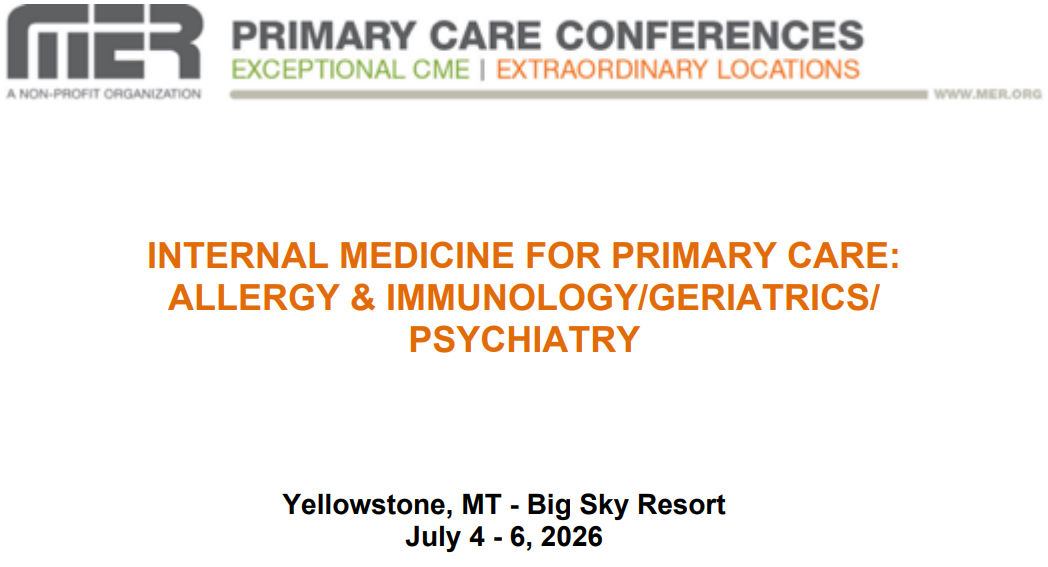
MER Primary Care Conferences Internal Medicine for Primary Care Allergy & Immuno Geri Psych Jul 04-06, 2026

$100.00
This Product is shared via google drive download link, So please share your correct Gmail id while placing the order .Please note that there are no CME points or certificate associated with this course Samples for Courses Can be found here : Free Samples Here!
EXPRESS DISCOVER PayPal
MER Internal Medicine for Primary Care: Allergy & Immuno/Geri/Psych 2026
Allergy & Immunology • Geriatrics • Psychiatry
July 4–6, 2026 | Big Sky Resort, Yellowstone, Montana
Strengthen your approach to common allergic, geriatric, cognitive, and psychiatric conditions with MER Internal Medicine for Primary Care: Allergy & Immuno/Geri/Psych 2026, a focused educational program from Medical Education Resources (MER).
The original conference was held July 4–6, 2026, at Big Sky Resort in Yellowstone, Montana.
This three-day primary care program combines practical updates in:
- Allergy & Immunology
- Geriatric Medicine
- Psychiatry
- Internal Medicine
- Primary Care
Major topics include:
- Adult ADHD
- Bipolar spectrum disorders
- Anxiety disorders
- Substance use disorders
- Asthma
- Allergic rhinitis
- Sinusitis
- Food allergy
- Hymenoptera / venom allergy
- Anaphylaxis
- Immunotherapy
- Urticaria
- Angioedema
- Atopic dermatitis / eczema
- Contact dermatitis
- Clinician burnout and wellness
- Comprehensive geriatric assessment
- Geriatric pharmacology
- Polypharmacy
- Osteoporosis
- DEXA
- FRAX fracture-risk assessment
- Alzheimer’s disease
- Other dementias
- Reversible causes of cognitive impairment
- Behavioral symptoms of dementia
- Non-pharmacologic dementia management
Course Details
- Course: Internal Medicine for Primary Care: Allergy & Immuno/Geri/Psych
- Provider: Medical Education Resources – MER
- Year: 2026
- Dates: July 4–6, 2026
- Duration: 3 Days
- Venue: Big Sky Resort
- Location: Yellowstone, Montana, USA
- Primary Focus: Internal Medicine / Primary Care
- Specialties: Allergy & Immunology / Geriatrics / Psychiatry
- Original Live Activity: 12 Credit Hours
- Original Pharmacotherapeutic Content: 5.50 ANCC Pharmacotherapeutic Contact Hours
- MedicalAmboss Delivery: Google Drive
- CME / Certificate with MedicalAmboss: Not Included
- Language: English
Course Overview
Primary care physicians routinely manage conditions that cross traditional specialty boundaries.
During a single clinic session, a clinician may evaluate:
- Poorly controlled asthma
- Chronic rhinitis
- Recurrent urticaria
- A suspected food allergy
- Cognitive decline in an older adult
- Polypharmacy
- Osteoporosis
- Adult ADHD
- Anxiety
- Bipolar disorder
- Substance use
The MER Allergy & Immuno/Geri/Psych 2026 curriculum provides a practical framework for approaching these common and sometimes overlapping presentations.
A useful clinical sequence is:
Recognize → Assess Severity → Build Differential → Select Treatment → Counsel → Monitor → Refer When Appropriate
Learning Objectives
Upon completion of the original educational program, participants should be better able to:
- Compare the benefits and side-effect profiles of pharmacologic treatment options for adult ADHD.
- Review psychosocial and pharmacologic treatment strategies for bipolar disorder.
- Recognize common psychiatric and medical comorbidities associated with bipolar spectrum disorders.
- Review evidence-based approaches to anxiety disorders.
- Identify and treat substance use disorders.
- Improve screening and clinical interviewing for substance use.
- Manage asthma efficiently in primary care.
- Review practical treatment of allergic rhinitis.
- Evaluate and manage sinusitis.
- Recognize and manage anaphylactic reactions.
- Understand appropriate indications for allergen immunotherapy.
- Review food allergy and Hymenoptera allergy.
- Recognize common forms of urticaria and angioedema.
- Review epidemiology and risk factors for atopic dermatitis.
- Distinguish common atopic and contact skin disorders.
- Apply strategies to improve clinician wellness and reduce burnout.
- Perform a comprehensive geriatric assessment.
- Review age-related changes affecting medication use.
- Identify potentially risky medication use in older adults.
- Interpret DEXA studies in osteoporosis evaluation.
- Apply FRAX fracture-risk assessment.
- Review current osteoporosis treatment options.
- Diagnose cognitive impairment and common dementias.
- Review Alzheimer’s disease.
- Recognize potentially reversible causes of cognitive decline.
- Apply non-pharmacologic approaches to difficult behaviors in dementia.
- Understand risks associated with psychotropic medication use in dementia.
PSYCHIATRY
The Complexity of Adult ADHD
Adult ADHD can be difficult to recognize because concentration problems, restlessness, and impaired executive function may overlap with:
- Anxiety
- Depression
- Bipolar disorder
- Sleep disorders
- Substance use
- Medical illness
- Medication effects
The course reviews adult ADHD with emphasis on:
- Symptom identification
- Co-occurring conditions
- Psychiatric differential diagnosis
- Medical differential diagnosis
- Evidence-based treatment
- FDA-approved pharmacologic options
Adult ADHD Assessment
Evaluation should extend beyond the complaint:
“I cannot concentrate.”
A structured assessment may include:
- Childhood symptoms
- Persistence into adulthood
- Occupational impairment
- Academic history
- Relationship effects
- Executive dysfunction
- Impulsivity
- Comorbid psychiatric conditions
- Substance-use history
ADHD Pharmacotherapy
Treatment decisions may involve comparison of different medication approaches according to:
- Expected benefit
- Adverse-effect profile
- Cardiovascular history
- Substance-use risk
- Psychiatric comorbidity
- Patient preference
Medication treatment should be combined with appropriate clinical monitoring.
Bipolar Spectrum Disorders
The program reviews bipolar spectrum disorders in adults with attention to:
- Comprehensive history-taking
- Differential diagnosis
- Comorbid psychiatric disorders
- Medical comorbidities
- Mood stabilization
- Phase-specific treatment
Recognizing Bipolar Disorder
Bipolar illness may be missed when patients present primarily during depressive episodes.
Assessment can include a history of:
- Elevated or irritable mood
- Reduced need for sleep
- Increased activity
- Increased energy
- Impulsivity
- Risk-taking
- Episodic changes in functioning
Accurate diagnosis is important because treatment strategies differ from those used for unipolar depression.
Psychosocial & Pharmacologic Treatment
Treatment can involve:
- Mood-stabilizing medication
- Selected antipsychotic therapies
- Psychotherapy
- Sleep stabilization
- Patient education
- Relapse prevention
- Monitoring of comorbid illness
Treatment should be matched to the phase and severity of illness.
Anxiety Disorders
The course reviews several important anxiety disorders, including:
- Generalized anxiety disorder
- Panic disorder
- Social anxiety disorder
- Post-traumatic stress disorder
Generalized Anxiety Disorder
Patients may present with:
- Excessive worry
- Restlessness
- Fatigue
- Difficulty concentrating
- Irritability
- Muscle tension
- Sleep disturbance
Clinicians should also consider medical and medication-related causes of anxiety symptoms.
Panic Disorder
Panic attacks can cause sudden episodes of intense fear accompanied by physical symptoms.
Because symptoms may resemble medical emergencies, clinicians need to distinguish psychiatric from cardiopulmonary or other medical causes.
Social Anxiety Disorder
Social anxiety can substantially affect:
- Work
- Relationships
- Academic performance
- Social functioning
The course reviews diagnosis and available treatment approaches.
PTSD
Post-traumatic stress disorder may involve:
- Intrusive symptoms
- Avoidance
- Mood and cognitive changes
- Hyperarousal
Treatment planning should consider severity, comorbidities, trauma history, and patient preference.
Substance Use Disorders
The program reviews strategies for identifying and treating substance use disorders.
Key areas include:
- Substance-use history
- Encouraging honest disclosure
- Screening
- Diagnosis
- Brief intervention
- Recovery
- Treatment options
- Motivational interviewing
- Family dynamics
- Codependency
Screening for Substance Use
Primary care clinicians are well positioned to identify substance-related problems before severe complications develop.
A useful approach includes:
Ask → Screen → Assess Severity → Discuss Readiness → Intervene / Refer → Follow Up
Motivational Interviewing
Motivational interviewing is a collaborative technique used to help patients explore ambivalence and strengthen motivation for behavior change.
Core principles include:
- Empathy
- Reflective listening
- Supporting autonomy
- Avoiding confrontation
- Reinforcing self-efficacy
ALLERGY & IMMUNOLOGY
Asthma, Allergic Rhinitis & Sinusitis for Primary Care
This session focuses on developing a practical and cost-effective approach to three common problems:
- Asthma
- Allergic rhinitis
- Sinusitis
Asthma
Asthma management begins with accurate assessment of:
- Symptoms
- Trigger pattern
- Exacerbation history
- Current medications
- Treatment adherence
- Inhaler technique
- Comorbid allergic disease
The clinical goal is not simply to treat acute symptoms but to achieve sustainable disease control.
Allergic Rhinitis
Allergic rhinitis can substantially affect:
- Sleep
- Concentration
- Productivity
- Asthma control
- Quality of life
Management may involve:
- Allergen avoidance when practical
- Pharmacologic therapy
- Patient education
- Immunotherapy in selected patients
Rhinitis Differential Diagnosis
Not every patient with nasal symptoms has allergic rhinitis.
Potential alternatives include:
- Nonallergic rhinitis
- Medication-related rhinitis
- Structural disease
- Chronic rhinosinusitis
- Infection
History and examination help guide appropriate treatment.
Sinusitis
The program reviews efficient diagnosis and treatment of sinusitis within primary care.
An important objective is distinguishing:
Viral / Self-Limited Disease
from presentations that may require further evaluation or different treatment.
Food Allergies
The course includes a primary care review of food allergy.
Clinicians should distinguish true food allergy from:
- Food intolerance
- Nonimmune adverse reactions
- Patient-perceived food sensitivity
Accurate history is critical before extensive testing or dietary restriction.
Hymenoptera Allergy
The program also reviews hypersensitivity to insect venom.
Clinicians should understand:
- Recognition of systemic reactions
- Risk assessment
- Acute management
- Referral considerations
- Role of venom immunotherapy when appropriate
Anaphylaxis
Anaphylaxis is a potentially life-threatening systemic hypersensitivity reaction.
Rapid recognition is essential.
Potential manifestations can involve:
- Skin
- Respiratory tract
- Cardiovascular system
- Gastrointestinal tract
Emergency management should follow current clinical guidance.
Immunotherapy
The course reviews indications for immunotherapy in appropriate allergic disease.
Treatment selection depends on:
- Confirmed allergy
- Clinical relevance
- Symptom severity
- Response to conventional management
- Patient-specific risk
- Availability of specialist care
Urticaria
Urticaria commonly presents as transient pruritic wheals.
Evaluation should consider:
- Acute vs. chronic presentation
- Trigger history
- Medication exposure
- Infection
- Associated angioedema
- Systemic symptoms
Angioedema
Angioedema involves deeper tissue swelling and can require different evaluation depending on whether it occurs with or without urticaria.
Airway involvement requires urgent assessment.
Eczema / Atopic Dermatitis
The program reviews:
- Epidemiology
- Risk factors
- Etiology
- Clinical recognition
- Practical management
Atopic dermatitis is a chronic inflammatory skin disorder in which barrier dysfunction and inflammatory mechanisms play important roles.
Contact Dermatitis
Contact dermatitis can be:
Irritant
caused by direct damage to the skin barrier.
Allergic
caused by delayed hypersensitivity to a specific allergen.
Exposure history and distribution are particularly useful diagnostically.
Atopic Skin Disease in Primary Care
The combination of:
- Urticaria
- Angioedema
- Eczema
- Contact dermatitis
provides a practical review of common skin presentations that may initially be evaluated outside dermatology or allergy specialty clinics.
Provider Wellness & Burnout
One distinctive topic in this MER program is:
Burnout and Provider Wellness
The session focuses on strategies healthcare professionals can use to address the pressures of contemporary clinical practice.
Rediscovering Joy in Medicine
Clinician wellbeing can affect:
- Professional satisfaction
- Patient communication
- Team relationships
- Burnout
- Career longevity
The course explores practical ways to reconnect with meaningful aspects of clinical practice.
GERIATRICS
Approach to the Geriatric Patient
Older adults often require assessment beyond a disease-specific problem list.
The course reviews:
- Demographics of aging
- Physiologic changes
- Medication use
- Pharmacokinetic changes
- Pharmacodynamic changes
- Medication adherence
- Potentially risky medications
Comprehensive Geriatric Assessment
A structured geriatric assessment may include:
Medical
- Chronic disease
- Medication burden
- Pain
- Sensory impairment
Functional
- Activities of daily living
- Mobility
- Fall risk
- Independence
Cognitive
- Memory
- Executive function
- Decision-making
Psychological
- Mood
- Behavioral symptoms
Social
- Living environment
- Caregiver support
- Safety
- Access to care
Geriatric Pharmacology
Age-related physiologic changes can alter:
- Drug distribution
- Metabolism
- Excretion
- Drug sensitivity
Older adults may therefore have a greater risk of:
- Adverse drug reactions
- Drug-drug interactions
- Drug-disease interactions
- Polypharmacy complications
Medication Review in Older Adults
A useful medication review asks:
- Is each medication still needed?
- Is the dose appropriate?
- Are there duplications?
- Is a medication causing a new symptom?
- Could treatment increase fall risk?
- Can the regimen be simplified?
Osteoporosis in the Older Adult
The course provides a focused review of:
- Epidemiology
- Pathophysiology
- Fracture risk
- DEXA
- FRAX
- Therapeutic options
DEXA
Dual-energy X-ray absorptiometry is widely used to evaluate bone mineral density.
Interpretation should be integrated with:
- Age
- Fracture history
- Clinical risk factors
- Medication exposure
- Other contributors to bone loss
FRAX Risk Assessment
FRAX incorporates clinical risk factors to estimate fracture probability.
The objective is to move beyond asking only:
“What is the T-score?”
and instead ask:
“What is this patient’s overall fracture risk?”
Osteoporosis Treatment
Treatment may include:
- Lifestyle measures
- Fall prevention
- Adequate calcium and vitamin D where clinically appropriate
- Pharmacologic therapy
- Monitoring
Choice of treatment depends on fracture risk and patient-specific factors.
Alzheimer’s Disease & Other Dementias
The course reviews:
- Normal cognitive aging
- Memory disorders
- Dementia
- Mental status examinations
- Alzheimer’s disease
- Other dementia types
- Reversible causes
- Treatment
- Clinician responsibilities
Normal Aging vs. Cognitive Impairment
Not every memory complaint represents dementia.
Clinical assessment should examine:
- Progression
- Functional impairment
- Mood
- Sleep
- Medication effects
- Sensory impairment
- Neurologic symptoms
Mental Status Examination
Cognitive screening tools can support assessment but have limitations.
Results may be influenced by:
- Education
- Language
- Hearing
- Vision
- Cultural factors
- Baseline function
Screening should therefore be interpreted within the full clinical context.
Types of Dementia
Accurate diagnosis is important because cognitive impairment may result from:
- Alzheimer’s disease
- Vascular dementia
- Lewy body dementia
- Frontotemporal disorders
- Mixed dementia
- Other neurologic or systemic conditions
Potentially Reversible Dementias
Assessment should consider potentially treatable contributors such as:
- Medication effects
- Depression
- Metabolic disease
- Endocrine abnormalities
- Nutritional deficiencies
- Sleep disorders
- Delirium
- Other medical illness
Managing Behavior Problems in Dementia
Behavioral disturbances may include:
- Agitation
- Aggression
- Wandering
- Repetitive behavior
- Sleep disturbance
- Resistance to care
- Anxiety
The MER curriculum emphasizes behavioral strategies that may reduce unnecessary reliance on psychotropic medications.
Non-Pharmacologic Management
A useful framework is:
Identify Trigger → Address Medical Cause → Modify Environment → Simplify Communication → Support Caregiver → Reassess
Potential interventions can include:
- Structured routines
- Environmental modification
- Pain management
- Sleep optimization
- Reduced overstimulation
- Caregiver education
Psychotropic Medication Risks
When psychotropic medication is considered for behavioral symptoms, clinicians should carefully evaluate:
- Severity
- Safety risk
- Potential adverse effects
- Drug interactions
- Non-pharmacologic alternatives
The objective is not simply to suppress behavior but to understand its cause.
Cross-Specialty Clinical Connections
One of the strengths of this MER program is the overlap among its three major clinical areas.
Allergy + Psychiatry
Symptoms such as:
- Dyspnea
- Palpitations
- Chest tightness
may occur in asthma, anaphylaxis, or anxiety-related conditions.
Appropriate clinical evaluation is therefore important before assuming a psychiatric or allergic cause.
Geriatrics + Psychiatry
Older adults may present with:
- Cognitive impairment
- Depression
- Medication effects
- Behavioral changes
These conditions can overlap substantially.
Geriatrics + Allergy
Older patients may have greater medication burden and comorbid disease, which can complicate treatment of:
- Asthma
- Rhinitis
- Urticaria
- Allergic reactions
Polypharmacy + Mental Health
Medication adverse effects can sometimes contribute to:
- Cognitive problems
- Sleep disturbance
- Anxiety
- Falls
- Functional decline
Medication review therefore connects geriatric and psychiatric care.
Major Allergy & Immunology Topics
- Asthma
- Allergic Rhinitis
- Sinusitis
- Food Allergy
- Hymenoptera Allergy
- Venom Allergy
- Anaphylaxis
- Immunotherapy
- Urticaria
- Angioedema
- Atopic Dermatitis
- Eczema
- Contact Dermatitis
- Hypersensitivity
Major Geriatrics Topics
- Comprehensive Geriatric Assessment
- Physiology of Aging
- Geriatric Pharmacology
- Pharmacokinetics
- Pharmacodynamics
- Polypharmacy
- Medication Adherence
- Risky Medications
- Osteoporosis
- DEXA
- FRAX
- Cognitive Impairment
- Alzheimer’s Disease
- Dementia
- Reversible Cognitive Impairment
- Behavioral Problems in Dementia
Major Psychiatry Topics
- Adult ADHD
- ADHD Pharmacotherapy
- Bipolar Spectrum Disorders
- Mood Stabilization
- Anxiety Disorders
- Generalized Anxiety Disorder
- Panic Disorder
- Social Anxiety Disorder
- PTSD
- Substance Use Disorders
- Motivational Interviewing
- Addiction
- Provider Burnout
- Clinician Wellness
Who Should Take This Course?
The original MER activity was designed for office-based primary care providers and other healthcare professionals seeking practical updates in adult medicine.
It is particularly relevant for:
- Primary Care Physicians
- Internal Medicine Physicians
- Family Medicine Physicians
- Allergists
- Immunologists
- Geriatricians
- Psychiatrists
- General Practitioners
- Hospitalists
- Residents
- Fellows
- Nurse Practitioners
- Physician Assistants / Associates
- Clinicians caring for older adults
- Clinicians managing common allergic disease
- Clinicians treating adult psychiatric conditions
Why This Course Is Useful
MER Internal Medicine for Primary Care: Allergy & Immuno/Geri/Psych 2026 combines three areas frequently encountered in everyday outpatient practice.
The program can help learners:
- Improve asthma management
- Review allergic rhinitis and sinusitis
- Recognize food and venom allergies
- Review anaphylaxis
- Understand immunotherapy indications
- Improve management of urticaria and angioedema
- Review atopic dermatitis and contact dermatitis
- Diagnose adult ADHD
- Review bipolar spectrum disorders
- Improve anxiety-disorder management
- Identify substance use disorders
- Apply motivational interviewing
- Address provider burnout
- Perform comprehensive geriatric assessment
- Review medication risks in older adults
- Interpret DEXA and FRAX
- Update osteoporosis management
- Diagnose cognitive impairment
- Review Alzheimer’s and other dementias
- Manage behavioral problems with non-pharmacologic strategies
The curriculum can be summarized as:
Allergic Disease → Mental Health → Healthy Aging → Cognitive Care
within a practical primary-care framework.
Original Conference Accreditation
The official MER activity was listed as:
Internal Medicine for Primary Care: Allergy & Immuno/Geri/Psych – 12 Credit Hours
with:
5.50 ANCC Pharmacotherapeutic Contact Hours
Important CME / Certificate Notice
These credits applied to eligible participation in the original MER educational activity and its applicable completion requirements.
The MedicalAmboss product states that:
CME points and certificate are not included.
Therefore, do not advertise the MedicalAmboss product as:
- 12 CME Credits Included
- 5.50 Pharmacology Hours Included
- Official MER CME Included
- MER Certificate Included
unless official MER participation and credit eligibility are actually included.
The correct distinction is:
Original MER Activity: 12 Credit Hours
and separately:
MedicalAmboss Product: CME / Certificate Not Included
Product / Delivery Information
- Product: MER Internal Medicine for Primary Care: Allergy & Immuno/Geri/Psych 2026
- Provider: Medical Education Resources – MER
- Dates: July 4–6, 2026
- Venue: Big Sky Resort
- Location: Yellowstone, Montana
- Specialties: Allergy & Immunology / Geriatrics / Psychiatry
- Original Activity: 12 Credit Hours
- Original Pharmacotherapeutic Content: 5.50 ANCC Contact Hours
- Delivery: Google Drive
- CME Points: Not Included
- Certificate: Not Included
4. Short Description
MER Internal Medicine for Primary Care: Allergy & Immuno/Geri/Psych 2026 provides a practical three-day update in allergy and immunology, geriatrics, and psychiatry.
Topics include adult ADHD, bipolar spectrum disorders, anxiety, substance use disorders, asthma, allergic rhinitis, sinusitis, food and Hymenoptera allergies, anaphylaxis, immunotherapy, urticaria, angioedema, atopic dermatitis, provider wellness, comprehensive geriatric assessment, geriatric pharmacology, osteoporosis, DEXA/FRAX, Alzheimer’s disease, dementia, and non-pharmacologic management of behavioral symptoms.
Topics
-
The Complexity of Adult ADHD: ADHD in adults with an emphasis on symptom identification; Co-occurring conditions; Psychiatric and medical differential diagnosis; evidence-based and FDA approved pharmacological treatments.
-
Bipolar Spectrum Disorders: Bipolar spectrum disorders in adults as compared to youth; Comprehensive history-taking; Differential diagnosis; Co-occurring psychiatric and medical conditions; Phase specific treatment considerations and interventions.
-
Anxiety Disorders: The nature of anxiety; Generalized anxiety disorder, panic disorder, social anxiety disorder and post-traumatic stress disorder; etiology and diagnosis; Co-occurring conditions; Treatment options for these disabling conditions.
-
Asthma, Allergic Rhinitis, and Sinusitis for Primary Care: Lecture focused on gaining a working knowledge of how to efficiently and cost effectively manage patients with asthma, rhinitis, and sinusitis.
-
Food Allergies and Hymenoptera Allergies: Primary care focused discussion of food and venom allergies including gaining a working knowledge of how to efficiently and cost effectively manage patients with hymenoptera hypersensitivity.
-
Urticaria, Angioedema, Eczema and Contact Dermatitis: Lecture focused on gaining a working knowledge of how to efficiently and cost effectively manage patients with various atopic skin conditions.
-
Burnout and Provider Wellness: Strategies that clinicians and healthcare providers can institute with ease to combat the challenges and pitfalls of the current healthcare system.
-
Substance Use Disorders: Substance abuse history-taking to encourage patient honesty; Accurate diagnosis; Use of screening tools; Brief intervention; Recovery and treatment options; Motivational interviewing; Family symptoms and codependency.
-
Approach to the Geriatric Patient: The demographics of aging and the physiologic changes in the elderly patient; Medication use in the elderly including changes in age-related pharmacokinetics and pharmacodymamics and medication adherence; Review of risky medications often used in elderly patients.
-
Osteoporosis in the Older Adult: Review the epidemiology and pathophysiology of osteoporosis along with interpretation of DEXA scans and FRAX risk assessment; up-to-date therapeutic options.
-
Alzheimer’s & Other Dementias: Review of normal age-related changes in cognitive function as well as disorders of memory and cognition as part of dementing illness; Mental status exams, including their limitations in evaluating memory; Various types of dementia and the importance of an accurate diagnosis; Current treatment options for various kinds of dementia; Potentially reversible dementias; The responsibilities of healthcare providers in managing patients with dementia.
-
Managing Behavior Problems in Dementia Patients: Review of common behavior disorders often seen in patients with dementia; Behavioral techniques which have shown to be effective in managing some of the behavior disorders in patients with Alzheimer’s and other dementias, focusing on the management of these patients without the use of psychotropic medications; Examples of behavior disturbances along with the behavior management technique which was effective in managing the patient with the behavior problem; Review of the potential adverse effects of the psychotropic medications usually used to manage behavior.
| Select | Full course Videos+Qbank, Only Videos, Only Qbank |
|---|
Related products
Anesthesiology & pain medicine
Critical Care Symposium: Mastering ED Mechanical Ventilation

Medical Accounts
Internal Medicine

Critical Care - Emergency medicine

Critical Care - Emergency medicine

Internal Medicine

Critical Care - Emergency medicine

Cardiology