
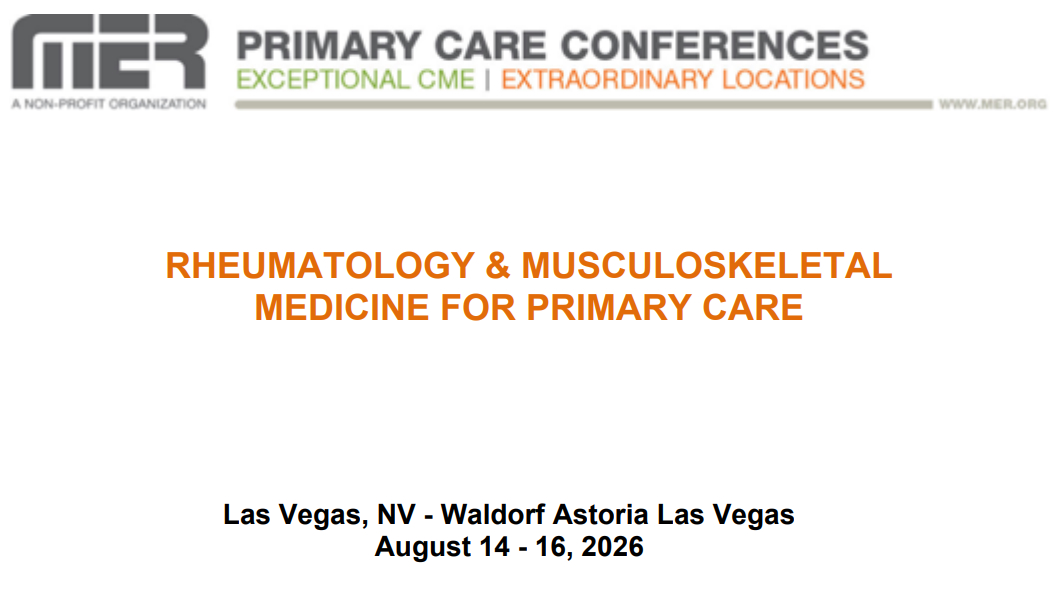
MER Primary Care Conferences Rheumatology & Musculoskeletal Medicine for Primary Care Aug 14-16, 2026

$65.00
This Product is shared via google drive download link, So please share your correct Gmail id while placing the order .Please note that there are no CME points or certificate associated with this course Samples for Courses Can be found here : Free Samples Here!
MER Rheumatology & Musculoskeletal Medicine for Primary Care 2026
Joint Pain • Inflammatory Arthritis • Osteoarthritis • Gout • Osteoporosis • Joint Injection • Fibromyalgia • Spinal Pain
Build a practical, evidence-based approach to common rheumatologic and musculoskeletal disorders with MER Rheumatology & Musculoskeletal Medicine for Primary Care 2026, a focused clinical program from Medical Education Resources (MER).
The original conference was held August 14–16, 2026, at the Waldorf Astoria Las Vegas in Las Vegas, Nevada.
Designed for office-based primary care clinicians and other healthcare professionals, the course combines rheumatologic diagnosis with practical musculoskeletal examination and procedural skills.
Major topics include:
- Inflammatory vs. non-inflammatory joint pain
- Joint aspiration and synovial fluid analysis
- Rheumatoid arthritis
- Systemic lupus erythematosus
- Spondyloarthropathies
- Sjögren syndrome
- Polymyalgia rheumatica
- Systemic sclerosis
- Infectious arthritis
- Arthritis pharmacology
- NSAIDs and COX-2 inhibitors
- DMARDs
- Regional pain syndromes
- Joint and soft-tissue examination
- Osteoarthritis
- Gout and pseudogout
- Osteoporosis
- DEXA and FRAX
- Joint injection techniques
- Fibromyalgia
- Low back and spinal pain
- DISH
- Ankylosing spondylitis
The program emphasizes an approach that can be summarized as:
Clinical Presentation → Focused Examination → Differential Diagnosis → Appropriate Testing → Evidence-Based Treatment → Procedure or Referral When Needed
Course Details
- Course: Rheumatology & Musculoskeletal Medicine for Primary Care
- Provider: Medical Education Resources – MER
- Year: 2026
- Dates: August 14–16, 2026
- Duration: 3 Days
- Venue: Waldorf Astoria Las Vegas
- Location: Las Vegas, Nevada
- Primary Specialty: Rheumatology
- Additional Focus: Musculoskeletal Medicine / Primary Care
- Original Live Activity: 12 Credit Hours
- Original Pharmacotherapeutic Content: 4.00 ANCC Pharmacotherapeutic Contact Hours
- Delivery: Google Drive
- CME / Certificate with MedicalAmboss Product: Not Included
- Language: English
Course Overview
Joint and musculoskeletal complaints are among the most frequent reasons patients seek medical care.
Primary care clinicians regularly evaluate patients with:
- Acute joint pain
- Chronic joint pain
- Joint swelling
- Morning stiffness
- Back pain
- Shoulder pain
- Hand and wrist symptoms
- Hip pain
- Knee pain
- Foot and ankle pain
- Suspected gout
- Osteoarthritis
- Osteoporosis
- Fibromyalgia
- Possible inflammatory arthritis
The challenge is determining whether symptoms arise from:
Inflammatory Disease → Degenerative Disease → Crystal Disease → Soft-Tissue Disorder → Mechanical Injury → Systemic Rheumatologic Disease
This MER program provides a practical framework for making those distinctions.
Learning Objectives
Upon completion of the original program, participants should be better able to:
- Differentiate inflammatory from non-inflammatory joint pain.
- Construct an appropriate differential diagnosis for joint complaints.
- Understand the role of joint aspiration in evaluating arthritis.
- Interpret basic synovial fluid findings.
- Review risks and benefits of commonly used arthritis medications.
- Understand clinical use of traditional NSAIDs and COX-2 inhibitors.
- Review conventional and biologic disease-modifying antirheumatic drugs.
- Perform a structured examination of joints and soft tissues.
- Recognize regional musculoskeletal pain syndromes.
- Identify important anatomic landmarks for major-joint injections.
- Recognize common inflammatory arthritis presentations.
- Review rheumatoid arthritis treatment principles.
- Review systemic lupus erythematosus, spondyloarthropathies, Sjögren syndrome, polymyalgia rheumatica, and systemic sclerosis.
- Apply evidence-based strategies to osteoarthritis.
- Diagnose and treat gout and pseudogout.
- Evaluate osteoporosis using DEXA and FRAX concepts.
- Review benefits and risks of bisphosphonate therapy.
- Understand joint aspiration and injection techniques.
- Compare pharmacologic options for fibromyalgia.
- Construct a differential diagnosis for low back and spinal pain.
Day 1 – August 14, 2026
Evaluating the Patient with Joint Pain
A major challenge in musculoskeletal medicine is determining whether joint pain is inflammatory or non-inflammatory.
Inflammatory Features May Include
- Prolonged morning stiffness
- Joint swelling
- Warmth
- Synovitis
- Systemic symptoms
- Multiple joint involvement
- Elevated inflammatory markers in appropriate settings
Non-Inflammatory Features May Include
- Pain related to activity
- Mechanical symptoms
- Limited morning stiffness
- Degenerative changes
- Localized overuse symptoms
The distinction helps determine the next diagnostic step.
Differential Diagnosis of Joint Pain
Potential causes include:
- Osteoarthritis
- Rheumatoid arthritis
- Crystal arthritis
- Spondyloarthritis
- Septic arthritis
- Tendinopathy
- Bursitis
- Trauma
- Systemic connective-tissue disease
A structured approach prevents unnecessary testing and helps identify conditions requiring urgent treatment.
Joint Aspiration & Synovial Fluid Analysis
Joint aspiration can provide valuable diagnostic information when a patient presents with an acutely swollen joint.
Synovial fluid assessment may help distinguish:
- Non-inflammatory arthritis
- Inflammatory arthritis
- Crystal arthritis
- Septic arthritis
- Hemarthrosis
The clinical question is not simply whether fluid is present, but:
What Does the Synovial Fluid Suggest About the Underlying Process?
Update in Pharmacology for Arthritis
This session reviews major pharmacologic approaches used for arthritis and musculoskeletal pain.
Topics include:
- Traditional NSAIDs
- COX-2 inhibitors
- Acetaminophen
- Analgesics
- Tramadol
- Opioid/narcotic analgesics
- Conventional synthetic DMARDs
- Biologic DMARDs
NSAIDs & COX-2 Inhibitors
These medications can be effective for pain and inflammation, but treatment requires consideration of:
- Gastrointestinal risk
- Renal function
- Cardiovascular risk
- Drug interactions
- Age
- Comorbid disease
- Duration of therapy
The safest medication is not necessarily the same for every patient.
DMARDs in Inflammatory Arthritis
Disease-modifying antirheumatic drugs are used to alter disease progression rather than simply control symptoms.
They are particularly important in diseases such as:
- Rheumatoid arthritis
- Selected spondyloarthropathies
- Other inflammatory rheumatic diseases
Treatment decisions often require rheumatology collaboration and appropriate monitoring.
Differential Diagnosis of Inflammatory Arthritis
This session reviews major inflammatory rheumatologic disorders and their clinical presentations.
Topics include:
- Rheumatoid arthritis
- Systemic lupus erythematosus
- Spondyloarthropathies
- Infectious arthritis
- Systemic sclerosis
- Sjögren syndrome
- Polymyalgia rheumatica
Rheumatoid Arthritis
Important clinical concepts include:
- Symmetrical inflammatory polyarthritis
- Small-joint involvement
- Morning stiffness
- Serologic testing
- Disease-modifying treatment
- Prevention of structural damage
Modern RA management emphasizes early identification and appropriate DMARD therapy.
Systemic Lupus Erythematosus
SLE can involve multiple organ systems.
Potential manifestations include:
- Musculoskeletal symptoms
- Skin disease
- Kidney disease
- Hematologic abnormalities
- Neurologic involvement
- Cardiopulmonary disease
Clinical context is essential when interpreting autoimmune testing.
Spondyloarthropathies
This group may involve:
- Axial pain
- Sacroiliac disease
- Enthesitis
- Peripheral arthritis
- Extra-articular manifestations
Recognizing an inflammatory pattern of back pain can help distinguish these disorders from common mechanical low back pain.
Infectious Arthritis
Septic arthritis is an important diagnosis because delayed treatment can result in substantial joint damage and systemic complications.
A painful, swollen joint—particularly with systemic illness—may require urgent:
- Joint aspiration
- Gram stain/culture
- Laboratory evaluation
- Antimicrobial treatment
Physical Examination of Joints and Soft Tissue
This practical section emphasizes examination skills rather than relying exclusively on imaging.
Topics include assessment of:
- Shoulder
- Elbow
- Wrist
- Hand
- Hip
- Knee
- Ankle
- Foot
- Periarticular soft tissues
Regional Pain Syndromes
The course includes several common disorders encountered in primary care.
Carpal Tunnel Syndrome
Median nerve compression can present with:
- Hand numbness
- Paresthesias
- Nocturnal symptoms
- Weakness in advanced cases
De Quervain Tenosynovitis
A common cause of pain along the radial side of the wrist associated with tendon irritation.
Epicondylitis
Can produce localized elbow pain related to overuse or repetitive strain.
Shoulder Impingement
A common cause of shoulder pain that should be distinguished from:
- Rotator cuff injury
- Adhesive capsulitis
- Cervical radiculopathy
- Glenohumeral pathology
Hip, Knee, Ankle & Foot Overuse Syndromes
Focused physical examination can often provide valuable localization before imaging is considered.
Joint & Soft-Tissue Examination Workshop
Small-group examination workshops reinforce practical assessment of joints and soft tissues.
The procedural and examination component is particularly useful because musculoskeletal diagnosis often depends heavily on accurate physical examination.
Day 2 – August 15, 2026
Osteoarthritis
Osteoarthritis is one of the most common musculoskeletal conditions encountered in primary care.
The program reviews:
- Pathogenesis
- Diagnosis
- Clinical features
- Nonpharmacologic treatment
- Pharmacologic treatment
Osteoarthritis Management
OA management can involve multiple strategies:
Education → Exercise → Weight Management → Physical Therapy → Analgesic / Anti-Inflammatory Therapy → Injection / Specialist Evaluation When Appropriate
Treatment should reflect:
- Joint involved
- Pain severity
- Functional limitation
- Comorbidities
- Patient goals
Crystal Disease – Gout & Pseudogout
The program reviews appropriate diagnosis and treatment of crystal arthritis.
Gout
Gout results from deposition of monosodium urate crystals.
Clinical presentation may include:
- Acute severe joint pain
- Swelling
- Warmth
- Erythema
- Recurrent attacks
Joint aspiration can help establish the diagnosis when uncertainty exists.
Pseudogout
Calcium pyrophosphate deposition disease can mimic:
- Gout
- Septic arthritis
- Osteoarthritis flare
Recognition of crystal type and clinical context helps guide treatment.
Acute Monoarthritis
When a patient presents with a single acutely swollen joint, the differential should include:
Septic Arthritis → Crystal Arthritis → Trauma → Other Inflammatory Arthritis
Missing septic arthritis can have serious consequences, making appropriate aspiration particularly important.
Osteoporosis
The course reviews:
- Epidemiology
- Pathophysiology
- Bone mineral density
- DEXA
- FRAX
- Fracture-risk assessment
- Contemporary treatment
- Bisphosphonates
DEXA & FRAX
Osteoporosis treatment should not be based on a DEXA value alone.
A more complete assessment incorporates:
- Bone density
- Age
- Previous fractures
- Medication history
- Family history
- Clinical risk factors
- FRAX risk assessment
The central goal is:
Fracture Prevention
Bisphosphonate Therapy
The course reviews both benefits and risks of bisphosphonate treatment.
Important considerations include:
- Fracture risk
- Duration of therapy
- Renal function
- Medication adherence
- Adverse effects
- Need for reassessment
Joint Injection Technique
The program includes practical instruction on injections of major joints.
Relevant sites include:
- Shoulder
- Elbow
- Fingers
- Hip
- Knee
- Ankle
Principles of Joint Injection
Safe injection requires attention to:
Correct Diagnosis → Anatomy → Appropriate Landmark → Sterile Technique → Appropriate Medication → Follow-Up
Injection should not substitute for establishing the correct diagnosis.
Joint Aspiration & Injection Workshop
Small-group workshops reinforce techniques for:
- Joint aspiration
- Major-joint injection
- Anatomic localization
- Procedural positioning
Joint Aspiration
Aspiration can serve both diagnostic and, in selected cases, therapeutic purposes.
Potential indications include:
- Acute monoarthritis
- Suspected crystal disease
- Suspected septic arthritis
- Significant effusion
- Diagnostic uncertainty
Day 3 – August 16, 2026
Fibromyalgia
Fibromyalgia can be difficult to diagnose and manage because pain may be widespread while conventional structural investigations remain unrevealing.
The course reviews:
- Differential diagnosis
- Clinical recognition
- Treatment
- Pharmacologic options
- Antiepileptic medications
- SNRIs
Fibromyalgia Management
Effective management often requires a multimodal strategy rather than medication alone.
Potential components include:
- Patient education
- Exercise
- Sleep optimization
- Management of associated symptoms
- Selected pharmacologic therapy
Clinicians should also evaluate for alternative diagnoses when symptoms or examination findings are atypical.
Spinal Pain
The final focused session reviews differential diagnosis and treatment of low back and spinal pain.
Topics include:
- Mechanical low back pain
- Osteoarthritis
- Diffuse idiopathic skeletal hyperostosis – DISH
- Ankylosing spondylitis
- Inflammatory vs. non-inflammatory back pain
Low Back Pain
Most low back pain is mechanical, but clinicians should identify patients who require more urgent evaluation.
Important considerations include:
- Neurologic deficits
- Trauma
- Infection risk
- Malignancy risk
- Systemic symptoms
- Inflammatory features
Mechanical vs. Inflammatory Back Pain
Mechanical Pain
Often worsens with activity and may improve with rest.
Inflammatory Back Pain
Can be associated with:
- Younger age at onset
- Morning stiffness
- Improvement with activity
- Night pain
- Sacroiliac involvement
Recognizing this pattern may raise suspicion for axial spondyloarthritis.
DISH
Diffuse Idiopathic Skeletal Hyperostosis (DISH) is included in the spinal pain curriculum and can produce stiffness and characteristic spinal changes.
It should be distinguished from inflammatory spondyloarthropathy.
Ankylosing Spondylitis
Important concepts include:
- Inflammatory back pain
- Sacroiliac disease
- Reduced mobility
- Extra-articular manifestations
- Appropriate rheumatologic evaluation
Challenging Rheumatology Cases
Case-based learning helps integrate the concepts covered throughout the conference.
A useful reasoning pathway is:
Symptoms → Pattern Recognition → Examination → Laboratory / Imaging Data → Diagnosis → Management
Major Rheumatology Topics Covered
- Rheumatoid Arthritis
- Systemic Lupus Erythematosus
- Spondyloarthritis
- Ankylosing Spondylitis
- Sjögren Syndrome
- Polymyalgia Rheumatica
- Systemic Sclerosis
- Infectious Arthritis
- Inflammatory Arthritis
- Crystal Arthritis
- Gout
- Pseudogout
Major Musculoskeletal Topics Covered
- Joint Pain
- Joint Examination
- Soft-Tissue Examination
- Regional Pain Syndromes
- Carpal Tunnel Syndrome
- De Quervain Tenosynovitis
- Epicondylitis
- Shoulder Impingement
- Hip Pain
- Knee Pain
- Ankle Pain
- Foot Pain
- Osteoarthritis
- Low Back Pain
- Spinal Pain
- DISH
Major Procedural Topics Covered
- Joint Aspiration
- Synovial Fluid Analysis
- Joint Injection
- Shoulder Injection
- Elbow Injection
- Finger Injection
- Hip Injection
- Knee Injection
- Ankle Injection
- Joint Anatomy
- Procedural Landmarks
Major Pharmacology Topics Covered
- NSAIDs
- COX-2 Inhibitors
- Acetaminophen
- Tramadol
- Opioid Analgesics
- Conventional Synthetic DMARDs
- Biologic DMARDs
- Bisphosphonates
- Antiepileptic Therapy for Fibromyalgia
- SNRIs
Inflammatory vs. Non-Inflammatory Joint Pain
One of the most useful concepts in this course is the early classification of joint symptoms.
A practical framework is:
Joint Pain → Is There Inflammation? → Monoarticular or Polyarticular? → Acute or Chronic? → Systemic Features? → Aspiration / Laboratory Testing When Appropriate
This reduces unnecessary testing and helps prioritize urgent diagnoses.
Primary Care Approach to an Acute Swollen Joint
A useful sequence is:
History → Examination → Determine Need for Aspiration → Synovial Fluid → Crystal / Culture Evaluation → Treatment
The differential should always account for infection before assuming a gout or osteoarthritis flare.
Musculoskeletal Examination Before Imaging
Many common regional pain syndromes can be approached initially through:
- History
- Inspection
- Range of motion
- Palpation
- Strength testing
- Provocative maneuvers
- Neurovascular examination
Imaging should answer a specific clinical question rather than replacing the physical examination.
Who Should Take This Course?
The program is targeted to office-based primary care clinicians and other professionals managing rheumatologic and musculoskeletal disorders.
It is particularly relevant for:
- Primary Care Physicians
- Internal Medicine Physicians
- Family Medicine Physicians
- Rheumatologists
- Sports Medicine Physicians
- Orthopedic Specialists
- Hospitalists
- General Practitioners
- Residents
- Fellows
- Nurse Practitioners
- Physician Assistants / Associates
- Clinicians evaluating musculoskeletal pain
- Clinicians performing joint aspiration or injection
Why This Course Is Useful
MER Rheumatology & Musculoskeletal Medicine for Primary Care 2026 combines disease-focused rheumatology with practical musculoskeletal examination and procedural education.
The program can help learners:
- Differentiate inflammatory from mechanical joint pain
- Improve differential diagnosis of arthritis
- Interpret synovial fluid concepts
- Review NSAID and DMARD pharmacology
- Recognize rheumatoid arthritis
- Review lupus and spondyloarthropathies
- Improve joint and soft-tissue examination
- Recognize regional pain syndromes
- Update osteoarthritis management
- Diagnose gout and pseudogout
- Interpret DEXA and FRAX
- Review osteoporosis treatment
- Understand joint injection anatomy
- Review joint aspiration technique
- Improve fibromyalgia management
- Differentiate mechanical from inflammatory spinal pain
The curriculum can be summarized as:
Joint Pain → Inflammatory Arthritis → Physical Examination → OA / Crystal Disease → Bone Health → Joint Procedures → Fibromyalgia → Spine
Original Conference Accreditation
The original MER activity was listed as:
Rheumatology & Musculoskeletal Medicine for Primary Care – 12 Credit Hours
with:
4.00 ANCC pharmacotherapeutic contact hours
Important CME / Certificate Notice
These credits apply to eligible participation through the official MER educational activity and its applicable completion requirements.
The MedicalAmboss product page states that the independently delivered digital product does not include CME points or a certificate.
Therefore, do not advertise:
- 12 CME Credits Included
- MOC Points Included
- 4 Pharmacology Hours Included
- Official MER Certificate Included
unless official MER participation and credit access are actually part of the product.
Use instead:
Original MER Live Activity: 12 Credit Hours
and separately:
CME / Certificate Not Included with the MedicalAmboss Digital Product
Product / Delivery Information
- Product: MER Rheumatology & Musculoskeletal Medicine for Primary Care 2026
- Provider: Medical Education Resources – MER
- Year: 2026
- Original Conference: August 14–16, 2026
- Venue: Waldorf Astoria Las Vegas
- Location: Las Vegas, Nevada
- Specialties: Rheumatology / Musculoskeletal Medicine
- Original Live Activity: 12 Credit Hours
- Delivery: Google Drive
- CME Points: Not Included
- Certificate: Not Included
4. Short Description
MER Rheumatology & Musculoskeletal Medicine for Primary Care 2026 provides a focused three-day review of common rheumatologic and musculoskeletal disorders encountered in primary care.
Topics include inflammatory vs. non-inflammatory joint pain, rheumatoid arthritis, lupus, spondyloarthropathies, arthritis pharmacology, joint and soft-tissue examination, regional pain syndromes, osteoarthritis, gout, pseudogout, osteoporosis, DEXA/FRAX, joint aspiration and injection, fibromyalgia, low back pain, DISH, and ankylosing spondylitis.
Topics
Friday, August 14, 2026
-
Evaluating the Patient with Joint Pain: Differentiating between inflammatory and non-inflammatory joint pain; The utility of joint aspiration and lab work-up with interpretation of synovial fluid analysis; Differential diagnosis of joint pain and inflammatory arthritis.
-
Update in Pharmacology for Arthritis: Review risks and benefits of traditional NSAIDs and cox-2 inhibitors; Analgesics (narcotics and tramadol), acetaminophen, conventional-synthetic DMARDs, and bDMARDs.
-
Differential Diagnosis of Inflammatory Arthritis: Clinical presentation and laboratory work-up and treatment for rheumatoid arthritis, systemic lupus erythematosus, spondyloarthropathies (SPA), infectious arthritis and systemic sclerosis; Treatment of RA with DMARDs; Treatment principles of SLE, Sjogren’s, SPA and PMR.
-
Physical Examination of Joints and Soft Tissue & Diagnosis of Regional Pain Syndromes: Includes: carpal tunnel syndrome; DeQuervain’s tenosynovitis; epicondylitis; impingement; hip, knee, ankle and foot overuse syndromes.
-
Joint & Soft Tissue Examination Workshop: Small-group workshops.
Saturday, August 15, 2026
-
Osteoarthritis: Pathogenesis, diagnosis and treatment.
-
Crystal Disease: Gout & Pseudogout: Properly diagnosing and treating crystal diseases such as gout and pseudogout.
-
Osteoporosis: Review the epidemiology and pathophysiology of osteoporosis along with interpretation of DEXA scans and FRAX risk assessment; up-to-date therapeutic options.
-
Panel Discussion/Joint Injection Technique: Interactive panel discussion with all faculty covering all aspects of rheumatology. Instruction on proper joint injection technique of major joints including shoulder, elbow, fingers, hip, knee, and ankle.
-
Joint Aspiration & Injection Technique Workshop: Small-group workshops.
Sunday, August 16, 2026
-
Fibromyalgia: Differential diagnosis and treatment of this difficult-to-manage pain syndrome; Treatment options of anti-epileptics and SNRI’s.
-
Spinal Pain: Differential diagnosis of lower back pain, epidemiology and treatment; OA, DISH, and ankylosing spondylitis (AS).
Related products

Critical Care - Emergency medicine

Critical Care - Emergency medicine
ASN Critical Care Nephrology – 2022 Update (On-Demand and Livestream)

Internal Medicine

Medical Accounts
Internal Medicine

Critical Care - Emergency medicine

Anesthesiology & pain medicine
Critical Care Symposium: Mastering ED Mechanical Ventilation

Anesthesiology & pain medicine