
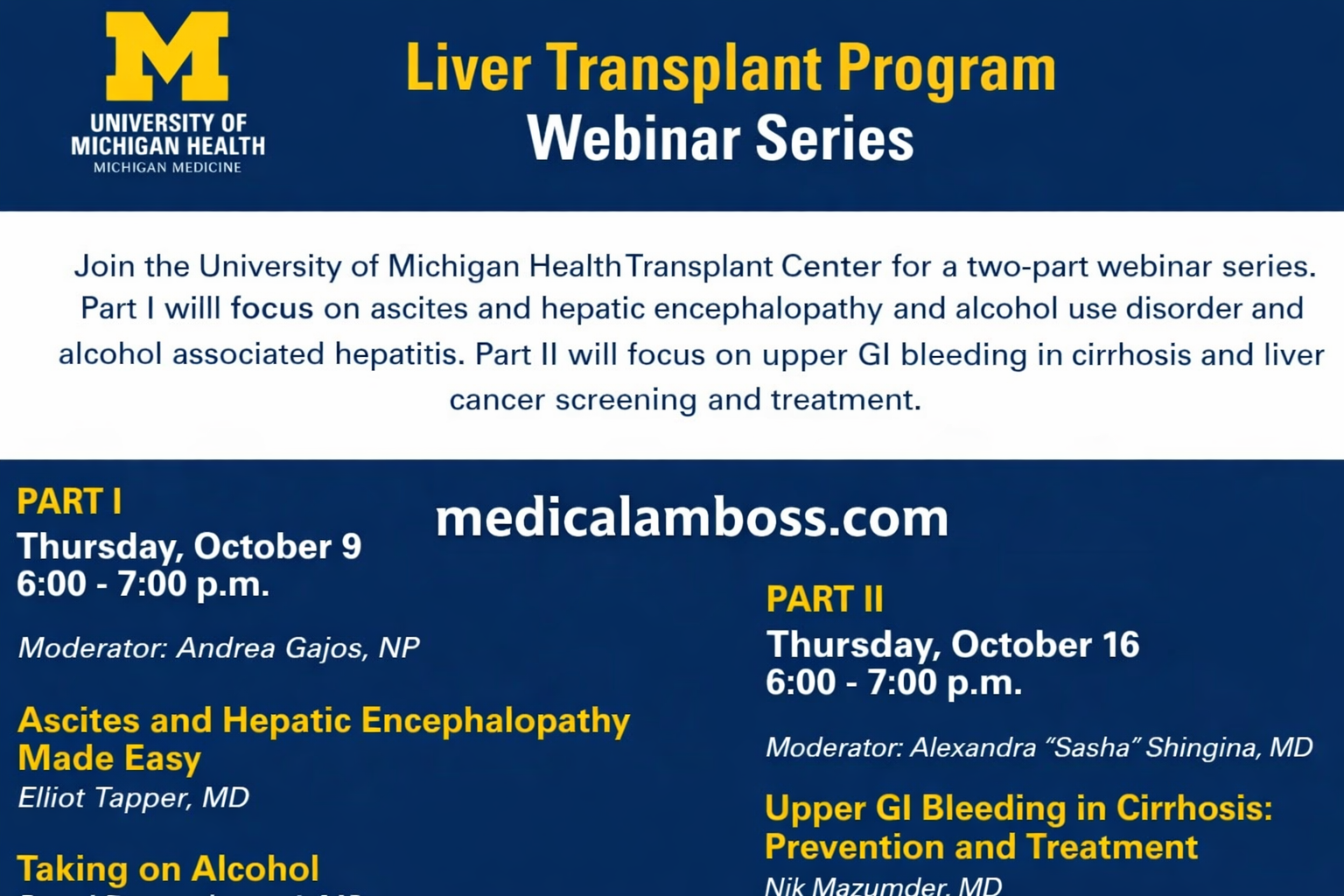
Michigan Medicine Liver Transplant Program Webinar Series 2025
Original price was: $120.00.$10.00Current price is: $10.00.
This Product is shared via google drive download link, So please share your correct Gmail id while placing the order .Please note that there are no CME points or certificate associated with this course Samples for Courses Can be found here : Free Samples Here
| Include: 6 videos + 6 audios + 6 file sub vtt + 1 pdf, size: 1.15 GB |
|---|
Michigan Medicine Liver Transplant Program Webinar Series 2025
Advanced Cirrhosis Management, Liver Transplant Care & Hepatology Essentials
The Michigan Medicine Liver Transplant Program Webinar Series 2025 is a focused hepatology education program designed to help clinicians confidently manage patients with advanced liver disease and liver transplantation-related complications. Developed by the University of Michigan Transplant Center, this practical webinar series delivers evidence-based strategies for diagnosing, treating, and preventing the most common causes of hospitalization and mortality among patients with cirrhosis and end-stage liver disease.
Unlike traditional academic conferences, this series emphasizes a streamlined, clinically relevant approach that transforms complex hepatology topics into practical management tools clinicians can immediately apply in outpatient and inpatient settings. Participants learn modern approaches to ascites management, hepatic encephalopathy prevention, alcohol-associated liver disease, hepatocellular carcinoma surveillance, portal hypertension, gastrointestinal bleeding, and liver transplant optimization.
Led by nationally recognized hepatology experts, including leaders in cirrhosis care, transplant hepatology, and liver cancer management, the course provides actionable insights aimed at improving patient quality of life, reducing hospital readmissions, and optimizing outcomes before and after liver transplantation.
Product Details
- Format: 6 Videos + 6 Audios + 6 Subtitle Files (.VTT) + 1 PDF
- Total Size: 1.15 GB
- Course Year: 2025
- Program Format: Virtual Webinar Series
- Course Dates: October 9 & October 16, 2025
- Access: On-Demand
Program Overview
This webinar series provides a practical review of the most challenging aspects of advanced liver disease management.
Key areas of focus include:
- Cirrhosis management
- Liver transplantation
- Ascites
- Diuretic resistance
- Hepatic encephalopathy
- Alcohol-associated liver disease
- Alcohol Use Disorder (AUD)
- Alcohol-associated hepatitis
- Portal hypertension
- Upper GI bleeding
- TIPS (Transjugular Intrahepatic Portosystemic Shunt)
- Hepatocellular carcinoma (HCC)
- Liver mass evaluation
- Hospitalization prevention
Participants gain practical guidance for managing patients across the entire liver disease continuum.
Learning Objectives
Upon completion of this activity, participants will be able to:
- Optimize diuretic therapy for patients with ascites.
- Manage refractory ascites and diuretic resistance.
- Implement evidence-based strategies to prevent hepatic encephalopathy-related hospitalizations.
- Diagnose and treat Alcohol Use Disorder in patients with chronic liver disease.
- Apply modern treatment approaches for alcohol-associated hepatitis.
- Prevent and manage upper gastrointestinal bleeding in cirrhosis.
- Evaluate the role of TIPS in portal hypertension management.
- Apply current recommendations for hepatocellular carcinoma screening and liver lesion evaluation.
Core Topics Covered
Cirrhosis Management
The webinar series provides practical guidance on managing patients with advanced cirrhosis.
Topics include:
- Disease progression
- Decompensated cirrhosis
- Risk assessment
- Outpatient management
- Prevention of complications
Faculty focus on strategies that improve quality of life and reduce hospital utilization.
Ascites & Fluid Management
Dedicated sessions explore:
- Ascites pathophysiology
- Diuretic optimization
- Sodium restriction
- Refractory ascites
- Paracentesis management
- Diuretic resistance
Participants learn practical approaches to one of the most common complications of cirrhosis.
Hepatic Encephalopathy
A major focus of the series is preventing recurrent encephalopathy.
Topics include:
- Early recognition
- Medical therapy optimization
- Readmission prevention
- Patient education
- Long-term monitoring
Experts discuss evidence-based strategies that reduce healthcare utilization and improve patient outcomes.
Alcohol Use Disorder (AUD)
The program reviews:
- Screening and diagnosis
- Behavioral interventions
- Pharmacologic therapy
- Harm reduction strategies
- Integrated liver disease management
Faculty emphasize the critical role of addiction treatment in hepatology practice.
Alcohol-Associated Hepatitis
Participants explore:
- Diagnostic criteria
- Risk stratification
- Medical treatment
- Nutritional support
- Liver transplant considerations
Current evidence and evolving treatment approaches are discussed.
Portal Hypertension & TIPS
Sessions cover:
- Portal hypertension complications
- Variceal bleeding prevention
- TIPS indications
- Patient selection
- Outcomes and follow-up
Participants gain practical knowledge for managing advanced portal hypertension.
Upper GI Bleeding in Cirrhosis
The conference reviews:
- Acute management
- Endoscopic treatment
- Secondary prophylaxis
- Risk reduction strategies
- Multidisciplinary care
Faculty discuss modern approaches to improving survival and preventing recurrence.
Hepatocellular Carcinoma (HCC)
A comprehensive review focuses on:
- HCC surveillance guidelines
- Liver imaging
- Liver mass evaluation
- Early detection strategies
- Referral pathways
Participants learn current recommendations for screening high-risk patients.
Liver Transplantation
The series highlights:
- Transplant evaluation
- Candidate selection
- Pre-transplant optimization
- Post-transplant considerations
- Long-term patient management
Experts discuss best practices for improving transplant outcomes.
Educational Features
✔ Practical Cirrhosis Management
✔ Ascites & Diuretic Optimization
✔ Hepatic Encephalopathy Prevention
✔ Alcohol Use Disorder Treatment Strategies
✔ TIPS & Portal Hypertension Education
✔ Hepatocellular Carcinoma Surveillance Updates
✔ Liver Transplant Care Essentials
✔ Evidence-Based Clinical Applications
Target Audience
This course is ideal for:
- Hepatologists
- Gastroenterologists
- Transplant Hepatologists
- Internal Medicine Physicians
- Family Medicine Physicians
- Hospitalists
- Nurse Practitioners
- Physician Assistants
- Gastroenterology Fellows
- Hepatology Fellows
- Advanced Practice Providers
- Liver Transplant Teams
Why This Course Stands Out
✔ Focused entirely on advanced liver disease management
✔ Practical “Made Easy” clinical approach
✔ Led by nationally recognized transplant hepatology experts
✔ Emphasizes hospitalization prevention
✔ Covers common cirrhosis complications in depth
✔ Strong focus on alcohol-associated liver disease
✔ Includes HCC surveillance and transplant updates
✔ Designed for immediate clinical implementation
Clinical & Educational Value
The Michigan Medicine Liver Transplant Program Webinar Series 2025 delivers a concise yet comprehensive review of advanced hepatology and transplant medicine. Through expert-led discussions on cirrhosis, ascites, hepatic encephalopathy, Alcohol Use Disorder, portal hypertension, gastrointestinal bleeding, liver cancer surveillance, and transplantation, participants gain practical tools to improve outcomes for patients with chronic liver disease and reduce complications across the transplant continuum.
+ Topics:
- 01 Ascites and Hepatic Encephalopathy Made Easy
- 02 Taking on Alcohol-Associated Liver Disease
- 03 Ascites & Alcohol-Associated Liver Disease Q&A
- 04 Upper GI Bleeding in Cirrhosis – Prevention and Treatment
- 05 HCC Surveillance and Treatment
- 06 HCC & Upper GI Bleeding Q&A
Related products
Critical Care - Emergency medicine
Cardiology
Internal Medicine
Medical Accounts

Critical Care - Emergency medicine

Critical Care - Emergency medicine

Internal Medicine

Critical Care - Emergency medicine
ASN Critical Care Nephrology – 2022 Update (On-Demand and Livestream)