
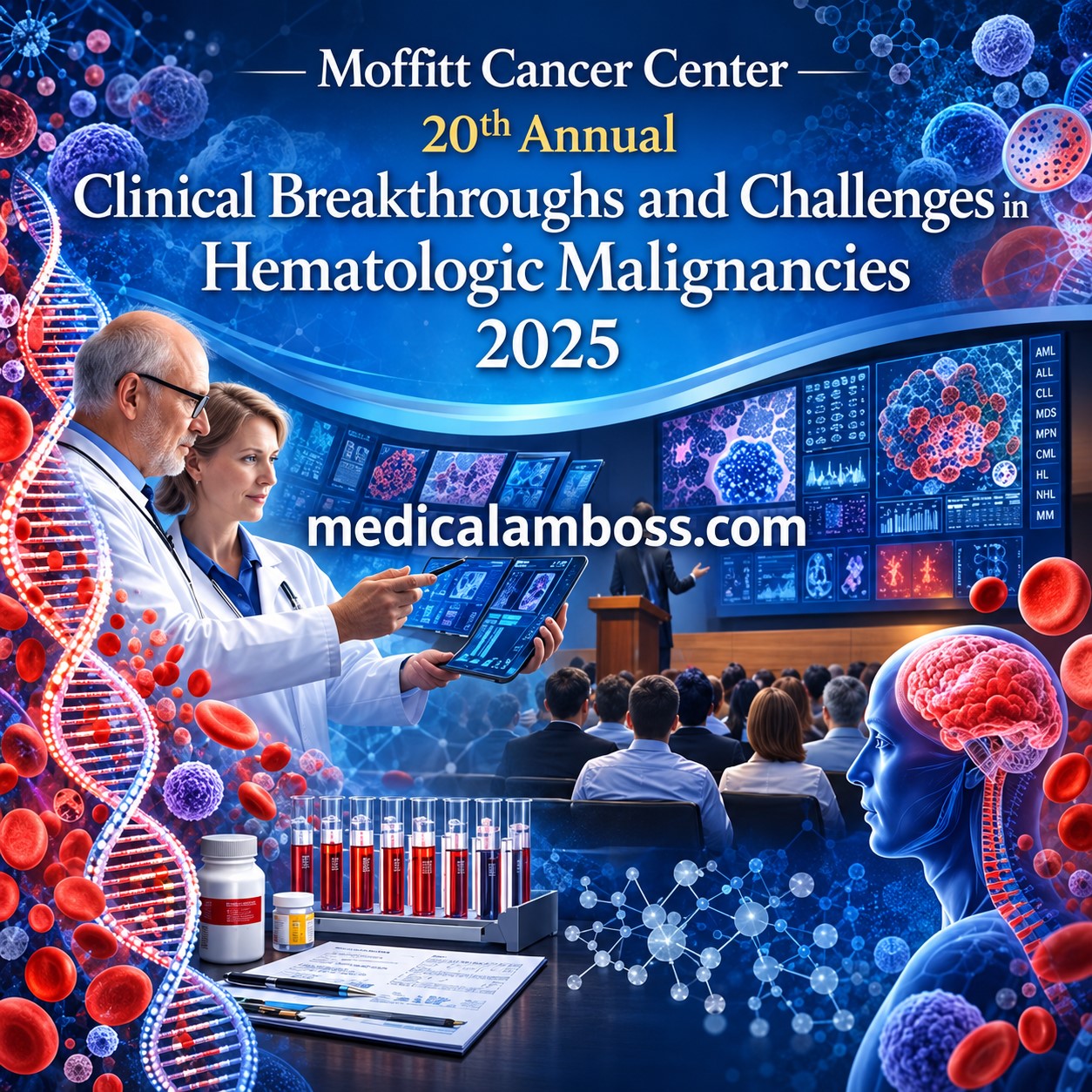
Moffitt Cancer Center 20th Annual Clinical Breakthroughs and Challenges in Hematologic Malignancies 2025

Original price was: $250.00.$30.00Current price is: $30.00.
This Product is shared via google drive download link, So please share your correct Gmail id while placing the order .Please note that there are no CME points or certificate associated with this course Samples for Courses Can be found here : Free Samples HereI
nclude: 14 videos + 14 audios + 14 file sub vtt + 14 pdfs, size: 3.89 GB
Moffitt Cancer Center 20th Annual Clinical Breakthroughs and Challenges in Hematologic Malignancies 2025
Advanced Updates in Leukemia, Lymphoma, Myeloma, CAR-T Therapy & Cellular Immunotherapy
The Moffitt Cancer Center 20th Annual Clinical Breakthroughs and Challenges in Hematologic Malignancies 2025 is a premier hematology-oncology conference dedicated to the latest advances in the diagnosis, treatment, and management of blood cancers. Hosted by one of the nation’s leading cancer centers, this highly regarded annual meeting delivers cutting-edge clinical updates that bridge the gap between rapidly evolving research and everyday patient care.
The program features expert-led “State of the Art” presentations, interactive debates, and evidence-based discussions covering lymphoid and myeloid malignancies, plasma cell disorders, cellular immunotherapies, measurable residual disease (MRD), and emerging targeted therapies. Special emphasis is placed on the rapidly expanding role of CAR T-cell therapy, bispecific antibodies, and precision medicine approaches that are transforming outcomes across hematologic oncology.
Held shortly after the annual American Society of Hematology (ASH) meeting, the conference serves as a valuable post-ASH review, helping clinicians translate the most important research findings into practical treatment strategies.
Product Details
- Format: 14 Videos + 14 Audios + 14 Subtitle Files (.VTT) + 14 PDFs
- Total Size: 3.89 GB
- Course Date: January 25, 2025
- Organizer: Moffitt Cancer Center
- Access: On-Demand
Program Overview
This conference provides comprehensive updates across the spectrum of hematologic malignancies.
Key areas of focus include:
- Acute Myeloid Leukemia (AML)
- Myelodysplastic Syndromes (MDS)
- Lymphoma
- Diffuse Large B-Cell Lymphoma (DLBCL)
- Follicular Lymphoma
- Multiple Myeloma
- Plasma Cell Disorders
- CAR T-Cell Therapy
- Bispecific Antibodies
- Cellular Immunotherapy
- Measurable Residual Disease (MRD)
- Clonal Hematopoiesis
- Stem Cell Transplantation
- Precision Oncology
Participants gain practical insights into modern treatment strategies, emerging therapies, and management of treatment-related complications.
Learning Objectives
Upon completion of this activity, participants will be able to:
- Evaluate current evidence supporting CAR T-cell therapy and bispecific antibodies.
- Optimize sequencing strategies for advanced lymphoma and multiple myeloma treatments.
- Apply MRD testing to guide management decisions in AML and MDS.
- Identify emerging therapeutic targets in relapsed and refractory hematologic malignancies.
- Assess the clinical significance of clonal hematopoiesis and associated risks.
- Manage complications associated with cellular immunotherapies.
- Analyze contemporary transplant strategies in high-risk hematologic diseases.
- Integrate post-ASH clinical updates into evidence-based practice.
Core Topics Covered
CAR T-Cell Therapy
The conference provides in-depth updates on cellular immunotherapy.
Topics include:
- CAR-T indications
- Patient selection
- Treatment sequencing
- Long-term outcomes
- Emerging CAR-T platforms
Experts discuss practical implementation across lymphoma and myeloma care.
Bispecific Antibodies
Dedicated sessions explore:
- Bispecific T-cell engager therapies
- Novel targets
- Treatment sequencing
- Response optimization
- Toxicity management
Participants learn how these agents are reshaping hematologic oncology practice.
Multiple Myeloma
The myeloma curriculum covers:
- Relapsed and refractory disease
- CAR-T versus transplant strategies
- Bispecific antibody therapies
- MRD-guided treatment
- Emerging therapeutic approaches
Faculty review evolving standards of care and future directions.
Lymphoma Updates
Comprehensive reviews focus on:
- Diffuse Large B-Cell Lymphoma (DLBCL)
- Follicular Lymphoma
- Aggressive lymphomas
- Novel targeted therapies
- Cellular immunotherapy integration
Clinical trial data and treatment algorithms are thoroughly discussed.
Acute Myeloid Leukemia (AML)
Sessions address:
- Risk stratification
- Molecular diagnostics
- MRD monitoring
- Targeted therapies
- Transplant decision-making
Participants gain updated knowledge on modern AML management.
Myelodysplastic Syndromes (MDS)
Topics include:
- Diagnostic advances
- Prognostic assessment
- Hypomethylating agents
- Transplant timing
- High-risk disease management
Experts review controversial topics through interactive debate sessions.
Measurable Residual Disease (MRD)
A major focus of the conference is MRD-directed care.
Participants explore:
- MRD testing technologies
- Clinical applications
- Treatment monitoring
- Prognostic implications
- Future integration into routine practice
MRD strategies are discussed across multiple hematologic malignancies.
Clonal Hematopoiesis
The program reviews:
- CHIP (Clonal Hematopoiesis of Indeterminate Potential)
- Cardiovascular implications
- Leukemia risk
- Monitoring strategies
- Emerging research
Faculty discuss practical considerations for clinical management.
Immunotherapy Toxicity Management
Essential sessions focus on:
- Cytokine Release Syndrome (CRS)
- Immune Effector Cell-Associated Neurotoxicity Syndrome (ICANS)
- Early recognition
- Prevention strategies
- Evidence-based treatment approaches
Participants learn best practices for managing immunotherapy complications.
Stem Cell Transplantation
Topics include:
- Transplant eligibility
- Pre-transplant therapies
- Post-transplant management
- Relapse prevention
- Transplant versus cellular therapy debates
Experts analyze evolving roles for transplantation in modern hematology.
Educational Features
✔ Post-ASH 2025 Clinical Updates
✔ CAR-T & Bispecific Antibody Reviews
✔ AML & MDS Management Strategies
✔ Lymphoma & Myeloma Advances
✔ MRD-Guided Treatment Approaches
✔ Cellular Therapy Toxicity Management
✔ Interactive Clinical Debates
✔ Evidence-Based Practice Updates
Target Audience
This course is ideal for:
- Hematologists
- Medical Oncologists
- Hematology-Oncology Fellows
- Oncology Nurses
- Nurse Practitioners
- Physician Assistants
- Oncology Pharmacists
- Bone Marrow Transplant Specialists
- Cellular Therapy Teams
- Clinical Researchers
- Academic Faculty
Why This Course Stands Out
✔ Hosted by a leading cellular therapy center
✔ Comprehensive review of hematologic malignancies
✔ Strong emphasis on CAR-T and immunotherapy
✔ Features interactive expert debates
✔ Practical guidance for toxicity management
✔ Comprehensive post-ASH update
✔ Covers both established and emerging therapies
✔ Highly relevant to modern hematology practice
Clinical & Educational Value
The Moffitt Cancer Center 20th Annual Clinical Breakthroughs and Challenges in Hematologic Malignancies 2025 provides a comprehensive review of the rapidly evolving field of blood cancer management. Through expert lectures, interactive debates, and cutting-edge clinical updates, participants gain valuable knowledge on CAR-T therapy, bispecific antibodies, MRD testing, stem cell transplantation, and emerging therapeutic strategies that are transforming patient care across hematologic oncology.
+ Topics:
- Management of First MM Relapse Debate – Cilta-Cel for All – No
- Management of First MM Relapse Debate – Cilta-Cel for All – Yes
- State-of-the-Art – Understanding Precursor States – CHIP and CCUS
- 2025 Updates on Treating Anemia in LR-MDS
- Debate – Should MRD Status Be Used to Alter Treatment Decisions in High-Risk MDS & AML – Yes
- Debate – Should MRD Status Be Used to Alter Treatment Decisions in High-Risk MDS & AML – No
- Beyond CAR-T – Management of Post-BCMA CAR-T Relapse in RRMM
- How I Treat High-Risk Multiple Myeloma – Interactive Case Discussion
- AQUILA Trial – Daratumumab vs. Active Monitoring in SMM – Perspectives for Practice
- Summary of Data for Transplant-Ineligible NDMM – Proposed SoC Approach
- LR-MDS Updates + Panel Discussion – Focus on Ph3 IMerge Trial
- Revmibeni for KMT2Ar RR Acute Leukemia – AUGMENT-101 Trial – Impact on Treatment Landscape
- Clinical Application of Practice-Changing SWOG S1826 Trial – Nivo+AVD vs. BV+AVD in 1L Advanced Stage cHL
- Golcadomide + R-CHOP in High-Risk, Untreated Aggressive B-cell Lymphoma – Panel Discussion on Future of 1L Therapy in DLBCL
Related products

Internal Medicine

Critical Care - Emergency medicine

Critical Care - Emergency medicine
Medical Accounts

USMLE / kaplan and Board Review
Uworld USMLE COMLEX Level 1 Qbank, Updated Jan 2023, System- and Subject-wise (PDF)
Medical Accounts

Internal Medicine