
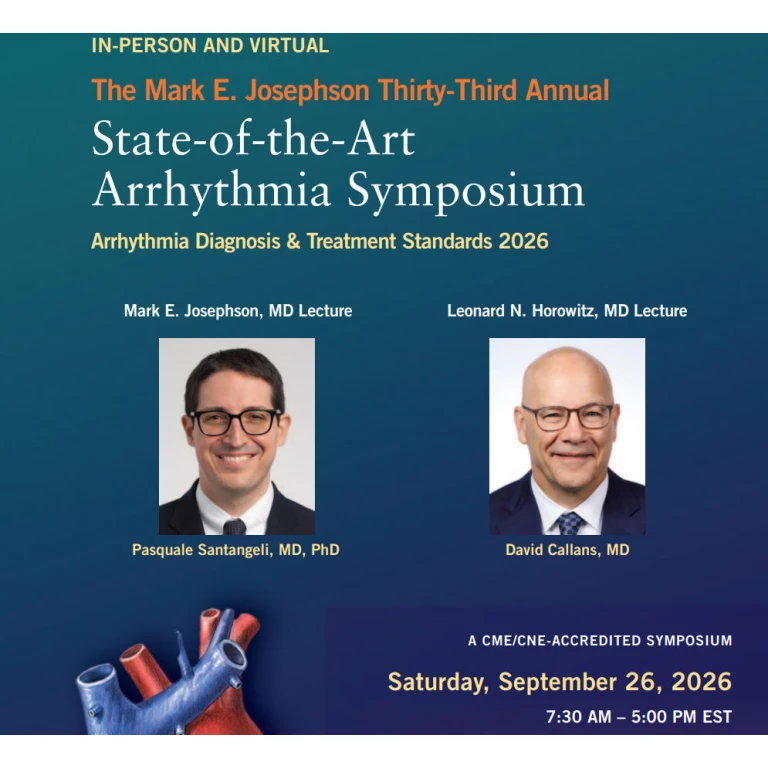
Penn Medicine The Mark E. Josephson 33rd Annual State-of-the-Art Arrhythmia Symposium 2026
$24.00
Review contemporary arrhythmia management through Penn Medicine’s 2026 symposium videos and PDFs. Topics cover AF and VT ablation, pacing, devices, inherited arrhythmias, procedural safety and AI in electrophysiology. The supplied topic list is preserved; the package format does not establish complete coverage of all concurrent tracks or procedural demonstrations.
Delivery Information: This Product is shared via google drive download link. Please use your correct Gmail address at checkout.
Please note: there are no CME points or certificate associated with this course.
Samples for Courses Can be found here: Free Samples Here!
Penn Medicine’s 33rd annual Mark E. Josephson State-of-the-Art Arrhythmia Symposium reviews cardiac rhythm care through lectures, debates, cases and procedural teaching. The 2026 program addresses atrial fibrillation, ventricular tachycardia, ablation, inherited arrhythmias, pacing and implantable devices, with attention to pulsed field energy and artificial intelligence. Directed by Francis E. Marchlinski, MD, the original meeting took place September 26, 2026, in Philadelphia. A combined morning program was followed by concurrent tracks for advanced electrophysiology, associated professionals and general cardiology. The listed package contains videos and PDFs for professionals seeking a specialist review of the topics below.
Learning Objectives
- Evaluate patients with frequent premature ventricular contractions (PVCs) and nonsustained ventricular tachycardia (NSVT).
- Recognize important ECG findings associated with serious cardiac arrhythmias and sudden cardiac death.
- Understand contemporary catheter ablation strategies for atrial fibrillation, atrial flutter, and ventricular tachycardia.
- Review the indications and implantation techniques for leadless pacemakers and defibrillator devices.
- Understand left atrial appendage occlusion, including patient selection, procedural considerations, and complications.
- Explore artificial intelligence applications in cardiac electrophysiology and ECG interpretation.
- Evaluate inherited arrhythmia syndromes and understand the clinical role of genetic testing.
- Review contemporary device therapies for patients with heart failure.
- Understand atrial fibrillation risk factor modification and anticoagulation strategies for stroke prevention.
- Review advanced procedural techniques and safety considerations in electrophysiology laboratories.
Topics
1. Atrial Fibrillation and Catheter Ablation
- Non-Thermal Pulsed Field Energy for Atrial Fibrillation Ablation
- New Trends in Atrial Fibrillation Risk Factor Modification
- What to Do with Low Burden Atrial Fibrillation
- Creating an Atrial Fibrillation Center of Excellence – Addressing the Remaining Challenges and Filling Knowledge-Technology Gaps
- Highlights from New Guidelines on Antiarrhythmic Drug Use for Atrial Fibrillation in Understudied Situations
- Panel Discussion with ARS – Atrial Fibrillation Management Controversies: Have Large Trials Provided a Roadmap for Therapy?
- New Insights on Ablation Lesion Formation
- What’s New in Medical Prevention of Strokes
2. Ventricular Tachycardia and Complex Ablation
- Changing Concepts in Post-MI Ventricular Tachycardia
- Epicardial Mapping and VT Ablation in Patients with an Ischemic Substrate
- How to Recognize and Ablate Septal VT Substrate Circuits in NICM
- How to Target the Most Complex VT Substrates – A Labor of Love
- New Strategies for Mapping and Ablating VT Substrate
- ParaHisian VT and VPD Ablation – Tips and Tricks to Optimize Safety and Efficacy
- Nonsustained VT – When to Worry
- Lessons Learned from Serial MR Imaging in VT Ablation Patients
- Debate – Ablation of VT Should Be Performed Coincident with ICD Implant
- How Does Radioablation Work – Lessons Learned from the Translational Laboratory
3. Cardiac Devices and Pacing Technologies
- Conduction System Pacing
- Leadless AV Pacing
- Extravascular ICD Therapy – Highlights of Implantation Techniques in the EP Lab: Prerecorded Cases
- Extravascular ICD Therapy – Case-Based Illustrations
- Cardiac Contractility Modulation Therapy for Heart Failure
- Troubleshooting Devices and Monitors
- Rapid Fire Cases – New Technology Updates: PFA, Leadless and Extravascular Leads/Devices, Cardioneuroablation, and LAAO Panel Discussion
4. ECG Interpretation, SVT and Clinical Electrophysiology
- How I Approach the Diagnosis of SVT Mechanism – 7 Tips to Remember
- Identifying High Risk of Arrhythmia Events Before the Life-Threatening Episode in Nonischemic Syndromes
- AI in Electrophysiology – Ready for Primetime
- Update on Cardioneuroablation
5. Genetic Arrhythmias and Congenital Heart Disease
- Inherited Arrhythmia and Cardiomyopathy Syndromes
- Role of Genetic Testing in EP Decision Making
- Common Congenital Heart Disease in Adults and Associated Arrhythmias – Pediatric EP Perspective
- Sarcoidosis – Diagnosis, Treatment, Identification of VT Risk and Role/Timing of Ablation
6. Electrophysiology Procedures and EP Laboratory Management
- New Access and Closure Techniques and Technology
- Preparing Your Patient to Get Safely Into and Out of the EP Lab
- Same Day Discharge – Devices, AF Ablation, LAAO
- Welcome and Introductions
Faculty and Moderators Named in the Agenda
- Francis Marchlinski, MD
- Thomas Boyle, MD
- Rajat Deo, MD
- Pasquale Santangeli, MD, PhD
- David Lin, MD
- Balaram Krishna J. Hanumanthu, MD
- David Frankel, MD
- Saman Nazarian, MD
- Robert D. Schaller, DO — Pro
- Gregory Supple, MD — Con
- David Callans, MD
- Timothy Markman, MD
- Poojita Shivamurthy, MD
- Timothy Maher, MD
- Ramanan Kumareswaran, MD
- Michael Riley, MD
- Cory M. Tschabrunn, PhD
- Fermin Garcia, MD
- Robert Hipp, PA-C
- Christian Yacono, PA-C
- Erica Zado, PA-C
- Tara Parham Graham, DNP
- Alanna Miller, DNP, CRNP
- Carli J. Peters, MD
- Maiwand Mirwais, MD
- Andres Enriquez, MD
- Maully Shah, MBBS
- Matthew C. Hyman, MD
- Andrew E. Epstein, MD
- Robert D. Schaller, DO
- Stephen Keane, MD
Videos + PDFs describes the package format, not a verified file count, total duration or complete coverage of all three parallel tracks. Availability of prerecorded procedural cases and interactive activities is not confirmed. The source agenda also includes “The Future of Pacing Therapy – Panel Discussion and Case Presentations,” moderated by Robert D. Schaller, DO. Official registration, live participation, publisher accounts, streaming access and CME/MOC benefits are not included.
Related products

Critical Care - Emergency medicine

USMLE / kaplan and Board Review
Uworld USMLE COMLEX Level 1 Qbank, Updated Jan 2023, System- and Subject-wise (PDF)
Medical Accounts
Critical Care - Emergency medicine
ASN Critical Care Nephrology – 2022 Update (On-Demand and Livestream)

Critical Care - Emergency medicine
Cardiology

Internal Medicine