
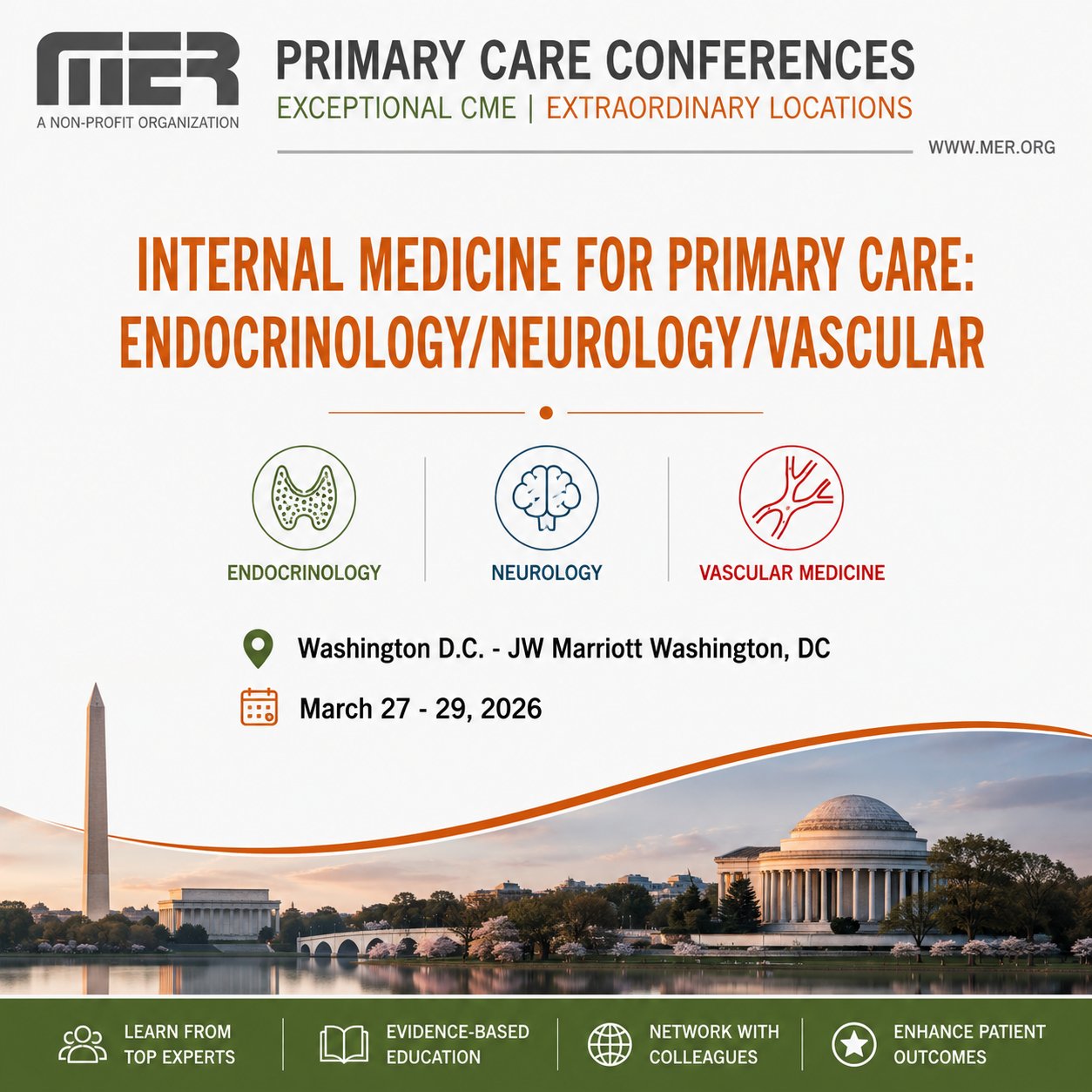
MER Primary Care Conferences Internal Medicine for Primary Care Endo Neuro Vasc Mar 27-29, 2026
$100.00
This Product is shared via google drive download link, So please share your correct Gmail id while placing the order .Please note that there are no CME points or certificate associated with this course Samples for Courses Can be found here : Free Samples Here!
MER Primary Care Conferences Internal Medicine for Primary Care: Endocrinology, Neurology & Vascular Medicine 2026 (Videos)
Comprehensive Primary Care Updates in Endocrinology, Neurology, and Vascular Medicine
Stay current with the latest evidence-based advances in primary care through MER Primary Care Conferences – Internal Medicine for Primary Care: Endocrinology, Neurology & Vascular Medicine 2026, a comprehensive continuing medical education (CME) program developed by Medical Education Resources (MER). Designed specifically for office-based clinicians, this multidisciplinary course provides practical updates on the diagnosis, evaluation, and management of common endocrine, neurologic, and vascular disorders encountered in everyday clinical practice.
Held March 27–29, 2026, at the JW Marriott Washington, DC, this conference features expert-led lectures focused on current clinical guidelines, diagnostic strategies, and patient-centered treatment approaches. Participants will strengthen their ability to recognize endocrine disorders, perform focused neurological assessments, diagnose vascular diseases, and implement evidence-based therapies that improve patient outcomes.
Through clinically relevant presentations and practical discussions, attendees will gain valuable knowledge that can be immediately applied in family medicine, internal medicine, outpatient clinics, and hospital-based practice.
Product Details
- Course: MER Primary Care Conferences – Internal Medicine for Primary Care: Endocrinology, Neurology & Vascular Medicine 2026
- Provider: Medical Education Resources (MER)
- Course Date: March 27–29, 2026
- Format: Videos
- Language: English
- Educational Level: Intermediate
Course Overview
Primary care physicians routinely manage patients with endocrine disorders, neurological conditions, and vascular diseases that require early recognition, accurate diagnosis, and timely intervention. Rapidly evolving clinical guidelines and emerging therapies make ongoing education essential for delivering high-quality patient care.
Internal Medicine for Primary Care: Endocrinology, Neurology & Vascular Medicine 2026 offers a practical review of contemporary medical management across three essential specialties. The curriculum emphasizes evidence-based approaches to thyroid disease, osteoporosis, pituitary disorders, peripheral vascular disease, stroke, venous thrombosis, Parkinson’s disease, Alzheimer’s disease, migraine, and other frequently encountered conditions.
Faculty members present current recommendations, practical diagnostic algorithms, and patient-centered management strategies that help clinicians improve diagnostic accuracy while optimizing treatment decisions in daily practice.
What You’ll Learn
After completing this course, participants will be able to:
- Recognize and evaluate common thyroid disorders and thyroid nodules using current diagnostic approaches.
- Apply evidence-based treatment strategies for osteoporosis and pituitary disorders.
- Diagnose and manage peripheral vascular disease and venous thromboembolism.
- Evaluate patients with suspected stroke and understand current interventional treatment options.
- Perform focused neurological examinations in primary care settings.
- Identify early clinical features of Alzheimer’s disease, Parkinson’s disease, and other movement disorders.
- Develop practical diagnostic and treatment strategies for migraine headaches.
- Integrate current clinical guidelines into the management of endocrine, neurologic, and vascular disorders.
Comprehensive Topics Covered
Endocrinology
Review practical approaches to thyroid dysfunction, thyroid nodules, osteoporosis, pituitary disorders, endocrine evaluation, diagnostic imaging, and evidence-based medical management using current clinical guidelines.
Thyroid Disease
Learn contemporary strategies for evaluating abnormal thyroid function, interpreting laboratory findings, assessing thyroid nodules with ultrasound and cytology, and selecting appropriate treatment options.
Osteoporosis
Review current recommendations for osteoporosis screening, fracture prevention, bone health assessment, and the appropriate use of bisphosphonates and other therapeutic interventions.
Neurology
Strengthen clinical skills in neurological assessment, differential diagnosis, and management of common neurologic disorders encountered in primary care, including dementia, Parkinson’s disease, movement disorders, weakness, and migraine.
Alzheimer’s Disease
Review current evidence-based approaches to diagnosing, evaluating, and managing Alzheimer’s disease while understanding advances in cognitive assessment and long-term patient care.
Parkinson’s Disease & Movement Disorders
Recognize the cardinal clinical features of Parkinson’s disease and distinguish it from other movement disorders using systematic neurological evaluation and current treatment recommendations.
Migraine & Headache Disorders
Develop practical diagnostic approaches to migraine and other common headache disorders while reviewing current pharmacologic and non-pharmacologic management strategies.
Vascular Medicine
Explore evidence-based management of peripheral vascular disease, aneurysms, venous thrombosis, cerebrovascular disease, and stroke prevention using current clinical guidelines.
Stroke & Cerebrovascular Disease
Review recognition, evaluation, acute management, and secondary prevention of stroke, including modern interventional treatment strategies and long-term vascular risk reduction.
Learning Objectives
Upon completion of this educational activity, participants will be able to:
- Identify the risks and clinical implications of abnormal thyroid function.
- Evaluate thyroid nodules using ultrasound and cytologic assessment.
- Apply evidence-based treatment strategies for osteoporosis and pituitary disorders.
- Diagnose and manage peripheral vascular disease and venous thrombosis.
- Perform focused neurological examinations in clinical practice.
- Evaluate weakness and recognize Parkinson’s disease and other movement disorders.
- Implement evidence-based management for Alzheimer’s disease.
- Diagnose and treat migraine headaches using current clinical recommendations.
Educational Highlights
- Comprehensive Primary Care Update
- Endocrinology Essentials
- Neurology Review
- Vascular Medicine Updates
- Thyroid Disease Management
- Thyroid Ultrasound & Cytology
- Osteoporosis Treatment
- Pituitary Disorders
- Neurological Examination
- Alzheimer’s Disease
- Parkinson’s Disease
- Migraine Management
- Stroke & Cerebrovascular Disease
- Peripheral Vascular Disease
- Venous Thrombosis
- Evidence-Based Clinical Guidelines
- Continuing Medical Education (CME)
Why This Course Stands Out
MER Primary Care Conferences – Internal Medicine for Primary Care: Endocrinology, Neurology & Vascular Medicine 2026 combines three high-impact medical specialties into one practical educational program specifically designed for primary care providers. Rather than presenting highly specialized content, the course focuses on common clinical scenarios, evidence-based decision-making, and practical diagnostic strategies that clinicians encounter every day. Participants leave with immediately applicable knowledge that enhances patient care across outpatient and hospital settings.
Target Audience
This educational activity is ideal for:
- Internists
- Primary Care Physicians
- Family Medicine Physicians
- General Practitioners
- Endocrinologists
- Neurologists
- Vascular Medicine Specialists
- Hospitalists
- Nurse Practitioners
- Physician Assistants
- Internal Medicine Residents
- Family Medicine Residents
- Healthcare Professionals involved in adult primary care
Why Choose This Course?
Whether you are updating your knowledge of endocrine disorders, improving your neurological examination skills, or strengthening your understanding of vascular medicine, MER Primary Care Conferences – Internal Medicine for Primary Care: Endocrinology, Neurology & Vascular Medicine 2026 provides a comprehensive, evidence-based review of current clinical practice. Combining expert faculty, practical guidance, and guideline-driven recommendations, this course helps clinicians deliver safer, more effective, and higher-quality patient care.
4. Topics
Friday, March 27, 2026
-
Endocrinology – Disorders of Thyroid Function: Prevalence, diagnosis and treatment options of hypothyroidism and hyperthyroidism.
-
Endocrinology – Thyroid Nodules and Cancer: Diagnosis and treatment.
-
Endocrinology – Osteoporosis: Review the epidemiology and pathophysiology of osteoporosis along with interpretation of DEXA scans and FRAX risk assessment; up-to-date therapeutic options.
-
Vascular Medicine – Peripheral Vascular Disease and Medical Therapy: Defining the spectrum of maladies under the umbrella of Peripheral Vascular Disease including the pathophysiology of atherosclerosis and treatments highlighting lipid lowering agents and antiplatelet therapy.
-
Vascular Medicine – Stroke: Initial Presentation to Medical and Surgical Treatment: An overview of embolic stroke including diagnosis and medical, surgical, and interventional therapy.
Saturday, March 28, 2026
-
Vascular Medicine – Aortic and Peripheral Aneurysms: A guide for primary care outlining diagnosis, management, and therapeutic options.
-
Vascular Medicine – Management of Venous Thrombosis: A discussion focusing on the variety of venous thrombotic diagnoses and the multiple available treatment options.
-
Endocrinology – Evaluation and Management of Pituitary Disease: Diagnosis and treatment of pituitary disorders.
-
Neurology – The Neurological Exam: Characteristics and objectives of the examination; exam phases; assessing general mental status; long-term predications; examination of infants; demonstration on conducting an exam.
-
Neurology – Alzheimer’s & Other Dementias: Review changes in cognition with normal aging; Behavioral changes that may precede early dementia; Screening tools for dementia; Characteristics of different dementia syndromes; Risks and benefits for treatment of Alzheimer Disease; Risk factors and causes of delirium, and how to reduce them; How to suspect and identify delirium; Management of the symptoms of delirium; Distinguishing delirium from dementia.
Sunday, March 29, 2026
-
Neurology – Parkinson’s Disease & Other Movement Disorders: Epidemiology; cardinal features; secondary features; pathology; neurochemistry; differential diagnosis; treatment; complication; other movement disorders; neuroleptic- induced movement disorders; chorea.
-
Neurology – Migraine Headaches: Diagnosis based on headache history; Classification and pathophysiology of migraine; Acute migraine treatment; Prophylaxis for recurrent migraine attacks; Chronic migraine, tension-type headaches, and cluster headaches; Trigeminal Neuralgia.
Related products
Endocrine and Nutrition
Cardiology
Endocrine and Nutrition
Comprehensive Care for Persons with Diabetes 2022: A Certificate Program
Endocrine and Nutrition

Endocrine and Nutrition
Endocrine and Nutrition
Cardiology
Endocrine and Nutrition
Harvard Testosterone Therapy and Sexual Dysfunction February 2023