
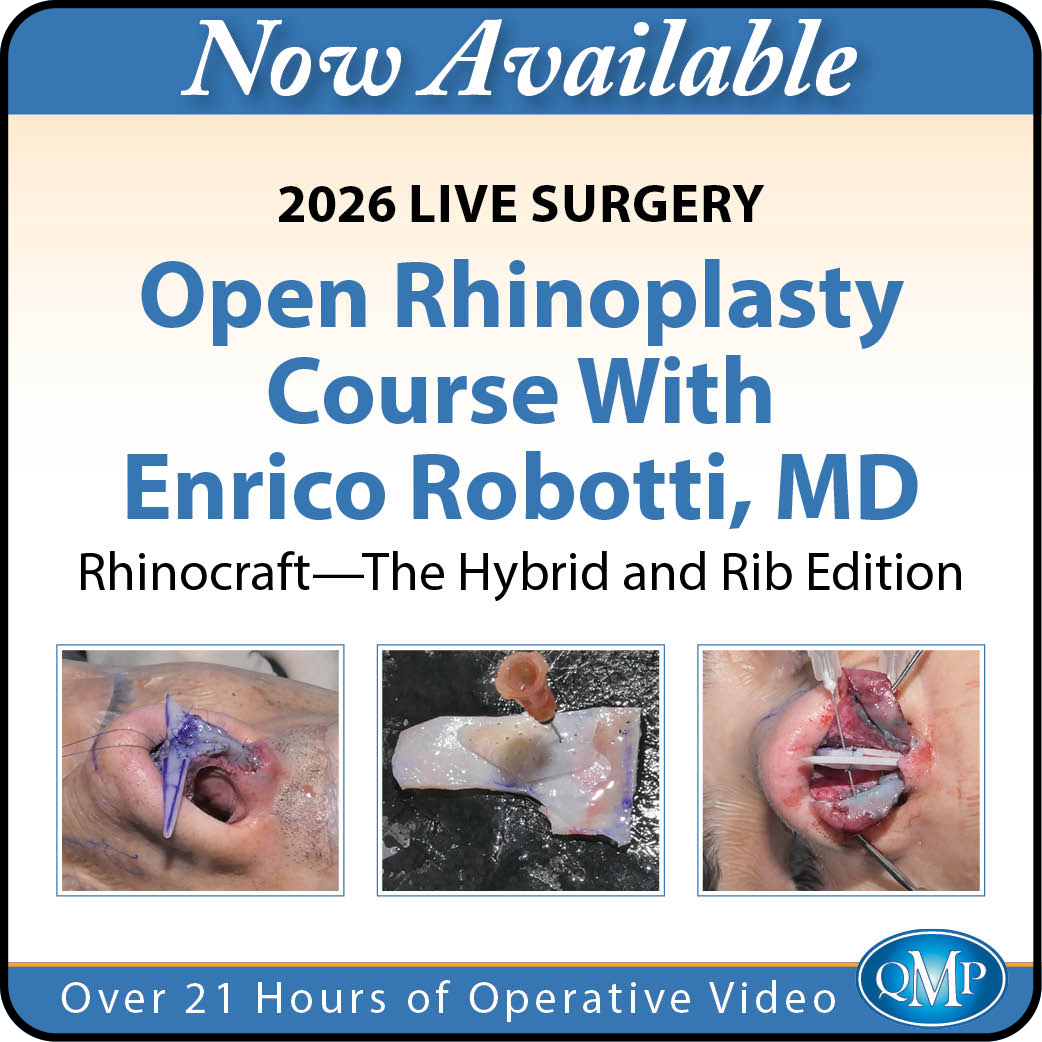
QMP 2026 Live Surgery Open Rhinoplasty Course With Enrico Robotti, MD Rhinocraft-The Hybrid and Rib Edition

$35.00
This Product is shared via google drive download link, So please share your correct Gmail id while placing the order .Please note that there are no CME points or certificate associated with this course Samples for Courses Can be found here : Free Samples Here!
6 Cases With Over 21 Hours of Operative Video
QMP 2026 Live Surgery Open Rhinoplasty Course with Enrico Robotti, MD
Rhinocraft – The Hybrid & Rib Edition
6 Primary & Revision Rhinoplasty Cases | 21+ Hours of Operative Video
Study advanced primary and revision open rhinoplasty with Enrico Robotti, MD in QMP 2026 Live Surgery Open Rhinoplasty Course – Rhinocraft: The Hybrid & Rib Edition.
Published by Quality Medical Publishing (QMP), this extensive surgical video program combines hybrid primary rhinoplasty, preservation concepts, structural rhinoplasty, secondary rhinoplasty, and finesse rib cartilage grafting through six detailed operative cases.
The series includes:
- 3 Primary Rhinoplasty Cases
- 3 Revision Rhinoplasty Cases
- More Than 21 Hours of Operative Video
- HD Streaming Format
- Detailed surgical analysis
- Intraoperative decision-making
- Primary and secondary rhinoplasty strategies
- Structural and preservation concepts
- Rib cartilage reconstruction
- Functional and aesthetic nasal surgery
Dr. Robotti demonstrates how structural and preservation principles can be combined according to individual nasal anatomy rather than applying a single technique to every patient.
Course Details
- Course: 2026 Live Surgery Open Rhinoplasty Course
- Edition: Rhinocraft – The Hybrid & Rib Edition
- Publisher: Quality Medical Publishing – QMP
- Faculty: Enrico Robotti, MD
- Year: 2026
- Primary Cases: 3
- Revision Cases: 3
- Total Cases: 6
- Duration: More Than 21 Hours
- Official QMP Format: HD Streaming
- Primary Specialty: Plastic Surgery
- Subspecialty: Rhinoplasty / Facial Plastic Surgery
- Main Focus: Hybrid, Preservation, Structural & Revision Rhinoplasty
- Advanced Focus: Rib Cartilage Grafting
Course Overview
Rhinoplasty increasingly involves a tailored combination of:
- Preservation techniques
- Structural techniques
- Dorsal modification
- Tip reconstruction
- Septal surgery
- Functional airway management
- Precision osteoplasty
- Piezoelectric instrumentation
- Cartilage grafting
The Rhinocraft – Hybrid & Rib Edition brings these concepts together through real operative cases.
The first three cases focus on primary rhinoplasty, where Dr. Robotti demonstrates his hybrid philosophy combining preservation and structural concepts.
The remaining three cases focus on revision rhinoplasty, where scar tissue, altered anatomy, missing septal cartilage, dorsal irregularities, and structural deficiencies can require more extensive reconstruction using costal cartilage.
Primary Rhinoplasty – The Hybrid Approach
The primary cases demonstrate a philosophy that does not treat structural and preservation rhinoplasty as mutually exclusive approaches.
Instead, techniques are selected according to:
- Nasal anatomy
- Dorsal configuration
- Septal anatomy
- Tip support
- Skin thickness
- Functional problems
- Desired aesthetic change
The resulting concept can be summarized as:
Preserve What Is Useful → Reshape What Is Needed → Reconstruct What Requires Support
Hybrid Rhinoplasty
Hybrid rhinoplasty combines selected elements of:
Preservation Rhinoplasty
with:
Structural Rhinoplasty
The goal is to preserve appropriate anatomy while using structural techniques when additional support or controlled modification is necessary.
Dorsal Preservation Concepts
The course demonstrates several variations of dorsal-preservation surgery, including:
- Cartilaginous push-down concepts
- Full let-down techniques
- Modified push-down techniques
- Partial bony-cap preservation
- Dorsal surface sculpturing
These variations highlight the importance of adapting the technique to individual anatomy.
Cartilaginous Push-Down
Push-down techniques aim to modify dorsal height while preserving important components of the dorsal architecture.
The course demonstrates several variations rather than presenting one universal preservation maneuver.
Full Let-Down
Let-down techniques represent another approach to dorsal lowering within preservation rhinoplasty.
The operative cases provide visual exposure to how these concepts integrate with:
- Osteoplasty
- Septal work
- Tip reconstruction
- Functional correction
Modified Push-Down
Selected cases demonstrate modified preservation techniques involving partial preservation of the bony cap and refinement of the dorsal surface.
This illustrates one of the key themes of the program:
Preservation Is a Spectrum, Not a Single Operation
Structural Tip Management
The series provides extensive exposure to structural tip surgery.
Topics include:
- Tip analysis
- Tip support
- Tip reshaping
- Cartilage preservation
- Structural reinforcement
- Ligament preservation
- Ligament reconstruction
- Septal extension graft concepts
- Lateral crural support
Ligament Preservation & Reconstruction
Modern rhinoplasty increasingly recognizes the importance of soft-tissue and ligamentous support.
The course demonstrates structural tip management while emphasizing preservation or reconstruction of relevant support structures where appropriate.
Subperichondrial & Subperiosteal Dissection
Tip and dorsal dissection are demonstrated in:
- Subperichondrial planes
- Subperiosteal planes
These approaches are closely related to contemporary preservation and structural rhinoplasty concepts.
Three-Point Compartmentalization Technique
One of Dr. Robotti’s recognizable techniques featured in the program is the:
Three-Point Compartmentalization Technique
The concept is used within the broader strategy of:
- Soft-tissue management
- Edema reduction
- Surface contour optimization
It represents one of the specific Robotti techniques that differentiates this course from a generic rhinoplasty review.
Sublaminar Septal Dissection
The program also demonstrates contemporary septal-dissection concepts, including:
Sublaminar Septal Dissection
within the broader framework of structural and preservation rhinoseptoplasty.
Septal Fusion Sling Suspension
Another technique included in the program is:
Septal Fusion Sling Suspension
introduced by Dr. Carlos Neves.
The course shows how this concept can be incorporated into selected hybrid rhinoplasty cases.
Piezoelectric Rhinoplasty
Modern rhinoplasty increasingly uses ultrasonic instruments for selected bony maneuvers.
The course demonstrates combined use of:
- Piezoelectric instruments
- Powered instrumentation
for procedures involving:
- Osteotomies
- Osteoplasty
- Dorsal sculpturing
Osteoplasty
Osteoplasty plays an important role in refining the bony dorsum.
The surgical videos demonstrate how powered and piezoelectric instruments can be incorporated into a controlled rhinoplasty workflow.
Osteotomies
The program demonstrates contemporary osteotomy strategies within both preservation and structural frameworks.
The technique selected depends on:
- Bony anatomy
- Nasal width
- Deviation
- Dorsal strategy
- Surgical plan
Septoplasty
Functional correction is integrated into the rhinoplasty cases.
The program includes:
- Septal assessment
- Septoplasty
- Septal reconstruction concepts
- Management of residual septal support
This reinforces the principle that aesthetic rhinoplasty should also consider nasal function.
Turbinate Management
The series includes turbinate management as part of functional nasal surgery.
A specific technique featured is:
Dr. Robotti’s Piezo Turbinoplasty
Functional Rhinoplasty
The operative planning addresses both:
Aesthetic Form
and:
Airway Function
Relevant functional structures can include:
- Septum
- Internal nasal valve
- External nasal valve
- Turbinates
- Lateral nasal wall
REVISION RHINOPLASTY
The second major part of Rhinocraft focuses on secondary and revision rhinoplasty.
Revision surgery can be more complex because previous procedures may leave:
- Scar tissue
- Altered anatomy
- Missing cartilage
- Weak structural support
- Dorsal irregularities
- Tip distortion
- Valve dysfunction
- Functional obstruction
The three revision cases demonstrate strategies for addressing these challenges.
Finesse Rib Grafting
A central theme of the revision cases is:
Finesse Rib Cartilage Grafting
Rather than relying on excessively bulky costal-cartilage constructs, the course emphasizes carefully designed grafts and tailored reconstruction.
Rib Cartilage in Revision Rhinoplasty
Costal cartilage can provide reconstructive material when available septal cartilage is limited or inadequate.
The series reviews concepts involving:
- Rib harvest
- Rib preparation
- Cartilage shaping
- Laminating
- Structural reconstruction
- Dorsal reconstruction
- Tip support
- Sidewall reconstruction
Rib Harvest
The program includes Dr. Robotti’s approach to rib harvesting as part of the revision workflow.
The teaching emphasizes appropriate attention to:
- Donor-site considerations
- Cartilage selection
- Subsequent graft preparation
Rib Shaping
Obtaining rib cartilage is only the first stage.
Successful revision rhinoplasty requires shaping the cartilage according to the specific reconstructive requirement.
Rib Laminating
The course also demonstrates rib lamination, an important component of Dr. Robotti’s contemporary approach to selected dorsal reconstructive techniques.
SPF & SPLF Grafts
A major advanced topic is the evolution of:
SPF / SPLF graft constructs
for reconstruction of the nasal dorsum in revision rhinoplasty.
These techniques are especially relevant when dealing with:
- Dorsal deficiency
- Previous over-resection
- Irregular dorsal contour
- Revision anatomy
- Need for controlled augmentation
SPLF Dorsal Reconstruction
The SPLF concept has evolved as a layered, customizable approach to dorsal reconstruction.
The 2026 program includes contemporary variations designed to create a refined dorsal contour while avoiding unnecessarily bulky reconstruction.
SPF-SPLF Variations
The course reviews current variations of SPF-SPLF constructs with attention to:
- Dorsal contour
- Height
- Surface smoothness
- Structural stability
- Aesthetic dorsal lines
Rib Plaster
Another characteristic Robotti technique included in the series is:
Rib Plaster
This concept uses finely prepared costal-cartilage material as a contouring adjunct in revision rhinoplasty.
Its role is primarily associated with:
- Contour refinement
- Camouflage
- Surface optimization
Dorsal Reconstruction
Revision dorsal surgery may require restoration of:
- Height
- Width
- Smoothness
- Symmetry
- Structural continuity
- Dorsal aesthetic lines
The program demonstrates how rib-based reconstruction can be customized rather than approached with one fixed graft design.
Rib Septal Extension Grafts
Revision tip support may require costal cartilage when septal cartilage is unavailable or inadequate.
The series includes concepts involving:
Rib Septal Extension Grafts
for selected complex reconstructions.
Lateral Crural Strut Grafts
The course also demonstrates:
Lateral Crural Strut Grafts
within strategies designed to improve:
- Tip support
- Alar contour
- External valve stability
- Lateral crural shape
Sidewall Reconstruction
Previous surgery can leave weakness or irregularity of the nasal sidewalls.
The course includes sidewall reshaping and reconstructive strategies tailored to revision anatomy.
Residual Septum + Rib Grafting
Revision rhinoplasty does not always require replacing every existing structure.
The program demonstrates strategies that combine:
Remaining Septal Cartilage + Rib Cartilage
when appropriate.
This reflects the same overall hybrid philosophy used throughout the course:
Preserve Useful Anatomy and Reconstruct Deficient Anatomy
Transosseous Sutures
The operative series includes use of transosseous sutures for selected stabilization and support strategies.
Scarred Revision Tip
One of the major technical challenges in secondary rhinoplasty is dissection through scarred tissue planes.
The program provides operative exposure to:
- Scarred tip anatomy
- Altered tissue planes
- Previous grafts
- Structural deficiencies
- Revision decision-making
Revision Dorsum
The revision dorsum may contain:
- Irregular cartilage
- Previous graft material
- Scar tissue
- Dorsal depression
- Asymmetry
- Surface irregularity
The course demonstrates how analysis and reconstruction are adapted intraoperatively to these findings.
Preservation Concepts in Secondary Rhinoplasty
Preservation principles are not limited exclusively to primary rhinoplasty.
One notable theme in Rhinocraft is the application of selected preservation concepts to secondary surgery when useful anatomy remains.
Primary vs. Revision Rhinoplasty
The six-case structure creates a useful contrast.
Primary Rhinoplasty
Focuses heavily on:
- Preservation
- Hybrid dorsal surgery
- Structural tip management
- Septal correction
- Functional optimization
Revision Rhinoplasty
Focuses heavily on:
- Scarred anatomy
- Structural deficiency
- Rib cartilage
- Dorsal reconstruction
- Advanced grafting
- Functional restoration
Together, the program connects:
Preservation → Structure → Reconstruction
Preoperative Analysis
Each rhinoplasty begins before the first incision.
The operative cases emphasize:
- Nasal analysis
- Identification of deformity
- Functional assessment
- Surgical priorities
- Technique selection
- Reconstruction strategy
This is particularly important because rhinoplasty should be individualized rather than based on a standard list of maneuvers.
Intraoperative Decision-Making
One of the strongest educational features of long-form operative video is the ability to observe how the planned procedure changes according to actual intraoperative anatomy.
Viewers can follow:
Preoperative Plan → Surgical Exposure → Anatomical Findings → Technique Selection → Refinement
Avoiding Over-Reconstruction
A recurring theme in Dr. Robotti’s revision approach is avoiding unnecessary graft bulk.
Revision reconstruction should aim to restore:
- Support
- Contour
- Function
- Proportion
without automatically using oversized graft constructs.
Natural Rhinoplasty Results
The course emphasizes outcomes intended to appear:
- Balanced
- Proportional
- Functional
- Refined
- Natural rather than obviously operated
The educational emphasis is on tailoring surgery to anatomy rather than creating the same nose for every patient.
Robotti Rhinoplasty Instruments
The program also demonstrates specialized instruments used by Dr. Robotti in contemporary rhinoplasty practice.
These complement:
- Piezoelectric technology
- Powered instrumentation
- Precision dissection
- Cartilage shaping
Key Surgical Concepts Covered
- Open Rhinoplasty
- Primary Rhinoplasty
- Revision Rhinoplasty
- Secondary Rhinoplasty
- Hybrid Rhinoplasty
- Preservation Rhinoplasty
- Structural Rhinoplasty
- Rhinoseptoplasty
- Dorsal Preservation
- Push-Down Rhinoplasty
- Let-Down Rhinoplasty
- Structural Tip Surgery
- Tip Reconstruction
- Ligament Preservation
- Sublaminar Septal Dissection
- Septal Fusion Sling
- Three-Point Compartmentalization
- Piezo Rhinoplasty
- Piezoelectric Osteotomy
- Osteoplasty
- Septoplasty
- Piezo Turbinoplasty
- Functional Rhinoplasty
- Rib Cartilage Grafting
- Costal Cartilage
- Rib Harvest
- Rib Lamination
- SPF Graft
- SPLF Graft
- Dorsal Reconstruction
- Rib Plaster
- Septal Extension Graft
- Lateral Crural Strut Graft
- Sidewall Reconstruction
- Transosseous Sutures
Who Should Take This Course?
This program is particularly relevant for:
- Plastic Surgeons
- Facial Plastic Surgeons
- Rhinoplasty Surgeons
- Reconstructive Surgeons
- ENT / Otolaryngology Surgeons with appropriate rhinoplasty training
- Plastic Surgery Residents
- Plastic Surgery Fellows
- Facial Plastic Surgery Fellows
- Rhinology / Facial Plastic Surgery Trainees
- Experienced surgeons expanding into revision rhinoplasty
- Surgeons studying rib-cartilage reconstruction
Why This Course Is Valuable
QMP Rhinocraft – The Hybrid & Rib Edition 2026 brings primary and revision rhinoplasty together within one extensive operative series.
The six cases allow viewers to study:
Primary Rhinoplasty
- Hybrid preservation
- Dorsal modification
- Tip reconstruction
- Piezo techniques
- Septoplasty
- Turbinate management
- Functional correction
Revision Rhinoplasty
- Scarred anatomy
- Rib harvesting
- Rib shaping
- Rib lamination
- Dorsal reconstruction
- SPF/SPLF grafts
- Rib plaster
- Septal extension grafting
- Sidewall reconstruction
- Functional restoration
The overall educational progression can be summarized as:
Analyze → Preserve → Reshape → Support → Reconstruct → Refine
Important Educational Notice
This is an advanced operative video education program.
Watching surgical recordings does not constitute hands-on surgical training, credentialing, or independent procedural competency.
Primary and revision rhinoplasty—particularly complex secondary reconstruction and rib cartilage grafting—require appropriate:
- Surgical residency/fellowship training
- Supervised operative experience
- Anatomical knowledge
- Institutional credentialing
- Patient-specific surgical judgment
Product Summary
- Product: QMP 2026 Live Surgery Open Rhinoplasty Course
- Edition: Rhinocraft – The Hybrid & Rib Edition
- Faculty: Enrico Robotti, MD
- Publisher: Quality Medical Publishing – QMP
- Year: 2026
- Cases: 6
- Primary Cases: 3
- Revision Cases: 3
- Duration: 21+ Hours
- Official QMP Format: HD Streaming
- Primary Focus: Open Rhinoplasty
- Advanced Focus: Hybrid Rhinoplasty + Rib Grafting
- Specialty: Plastic & Facial Plastic Surgery
4. Short Description
QMP 2026 Live Surgery Open Rhinoplasty Course with Enrico Robotti, MD – Rhinocraft: The Hybrid & Rib Edition provides 6 primary and revision rhinoplasty cases with more than 21 hours of operative video.
The series combines preservation and structural rhinoplasty with advanced revision rhinoplasty and finesse rib cartilage grafting.
Topics include cartilaginous push-down, full and modified let-down techniques, dorsal preservation, structural tip management, ligament reconstruction, subperichondrial/subperiosteal dissection, three-point compartmentalization, sublaminar septal dissection, septal fusion sling, piezo osteoplasty and osteotomies, septoplasty, piezo turbinoplasty, rib harvest and lamination, SPF/SPLF grafts, rib plaster, septal extension grafts, lateral crural strut grafts, and secondary dorsal reconstruction.
Topics:
6 Cases With Over 21 Hours of Operative Video:
- Case 1 – Primary Rhinoplasty in a 47-year-old Female Patient With Multiple Asymmetries of the Dorsum, Contour Irregularities, Extreme Bulbosity of the Tip, Hump, Excessive Tip Projection, and Functional Issues: Direct columella shortening, modified dorsal split, osteoplasty, high strip dorsal reduction, cartilaginous push down, septoplasty, septal fusion sling, medial crural transection overlap, full lateral crural transposition, multiple dome-refining sutures, columellar strut, and mini alar contour grafts.
- Case 2 – Primary Rhinoplasty in a 27-year-old Female Patient With Dorsal Hump, Excess Volume, and Wide Tip: Modified dorsal split, osteoplasty, sublaminar septal dissection, high strip dorsal reduction with inclusion of a portion of bony cap, three-point compartmentalization, septal extension graft, fusion sling, slide under of LLCs, lateral crural steal, dome-defining sutures, and alar wedges.
- Case 3 – Primary Rhinoplasty in a 34-year-old Female Patient With Thin Skin, Dorsal Hump, Droopy Tip, and Deviated Septum: Modified dorsal split, osteoplasty, sublaminar septal dissection, high strip full let down, three-point compartmentalization, double septal extension graft, fusion sling, turn under of LLCs, lateral crural steal, dome-defining sutures, diced cartilage, and alar wedges.
- Case 4 – Secondary Rhinoplasty in a 22-year-old Male Patient With Thin Skin, Severe Tip Deformity, Open Roof, Saddling of the Dorsum, Pollybeak, and Severe Functional Issues: Burr osteoplasty and piezoelectric selective osteotomies, full rib L-strut reconstruction, multiple tip grafts, perichondrium grafts, and SPLF graft to dorsum.
- Case 5 – Tertiary Rhinoplasty in a 33-year-old Female Patient With Tip Overprojection and Severe Overrotation, Alar Retraction, and Saddling of the Dorsum: Septum lengthening with composite graft of perforated PPE and septal cartilage, full L-strut reconstruction with rib extended spreaders and rib vertical element fixated to the spine, full tip reconstruction by extended and transposed lateral crural struts, interpositional grafts, perichondrium grafts to tip, and SPLF graft to the dorsum.
- Case 6 – Status Post Septoplasty in a 41-year-old Male Patient With Tip Drop, Axis Deviation, and Severe Functional Issues: Osteoplasty, Cottle septoplasty, full L-strut reconstruction with laminated rib grafts, modified dorsal split and spare roof type B dorsal reduction, septal extension graft, and multiple tip sutures.
Related products
Plastic Surgery
Plastic Surgery
Osteocom Sutures, Materials, Instruments and Techniques – Korkurd Demirel, Burak Cankaya

Plastic Surgery
Plastic Surgery
Istanbul Live Regenerative Surgery Multispecialty Course 2022
Plastic Surgery
AMWC 19th Aesthetic & Anti-Aging Medicine World Congress 2021
Orthopaedic