
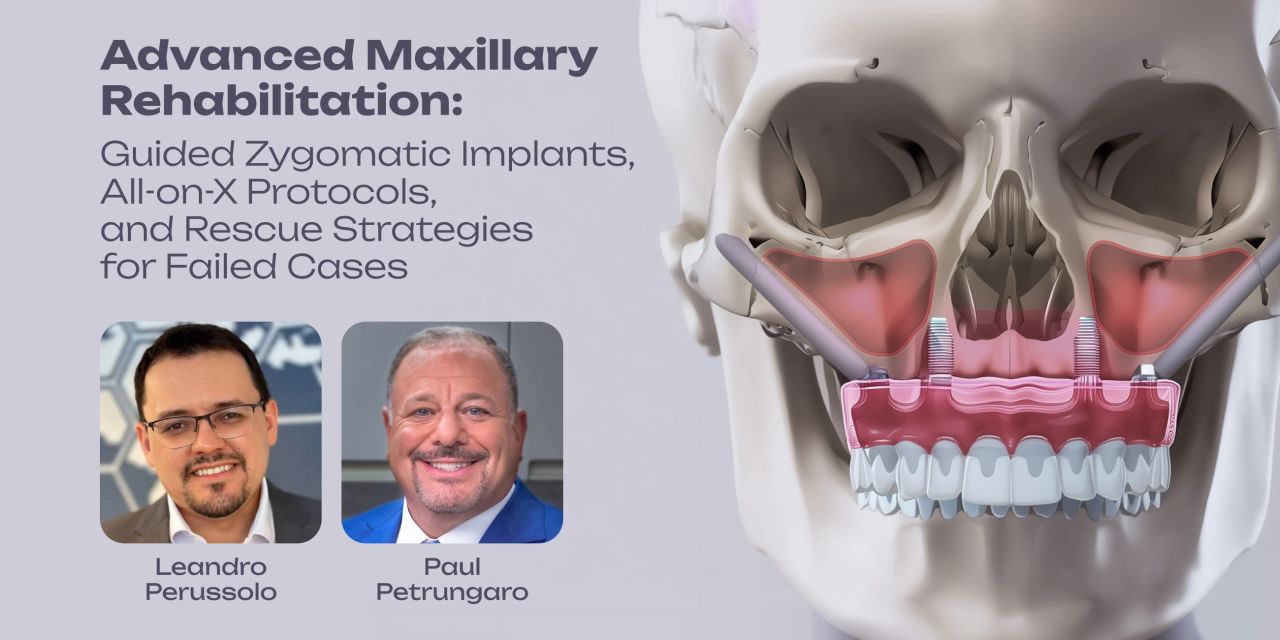
OHI-S Advanced Maxillary Rehabilitation Guided Zygomatic Implants, All-on-X Protocols, and Rescue Strategies for Failed Cases 3 lessons 3h 21min
$35.00
This Product is shared via google drive download link, So please share your correct Gmail id while placing the order .Please note that there are no CME points or certificate associated with this course Samples for Courses Can be found here : Free Samples Here!
EXPRESS DISCOVER PayPal
OHI-S Advanced Maxillary Rehabilitation
Guided Zygomatic Implants, All-on-X Protocols & Rescue Strategies for Failed Cases
3 Lessons | 3 Hours 21 Minutes | 3 CE Credits
Develop an advanced, prosthetically driven approach to the rehabilitation of the severely atrophic maxilla with OHI-S Advanced Maxillary Rehabilitation: Guided Zygomatic Implants, All-on-X Protocols, and Rescue Strategies for Failed Cases.
Presented by Paul Petrungaro and Leandro Perussolo, this advanced implantology program addresses some of the most challenging scenarios in full-arch dentistry, including:
- Severe maxillary atrophy
- Long-term edentulism
- Failed full-arch implant rehabilitation
- Failing implants
- Peri-implant disease
- Limited posterior maxillary bone
- Complex All-on-X treatment planning
- Zygomatic implant rehabilitation
- Pterygoid implant surgery
- Revision and rescue treatment
The course integrates:
- CBCT-based diagnosis
- 3D digital implant planning
- Guided surgery
- Zygomatic implants
- Pterygoid implants
- All-on-X protocols
- Prosthetically driven implant positioning
- Surgical-guide design
- Tilted implant concepts
- Single and double zygoma strategies
- Peri-implant disease management
- Full-arch revision
- Salvage and reconstruction
- Soft-tissue considerations
- Maintenance and long-term risk management
The central treatment pathway is:
Diagnose → Evaluate Anatomy & Failure Risk → Define the Prosthetic Endpoint → Plan Digitally → Select Anchorage → Execute Surgery → Reconstruct → Maintain
Course Details
- Course: Advanced Maxillary Rehabilitation: Guided Zygomatic Implants, All-on-X Protocols, and Rescue Strategies for Failed Cases
- Provider: OHI-S
- Faculty: Paul Petrungaro, Leandro Perussolo
- Lessons: 3
- Official Duration: 3 Hours 21 Minutes
- Language: English
- Official OHI-S CE: 3 CE Credits
- Primary Specialty: Implantology
- Additional Specialty: Oral & Maxillofacial Surgery
- Clinical Level: Advanced
- Main Focus: Severely Atrophic Maxilla & Complex Full-Arch Rehabilitation
Course Overview
Severe maxillary atrophy represents one of the most difficult problems in implant rehabilitation.
Treatment may be complicated by:
- Reduced residual bone
- Maxillary sinus anatomy
- Previous implant failure
- Long-term edentulism
- Soft-tissue deficiencies
- Peri-implantitis
- Prosthetic complications
- Altered anatomy following previous surgery
These cases require more than simply increasing the number of implants.
The clinician must determine:
- Where reliable anchorage can be obtained
- Whether conventional implants are feasible
- Whether tilted, pterygoid, or zygomatic implants are indicated
- Whether the existing rehabilitation can be salvaged
- Whether implants need to be removed or replaced
- How the final prosthesis should drive surgical planning
Prosthetically Driven Maxillary Rehabilitation
One of the strongest themes of this OHI-S course is:
The Prosthesis Should Guide the Surgical Plan
rather than:
Place the Implants First and Solve the Prosthetics Later
A comprehensive workflow therefore begins with:
Final Prosthetic Objective → Implant Distribution → Anatomical Assessment → Surgical Strategy
Severe Maxillary Atrophy
Severe resorption can limit conventional implant placement because there may be insufficient bone in the posterior maxilla.
Potential strategies discussed in the course include:
- Tilted implants
- Zygomatic implants
- Pterygoid implants
- Combination strategies
- Advanced full-arch rehabilitation
The correct approach depends on:
- Residual bone
- Sinus anatomy
- Zygomatic anatomy
- Prosthetic objectives
- Existing implants
- Surgical history
- Risk factors
LESSON 1
Guided Zygomatic and Pterygoid Implant Surgery: From Digital Planning to Clinical Execution
Instructor: Leandro Perussolo
Duration: 51 Minutes
Official CE: 0.75 CE Credits
The first lesson focuses on the complete guided-surgery workflow for advanced remote anchorage.
Topics include:
- What is guided surgery?
- Indications for guided implant surgery
- Advantages and limitations
- Imaging in complex implant dentistry
- Correct CBCT acquisition
- 3D implant positioning
- Anatomical criteria
- Zygomatic surgical-guide design
- Guided zygomatic implant systems
- Guided pterygoid implant systems
- Model-based surgical demonstration
- Patient-specific guide design
- Live surgical demonstration
- Clinical-case assessment
- Prosthetic rehabilitation after implant placement
Digital Planning
Digital planning is particularly important when treatment involves complex anatomical pathways.
The workflow may include:
CBCT → 3D Reconstruction → Anatomical Assessment → Implant Trajectory → Surgical Guide → Clinical Execution
The objective is to translate a digitally planned trajectory into surgery as accurately as the clinical system allows.
CBCT Acquisition
A sophisticated digital workflow begins with usable diagnostic imaging.
The course reviews how to obtain an appropriate CBCT dataset for advanced implant planning.
Important anatomy may include:
- Residual maxillary bone
- Maxillary sinus
- Nasal cavity
- Zygomatic bone
- Pterygoid region
- Adjacent anatomical structures
3D Implant Positioning
Implant position should be evaluated in all three dimensions.
For zygomatic and pterygoid treatment, this requires consideration of:
- Entry point
- Trajectory
- Final anchorage
- Prosthetic emergence
- Anatomical safety
The implant cannot be planned from a bone-only perspective.
Zygomatic Implant Planning
Zygomatic implants use remote anchorage in the zygomatic region to support rehabilitation of selected severely atrophic maxillae.
Planning requires detailed knowledge of:
- Zygomatic anatomy
- Sinus relationships
- Implant trajectory
- Prosthetic emergence
- Soft-tissue pathway
Guided Zygomatic Surgery
Lesson 1 demonstrates a guided approach designed to transfer the planned zygomatic trajectory into the surgical procedure.
The curriculum includes:
- Guide design
- System selection
- Model demonstration
- Live surgical demonstration
This allows learners to see the transition from:
Virtual Planning → Surgical Guide → Clinical Procedure
Pterygoid Implants
Pterygoid implant placement can provide posterior support in selected maxillary rehabilitation cases.
The course discusses the planning principles of:
- Posterior anchorage
- 3D trajectory
- Anatomical relationships
- Guided placement
Zygomatic + Pterygoid Strategies
Complex maxillary cases may require more than one anchorage strategy.
The clinician may consider combinations involving:
- Conventional implants
- Tilted implants
- Pterygoid implants
- Zygomatic implants
according to anatomy and prosthetic need.
Surgical Guide Design
A guide for complex implant surgery should be designed according to the individual patient.
OHI-S specifically emphasizes:
Individualized Surgical-Guide Design
rather than applying a universal template.
Live Clinical Demonstration
The lesson includes clinical demonstration of the guided procedure.
Recorded surgical education is valuable for understanding:
- Surgical sequence
- Instrument workflow
- Guide use
- Implant trajectory
but does not replace supervised advanced surgical training.
LESSON 2
Advanced Rescue of the Atrophic Maxilla
Comprehensive Solutions for Long-Term Edentulism, Failing Implants & Full-Arch Complications
Instructor: Paul Petrungaro
Duration: 1 Hour 12 Minutes
Official CE: 1 Credit
This lesson focuses on the patient whose maxillary rehabilitation is already compromised.
Topics include:
- Severe maxillary atrophy
- Long-term edentulism
- Failing implants
- Failed full-arch treatment
- All-on-4® complications
- Surgical causes of failure
- Prosthetic causes of failure
- Biomechanical causes of failure
- Biological causes of failure
- Bone-quality assessment
- Sinus evaluation
- Risk assessment
- Salvage strategies
- Reconstruction
- Tilted implants
- Zygomatic implants
- Zirconia implant solutions
- Peri-implant disease
- Soft-tissue optimization
- Prevention
- Maintenance
Why Full-Arch Cases Fail
The course emphasizes that full-arch failure can arise from several domains.
Surgical
Examples can involve:
- Implant position
- Primary stability
- Anatomical limitations
- Surgical execution
Prosthetic
Problems may involve:
- Prosthetic design
- Passive fit
- Access
- Emergence
- Cleansability
Biomechanical
Potential contributors include:
- Implant distribution
- Cantilever
- Load
- Occlusal factors
Biological
Problems can include:
- Peri-implant mucosal disease
- Peri-implantitis
- Bone loss
- Soft-tissue deficiencies
Successful rescue requires identifying the dominant cause rather than simply replacing the same treatment.
Failed All-on-4® / Full-Arch Rehabilitation
When a full-arch rehabilitation fails, the clinician must determine:
- Which implants remain usable?
- Which implants are failing?
- Is infection or peri-implant disease present?
- Has the prosthesis contributed to failure?
- Is remaining bone adequate?
- Is remote anchorage now required?
A rescue pathway may therefore involve:
Diagnose Cause → Determine What Can Be Preserved → Remove Unsalvageable Components → Reconstruct Support → Redesign Prosthetics
Clinical & Radiographic Assessment
The program emphasizes assessment of:
- Bone quality
- Residual bone
- Maxillary sinus
- Implant condition
- Prosthetic status
- Risk factors
before revision surgery.
Peri-Implant Disease
The lesson includes management concepts for:
- Peri-implant mucosal disease
- Peri-implantitis
- Failing implants
A biologically driven rescue strategy should consider both:
Implant Survival
and:
Peri-Implant Tissue Health
Soft-Tissue Outcomes
Soft tissue is critical in complex full-arch rehabilitation.
Issues can affect:
- Hygiene
- Tissue stability
- Prosthetic emergence
- Patient comfort
- Esthetics
The course therefore integrates soft-tissue optimization into the rescue plan.
Tilted Implants
Tilted implants can be used to exploit available native bone and optimize anterior-posterior implant distribution in selected full-arch cases.
Treatment planning should account for:
- Anatomy
- Prosthetic position
- Load distribution
- Available bone
Zygomatic Implants as a Rescue Option
When conventional posterior maxillary support is severely compromised, zygomatic anchorage may provide an alternative reconstructive strategy in appropriately selected patients.
This is especially relevant in cases involving:
- Severe atrophy
- Previous implant loss
- Failed augmentation
- Compromised full-arch support
Zirconia Implant Solutions
The official curriculum includes discussion of zirconia implant solutions among advanced reconstruction options.
This should be presented as:
A treatment concept discussed in the course
rather than a universal recommendation for all failed maxillary cases.
Prevention & Maintenance
Rescue treatment is only one part of the process.
Long-term management requires:
- Hygiene access
- Peri-implant monitoring
- Prosthetic maintenance
- Occlusal evaluation
- Soft-tissue surveillance
- Patient compliance
LESSON 3
Treatment Planning for the Atrophic Maxillae in ALL-ON-X Protocols
Instructor: Paul Petrungaro
Duration: 1 Hour 17 Minutes
Official CE: 1.25 CE Credits
The final lesson integrates diagnosis, surgery, and prosthetics into a comprehensive All-on-X framework.
Topics include:
- Severe maxillary atrophy
- All-on-X treatment planning
- Full-arch rehabilitation
- CBCT-based planning
- Digital workflows
- Interdisciplinary communication
- Prosthetically driven concepts
- Zygomatic implant indications
- Zygomatic implant planning
- Failing full-arch rehabilitation
- Peri-implantitis
- Peri-mucositis
- Revision strategies
- Reconstruction
- Single zygoma
- Double zygoma
- Surgical and prosthetic protocols
All-on-X
All-on-X is a general term used for full-arch fixed implant rehabilitation supported by a strategic number and distribution of implants.
The exact number and location of implants should be determined by:
- Anatomy
- Bone availability
- Prosthetic design
- Biomechanics
- Patient-specific factors
The term should not imply that every patient receives an identical implant configuration.
All-on-X vs. All-on-4®
All-on-4® is a specific trademarked treatment concept.
All-on-X is the broader descriptive term.
For SEO and product copy, use:
All-on-X
for the general educational topic.
Use:
All-on-4®
when discussing the specifically named concept or its failure mechanisms.
Prosthetically Driven All-on-X
The course emphasizes that the final prosthesis should determine:
- Implant position
- Implant distribution
- Emergence
- Surgical access
- Restorative space
A strong workflow is:
Diagnostic Setup → Prosthetic Design → Implant Planning → Surgery
Digital All-on-X Planning
CBCT-based planning helps integrate:
- Bone
- Sinus anatomy
- Implant positions
- Prosthetic requirements
Digital communication is especially useful in interdisciplinary cases involving:
- Surgeon
- Restorative dentist
- Prosthodontist
- Laboratory team
Zygomatic Implants in All-on-X
The course discusses when zygomatic implants may be incorporated into an All-on-X strategy.
Potential considerations include:
- Severe posterior bone deficiency
- Previous implant failure
- Prosthetic support needs
- Anatomy
- Treatment history
Single Zygoma
A single zygomatic implant may be incorporated on one side or within a hybrid configuration according to anatomy and support requirements.
Double Zygoma
More severe cases may require double-zygoma approaches.
These represent advanced reconstructive strategies and demand:
- Detailed anatomical planning
- Surgical experience
- Prosthetic coordination
- Risk assessment
Failing All-on-X Cases
The curriculum includes management of:
- Failing implants
- Peri-implantitis
- Peri-mucositis
- Compromised prostheses
- Failed full-arch rehabilitation
The objective is not simply to repeat the original procedure.
Revision requires understanding:
Why the Original Rehabilitation Failed
Revision Strategies
Revision options depend on:
- Number and location of remaining implants
- Bone condition
- Prosthetic design
- Biological disease
- Patient factors
Potential strategies discussed include:
- Salvage
- Reconstruction
- Alternative anchorage
- Zygomatic implants
- Revised prosthetic planning
Severe Atrophic Maxilla Treatment Algorithm
A simplified educational framework is:
Step 1 — Define the Prosthetic Goal
↓
Step 2 — Evaluate Residual Maxillary Bone
↓
Step 3 — Assess Sinus and Zygomatic Anatomy
↓
Step 4 — Evaluate Existing/Future Implant Distribution
↓
Step 5 — Determine Conventional vs. Tilted vs. Pterygoid vs. Zygomatic Anchorage
↓
Step 6 — Plan Digitally
↓
Step 7 — Execute Surgery
↓
Step 8 — Verify Prosthetic Compatibility
↓
Step 9 — Establish Maintenance
Zygomatic Implants
Zygomatic implant rehabilitation is an advanced surgical technique.
It may be considered in selected patients with severe maxillary bone deficiency when conventional implant strategies are insufficient or undesirable.
Planning requires detailed understanding of:
- Maxillary anatomy
- Sinus anatomy
- Zygomatic bone
- Prosthetic trajectory
- Soft tissue
- Surgical access
Pterygoid Implants
Pterygoid implants use posterior maxillary/pterygoid anchorage.
Potential advantages in selected cases include establishing posterior support without relying solely on grafting.
However, the technique is anatomically and surgically demanding.
Zygomatic vs. Pterygoid Anchorage
These are not interchangeable procedures.
Zygomatic
Anchorage extends toward the zygomatic complex.
Pterygoid
Anchorage uses the posterior maxillary/pterygoid region.
The selection depends on:
- Anatomy
- Prosthetic needs
- Available support
- Surgeon experience
- Case complexity
Guided Surgery
The program emphasizes guided techniques for complex implant trajectories.
Guided surgery can assist in transferring a digital plan but does not eliminate the need for:
- Surgical anatomy knowledge
- Intraoperative judgment
- Verification
- Backup strategies
Digital Workflow
The course strongly supports a modern digital pathway:
CBCT → 3D Planning → Prosthetic Design → Surgical Guide → Implant Placement → Full-Arch Prosthesis
This is one of the strongest SEO themes for the product.
Peri-Implant Disease & Full-Arch Failure
Failed full-arch cases often require simultaneous assessment of:
- Implant condition
- Bone loss
- Soft tissues
- Prosthetic design
- Hygiene access
- Biomechanics
A prosthetic complication should not be mistaken for a biological complication, and vice versa.
Interdisciplinary Treatment
Advanced full-arch rehabilitation benefits from coordination among:
- Implant surgeon
- Oral and maxillofacial surgeon
- Prosthodontist
- Restorative dentist
- Periodontist
- Dental technician
The treatment should be planned as one integrated rehabilitation.
Major Topics Covered
- Advanced Maxillary Rehabilitation
- Severe Maxillary Atrophy
- Atrophic Maxilla
- Zygomatic Implants
- Guided Zygomatic Implants
- Pterygoid Implants
- Guided Implant Surgery
- All-on-X
- All-on-4
- Full-Arch Implant Rehabilitation
- Full-Arch Implant Failure
- Implant Rescue
- Implant Salvage
- Failing Dental Implants
- Peri-Implantitis
- Peri-Mucositis
- CBCT Implant Planning
- 3D Implant Planning
- Surgical Guides
- Prosthetically Driven Implantology
- Tilted Implants
- Single Zygoma
- Double Zygoma
- Long-Term Edentulism
- Digital Implant Dentistry
- Zirconia Implant Solutions
- Full-Mouth Rehabilitation
- Complex Implant Dentistry
Who Should Take This Course?
This is an advanced surgical and prosthetic implantology program.
It is particularly relevant for:
- Implantologists
- Oral and Maxillofacial Surgeons
- Prosthodontists
- Periodontists involved in complex implant rehabilitation
- Full-Arch Implant Clinicians
- Experienced Restorative Dentists involved in All-on-X cases
- Implantology Residents and Fellows
- Advanced Oral Surgery Trainees
The strongest primary audience is:
Experienced Implantologists + Oral and Maxillofacial Surgeons
with prosthodontists playing a major role because of the strongly prosthetically driven treatment philosophy.
Is This a Beginner Implant Course?
No.
The curriculum includes:
- Zygomatic surgery
- Pterygoid implants
- Revision surgery
- Failed full-arch rescue
- Severe maxillary atrophy
- Guided surgical workflows
It should therefore be positioned as:
Advanced Implantology
rather than introductory implant education.
Why This Course Is Useful
The strongest value of this OHI-S course is that it covers the full spectrum from:
Planning
- CBCT
- 3D workflow
- Surgical guides
Advanced Anchorage
- Zygomatic
- Pterygoid
- Tilted implants
Full-Arch Rehabilitation
- All-on-X
- Prosthetic planning
- Single/double zygoma
Rescue
- Failing implants
- Peri-implant disease
- Failed All-on-4 / full arch
- Revision
Maintenance
- Biological stability
- Soft tissues
- Prevention
- Long-term follow-up
The overall pathway is:
Digital Diagnosis → Prosthetic Endpoint → Advanced Anchorage → Full-Arch Reconstruction → Rescue When Necessary → Maintenance
Advanced Surgical Training Notice
Zygomatic and pterygoid implant placement are advanced surgical procedures performed in anatomically complex regions.
Online recorded education can support understanding of:
- Diagnosis
- Treatment planning
- Anatomy
- Digital workflow
- Surgical sequence
- Prosthetic integration
but it does not replace:
- Advanced implant training
- Formal surgical education
- Cadaver or hands-on training
- Supervised clinical experience
- Emergency management competency
- Appropriate credentialing and legal scope
Guided surgery should not be interpreted as making an advanced procedure automatically safe or suitable for inexperienced operators.
Predictability Notice
The official course uses the concept of improving predictability.
For MedicalAmboss copy, avoid wording such as:
“Guaranteed Predictable Outcomes”
because outcomes depend on factors including:
- Patient anatomy
- Systemic health
- Bone quality
- Surgical execution
- Implant selection
- Prosthetic design
- Maintenance
- Biological healing
The safer wording is:
“protocols designed to support more structured and predictable treatment planning.”
Original OHI-S CE Information
The official OHI-S program is listed for:
3 CE Credits
with individual lessons listed as:
- Lesson 1: 0.75 CE Credits
- Lesson 2: 1 CE Credit
- Lesson 3: 1.25 CE Credits
Total:
3 CE Credits
These credits relate to participation through the original OHI-S educational platform and completion of its applicable requirements.
An independently distributed MedicalAmboss package should not automatically be represented as providing official OHI-S CE credit or certificate unless official CE participation is actually included.
Product Summary
- Product: Advanced Maxillary Rehabilitation: Guided Zygomatic Implants, All-on-X Protocols, and Rescue Strategies for Failed Cases
- Provider: OHI-S
- Faculty: Paul Petrungaro, Leandro Perussolo
- Lessons: 3
- Official Duration: 3h 21min
- Language: English
- Official OHI-S CE: 3 Credits
- Primary Specialty: Implantology
- Additional Specialty: Oral & Maxillofacial Surgery
- Level: Advanced
- Main Topics: Zygomatic Implants, Pterygoid Implants, All-on-X, Full-Arch Rescue
4. Short Description
OHI-S Advanced Maxillary Rehabilitation: Guided Zygomatic Implants, All-on-X Protocols, and Rescue Strategies for Failed Cases is an advanced 3-lesson, 3h 21min implantology program by Paul Petrungaro and Leandro Perussolo.
The course covers CBCT-based digital planning, guided zygomatic and pterygoid implant surgery, surgical-guide design, severe maxillary atrophy, All-on-X treatment planning, prosthetically driven full-arch rehabilitation, single and double zygoma strategies, failing implants, peri-implant disease, failed All-on-4/full-arch reconstruction, tilted implants, and advanced rescue protocols.
Topics
Lesson 1. Guided Zygomatic and Pterygoid Implant Surgery: From Digital Planning to Clinical Execution
-
What is guided surgery?
-
Indications and advantages of guided surgery
-
Imaging techniques in implant dentistry and how to obtain the correct CBCT scan
-
Understanding the concept of 3D implant positioning and anatomical criteria
-
Design principles of the zygomatic surgical guide
-
Guided zygomatic and pterygoid implant surgery systems
-
Step-by-step video demonstration of guided zygomatic implant placement on a model
-
Individualized design of surgical guides according to specific clinical cases
-
Live demonstration of the surgical procedure
-
Analysis of clinical cases and evaluation of prosthetic rehabilitation after implant placement
Lesson 2. Advanced Rescue of the Atrophic Maxilla: Comprehensive Solutions for Patients with Long-Term Edentulism, Failing Implants, and Full-Arch Complications
-
Challenges and limitations of implant rehabilitation in the severely atrophic maxilla
-
Aetiology of All-on-4® and full-arch implant failures: surgical, prosthetic, biomechanical, and biological factors
-
Clinical and radiographic assessment of bone quality, sinus anatomy, and treatment risk factors
-
Diagnosis and management of failing and failed full-arch rehabilitations, including salvage and reconstruction strategies
-
Advanced treatment concepts for severe maxillary atrophy: tilted implants, zygomatic implants, and zirconia implant solutions
-
Biologically driven protocols for managing peri-implant disease and optimizing soft tissue outcomes
-
Prevention and maintenance strategies to ensure long-term stability of complex implant rehabilitations
Lesson 3. Treatment Planning for the Atrophic Maxillae in ALL-ON-X Protocols
-
Diagnosis and treatment planning of severe maxillary atrophy in All-on-X full-arch rehabilitation
-
Integration of CBCT-based digital planning for surgical accuracy and interdisciplinary communication
-
Prosthetically driven treatment concepts for predictable All-on-X outcomes
-
Indications and planning protocols for incorporating zygomatic implants into complex maxillary cases
-
Management of failing full-arch rehabilitations, peri-implantitis, and peri-mucositis cases
-
Revision strategies for compromised All-on-X cases and reconstruction options
-
Surgical and prosthetic protocols for zygomatic implant rehabilitation, including anatomical considerations of single and double zygoma approaches
| Select | Full course Videos+Qbank, Only Videos, Only Qbank |
|---|
Related products
Pathology
USCAP Fourth Edition Modern Surgical Pathology Through the Expert Eyes of Our Presidents 2023
Obstetrics & Gynecology
2023 Surgical Pathology Update: Diagnostic Pearls for the Practicing Pathologist: Vol. VII
General Surgery
- Anesthesiology & pain medicine
- Books
- Anesthesiology books
- Basic science
- Cardiology books
- Dermatology books
- DENTAL BOOKS
- Endocrine and Nutrition books
- Gastroenterology and Hepatology books
- Hematology / Oncology books
- INTERNAL MEDICINE BOOKS
- Nephrology / urology books
- Neurology / neurosurgery books
- Obstetrics and gynecology books
- ophthalmology / Optometry books
- ORTHOPEDIATRICS BOOKS
- Pathology books
- pediatric books
- plastic surgery books
- Psychiatric books
- PULMONARY BOOKS
- Qbank & Questions
- Radiology books
- Cardiology
- Critical Care – Emergency medicine
- DENTAL
- Dermatology
- Endocrine and Nutrition
- ENT / Otolaryngology
- Family medicine
- General Surgery
- GIT COURSES
- Hematology / Oncology
- Internal Medicine
- Medical Accounts
- Nephrology / Urology
- Neurology / neurosurgery courses
- Obstetrics & Gynecology
- Ophthalmology & Optometry
- Orthopaedic
- Pathology
- Pediatrics
- physiotherapy
- Plastic Surgery
- psychology
- Qbank & Questions
- Radiology
- Respiratory / Pulmonary
- Rheumatology
- Surgery