
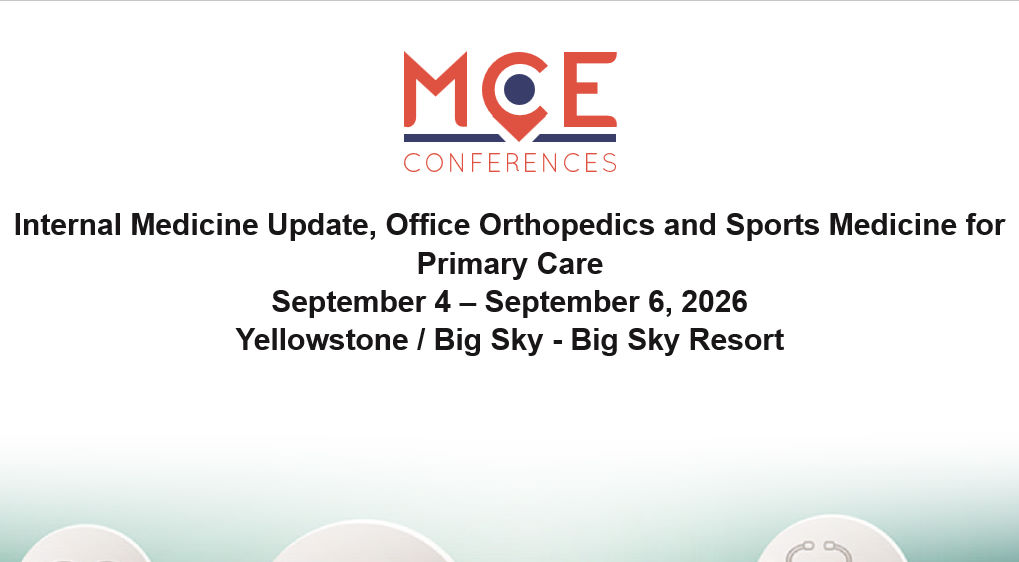
MCE Conferences Internal Medicine Update, Office Orthopedics and Sports Medicine for Primary Care Sep 04, 2026 – Sep 06, 2026
$125.00
This Product is shared via google drive download link, So please share your correct Gmail id while placing the order .Please note that there are no CME points or certificate associated with this course Samples for Courses Can be found here : Free Samples Here!
MCE Conferences Internal Medicine Update, Office Orthopedics and Sports Medicine for Primary Care Sep 04, 2026 – Sep 06, 2026
Internal Medicine • Office Orthopedics • Sports Medicine • Dermatology • Primary Care
September 4–6, 2026 | Big Sky Resort / Yellowstone, Montana
Review practical, evidence-based approaches to common problems in Internal Medicine, Office Orthopedics, Sports Medicine, and Primary Care with MCE Conferences Internal Medicine Update, Office Orthopedics and Sports Medicine for Primary Care Sep 04, 2026 – Sep 06, 2026.
Organized by MCE Conferences, the original live conference was held September 4–6, 2026, at Big Sky Resort near Yellowstone National Park in Montana. The official program was designed to provide primary care practitioners with current, evidence-based information and pragmatic approaches to clinical management.
The discussion-based educational format incorporates dynamic lectures, case-based studies, and hands-on learning, with clinical updates spanning concussion, sports medicine examination, dementia, osteoporosis, menopausal hormone therapy, exercise prescription, knee and shoulder pain, tendinopathy, and common dermatologic conditions.
The overall program emphasizes practical clinical decision-making that can be applied during routine outpatient encounters:
Recognize → Examine → Assess Risk → Diagnose → Treat → Counsel → Refer When Appropriate
Course Details
- Course: Internal Medicine Update, Office Orthopedics and Sports Medicine for Primary Care
- Provider: MCE Conferences
- Year: 2026
- Conference Dates: September 4–6, 2026
- Duration: 3 Days
- Venue: Big Sky Resort / Big Sky Conference Center
- Location: Big Sky / Yellowstone National Park, Montana
- Official Course Listing: 12 Credits
- Primary Specialty: Internal Medicine / Primary Care
- Related Specialties: Office Orthopedics, Sports Medicine, Dermatology, Geriatric Medicine, Women’s Health
- Primary Audience: Physicians and Other Healthcare Professionals
- Educational Format: Lectures, Case-Based Education, Discussion, and Practical Clinical Training
- Daily Conference Hours: 7:30 AM – 11:50 AM
- Primary Clinical Focus: Evidence-Based Diagnosis, Management, and Treatment of Common Primary Care Conditions
MCE officially lists all three conference days at the Big Sky Conference Center, with educational sessions running from 7:30 AM to 11:50 AM.
Who Was the Original Program Designed For?
MCE describes the target audience as:
All Physicians and other Healthcare Professionals seeking clinical information about issues in Internal Medicine, Office Orthopedics and Sports Medicine.
The conference is particularly relevant for:
- Internal Medicine Physicians
- Family Medicine Physicians
- Primary Care Physicians
- General Practitioners
- Sports Medicine Specialists
- Orthopedists
- Dermatologists
- Nurse Practitioners
- Physician Assistants
- Clinicians managing common musculoskeletal injuries
- Clinicians treating older adults with cognitive impairment
- Healthcare professionals providing outpatient preventive and chronic disease care
The strongest clinical audience remains:
Internal Medicine + Primary Care + Sports Medicine + Office Orthopedics
Learning Objectives
Upon completion of this program, participants should be better able to:
- Assess and manage concussions, including utilizing assessment tools, interpreting neuropsychological testing, and determining return-to-play recommendations.
- Perform accurate physical examinations for sports medicine injuries (hand, foot, ankle) to determine appropriate testing and the need for urgent referral.
- Diagnose mild cognitive impairment and dementia, effectively communicate with patients and families, and incorporate advance care planning and supportive resources.
- Screen, evaluate, and assess fracture risk for osteoporosis to guide long-term pharmacologic therapy and consolidation.
- Identify candidates for Menopausal Hormone Therapy (MHT), weigh risks and benefits, apply safe prescribing practices, and recommend evidence-based alternatives.
- Prepare effective exercise prescriptions using the FITT-PRO framework while addressing patient barriers to implementation.
- Diagnose the etiology of knee and shoulder pain using targeted history elements and accurate examination tests to formulate evidence-based treatment plans.
- Differentiate types of tendinopathy and select appropriate evidence-based treatments, evaluating the indications and risks of injections.
- Implement a systematic approach to diagnosing common skin conditions and recognizing dermatologic emergencies.
- Select appropriate topical therapies and multi-target approaches for managing eczema, acne, rosacea, stasis dermatitis, pruritus, and pattern hair loss.
SPORTS MEDICINE
Sports medicine represents a major component of the conference, with sessions addressing:
- Concussion
- Return-to-play decisions
- Hand injuries
- Foot injuries
- Ankle injuries
- Knee pain
- Shoulder pain
- Tendinopathy
- Exercise prescription
The program combines history, physical examination, testing, evidence-based treatment, and referral decisions.
Concussion Update
The conference begins with a dedicated Concussion Update.
Official objectives include reviewing:
- Etiology of concussion
- Pathophysiology
- Signs and symptoms
- Concussion assessment tools
- Medical clearance
- Return to learn
- Return to play
- Neuropsychological testing
- Second impact syndrome
Concussion Assessment
Effective concussion evaluation requires more than asking whether the patient lost consciousness.
The clinical assessment may integrate:
- Mechanism of injury
- Symptoms
- Cognitive findings
- Neurologic evaluation
- Balance
- Functional status
- Standardized assessment tools
The conference emphasizes the appropriate use of concussion assessment tools to support management decisions.
Return to Learn & Return to Play
The official program includes determination of:
- Medical clearance
- Return-to-learn recommendations
- Return-to-play recommendations
The goal is a structured and individualized recovery process rather than immediate return to full activity.
Neuropsychological Testing
Another objective is to consider:
When and how to interpret neuropsychological testing
in patients with concussion.
Testing should be incorporated into the overall clinical picture rather than interpreted in isolation.
Second Impact Syndrome
The concussion session also addresses:
- Definition
- Potential complications
- Clinical significance
of second impact syndrome.
This reinforces the importance of appropriate recovery and clearance decisions following concussion.
Sports Medicine Exam Tips and Tricks
The second official session is:
Sports Medicine Exam Tips and Tricks
with an emphasis on performing focused examination and identifying cases requiring further testing or referral.
Hand Injuries
A specific objective is to determine when a hand injury requires urgent referral based on:
- History
- Physical examination
This is particularly relevant in primary care and sports medicine, where hand injuries are common but some require prompt specialist management.
Musculoskeletal Examination
The course emphasizes selecting the most accurate examination for particular musculoskeletal complaints.
A practical examination framework may include:
Location → Mechanism → Inspection → Range of Motion → Strength → Focused Tests → Neurovascular Assessment
Foot & Ankle Injuries
The official session also covers appropriate testing for:
- Foot injuries
- Ankle injuries
to determine which patients may require:
- Additional diagnostic testing
- Imaging
- Specialist referral
INTERNAL MEDICINE & GERIATRIC CARE
The Internal Medicine component includes significant education involving:
- Mild cognitive impairment
- Dementia
- Osteoporosis
- Menopause
- Exercise prescription
These topics reflect issues commonly encountered in adult and older-patient primary care.
Dementia in Primary Care
MCE devotes two full sessions to:
Dementia in Primary Care: Evaluation, Management, and Beyond
The first session emphasizes evaluation and diagnosis, while the second focuses on communication, dementia subtypes, management, caregiver resources, and advance care planning.
Cognitive Impairment Evaluation
Part 1 includes:
- Efficient tools for evaluating cognitive impairment
- Documentation in the EHR
- Appropriate diagnostic workup
- Recognition of Mild Cognitive Impairment
- Diagnosis of dementia
The clinical pathway can be summarized as:
Concern → Cognitive Assessment → Documentation → Diagnostic Workup → Diagnosis
Mild Cognitive Impairment – MCI
The program specifically addresses recognition and diagnosis of Mild Cognitive Impairment.
Clinicians must distinguish MCI from:
- Normal cognitive aging
- Dementia
- Other causes of cognitive symptoms
The course also prepares clinicians to communicate the diagnosis appropriately.
Dementia Diagnosis
Primary care clinicians frequently play an important role in initial dementia evaluation.
The program emphasizes:
- Cognitive assessment
- Diagnostic workup
- Recognition of dementia
- Differentiation among common dementia types
This supports more structured diagnostic reasoning rather than treating all memory complaints as the same condition.
Communicating Dementia Diagnoses
Part 2 specifically addresses how to communicate diagnoses of:
- Mild Cognitive Impairment
- Dementia
with:
- Patients
- Families
Communication is a major component of dementia care because diagnosis has implications for independence, safety, caregivers, and future planning.
Dementia Types
The official objectives include differentiating key features of common dementia types.
This is important because clinical progression, treatment considerations, and supportive needs may differ depending on the underlying diagnosis.
Dementia Management & Caregiver Support
The program reviews:
- Management strategies
- Supportive resources
- Patient needs
- Caregiver needs
This recognizes that dementia management extends beyond medication alone.
Advance Care Planning
The session specifically includes:
Advance care planning and billing practices in dementia care.
Advance planning can help patients and families address future healthcare decisions while the patient retains the ability to participate meaningfully.
Osteoporosis
Saturday begins with a dedicated session on Osteoporosis.
The official program addresses:
- Screening
- Diagnosis
- Secondary causes
- Fracture-risk assessment
- Pharmacologic treatment
- Long-term treatment
- Consolidation
- Follow-up
Osteoporosis Screening & Diagnosis
Clinicians should be able to:
- Screen appropriate patients
- Diagnose osteoporosis
- Evaluate possible secondary causes
The goal is to move from simple bone-density testing toward a broader fracture-prevention strategy.
Fracture Risk Assessment
The course specifically emphasizes:
Assessing fracture risk to guide individualized treatment decisions.
Treatment decisions should therefore consider both measured bone density and broader patient-specific risk.
Pharmacologic Therapy for Osteoporosis
The official session includes comparison and selection of appropriate pharmacologic therapies.
Rather than using one treatment strategy for all patients, the program focuses on individualized decision-making.
Long-Term Osteoporosis Management
The osteoporosis curriculum also covers:
- Treatment duration
- Consolidation
- Follow-up
This is important because osteoporosis management often extends over many years and may require transitions between therapies.
WOMEN’S HEALTH
The program includes a dedicated session on:
Menopausal Hormone Therapy – MHT
covering identification of appropriate candidates, risk-benefit assessment, safe prescribing, and evidence-based alternatives.
Menopausal Hormone Therapy – MHT
Official objectives include:
- Recognizing common menopause symptoms
- Identifying patients who may benefit from MHT
- Weighing risks and benefits
- Applying appropriate prescribing practices
- Recommending alternatives when MHT is unsuitable
Menopause Symptoms
The course begins with recognition of common symptoms associated with menopause.
Clinical decision-making then progresses to whether treatment is needed and which treatment strategy is most appropriate.
Selecting Candidates for MHT
A major learning objective is to identify patients who may benefit from Menopausal Hormone Therapy.
Treatment should be individualized according to:
- Symptoms
- Risks
- Potential benefits
- Medical history
- Contraindications
- Patient preferences
MHT Risks & Benefits
The program specifically emphasizes weighing:
Benefits ↔ Risks
before prescribing menopausal hormone therapy.
This supports shared decision-making rather than routine hormone prescribing.
Evidence-Based Alternatives to MHT
When MHT is not appropriate, clinicians should be able to recommend evidence-based alternatives.
This allows management to remain patient-centered even when hormone therapy is unsuitable.
EXERCISE & PREVENTIVE MEDICINE
The conference also includes:
Exercise Rx: What and For Whom?
which focuses on translating physical-activity evidence into specific exercise prescriptions.
Exercise Prescription
The session reviews the health benefits that can be achieved through regular physical activity and teaches clinicians how to prepare effective exercise prescriptions.
Rather than giving generic advice such as “exercise more,” the course emphasizes a structured prescription.
FITT-PRO Framework
The official objectives specifically include use of the FITT-PRO framework.
This allows physical activity to be approached more like a clinical prescription, with attention to factors such as:
- Frequency
- Intensity
- Time
- Type
- Progression
- Patient-specific considerations
Barriers to Exercise
The course also addresses barriers that may prevent some patients from implementing exercise recommendations.
Successful exercise counseling therefore requires both:
Good Prescription + Realistic Implementation Plan
OFFICE ORTHOPEDICS
The orthopedic portion provides practical outpatient strategies for:
- Knee pain
- Shoulder pain
- Tendinopathy
with emphasis on accurate examination and evidence-based treatment.
Knee Pain Evaluation and Management
The official session focuses on:
- History elements
- Physical examination
- Diagnosis
- Evidence-based treatment
Knee Pain History
A key objective is to identify history elements that help determine the likely cause of knee pain.
Relevant factors may include:
- Mechanism
- Location
- Timing
- Swelling
- Instability
- Mechanical symptoms
- Functional limitations
The history guides the focused examination.
Knee Examination
The course emphasizes choosing the most accurate examination tests for evaluating knee pain.
This supports a more targeted approach rather than performing every possible orthopedic maneuver.
Evidence-Based Knee Pain Treatment
Participants should also be able to counsel patients on the most effective and evidence-based treatments for knee pain.
The overall approach is:
History → Examination → Etiology → Treatment Plan
Shoulder Pain Evaluation and Management
Sunday begins with:
Shoulder Pain Evaluation and Management
The official objectives parallel the knee session and emphasize:
- Key history elements
- Accurate examination tests
- Evidence-based treatment
Shoulder Examination
The clinician should use history and focused examination to identify the likely etiology of shoulder pain.
Assessment may include:
- Range of motion
- Strength
- Pain pattern
- Functional limitations
- Focused provocative tests
The program emphasizes accuracy rather than indiscriminate examination.
Evidence-Based Shoulder Treatment
The conference also prepares clinicians to counsel patients regarding effective, evidence-based treatments for shoulder pain.
Tendinitis: The Challenges and Controversies
The official program includes:
Tendinitis: The Challenges and Controversies
with objectives covering diagnosis, treatment, and injection decisions.
Tendinopathy Classification
Participants should be able to:
Define and differentiate types of tendinopathy.
This is important because not every tendon complaint represents the same biological process or requires the same treatment.
Evidence-Based Tendinopathy Treatment
The session reviews evidence-based treatment options for tendinopathy.
Management should therefore reflect:
- Type of tendon disorder
- Duration
- Functional impairment
- Patient factors
- Current evidence
Injections for Tendinopathy
One of the most clinically relevant objectives is determining:
- Indications for injections
- Potential benefits
- Potential harms
This allows clinicians to weigh interventional treatment against noninvasive management.
DERMATOLOGY
The final two sessions focus on common dermatologic problems encountered in primary care.
The program is structured around two practical questions:
- What is the diagnosis?
- What should I use to treat it?
Diagnosis of Common Skin Conditions
The official session is titled:
Diagnosis of Skin Conditions Commonly Encountered in the Primary Care Setting
and emphasizes a systematic approach to evaluating common dermatologic presentations.
Systematic Dermatologic Diagnosis
The course addresses:
- Facial rashes
- Intertriginous rashes
- Generalized rashes
- Hair loss
A systematic dermatologic approach may consider:
Location → Distribution → Morphology → Symptoms → Exposure → Differential Diagnosis
Facial Rashes
Facial dermatologic presentations often require differentiation among inflammatory, infectious, and other causes.
The program includes facial rashes within the structured diagnostic approach.
Intertriginous Rashes
Rashes occurring in skin folds form another confirmed presentation category.
Distribution and local environment can provide important diagnostic clues.
Generalized Rashes
The course also addresses generalized dermatologic presentations.
These can require broader consideration of:
- Medication exposure
- Infection
- Inflammatory disease
- Systemic illness
- Dermatologic emergencies
Hair Loss
Hair loss is included as one of the common outpatient dermatologic presentations.
The diagnostic strategy emphasizes systematic evaluation rather than treating all hair loss as one condition.
Dermatologic Emergencies
A specific objective is to:
Recognize the signs of a dermatologic emergency.
This is particularly important in primary care because some skin findings may indicate conditions requiring urgent evaluation rather than routine outpatient management.
Treatment Approaches for Common Skin Conditions
The final official session is:
Treatment Approaches for Common Skin Conditions in Primary Care
with emphasis on practical topical therapy and common outpatient skin disorders.
Topical Therapy
The program reviews selection of appropriate topical treatments, including:
- Delivery vehicles
- Steroid use
Choosing the appropriate formulation can be as important as selecting the active medication.
Eczema
The official curriculum includes practical strategies for managing eczema.
Treatment is discussed as part of everyday primary care dermatology rather than specialty dermatology alone.
Acne
Acne is another confirmed common skin condition addressed in the treatment session.
Rosacea
The program also includes practical management of rosacea.
Stasis Dermatitis
Stasis dermatitis is specifically listed among the common chronic skin conditions included in the session.
Pruritus
The course includes evidence-based treatment selection for pruritus.
Because itching can result from a wide range of dermatologic and systemic conditions, treatment requires consideration of the underlying cause.
Pattern Hair Loss
The final dermatology session also addresses evidence-based treatment for pattern hair loss.
This connects the diagnostic hair-loss content with practical management.
Multi-Target Dermatologic Treatment
One official objective is to integrate multi-target approaches to improve outcomes in chronic skin conditions.
This recognizes that some chronic dermatologic disorders may require treatment of more than one pathogenic or symptomatic component.
Multidisciplinary Primary Care Integration
The value of the conference comes from combining several major clinical domains:
Sports Medicine
Concussion + Sports Examination + Return to Play
Cognitive & Geriatric Medicine
MCI + Dementia + Caregiver Support + Advance Care Planning
Bone & Women’s Health
Osteoporosis + MHT
Preventive Medicine
Exercise Prescription + FITT-PRO
Office Orthopedics
Knee + Shoulder + Tendinopathy
Dermatology
Rash Diagnosis + Topical Therapy + Hair Loss + Dermatologic Emergencies
This multidisciplinary structure is especially useful for clinicians who manage a broad outpatient population.
Major Topics Covered
- Internal Medicine
- Primary Care
- Sports Medicine
- Office Orthopedics
- Concussion
- Concussion Assessment
- Neuropsychological Testing
- Return to Learn
- Return to Play
- Second Impact Syndrome
- Sports Medicine Examination
- Hand Injuries
- Foot Injuries
- Ankle Injuries
- Mild Cognitive Impairment
- MCI
- Dementia
- Cognitive Assessment
- Dementia Diagnosis
- Dementia Management
- Caregiver Support
- Advance Care Planning
- Osteoporosis
- Osteoporosis Screening
- Fracture Risk
- Osteoporosis Pharmacotherapy
- Menopause
- Menopausal Hormone Therapy
- MHT
- Exercise Prescription
- FITT-PRO
- Physical Activity
- Knee Pain
- Knee Examination
- Shoulder Pain
- Shoulder Examination
- Tendinitis
- Tendinopathy
- Tendon Injections
- Dermatology
- Facial Rashes
- Intertriginous Rashes
- Generalized Rashes
- Hair Loss
- Dermatologic Emergencies
- Topical Therapy
- Topical Steroids
- Eczema
- Acne
- Rosacea
- Stasis Dermatitis
- Pruritus
- Pattern Hair Loss
- Evidence-Based Primary Care
Who Should Take This Course?
MCE Conferences Internal Medicine Update, Office Orthopedics and Sports Medicine for Primary Care Sep 04, 2026 – Sep 06, 2026 is particularly relevant for:
- Internal Medicine Physicians
- Family Medicine Physicians
- Primary Care Physicians
- General Practitioners
- Sports Medicine Specialists
- Orthopedists
- Dermatologists
- Nurse Practitioners
- Physician Assistants
- Clinicians evaluating sports injuries
- Clinicians managing dementia and osteoporosis
- Clinicians providing menopause care
- Clinicians managing common skin conditions
- Healthcare professionals providing broad outpatient care
The strongest clinical audience remains:
Internal Medicine + Primary Care + Sports Medicine + Office Orthopedics
Why This Course Is Useful
This MCE conference provides an efficient review of common conditions requiring practical outpatient decision-making.
Sports & Musculoskeletal Medicine
- Concussion
- Hand injuries
- Foot and ankle injuries
- Knee pain
- Shoulder pain
- Tendinopathy
Internal & Geriatric Medicine
- Mild Cognitive Impairment
- Dementia
- Osteoporosis
Women’s Health
- Menopause
- Menopausal Hormone Therapy
Preventive Medicine
- Exercise counseling
- FITT-PRO exercise prescriptions
Dermatology
- Common rashes
- Dermatologic emergencies
- Eczema
- Acne
- Rosacea
- Stasis dermatitis
- Pruritus
- Hair loss
The overall clinical pathway can be summarized as:
Evaluate → Identify Risk → Perform Focused Examination → Diagnose → Select Evidence-Based Treatment → Counsel → Refer When Necessary
Original MCE Credit & Accreditation Information
The official conference was designated for a maximum of:
12 AMA PRA Category 1 Credits™.
MCE Conferences is accredited by the Accreditation Council for Continuing Medical Education – ACCME to provide continuing medical education for physicians.
The official activity also includes:
- Up to 12 ABIM Part II MOC Points
- Up to 12.00 Live AAFP Prescribed Credits
- AAFP credit recognition through the stated term of approval
- AOA recognition pathways
- ANCC recognition of AMA PRA Category 1 Credit™ for applicable recertification/continuing education
- AANP/AANPCP recognition pathways for nurse practitioners
- Up to 12 Category 1 credits for eligible physician assistants
- Up to 12 CME credits potentially applicable toward pharmacology requirements depending on the relevant medical board
These credits apply to eligible participation in the original MCE Conferences educational activity and completion of the provider’s requirements.
An independently distributed MedicalAmboss package should not automatically be represented as providing:
- MCE CME Credit
- AMA PRA Category 1 Credits™
- ABIM MOC Points
- AAFP Prescribed Credit
- ANCC Credit
- NCCPA Category 1 Credit
- Pharmacology Credit
- Official MCE Certificate
- Official MCE Account Access
unless official participation and credit-claiming eligibility are specifically included with the purchase.
Product Summary
- Product: MCE Conferences Internal Medicine Update, Office Orthopedics and Sports Medicine for Primary Care Sep 04, 2026 – Sep 06, 2026
- Provider: MCE Conferences
- Year: 2026
- Conference Dates: September 4–6, 2026
- Duration: 3 Days
- Venue: Big Sky Resort / Big Sky Conference Center
- Location: Big Sky / Yellowstone National Park, Montana
- Official Listing: 12 Credits
- Primary Specialty: Internal Medicine / Primary Care
- Related Areas: Sports Medicine, Office Orthopedics, Dermatology, Geriatric Medicine, Women’s Health
- Primary Audience: Physicians and Other Healthcare Professionals
- Major Areas: Concussion, Dementia, Osteoporosis, MHT, Exercise Prescription, Knee and Shoulder Pain, Tendinopathy, and Dermatology
Short Description
MCE Conferences Internal Medicine Update, Office Orthopedics and Sports Medicine for Primary Care Sep 04, 2026 – Sep 06, 2026 is a three-day evidence-based primary care conference held at Big Sky Resort / Yellowstone, Montana.
The program covers concussion management, sports medicine examinations, mild cognitive impairment and dementia, osteoporosis, menopausal hormone therapy, exercise prescription, knee and shoulder pain, tendinopathy, dermatologic diagnosis, topical therapies, eczema, acne, rosacea, stasis dermatitis, pruritus, and pattern hair loss.
Topics
Friday, September 4, 2026
- Concussion Update: Etiology, pathophysiology, signs and symptoms of concussion; concussion assessment tools; medical clearance; return-to-learn and return-to-play recommendations; neuropsychological testing; second impact syndrome and its significance.
- Sports Medicine Exam Tips and Tricks: Hand injury history and physical examination; identification of injuries requiring urgent referral; accurate musculoskeletal examination; evaluation of foot and ankle injuries; selection of further testing and referral.
- Dementia in Primary Care: Evaluation, Management, and Beyond (Part 1): Efficient cognitive assessment tools; EHR documentation; diagnostic workup for cognitive impairment; recognition and diagnosis of Mild Cognitive Impairment and dementia.
- Dementia in Primary Care: Evaluation, Management, and Beyond (Part 2): Communication of MCI and dementia diagnoses; differentiation of common dementia types; management strategies; patient and caregiver resources; advance care planning and billing practices.
Saturday, September 5, 2026
- Osteoporosis: Screening, diagnosis, secondary causes, fracture-risk assessment, individualized treatment decisions, pharmacologic therapy, long-term management, treatment duration, consolidation, and follow-up.
- Menopausal Hormone Therapy (MHT): Menopause symptoms; identification of appropriate MHT candidates; risks and benefits; appropriate prescribing practices; evidence-based alternatives.
- Exercise Rx: What and For Whom?: Health benefits of regular physical activity; preparation of effective exercise prescriptions using FITT-PRO; barriers to implementation.
- Knee Pain Evaluation and Management: Key history elements; accurate knee examination tests; diagnosis of pain etiology; evidence-based patient counseling and treatment.
Sunday, September 6, 2026
- Shoulder Pain Evaluation and Management: Key history elements; examination tests; determination of pain etiology; evidence-based treatment.
- Tendinitis: The Challenges and Controversies: Types of tendinopathy; evidence-based treatment; indications, benefits, and potential harms of injections.
- Diagnosis of Skin Conditions Commonly Encountered in the Primary Care Setting: Systematic evaluation of facial, intertriginous, and generalized rashes; hair loss; recognition of dermatologic emergencies.
- Treatment Approaches for Common Skin Conditions in Primary Care: Topical treatment selection; delivery vehicles; steroid use; management of eczema, acne, rosacea, and stasis dermatitis; evidence-based treatment of pruritus and pattern hair loss; multi-target management of chronic skin conditions.
-
Concussion Update
-
Sports Medicine Exam Tips and Tricks
-
Dementia in Primary Care: Evaluation, Management, and Beyond (Part 1)
-
Dementia in Primary Care: Evaluation, Management, and Beyond (Part 2)
-
Osteoporosis
-
Menopausal Hormone Therapy (MHT)
-
Exercise Rx: What and For Whom?
-
Knee Pain Evaluation and Management
-
Shoulder Pain Evaluation and Management
-
Tendinitis: The Challenges and Controversies
-
Diagnosis of Skin Conditions Commonly Encountered in the Primary Care Setting
-
Treatment Approaches for Common Skin Conditions in Primary Care
Related products

Critical Care - Emergency medicine
The Brigham Board Review in Infectious Diseases Brigham and Women’s Hospital Board Review
Critical Care - Emergency medicine
2022 UPDATES IN THERAPEUTICS: CRITICAL CARE PHARMACY PREPARATORY REVIEW AND RECERTIFICATION COURSE

Internal Medicine
Critical Care - Emergency medicine

Internal Medicine

Medical Accounts
Critical Care - Emergency medicine
2022 ISICEM International Symposium on Intensive Care & Emergency Medicine
Critical Care - Emergency medicine
40th ISICEM International Symposium on Intensive Care & Emergency Medicine 2021