
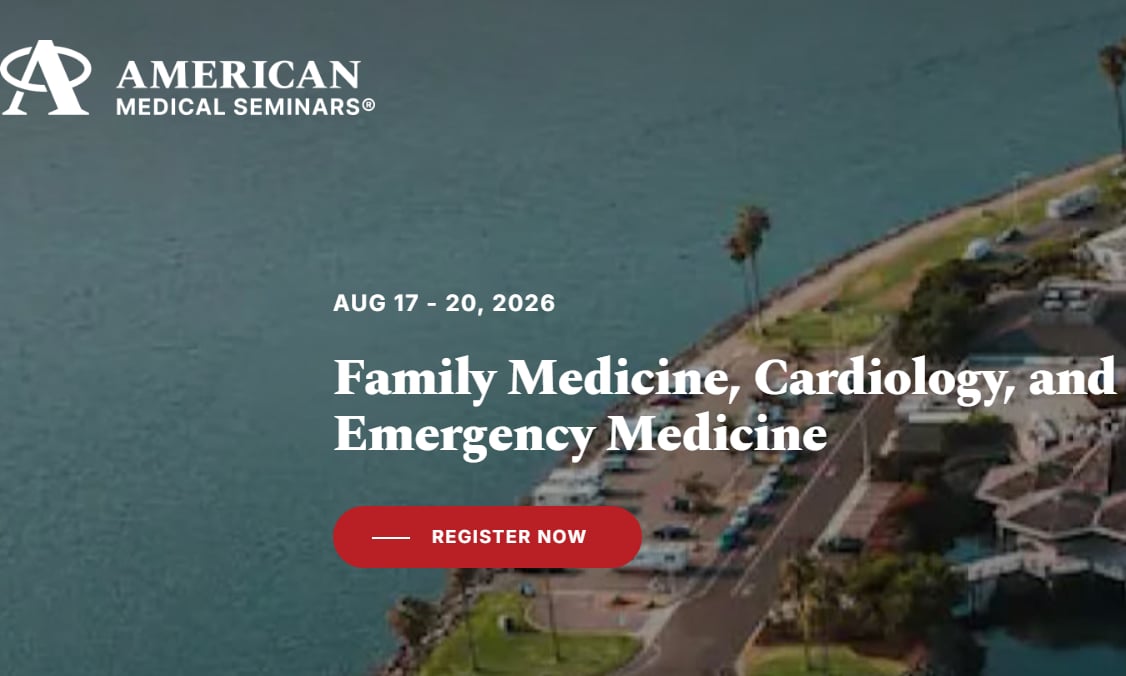
American Medical Seminars Family Medicine, Cardiology, and Emergency Medicine 2026
$100.00
T
American Medical Seminars Family Medicine, Cardiology, and Emergency Medicine 2026 features a four-day educational program with 20 scheduled clinical lectures from August 17–20, 2026. Covers acute coronary syndromes, ECG interpretation, atrial fibrillation, aortic emergencies, vertigo, thunderclap headache, trauma, drug interactions, thyroid emergencies, anaphylaxis, infant fever, geriatric care, and coagulopathy. Presented by Andrew Chang, MD; Joel Kravitz, MD; and Joe Nemeth, MD.
Category Classification
American Medical Seminars Family Medicine, Cardiology, and Emergency Medicine 2026
Family Medicine 2026 | Emergency Medicine | Cardiology | Acute Care | Clinical Updates | American Medical Seminars
Target Audience
Family Physicians, Internal Medicine Physicians, Primary Care Physicians, Emergency Medicine Physicians, Cardiologists, Hospitalists, Urgent Care Physicians, Critical Care Specialists, Nurse Practitioners, Physician Assistants, and healthcare professionals involved in diagnosing and managing acute and common medical conditions.
Information
American Medical Seminars Family Medicine, Cardiology, and Emergency Medicine 2026 is a four-day medical education conference organized by American Medical Seminars, Inc. (AMS), focusing on evidence-based clinical updates in family medicine, emergency medicine, cardiology, acute care, and patient safety.
Originally held on August 17–20, 2026, at the Hyatt Regency Mission Bay Spa and Marina in San Diego, California, USA, the program features 20 scheduled educational lectures presented by experienced emergency medicine faculty.
The conference examines practical approaches to evaluating, diagnosing, and managing common and challenging medical emergencies encountered in emergency departments, hospitals, urgent care centers, and primary care settings.
Major educational topics include acute coronary syndromes, atrial fibrillation, ECG interpretation, acute aortic emergencies, peripheral vertigo, thunderclap headache, facial trauma, neuromuscular weakness, and ophthalmologic emergencies.
Additional sessions explore endocrine emergencies, thyroid storm, drug-drug interactions, orthopedic injuries, anaphylaxis, infant fever, geriatric emergency medicine, and coagulopathy.
The curriculum also addresses high-value diagnostic testing, emergency psychiatric assessment, cognitive workload, clinical misconceptions, and evidence-based decision-making.
Through expert-led lectures and case-oriented discussions, the program emphasizes early recognition of serious medical conditions, appropriate diagnostic evaluation, treatment considerations, and safe patient management.
The original conference schedule identifies 20 lectures across four days. The number and completeness of recordings supplied with a digital purchase should be confirmed separately.
Product Details
| Information | Details |
|---|---|
| Course Title | Family Medicine, Cardiology, and Emergency Medicine |
| Organizer | American Medical Seminars, Inc. (AMS) |
| Edition | 2026 |
| Conference Dates | August 17–20, 2026 |
| Original Location | Hyatt Regency Mission Bay Spa and Marina, San Diego, California, USA |
| Duration | Four-Day Educational Program |
| Original Format | Hybrid Medical Seminar |
| Scheduled Lectures | 20 |
| Primary Specialty | Emergency Medicine & Family Medicine |
| Additional Focus | Cardiology, Internal Medicine, Acute Care |
| Language | English |
Digital Materials Notice: The original schedule describes 20 educational lectures, which do not necessarily correspond to 20 separate video files. Official conference registration, live participation, provider-platform access, CME credits, and certificates are not included unless expressly specified in the purchased package.
Learning Objectives
Upon completion of this educational activity, participants should be better able to:
- Perform rapid screening and systematic evaluation of patients presenting with facial trauma.
- Recognize important drug-drug interactions and their potential complications in emergency care.
- Evaluate patients with neuromuscular weakness and common neurologic emergencies.
- Differentiate peripheral vertigo from potentially serious central neurologic causes.
- Recognize acute aortic emergencies and initiate appropriate clinical assessment.
- Apply evidence-based approaches to atrial fibrillation management in emergency settings.
- Develop differential diagnoses for thunderclap headache beyond subarachnoid hemorrhage.
- Review emergency ophthalmologic conditions, including glaucoma and retinal vascular occlusion.
- Recognize orthopedic and trauma-related injuries that may be overlooked during initial evaluation.
- Review diagnostic and treatment considerations for thyrotoxicosis, hyperthyroidism, and thyroid storm.
- Improve appropriate use of diagnostic testing in emergency departments.
- Recognize psychiatric emergencies and apply patient safety principles.
- Evaluate acute coronary syndromes using clinical assessment and ECG interpretation.
- Apply practical approaches to fever evaluation in infants.
- Develop appropriate management strategies for older adults presenting to emergency departments.
- Review contemporary anaphylaxis recognition and treatment principles.
- Recognize the effects of cognitive workload on clinical performance.
- Evaluate clinical assumptions using evidence-based reasoning.
- Understand important approaches to coagulopathy and bleeding management.
Complete Conference Curriculum – 20 Lectures
Day 1 – Monday, August 17, 2026
Focus: Emergency Neurology, Aortic Disease, Facial Trauma and Medication Safety
| Time | Lecture | Faculty |
|---|---|---|
| 7:30–8:30 AM | Peripheral Vertigo in the Emergency Department | Andrew Chang, MD |
| 8:35–9:35 AM | Aortic Catastrophes | Andrew Chang, MD |
| 9:40–10:40 AM | Facial Trauma | Joel Kravitz, MD |
| 10:45–11:45 AM | Drug-Drug Interactions (DDIs) | Joel Kravitz, MD |
| 11:50 AM–12:50 PM | Neuromuscular Weakness | Joel Kravitz, MD |
1. Peripheral Vertigo in the Emergency Department
Faculty: Andrew Chang, MD
Reviews the clinical evaluation of patients presenting with vertigo, emphasizing differential diagnosis and recognition of potentially serious central neurologic conditions.
2. Aortic Catastrophes
Faculty: Andrew Chang, MD
Examines acute aortic emergencies, including important clinical presentations and diagnostic considerations in emergency cardiovascular assessment.
3. Facial Trauma
Faculty: Joel Kravitz, MD
Reviews rapid screening, systematic evaluation, and diagnostic considerations in patients presenting with facial injuries.
4. Drug-Drug Interactions (DDIs)
Faculty: Joel Kravitz, MD
Explores clinically significant medication interactions, adverse effects, and drug-related complications encountered in emergency medical practice.
5. Neuromuscular Weakness
Faculty: Joel Kravitz, MD
Discusses the evaluation of patients presenting with neuromuscular weakness, including important diagnostic considerations and differential diagnoses.
Day 2 – Tuesday, August 18, 2026
Focus: Ophthalmologic Emergencies, Orthopedic Trauma, Endocrine Emergencies and Cardiac Arrhythmias
| Time | Lecture | Faculty |
|---|---|---|
| 7:30–8:30 AM | Ophthalmologic Emergencies | Joel Kravitz, MD |
| 8:35–9:35 AM | Trauma and Orthopedic Pitfalls – Injuries Not to Be Missed | Joel Kravitz, MD |
| 9:40–10:40 AM | Endocrine Emergencies | Joel Kravitz, MD |
| 10:45–11:45 AM | Atrial Fibrillation in the ED | Andrew Chang, MD |
| 11:50 AM–12:50 PM | The Thunderclap Headache | Andrew Chang, MD |
6. Ophthalmologic Emergencies
Faculty: Joel Kravitz, MD
Reviews urgent ophthalmologic conditions, including acute glaucoma, retinal artery occlusion, and retinal vein occlusion, emphasizing emergency assessment and referral considerations.
7. Trauma and Orthopedic Pitfalls – Injuries Not to Be Missed
Faculty: Joel Kravitz, MD
Examines musculoskeletal injuries and trauma-related diagnostic pitfalls that may contribute to missed injuries during initial emergency evaluation.
8. Endocrine Emergencies
Faculty: Joel Kravitz, MD
Reviews acute endocrine disorders, including hyperthyroidism, thyrotoxicosis, and thyroid storm, with emphasis on diagnostic recognition and emergency management considerations.
9. Atrial Fibrillation in the ED
Faculty: Andrew Chang, MD
Discusses clinical assessment, diagnostic considerations, and evidence-based management approaches for atrial fibrillation in emergency departments.
10. The Thunderclap Headache
Faculty: Andrew Chang, MD
Explores the differential diagnosis and clinical evaluation of sudden-onset severe headache, including important causes beyond subarachnoid hemorrhage.
Day 3 – Wednesday, August 19, 2026
Focus: High-Value Testing, Psychiatric Emergencies, Acute Coronary Syndromes, ECG Interpretation and Anaphylaxis
| Time | Lecture | Faculty |
|---|---|---|
| 7:30–8:30 AM | Is This Test Necessary: Efficient Use of Testing in the ED | Joel Kravitz, MD |
| 8:35–9:35 AM | Management of the Emergency Psychiatric Patient | Joel Kravitz, MD |
| 9:40–10:40 AM | ACS Diagnosis/Semantics/Treatment | Joe Nemeth, MD |
| 10:45–11:45 AM | ECG Landmines – Tread Carefully | Joe Nemeth, MD |
| 11:50 AM–12:50 PM | Anaphylaxis 2026 Update | Joe Nemeth, MD |
11. Is This Test Necessary: Efficient Use of Testing in the ED
Faculty: Joel Kravitz, MD
Reviews appropriate diagnostic testing, high-value emergency care, and clinical decision-making strategies designed to reduce unnecessary investigations.
12. Management of the Emergency Psychiatric Patient
Faculty: Joel Kravitz, MD
Examines clinical evaluation, patient safety, stabilization, and management considerations for psychiatric emergencies.
13. ACS Diagnosis/Semantics/Treatment
Faculty: Joe Nemeth, MD
Reviews the recognition, diagnostic terminology, clinical assessment, and treatment considerations of acute coronary syndromes.
14. ECG Landmines – Tread Carefully
Faculty: Joe Nemeth, MD
Explores important ECG interpretation pitfalls and clinically significant electrocardiographic findings encountered during emergency cardiovascular assessment.
15. Anaphylaxis 2026 Update
Faculty: Joe Nemeth, MD
Reviews contemporary principles of anaphylaxis recognition, emergency treatment, and patient stabilization.
Day 4 – Thursday, August 20, 2026
Focus: Pediatric and Geriatric Emergency Medicine, Cognitive Load, Clinical Reasoning and Coagulopathy
| Time | Lecture | Faculty |
|---|---|---|
| 7:30–8:30 AM | Infant Fever – New Game-Changing Info You Will Want to Know | Joe Nemeth, MD |
| 8:35–9:35 AM | The Geriatric Patient in the ED – A Dangerous Place to Be | Joe Nemeth, MD |
| 9:40–10:40 AM | How to Manage Cognitive Load in Your Daily Practice | Joe Nemeth, MD |
| 10:45–11:45 AM | Mythbusters: Challenging Dogma in EM | Joel Kravitz, MD |
| 11:50 AM–12:50 PM | Coagulopathy in the ER: All Bleeding Stops Eventually | Joel Kravitz, MD |
16. Infant Fever – New Game-Changing Info You Will Want to Know
Faculty: Joe Nemeth, MD
Reviews important diagnostic and clinical management considerations for infants presenting with fever in emergency settings.
17. The Geriatric Patient in the ED – A Dangerous Place to Be
Faculty: Joe Nemeth, MD
Examines challenges in evaluating and managing older adults in emergency departments, including age-related clinical considerations.
18. How to Manage Cognitive Load in Your Daily Practice
Faculty: Joe Nemeth, MD
Explores cognitive workload, its effects on clinical performance, and practical considerations for improving medical decision-making.
19. Mythbusters: Challenging Dogma in EM
Faculty: Joel Kravitz, MD
Reviews commonly accepted emergency medicine assumptions and examines clinical practices through evidence-based reasoning.
20. Coagulopathy in the ER: All Bleeding Stops Eventually
Faculty: Joel Kravitz, MD
Discusses recognition, assessment, and management considerations for coagulopathy and acute bleeding disorders in emergency care.
Core Educational Topics
Emergency Neurology
- Peripheral vertigo
- Thunderclap headache
- Neuromuscular weakness
- Neurologic assessment
- Differential diagnosis
- Recognition of high-risk presentations
Cardiovascular Emergencies
- Acute aortic syndromes
- Aortic catastrophes
- Atrial fibrillation
- Acute coronary syndrome
- ECG interpretation
- Cardiovascular emergency assessment
Trauma and Musculoskeletal Emergencies
- Facial trauma
- Orthopedic injuries
- Trauma-related diagnostic pitfalls
- Recognition of missed injuries
- Appropriate emergency assessment
Medication Safety
- Drug-drug interactions
- High-risk medication combinations
- Adverse drug reactions
- Emergency pharmacology
- Medication-related complications
Ophthalmologic Emergencies
- Acute glaucoma
- Retinal artery occlusion
- Retinal vein occlusion
- Emergency eye assessment
- Urgent ophthalmology referral considerations
Endocrine Emergencies
- Hyperthyroidism
- Thyrotoxicosis
- Thyroid storm
- Acute endocrine evaluation
- Emergency treatment considerations
Emergency Department Decision-Making
- Appropriate diagnostic testing
- High-value medical care
- Clinical risk assessment
- Cognitive workload
- Diagnostic reasoning
- Clinical practice misconceptions
Psychiatric Emergencies
- Emergency psychiatric assessment
- Behavioral health crises
- Patient safety
- Clinical stabilization
- Appropriate referral considerations
Pediatric and Geriatric Emergency Medicine
- Infant fever
- Pediatric emergency evaluation
- Geriatric emergency assessment
- Age-related clinical considerations
- Complex emergency presentations
Anaphylaxis and Coagulation Disorders
- Anaphylaxis recognition
- Emergency allergy management
- Coagulopathy
- Bleeding disorders
- Acute hemorrhage evaluation
- Emergency patient stabilization
Presenting Faculty
Andrew Chang, MD, MS, FACEP, FAAEM
Endowed Professor of Emergency Medicine
His scheduled lectures focus on peripheral vertigo, acute aortic conditions, atrial fibrillation, and thunderclap headache.
Joel Kravitz, MD, FACEP, FRCPSC
Associate Program Director, Emergency Medicine, Robert Wood Johnson, Rutgers
His presentations address facial trauma, medication interactions, neuromuscular weakness, ophthalmologic emergencies, orthopedic injuries, endocrine emergencies, psychiatric assessment, diagnostic testing, clinical reasoning, and coagulopathy.
Joe Nemeth, MD, CCFP (EM), FCFP
Emergency Medicine Physician and Professor
His lectures cover acute coronary syndromes, ECG interpretation, anaphylaxis, infant fever, geriatric emergency medicine, and cognitive workload management.
Educational Highlights
- American Medical Seminars 2026
- Four-Day Medical Education Conference
- 20 Scheduled Clinical Lectures
- Family Medicine and Emergency Medicine Updates
- Cardiology and Acute Care
- Peripheral Vertigo Assessment
- Acute Aortic Emergencies
- Facial Trauma Evaluation
- Drug-Drug Interactions
- Neuromuscular Weakness
- Ophthalmologic Emergencies
- Orthopedic and Trauma Diagnostic Pitfalls
- Thyroid and Endocrine Emergencies
- Atrial Fibrillation Management
- Thunderclap Headache Evaluation
- High-Value Diagnostic Testing
- Emergency Psychiatric Care
- Acute Coronary Syndromes
- ECG Interpretation
- Anaphylaxis Management
- Pediatric and Geriatric Emergencies
- Cognitive Workload and Clinical Decision-Making
- Coagulopathy and Bleeding Management
Clinical & Educational Value
American Medical Seminars Family Medicine, Cardiology, and Emergency Medicine 2026 provides a multidisciplinary educational review of acute clinical conditions commonly encountered in emergency medicine, family medicine, internal medicine, and cardiovascular care.
The program emphasizes rapid recognition of high-risk presentations, diagnostic assessment, evidence-informed treatment approaches, and patient safety.
Its educational content integrates cardiovascular emergencies, neurologic presentations, trauma, medication safety, endocrine disorders, psychiatric assessment, and age-specific emergency medicine.
Sessions addressing ECG interpretation, acute coronary syndromes, atrial fibrillation, aortic emergencies, and anaphylaxis offer clinically relevant perspectives on urgent medical decision-making.
The curriculum also explores diagnostic testing efficiency, cognitive workload, and common clinical misconceptions to support more effective clinical reasoning.
This program is particularly relevant to physicians, advanced practice clinicians, and healthcare professionals managing patients with acute or complex medical presentations.
Educational Notice: Recorded medical lectures support professional education but do not replace supervised clinical training, current treatment guidelines, or individualized clinical judgment. Official provider-platform access, live participation, CME credits, and certificates are not included unless expressly stated in the purchased package.
Frequently Asked Questions
What is American Medical Seminars Family Medicine, Cardiology, and Emergency Medicine 2026?
It is a four-day medical education conference covering practical clinical topics in emergency medicine, family medicine, cardiology, and acute care.
How many lectures are included in the conference program?
The original conference schedule lists 20 educational lectures across four days. This does not independently establish the number of supplied video files.
When and where was the conference held?
The program took place August 17–20, 2026, at the Hyatt Regency Mission Bay Spa and Marina in San Diego, California, USA.
Does the course cover cardiovascular emergencies?
Yes. Topics include acute coronary syndromes, atrial fibrillation, acute aortic emergencies, and ECG interpretation.
Are neurological emergencies discussed?
Yes. Educational sessions cover peripheral vertigo, thunderclap headache, neuromuscular weakness, and related diagnostic considerations.
Does the course include pediatric and geriatric emergency medicine?
Yes. Dedicated sessions review fever in infants and emergency department assessment of older adults.
Are endocrine and ophthalmologic emergencies included?
Yes. The curriculum includes thyroid emergencies, acute glaucoma, retinal vascular occlusions, and other urgent diagnostic considerations.
Does the program cover trauma and medication safety?
Yes. Topics include facial trauma, orthopedic injuries, diagnostic pitfalls, drug-drug interactions, and medication-related complications.
Are CME credits and certificates included?
CME credits and certificates are not established as part of the digital purchase and should not be assumed to be included.
Related products
Critical Care - Emergency medicine
2022 UPDATES IN THERAPEUTICS: CRITICAL CARE PHARMACY PREPARATORY REVIEW AND RECERTIFICATION COURSE
Critical Care - Emergency medicine
Critical Care - Emergency medicine
International Symposium on Intensive Care & Emergency Medicine ( ISICEM ) 2020

Critical Care - Emergency medicine

Critical Care - Emergency medicine

Medical Accounts
Critical Care - Emergency medicine
2022 ISICEM International Symposium on Intensive Care & Emergency Medicine