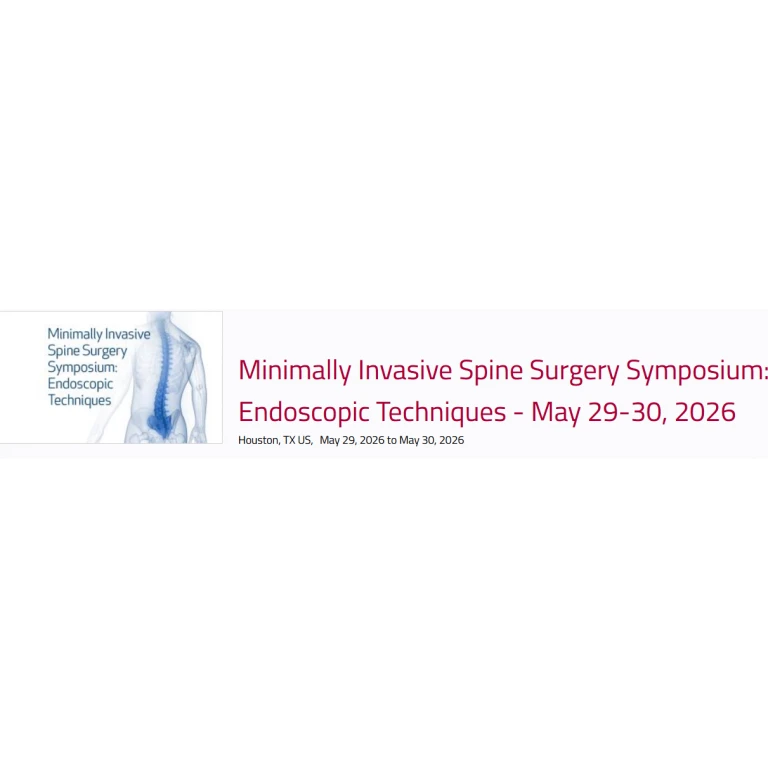
Houston Methodist Minimally Invasive Spine Surgery Symposium: Endoscopic Techniques 2026

$10.00
This Product is shared via google drive download link, So please share your correct Gmail id while placing the order .Please note that there are no CME points or certificate associated with this course Samples for Courses Can be found here : Free Samples Here!
EXPRESS DISCOVER PayPal
Houston Methodist Minimally Invasive Spine Surgery Symposium: Endoscopic Techniques 2026
9 Videos + Subtitles | Lumbar • Thoracic • Cervical Endoscopic Spine Surgery
Advance your understanding of endoscopic and minimally invasive spine surgery with the Houston Methodist Minimally Invasive Spine Surgery Symposium: Endoscopic Techniques 2026.
Held May 29–30, 2026, at the Houston Methodist Research Institute in Houston, Texas, this focused educational symposium was designed for orthopedic and neurological surgeons specializing in spinal disorders.
The program concentrates on the technical principles of modern spinal endoscopy, including:
- Lumbar endoscopy
- Interlaminar lumbar discectomy
- Transforaminal lumbar endoscopy
- Endoscopic lumbar discectomy
- Thoracic endoscopic discectomy
- Thoracic docking and anatomy
- Posterior cervical decompression
- Posterior cervical foraminotomy
- Cervical stenosis
- Cervical myelopathy
- Spontaneous CSF leaks
- Endoscope ergonomics
- Patient and pathology selection
- Surgical approach selection
- Technical pitfalls
- Complication avoidance
The MedicalAmboss digital package contains 9 expert video presentations with accompanying subtitle files and approximately 2 hours 37 minutes of educational content.
Package Includes
- 9 Expert Video Presentations
- Video + Subtitle Files
- Approx. 2 Hours 37 Minutes
- Download & Watch Offline
- Digital Delivery via Google Drive
- No PDFs
- No Presentation Slides
- No Syllabus Files
- No Handouts
Important Package Notice
VIDEOS + SUBTITLES ONLY
This package does not include:
- PDF files
- PowerPoint slides
- Presentation handouts
- Syllabus documents
- Workshop materials
Only the available recorded video presentations and accompanying subtitle files are included.
Course Details
- Course: Minimally Invasive Spine Surgery Symposium: Endoscopic Techniques
- Provider: Houston Methodist
- Year: 2026
- Dates: May 29–30, 2026
- Venue: Houston Methodist Research Institute
- Location: Houston, Texas, USA
- Primary Specialty: Neurosurgery / Spine Surgery
- Additional Specialty: Orthopedic Spine Surgery
- Package: 9 Videos + Subtitle Files
- Duration: Approximately 2 Hours 37 Minutes
- Delivery: Google Drive
- PDFs / Slides / Handouts: Not Included
- CME / Certificate with MedicalAmboss: Not Included
Course Overview
Endoscopic spine surgery has become an important area within contemporary minimally invasive spinal surgery.
Compared with conventional open exposure, endoscopic approaches can require a different understanding of:
- Surgical anatomy
- Endoscopic visualization
- Working corridors
- Instrument orientation
- Docking
- Endoscope handling
- Ergonomics
- Pathology selection
- Approach selection
The Houston Methodist symposium was developed to help spine surgeons better understand these technical nuances and determine when an endoscopic approach may be appropriate.
A practical framework is:
Identify Pathology → Select Patient → Choose Approach → Understand Anatomy → Establish Working Corridor → Perform Decompression → Avoid Pitfalls → Assess Outcome
Learning Objectives
After reviewing the program, learners should be better able to:
- Discuss endoscopic approaches to the cervical spine.
- Review endoscopic approaches to the thoracic spine.
- Review endoscopic approaches to the lumbar spine.
- Identify spinal pathologies that may be suitable for endoscopic treatment.
- Select an appropriate endoscopic approach according to pathology and anatomy.
- Review interlaminar lumbar endoscopy.
- Review transforaminal lumbar endoscopy.
- Understand thoracic endoscopic discectomy principles.
- Review posterior cervical decompression techniques.
- Understand important endoscopic anatomical landmarks.
- Improve endoscope ergonomics and operating-room positioning.
- Recognize common technical pitfalls.
- Review potential complications associated with endoscopic spine surgery.
- Understand endoscopic concepts related to spontaneous CSF leak treatment.
Complete MedicalAmboss Video Curriculum
1. Lumbar Interlaminar Discectomy
Runtime: 18:41
This presentation reviews the lumbar interlaminar approach for endoscopic discectomy.
The interlaminar corridor can provide access to selected lumbar disc pathology through a posterior approach.
Topics relevant to this technique include:
- Interlaminar anatomy
- Entry-point selection
- Endoscopic orientation
- Ligamentous anatomy
- Neural structures
- Disc access
- Decompression
- Working-channel progression
- Technical choke points
Lumbar Interlaminar Anatomy
Understanding the posterior lumbar anatomy is essential.
Important structures include:
- Lamina
- Interlaminar window
- Ligamentum flavum
- Facet joint
- Traversing nerve root
- Dural sac
- Disc space
The relationship among these structures determines how safely an endoscopic working corridor can be established.
Interlaminar Endoscopic Discectomy
A conceptual sequence can be summarized as:
Identify Level → Position Patient → Establish Entry → Dock → Visualize Anatomy → Protect Neural Structures → Access Disc → Decompress → Confirm Adequacy
The exact technique depends on pathology and surgeon training.
2. Transforaminal Lumbar Endoscopy
Runtime: 18:51
This presentation focuses on transforaminal endoscopic access to the lumbar spine.
The transforaminal route uses a lateral/posterolateral corridor to reach selected spinal pathology.
Transforaminal Approach
Relevant anatomical considerations include:
- Neural foramen
- Exiting nerve root
- Traversing nerve root
- Superior articular process
- Pedicle
- Disc space
- Foraminal boundaries
Successful endoscopic treatment requires accurate understanding of these relationships.
Patient & Pathology Selection
Not every disc herniation or stenotic lesion is approached in the same way.
Important questions include:
- Where is the pathology located?
- Is it central, paracentral, foraminal, or extraforaminal?
- Which nerve root is affected?
- Which corridor offers the safest access?
- Is an interlaminar or transforaminal route more appropriate?
This is one of the central themes of the Houston Methodist symposium.
Foraminoplasty Concepts
In selected transforaminal procedures, enlargement or modification of the foraminal working corridor may be required.
This requires careful knowledge of:
- Foraminal anatomy
- Facet anatomy
- Neural structures
- Bone removal
- Instrument trajectory
3. Ergonomics in Endoscopic Spine Surgery
Runtime: 24:26
Endoscopic spine surgery is not only an anatomical challenge.
It is also an ergonomic challenge.
This session reviews endoscope ergonomics and surgeon self-preservation.
Endoscopic Ergonomics
Important considerations include:
- Monitor position
- Surgeon posture
- Hand position
- Instrument alignment
- Endoscope orientation
- Table height
- Operating-room setup
- Repetitive strain
- Procedure duration
Poor ergonomics may affect both:
- Surgeon fatigue
- Technical precision
Monitor & Instrument Alignment
Unlike traditional open surgery, the surgeon frequently operates while viewing a monitor rather than directly looking at the operative field.
This creates a need to coordinate:
Eyes → Hands → Endoscope → Instruments → Monitor
A well-designed operating setup can reduce unnecessary movement and cognitive load.
Surgeon Self-Preservation
Long-term spine practice can expose surgeons to:
- Neck strain
- Back strain
- Shoulder fatigue
- Hand fatigue
- Static posture
Ergonomic planning is therefore an important component of sustainable endoscopic practice.
4. Endoscopic Thoracic Discectomy
Runtime: 19:16
Thoracic disc pathology represents a technically challenging area because of:
- Spinal cord proximity
- Limited working space
- Thoracic anatomy
- Neurologic risk
This presentation reviews endoscopic concepts for thoracic disc surgery.
Thoracic Disc Herniation
Thoracic disc herniations are less common than lumbar disc herniations but may produce:
- Axial thoracic pain
- Radicular symptoms
- Myelopathy
- Spinal cord compression
- Neurologic deficits
Approach selection depends heavily on the location and morphology of the pathology.
Endoscopic Thoracic Approach
Important concepts include:
- Thoracic anatomy
- Docking
- Safe working corridor
- Disc localization
- Neural protection
- Decompression
- Instrument control
The narrow anatomical environment makes careful planning especially important.
5. Cervical Stenosis & Myelopathy
Runtime: 19:15
This session focuses on cervical pathology associated with:
- Stenosis
- Neural compression
- Myelopathy
Cervical Spinal Stenosis
Cervical stenosis may cause compression of:
- Spinal cord
- Nerve roots
- Both structures
Clinical presentation may include:
- Neck pain
- Radicular symptoms
- Hand dysfunction
- Gait disturbance
- Weakness
- Myelopathic signs
Cervical Myelopathy
Cervical myelopathy is particularly important because spinal cord dysfunction can progress if significant compression persists.
Evaluation may involve:
- Neurologic examination
- MRI
- Assessment of compression
- Alignment
- Stability
- Functional impairment
The surgical strategy should reflect the individual anatomy and pathology.
Endoscopic Cervical Decompression
The symposium reviews posterior endoscopic approaches that may be useful for selected cervical pathology.
The goal is:
Adequate Neural Decompression While Minimizing Unnecessary Tissue Disruption
6. Thoracic Discectomy: Docking & Anatomy
Runtime: 12:40
This presentation provides a focused review of thoracic docking and surgical anatomy.
Correct docking is one of the key steps in endoscopic spine surgery because the initial working position influences the entire procedure.
Endoscopic Docking
Docking refers to establishing the endoscopic working position relative to the intended anatomical target.
Successful docking requires:
- Imaging correlation
- Correct spinal level
- Proper trajectory
- Anatomical understanding
- Controlled instrument placement
An incorrect trajectory can make the procedure unnecessarily difficult or unsafe.
Thoracic Anatomy
The thoracic spine presents unique anatomical challenges involving:
- Ribs
- Facets
- Pedicles
- Spinal canal
- Neural structures
- Pleural structures
- Thoracic disc space
Understanding the three-dimensional anatomy is essential.
7. Posterior Cervical Foraminotomy
Runtime: 14:16
Posterior cervical foraminotomy is a decompression technique used for selected cervical nerve-root compression.
The presentation reviews the procedure through an endoscopic perspective.
Cervical Foraminal Anatomy
Important structures include:
- Cervical facet joint
- Lamina
- Foramen
- Exiting nerve root
- Ligamentous structures
The goal is to create adequate decompression while preserving important stabilizing anatomy whenever possible.
Cervical Radiculopathy
Patients with foraminal nerve-root compression may present with:
- Neck pain
- Arm pain
- Numbness
- Paresthesia
- Weakness
Imaging and clinical findings must correlate before operative treatment is selected.
Posterior Cervical Decompression
A conceptual workflow includes:
Identify Level → Establish Posterior Corridor → Visualize Anatomy → Perform Controlled Bony Decompression → Identify Nerve Root → Confirm Adequate Decompression
8. Endoscopic Lumbar Discectomy
Runtime: 15:47
This presentation reinforces the fundamental concepts of lumbar endoscopic discectomy.
Lumbar Disc Herniation
Lumbar disc herniation can produce:
- Low back pain
- Radicular leg pain
- Sensory symptoms
- Motor weakness
- Nerve-root compression
The decision to perform surgery depends on clinical presentation, imaging, duration, severity, and response to non-operative treatment.
Endoscopic Lumbar Decompression
Potential advantages of an endoscopic approach in appropriately selected patients may include a smaller working corridor and reduced tissue disruption.
However, treatment success depends heavily on:
- Correct indication
- Appropriate approach
- Anatomy
- Technical expertise
- Adequate decompression
Interlaminar vs. Transforaminal Endoscopy
One of the key decisions in lumbar endoscopic surgery is selecting the appropriate route.
Interlaminar
Posterior approach through the interlaminar window.
Transforaminal
Posterolateral approach through the neural foramen.
The ideal approach depends on:
- Level
- Herniation location
- Foraminal anatomy
- Neural anatomy
- Surgeon experience
9. Endoscopic Treatment of Spontaneous CSF Leaks
Runtime: 14:01
This specialized presentation reviews the use of endoscopic techniques in the evaluation and treatment of spontaneous cerebrospinal fluid leaks.
Spontaneous CSF Leak
Spontaneous spinal CSF leaks can be associated with:
- Intracranial hypotension
- Orthostatic headache
- Neurologic symptoms
- Spinal fluid collections
Localization can be technically challenging.
Endoscopic Treatment Concepts
The lecture explores an advanced endoscopic approach to selected leak pathology.
Important considerations include:
- Accurate localization
- Relevant spinal anatomy
- Leak mechanism
- Surgical access
- Dural structures
- Avoidance of neural injury
This represents one of the most specialized topics in the MedicalAmboss video package.
Official Houston Methodist Program Topics
The original Houston Methodist program also included sessions on:
- Uniportal interlaminar and transforaminal targeting
- Endoscopic treatment of spontaneous CSF leaks
- Uniportal vs. biportal endoscopy
- Endoscopic laminectomy / ULBD
- Endoscopic spine surgery from a deformity-surgeon perspective
- Lumbar interlaminar discectomy
- Lumbar transforaminal endoscopy
- Endoscopic ergonomics
- Posterior cervical decompression
- Thoracic endoscopic discectomy
- Live demonstrations
- Hands-on laboratory training
Important Package Distinction
The MedicalAmboss package contains 9 available recorded presentations only.
It should not be described as including:
- The hands-on laboratory
- All original symposium lectures
- In-person workshop access
- Live surgical skills training
unless those components are actually present in the delivered files.
Cervical, Thoracic & Lumbar Endoscopy
A major strength of the symposium is that it does not focus on only one spinal region.
The course includes endoscopic approaches involving:
Cervical Spine
- Cervical stenosis
- Myelopathy
- Posterior decompression
- Foraminotomy
Thoracic Spine
- Thoracic disc herniation
- Thoracic discectomy
- Docking
- Thoracic anatomy
Lumbar Spine
- Interlaminar discectomy
- Transforaminal endoscopy
- Lumbar discectomy
- Nerve-root decompression
Pathology Selection
One of the most important concepts in endoscopic spine surgery is determining which pathology is suitable for a particular endoscopic technique.
The decision should incorporate:
- Clinical symptoms
- Neurologic findings
- MRI / CT findings
- Pathology location
- Spinal level
- Canal anatomy
- Foraminal anatomy
- Stability
- Previous surgery
- Surgeon experience
Approach Selection
A technically possible approach is not automatically the optimal approach.
Surgeons should determine:
Where Is the Pathology? → What Structure Requires Decompression? → Which Corridor Provides the Safest Access?
The choice may differ for:
- Central lumbar disc herniation
- Foraminal pathology
- Thoracic disc disease
- Cervical foraminal stenosis
- Cervical central stenosis
Technical Pitfalls
Endoscopic procedures involve a learning curve.
Potential challenges can include:
- Incorrect docking
- Poor orientation
- Inadequate visualization
- Insufficient decompression
- Neural manipulation
- Inappropriate trajectory
- Limited working space
- Instrument conflict
- Surgeon fatigue
The Houston Methodist curriculum specifically emphasizes identification of common pitfalls and complications.
Complication Awareness
Potential complications of spine surgery vary according to anatomy and procedure.
Relevant concerns can include:
- Neural injury
- Dural injury
- CSF leak
- Hematoma
- Infection
- Inadequate decompression
- Recurrent symptoms
- Vascular injury
- Procedure-specific complications
Recorded educational material should therefore complement—not replace—formal procedural training.
Endoscopic Spine Surgery Learning Curve
Spine endoscopy requires development of skills that may differ from conventional open or microscopic surgery.
These include:
- Two-dimensional monitor-based visualization
- Endoscope orientation
- Working-channel instrumentation
- Docking
- Continuous anatomical orientation
- Endoscopic hemostasis
- Ergonomic control
A structured training pathway can be summarized as:
Anatomy → Observation → Simulation / Lab → Mentorship → Selected Cases → Progressive Complexity
Major Topics Covered
- Endoscopic Spine Surgery
- Minimally Invasive Spine Surgery
- MISS
- Spine Endoscopy
- Lumbar Endoscopy
- Lumbar Discectomy
- Endoscopic Lumbar Discectomy
- Interlaminar Discectomy
- Lumbar Interlaminar Approach
- Transforaminal Endoscopy
- Transforaminal Discectomy
- Foraminoplasty
- Thoracic Endoscopy
- Thoracic Discectomy
- Thoracic Docking
- Cervical Endoscopy
- Cervical Decompression
- Posterior Cervical Foraminotomy
- Cervical Stenosis
- Cervical Myelopathy
- Nerve Root Decompression
- Spinal Stenosis
- CSF Leak
- Spontaneous CSF Leak
- Endoscopic Ergonomics
- Spine Surgery Anatomy
- Surgical Approach Selection
- Endoscopic Complications
Who Should Take This Course?
The official Houston Methodist target audience includes:
- Neurosurgeons
- Orthopedic Surgeons
- Fellows
- Residents
The MedicalAmboss package is particularly relevant for:
- Spine Surgeons
- Neurosurgeons
- Orthopedic Spine Surgeons
- Neurosurgery Fellows
- Orthopedic Spine Fellows
- Neurosurgery Residents
- Orthopedic Surgery Residents
- Surgeons interested in minimally invasive spine surgery
- Surgeons studying spinal endoscopy
- Qualified healthcare professionals involved in spine surgery education
Why This Course Is Useful
The Houston Methodist Minimally Invasive Spine Surgery Symposium: Endoscopic Techniques 2026 provides a concentrated review of technically important spine-endoscopy topics.
Learners can review:
- Lumbar interlaminar techniques
- Lumbar transforaminal techniques
- Endoscopic lumbar discectomy
- Thoracic disc surgery
- Thoracic docking
- Cervical decompression
- Cervical foraminotomy
- Cervical myelopathy
- Endoscopic ergonomics
- Spontaneous CSF leak treatment
- Patient selection
- Approach selection
- Technical pitfalls
The curriculum progresses logically through:
Lumbar → Ergonomics → Thoracic → Cervical → Advanced Endoscopic Applications
Original Houston Methodist Accreditation
The original Houston Methodist live activity was designated for a maximum of:
3.00 AMA PRA Category 1 Credits™
Houston Methodist is accredited by the Accreditation Council for Continuing Medical Education (ACCME) to provide continuing medical education for physicians.
Important MedicalAmboss CME Notice
The MedicalAmboss digital package does not include:
- CME credit
- Official Houston Methodist CME claim
- CME certificate
- Attendance certificate
Therefore, do not advertise the MedicalAmboss files as:
- 3 CME Credits Included
- Houston Methodist CME Certificate Included
- Official CME Access Included
The accurate wording is:
Original Houston Methodist Activity: Up to 3.00 AMA PRA Category 1 Credits™
and separately:
MedicalAmboss Digital Package: CME / Certificate Not Included
Important Training Notice
Endoscopic cervical, thoracic, and lumbar spine procedures are advanced surgical techniques.
Recorded videos and subtitles are intended for professional education and do not replace:
- Accredited neurosurgical or orthopedic training
- Hands-on laboratory experience
- Supervised procedural training
- Institutional credentialing
- Proctoring
- Patient-specific surgical judgment
The original Houston Methodist virtual option specifically did not include the hands-on workshops, and the MedicalAmboss package contains recorded videos only.
Product / Delivery Information
- Product: Houston Methodist Minimally Invasive Spine Surgery Symposium: Endoscopic Techniques 2026
- Provider: Houston Methodist
- Dates: May 29–30, 2026
- Specialty: Neurosurgery / Orthopedic Spine Surgery
- Videos: 9
- Subtitles: Included
- Duration: Approximately 2 Hours 37 Minutes
- Delivery: Google Drive
- Offline Viewing: Available after download
- PDF Files: Not Included
- Presentation Slides: Not Included
- Syllabus: Not Included
- Handouts: Not Included
- CME Points: Not Included
- Certificate: Not Included
4. Short Description
Houston Methodist Minimally Invasive Spine Surgery Symposium: Endoscopic Techniques 2026 provides focused education in cervical, thoracic, and lumbar endoscopic spine surgery.
The MedicalAmboss package includes 9 expert videos + subtitle files with approximately 2 hours 37 minutes of content covering lumbar interlaminar discectomy, transforaminal lumbar endoscopy, endoscopic ergonomics, thoracic discectomy, cervical stenosis and myelopathy, thoracic docking and anatomy, posterior cervical foraminotomy, endoscopic lumbar discectomy, and spontaneous CSF leak treatment.
| Select | Full course Videos+Qbank, Only Videos, Only Qbank |
|---|
Related products

Anesthesiology & pain medicine

Orthopaedic

Medical Accounts
Anesthesiology & pain medicine