
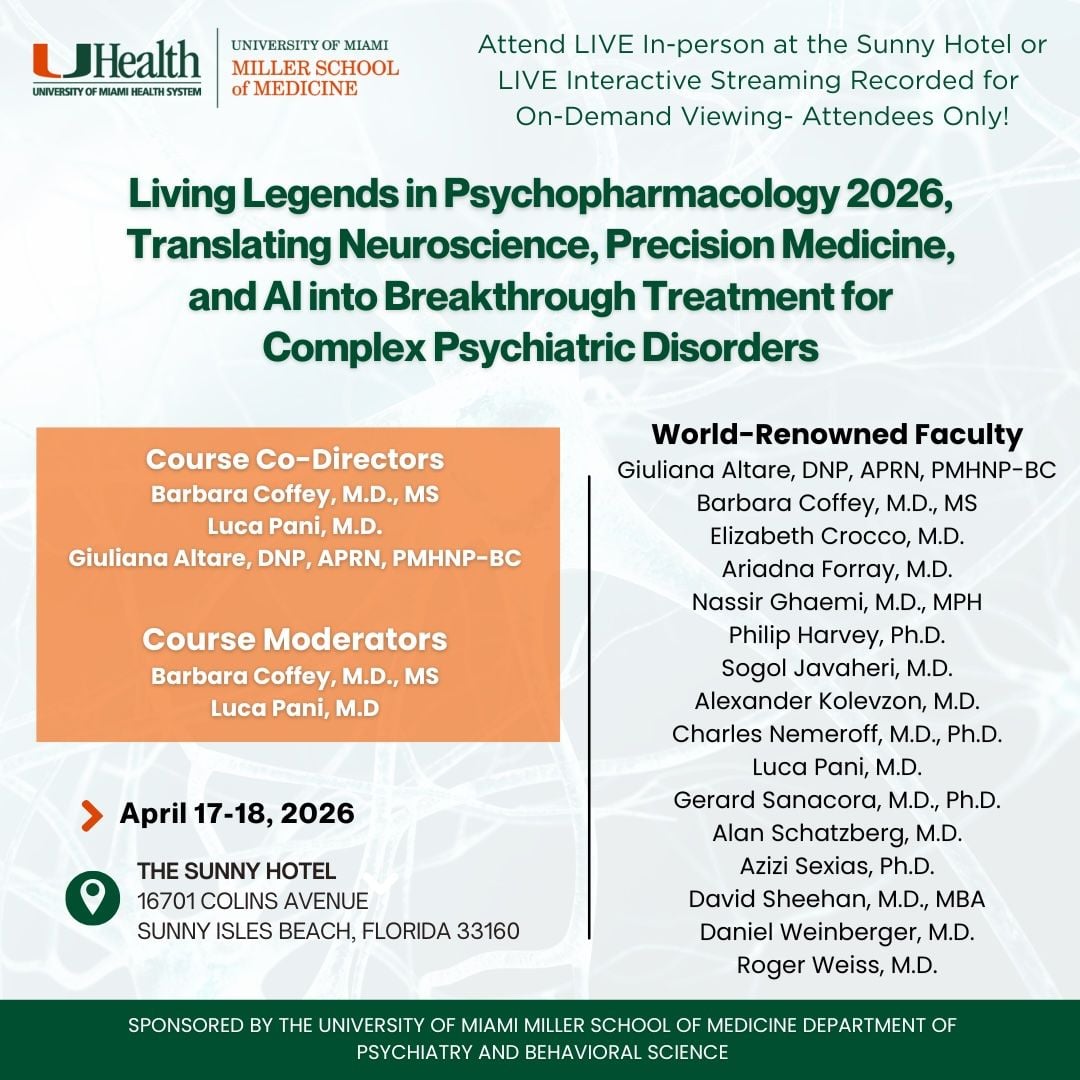
University of Miami Living Legends in Psychopharmacology 2026
$15.00
Explore psychopharmacology across the lifespan, from pediatric and reproductive mental health to geriatric care. University of Miami faculty and guest speakers discuss treatment resistance, genetics, neuromodulation, sleep, addiction, and artificial intelligence, connecting clinical neuroscience with decisions about individualized psychiatric treatment and monitoring.
Delivery Information: This Product is shared via google drive download link. Please use your correct Gmail address at checkout.
Please note: there are no CME points or certificate associated with this course.
Samples for Courses Can be found here: Free Samples Here!
Living Legends in Psychopharmacology brings together clinical neuroscience and psychiatric treatment across the lifespan. The University of Miami Miller School of Medicine conference was held on April 17–18, 2026, in Sunny Isles Beach, Florida, with Barbara J. Coffey and Luca Pani as co-directors. Its program examines mood and anxiety disorders, treatment resistance, pediatric and geriatric care, reproductive mental health, autism, sleep, and substance use. Sessions also consider genetics, digital phenotyping, neuromodulation, psychedelics, and the ethical use of artificial intelligence. The material is aimed at psychiatrists and other mental health clinicians evaluating emerging evidence and its implications for individualized treatment.
Learning Objectives
-
Apply principles of personalized psychiatry to optimize psychotropic medication regimens in treatment-resistant patients.
-
Evaluate and implement evidence-based use of cutting-edge therapies.
-
Integrate current neurobiological insights into the diagnosis and treatment planning of complex psychiatric conditions.
-
Select and sequence appropriate pharmacologic and somatic treatments for major depressive disorder, schizophrenia, and bipolar disorder.
-
Translate emerging clinical research into practical decision-making tools for the treatment of complex psychiatric cases.
-
Formulate individualized treatment plans for anxiety disorders and PTSD.
-
Design safe and effective psychopharmacologic treatment strategies for women across the reproductive lifespan.
-
Interpret and apply recent findings in pediatric, adolescent, and geriatric psychiatry to inform age-appropriate diagnosis, medication selection, and monitoring strategies.
-
Assess and treat autism spectrum disorders using advanced pharmacologic approaches.
-
Diagnose and manage sleep disorders and substance use disorders with a focus on neurobiological mechanisms, risk mitigation, and integrated pharmacologic and behavioral treatments.
-
Translate emerging clinical research into practical decision-making tools for the treatment of complex psychiatric cases.
-
Demonstrate enhanced clinical communication and therapeutic alliance skills that support adherence, safety, and patient-centered care in psychopharmacologic practice.
-
Analyze the ethical implications of integrating artificial intelligence in psychiatric care, focusing on data privacy, algorithmic biases, and the preservation of the therapeutic alliance, while identifying strategies to ensure that AI tools enhance, rather than replace, patient-centered care.
The original conference listed up to 15 AMA PRA Category 1 Credits. Those credits are not included with this purchase. Session titles describe the original educational scope and do not independently confirm every recording in the store package.
+ Topics:
- 01 New Vistas in the Treatment of Mood & Anxiety Disorders – Psychedelics, Neuromodulation and More
- 02 Young Brains Current Evidence and Innovations in Pediatric and Adolescent Psychopharmacology
- 03 Hormones and the Mind – Psychopharmacology Across the Female Reproductive Lifespan
- 04 Caring for the Aging Mind – Psychopharmacologic Approaches in Geriatric Psychiatry
- 05 Advances in Pharmacological Treatments in Serious Mental Illness – Decoding the Breadth of Treatment Effects With Accessible Digital Phenotyping
- 06 Beyond Behavior – Pharmacologic and Neurobiological Advances in Treating Autism Spectrum Disorder
- 07 From Mesmer to Psychedelics – Appreciating the Contributions of Contextual Factors to Treatment Response
- 08 Improving Outcomes in Treatment-Resistant Depression Through Personalized, Evidence-Based Strategies
- 08 Personalizing Psychopharmacology Through Genetics and Artificial Intelligence
- 09 From Synapse to Symptom to Disease – Nosology and Pathogenesis as the Foundation for Psychiatric Treatment
- 10 Depression Decoded – Inflammation, Neurocircuitry, and Breakthrough Treatments for Difficult-to-Treat Mood Disorders
- 11 Navigating the Future – Ethical Challenges and Considerations of Artificial Intelligence in Psychiatric Care
- 13 Restoring Rest – Neurobiological and Pharmacologic Strategies for Sleep Disorders in Psychiatric Practice
- 14 Dual Diagnosis in Focus – Treating Co-Occurring Psychiatric and Substance Use Disorders
- 15 The Risks and Benefits of Benzodiazepines – A Balanced Update
Co-Directors and Faculty
-
Barbara J. Coffey, MD, MS
-
Luca Pani, MD
Featured Faculty and Speakers
-
Nassir Ghaemi, MD, MPH
-
Ariadna Forray, MD
-
Elizabeth Crocco, MD
-
Philip Harvey, PhD
-
Alexander Kolevzon, MD
-
Gerard Sanacora, MD, PhD
-
Daniel Weinberger, MD
-
Charles Nemeroff, MD, PhD
-
Alan Schatzberg, MD
-
Azizi Seixas, PhD
-
Sogol Javaheri, MD, MPH
-
Roger D. Weiss, MD
-
David V. Sheehan, MD, MBA
-
Giuliana Altare, DNP, APRN, PMHNP-BC

Related products
Medical Accounts
Internal Medicine
Critical Care - Emergency medicine

USMLE / kaplan and Board Review
Uworld USMLE COMLEX Level 1 Qbank, Updated Jan 2023, System- and Subject-wise (PDF)
Internal Medicine
Internal Medicine

Internal Medicine
Critical Care - Emergency medicine
ASN Critical Care Nephrology – 2022 Update (On-Demand and Livestream)