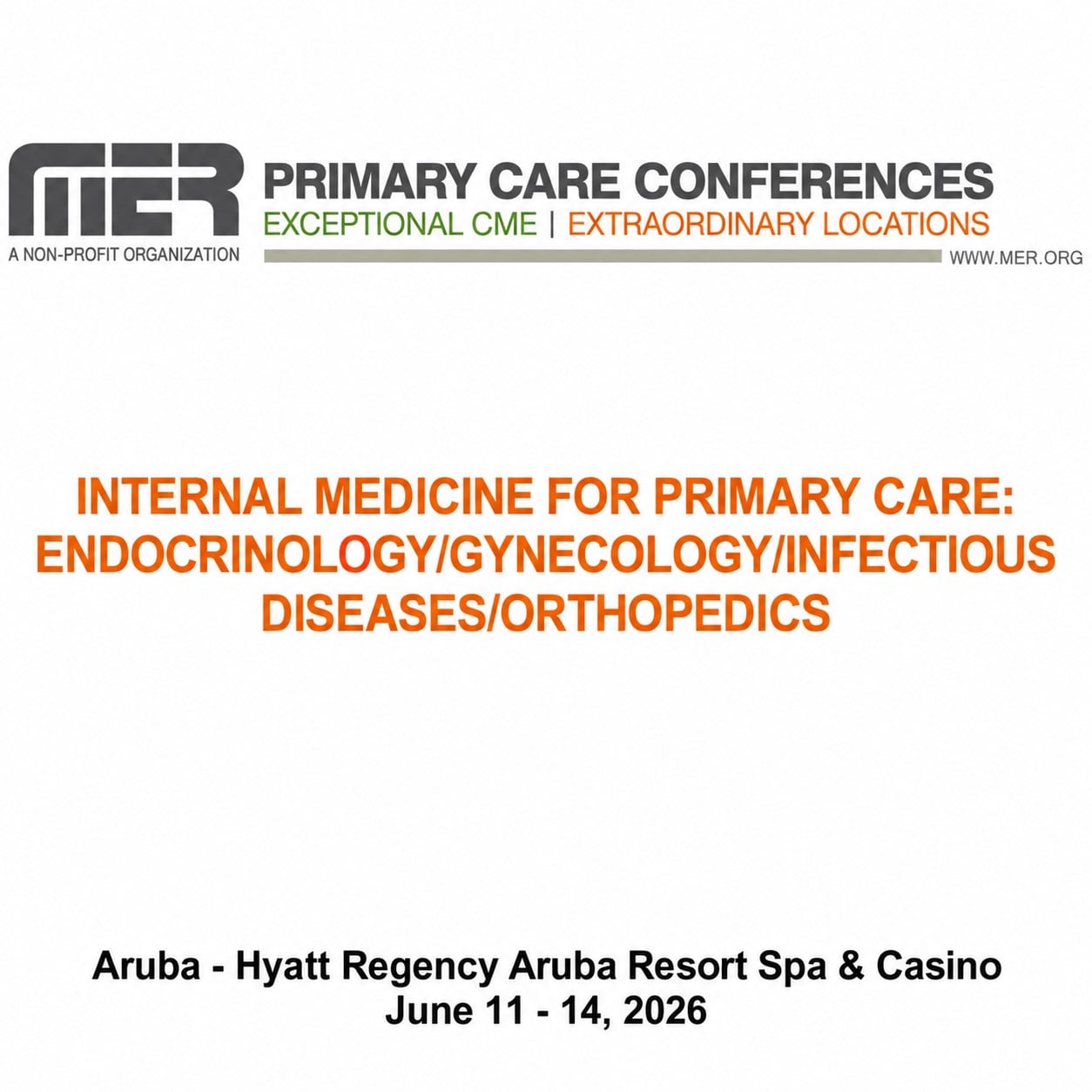
MER Primary Care Conferences Internal Medicine for Primary Care: Endocrinology/Gynecology/Infectious Diseases/Orthopedics 2026
Comprehensive Primary Care Update – Endocrinology, Gynecology, Infectious Diseases & Orthopedics
Stay current with important developments in internal medicine and primary care through the MER Primary Care Conferences – Internal Medicine for Primary Care: Endocrinology/Gynecology/Infectious Diseases/Orthopedics 2026.
This multidisciplinary educational program provides practical updates across four major areas of primary care, with an emphasis on evidence-based diagnosis, treatment, and clinical decision-making.
Course Details
- Course: Internal Medicine for Primary Care: Endocrinology/Gynecology/Infectious Diseases/Orthopedics
- Year: 2026
- Dates: June 11–14, 2026
- Venue: Hyatt Regency Aruba Resort Spa & Casino, Aruba
- Provider: Medical Education Resources (MER)
- Specialties: Internal Medicine, Primary Care, Endocrinology, Gynecology, Infectious Diseases & Orthopedics
Course Overview
The program is designed for office-based primary care providers and healthcare professionals seeking clinically relevant updates in commonly encountered medical conditions.
The curriculum integrates updates in:
- Endocrinology
- Gynecology
- Infectious Diseases
- Orthopedics
Participants will review practical approaches to diabetes, osteoporosis, thyroid disorders, emerging infections, respiratory infections, diarrhea, healthcare-associated infections, musculoskeletal injuries, pelvic pain, contraception, and preconception care.
Endocrinology
Diabetes Mellitus
Review practical approaches to:
- Type 1 diabetes
- Type 2 diabetes
- Diabetes diagnosis
- Patient-specific treatment planning
- Tailoring treatment strategies
Osteoporosis
Explore:
- Osteoporosis management
- Bisphosphonate therapy
- Risks and benefits of bisphosphonates
- Evidence-based treatment considerations
Thyroid Disorders
Review:
- Abnormal thyroid function
- Clinical implications of thyroid disorders
- Diagnostic considerations
- Treatment approaches
Infectious Diseases
The infectious disease component addresses common and emerging infections encountered in primary care.
Topics include:
Emerging Infectious Diseases
- Resurgence of vaccine-preventable diseases
- Zoonotic diseases
- Animal-associated infections
- Emerging infectious disease considerations
Respiratory Tract Infections
Review:
- Common respiratory pathogens
- Clinical evaluation
- Diagnosis
- Treatment considerations
Diarrhea
Learn how to:
- Assess the severity of diarrhea
- Identify patients requiring treatment
- Apply appropriate management strategies
Healthcare-Associated Infections
Identify patients at increased risk for healthcare-associated infections and recognize important risk factors.
Orthopedics
The orthopedic component focuses on common musculoskeletal problems encountered in primary care.
Shoulder Injuries
Learn approaches to:
- Evaluation of shoulder injuries
- Diagnosis
- Initial management
- Treatment strategies
Wrist, Hand & Finger Injuries
Review the assessment and management of common injuries involving:
- Wrist
- Hand
- Fingers
Knee
Understand:
- Knee anatomy
- Knee joint function
- Common knee conditions
- Clinical evaluation
Foot & Ankle
Recognize:
- Chronic injuries
- Common pain syndromes
- Clinical presentation
- Management considerations
Gynecology
Premenstrual Syndrome
Review the current diagnostic criteria and treatment options for PMOS in women, as presented in the program.
Pelvic Pain
Explore:
- Common causes of pelvic pain
- Differential diagnosis
- Appropriate evaluation
- Effective treatment options
Contraceptive Counseling
Develop approaches for counseling patients regarding:
- Complex contraceptive decisions
- Individual patient considerations
- Appropriate contraceptive choices
Preconception Care
Identify interventions that can be implemented before conception to help improve pregnancy outcomes.
Learning Objectives
Upon completion of this program, participants should be better able to:
- Develop patient-specific treatment plans for the management of type 2 diabetes.
- Diagnose and tailor treatment strategies for type 1 and type 2 diabetes.
- Identify the risks and benefits of utilizing bisphosphonates in osteoporosis treatment.
- Identify risks associated with abnormal thyroid function.
- Discuss emerging infectious diseases, including vaccine-preventable disease resurgence and zoonoses.
- Identify common pathogens responsible for respiratory tract infections.
- Evaluate the severity of diarrhea and determine the need for treatment.
- Identify patients at risk for healthcare-associated infections.
- Diagnose and treat shoulder injuries.
- Diagnose and treat wrist, hand, and finger injuries.
- Describe the anatomy and function of the knee joint.
- Recognize chronic foot and ankle injuries and pain syndromes.
- Describe current diagnostic criteria and treatment options for PMOS in women.
- Distinguish common causes of pelvic pain and utilize effective treatment options.
- Counsel patients regarding complex contraceptive decisions.
- Identify preconception interventions that can improve pregnancy outcomes.
Who Should Attend?
This program is targeted toward office-based primary care providers and other healthcare professionals seeking updates in primary care medicine.
Best For
- Internists
- Primary Care Physicians
- Endocrinologists
- Gynecologists
- Infectious Disease Specialists
- Orthopedists
Major Clinical Areas
- Internal Medicine
- Primary Care
- Endocrinology
- Diabetes Mellitus
- Osteoporosis
- Thyroid Disorders
- Infectious Diseases
- Respiratory Tract Infections
- Emerging Infectious Diseases
- Healthcare-Associated Infections
- Gynecology
- Pelvic Pain
- Contraception
- Preconception Care
- Orthopedics
- Shoulder Injuries
- Knee Disorders
- Wrist & Hand Injuries
- Foot & Ankle Disorders
Why This Course Is Valuable
The MER Internal Medicine for Primary Care 2026 program provides a broad, practical review of conditions frequently encountered in primary care.
Its multidisciplinary structure makes it particularly useful for clinicians who want to strengthen their knowledge across endocrinology, gynecology, infectious diseases, and musculoskeletal medicine while improving everyday diagnostic and treatment decisions.
4. Topics
Thursday, June 11, 2026
-
Endocrinology – Type 2 Diabetes Mellitus: Diagnosis and treatment; lessons from the DCCT; managing diabetic emergencies; screening; pre-diabetes.
-
Endocrinology – Insulin Therapy for Diabetes: Treating T2DM with insulin; T1DM.
-
Endocrinology – Osteoporosis: Review the epidemiology and pathophysiology of osteoporosis along with interpretation of DEXA scans and FRAX risk assessment; up-to-date therapeutic options.
-
Infectious Diseases – Emerging Infectious Diseases: Novel influenza viruses, resurgence of vaccine-preventable diseases, zoonoses and disease related to animal exposures (including vectors such as mosquitoes that bear west Nile virus and dengue), bioterrorism and food/waterborne illness.
-
Infectious Diseases – Respiratory Tract Infections: Discussion highlighting critical points regarding the diagnosis and management of pneumonia and bronchitis – with a focus on the impact of multidrug resistant pathogens.
Friday, June 12, 2026
-
Infectious Diseases – Gastrointestinal Infections & Clostridiodes Difficile: Presentation on important enteric pathogens and their recognition, diagnosis and management; special emphasis on clostridiodes difficile colitis and related updates from the ID and infection control literature.
-
Infectious Diseases – Healthcare-Associated Infections: Presentation on important pathogens in the healthcare setting and related clinical, epidemiologic and infection control information (please note that the discussion on blood-borne pathogens will NOT suffice for standard hospital CME requirements for BBP training).
-
Endocrinology – Disorders of Thyroid Function: Prevalence, diagnosis and treatment options of hypothyroidism and hyperthyroidism.
-
Orthopedics – The Shoulder: Anatomy, Common Injuries, and Exam Techniques: Rotator cuff syndrome; impingement, frozen shoulder; subacromail bursitis; bicipital tendonitis; A-C joint disease.
-
Orthopedics – Wrist, Hand, and Fingers: Carpal tunnel, CMC arthritis thumb, ganglion cyst, trigger finger, de Quervains disease.
Saturday, June 13, 2026
-
Orthopedics – The Knee: Anatomy, Common Injuries, and Exam Techniques: ACL, meniscus, MRI; common sports injuries; osteoarthritis and hyaluronan; bursitis: prepatellar, pesanserine; baker’s cyst; joint injection/X-ray interpretation; pediatrics.
-
Orthopedics – Ankle and Foot: This presentation will address a series of common acute and chronic injuries and pain syndromes to the foot and ankle as they would present in the primary care setting. The focus will be on developing a working differential diagnosis based on the historical mechanism of injury and exam findings.
-
Gynecology – Polyendocrine Metabolic Ovarian Syndrome (PMOS) Overview for Primary Care: Discussion of the normal balance of hormones (estrogen, progesterone and androgens) in the ovaries; Treatment of cysts and the regulation of menstrual cycles; Acne and hair growth; Treatment options and referral guidelines.
-
Gynecology – Endometriosis: Discussion of the most common caused of pelvic pain; Endometriosis, fibroids, and dysmenorrhea.
Sunday, June 14, 2026
-
Gynecology – Contraception: A Primary Care Review of Best Practice: Coverage of the effectiveness, side effects and non-contraceptive benefits of available contraceptive options in the U.S.; Discussion of contraceptive counseling that is patient-centric including communicating without coercion; Management strategies for medically complex contraceptive decisions (patients with a history of VTE, breast cancer, hypertension).
-
Gynecology – Preconception Counseling: Screening and evaluation prior to a planned pregnancy; Review of current recommendations for carrier testing and when to refer a patient for specialty evaluation prior to conception.