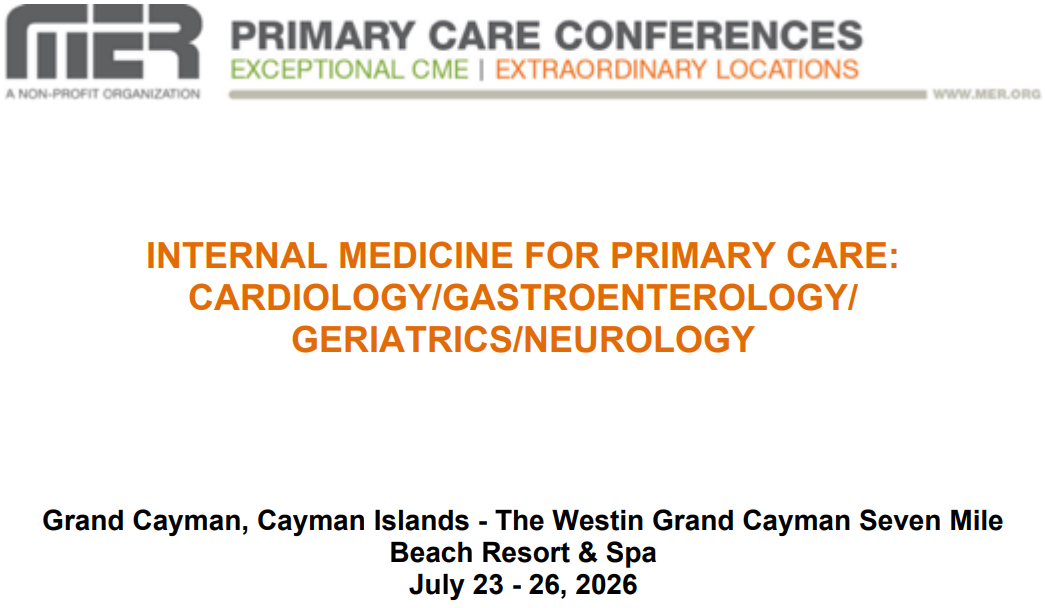

MER Internal Medicine for Primary Care: Cardiology, Gastroenterology, Geriatrics & Neurology 2026
Comprehensive Primary Care Review in Cardiology, Gastroenterology, Geriatrics & Neurology
The MER Internal Medicine for Primary Care: Cardiology, Gastroenterology, Geriatrics & Neurology 2026 program provides a multidisciplinary clinical review designed for primary care physicians and other healthcare professionals seeking practical updates across four major areas of internal medicine.
Organized by Medical Education Resources (MER), the conference was held from July 23 to July 26, 2026, at The Westin Grand Cayman Seven Mile Beach Resort & Spa in Grand Cayman, Cayman Islands.
This 16-credit-hour primary care program addresses frequently encountered clinical problems in cardiovascular medicine, gastroenterology and hepatology, geriatrics, and neurology.
The curriculum emphasizes evidence-based diagnosis, risk assessment, treatment selection, preventive care, and long-term patient management.
Course Details
- Provider: Medical Education Resources (MER)
- Course: Internal Medicine for Primary Care: Cardio/Gastro/Geri/Neuro
- Year: 2026
- Dates: July 23–26, 2026
- Location: The Westin Grand Cayman Seven Mile Beach Resort & Spa
- Location Region: Grand Cayman, Cayman Islands
- Credit Hours: 16
- Specialties: Internal Medicine, Cardiology, Gastroenterology, Geriatrics, Neurology
- Focus: Evidence-Based Primary Care Updates
Who Should Attend?
This program is targeted to office-based primary care providers and other healthcare professionals seeking updates in primary care medicine.
Best For
- Primary Care Physicians
- Internal Medicine Physicians
- Family Medicine Physicians
- Cardiologists
- Gastroenterologists
- Geriatricians
- Neurologists
- Nurse Practitioners
- Physician Assistants
- Other healthcare professionals involved in outpatient primary care
Gastroenterology & Hepatology
Lower Gastrointestinal Bleeding
Review current recommendations for evaluating and managing patients presenting with lower gastrointestinal bleeding.
Important clinical considerations include:
- Initial patient evaluation
- Severity assessment
- Appropriate diagnostic testing
- Management strategies
- Identification of patients requiring escalation of care
Colorectal Cancer Screening & Surveillance
Review current principles and guidelines related to:
- Colorectal cancer screening
- Colonoscopy
- Screening intervals
- Surveillance strategies
- Follow-up after abnormal findings
- Risk-based screening considerations
Celiac Disease
Review appropriate testing strategies for patients with suspected celiac disease.
Topics include:
- Clinical suspicion
- Appropriate laboratory testing
- Diagnostic evaluation
- Interpretation of results
- Selecting patients for additional gastrointestinal evaluation
Hepatitis B & Hepatitis C
Review current treatment recommendations and management considerations for:
- Hepatitis B virus infection
- Hepatitis C virus infection
- Diagnostic testing
- Treatment selection
- Long-term follow-up
Neurology
Weakness & Neurologic Assessment
Learn how to use history and physical examination to distinguish true neurologic weakness from nonspecific symptoms.
Clinical considerations include:
- Neurologic history
- Motor examination
- Functional assessment
- Differential diagnosis
- Identification of concerning findings
Alzheimer’s Disease
Review evidence-based approaches to Alzheimer’s disease including:
- Clinical recognition
- Diagnosis
- Cognitive assessment
- Treatment options
- Long-term patient management
- Supportive care considerations
Migraine & Headache Disorders
Develop a structured approach to patients presenting with headaches.
Review:
- Migraine diagnosis
- Headache differential diagnosis
- Acute treatment
- Preventive therapy
- Identification of secondary headache warning signs
Sleep Disorders
Review the spectrum of commonly encountered sleep disorders and available management strategies.
Topics include:
- Sleep disturbance assessment
- Common sleep disorders
- Diagnostic considerations
- Pharmacologic management
- Non-pharmacologic management
Geriatric Medicine
Comprehensive Geriatric Assessment
Review how comprehensive geriatric assessment can identify important health and functional issues in older adults.
Areas of assessment may include:
- Functional status
- Cognitive function
- Medication review
- Mobility
- Fall risk
- Social factors
- Comorbid disease
Lower Urinary Tract Symptoms & Urinary Incontinence
Review common lower urinary tract symptoms that may progress to urinary incontinence.
Clinical considerations include:
- Patient evaluation
- Differentiating common causes
- Initial treatment options
- Appropriate follow-up
Gait Disorders & Fall Prevention
Review strategies for evaluating patients with abnormal gait patterns.
Topics include:
- Gait assessment
- Balance
- Neurologic causes
- Musculoskeletal causes
- Medication-related risks
- Fall prevention strategies
Behavioral Symptoms of Dementia
Explore approaches to difficult behaviors in patients with dementia with an emphasis on non-pharmacologic management whenever appropriate.
Topics include:
- Behavioral assessment
- Environmental triggers
- Caregiver strategies
- Non-drug interventions
- Patient safety
- Avoiding unnecessary psychotropic medications
Cardiology
Coronary Artery Disease Prevention
Review preventive strategies designed to reduce cardiovascular risk.
Topics include:
- Lifestyle modification
- Lipid management
- Cholesterol guidelines
- Cardiovascular risk reduction
- Primary prevention of coronary artery disease
Suspected Coronary Artery Disease
Develop a structured diagnostic approach to patients with suspected CAD.
Review:
- Clinical risk assessment
- Symptom evaluation
- Test selection
- Appropriate cardiovascular investigations
- Risk stratification
Heart Failure
Review treatment strategies based on recent guidelines and evidence-based medicine.
Topics include:
- Heart failure assessment
- Pharmacologic management
- Guideline-directed therapy
- Patient monitoring
- Comorbidity management
- Long-term follow-up
Arrhythmias & Atrial Fibrillation
Review current approaches to the diagnosis and treatment of commonly encountered cardiac arrhythmias.
Topics include:
- Arrhythmia recognition
- Atrial fibrillation diagnosis
- Initial clinical assessment
- Rate-control strategies
- Rhythm-control considerations
- Stroke-risk assessment
- Long-term management
Learning Objectives
Upon completion of this program, participants should be better able to:
- List current treatment recommendations for the management of lower GI bleeding.
- Discuss guidelines for colonoscopic colorectal cancer screening and surveillance.
- Recommend appropriate testing for the workup of celiac disease.
- List current treatment recommendations for HBV and HCV.
- Utilize history and physical examination to distinguish weakness from non-specific symptoms.
- Discuss evidence-based management options for Alzheimer’s disease.
- Describe the differential diagnosis and treatment options for migraine headaches.
- Discuss the spectrum of sleep disorders and current management strategies.
- Utilize a comprehensive geriatric assessment to identify potential issues in elderly patients.
- Review common lower urinary tract symptoms that may progress to urinary incontinence and identify initial treatment options.
- Assess and manage gait disorders to help prevent falls.
- Discuss strategies for managing difficult behaviors in patients with dementia without unnecessary use of psychotropic medications.
- Implement lifestyle changes and lipid and cholesterol guidelines for the prevention of coronary artery disease.
- Describe the work-up, risk assessment, and test selection for patients with suspected CAD.
- Implement heart failure treatment strategies reflective of recent guidelines and evidence-based medicine.
- Describe current diagnostic and treatment approaches to arrhythmias and atrial fibrillation.
Major Clinical Topics
Cardiology
- Coronary Artery Disease
- Cardiovascular Risk Assessment
- Lipid Management
- Cholesterol Guidelines
- Heart Failure
- Arrhythmias
- Atrial Fibrillation
- Cardiovascular Prevention
Gastroenterology & Hepatology
- Lower GI Bleeding
- Colorectal Cancer Screening
- Colonoscopy Surveillance
- Celiac Disease
- Hepatitis B
- Hepatitis C
Geriatrics
- Comprehensive Geriatric Assessment
- Gait Disorders
- Fall Prevention
- Urinary Incontinence
- Lower Urinary Tract Symptoms
- Dementia
- Behavioral Symptoms of Dementia
Neurology
- Neurologic Weakness
- Alzheimer’s Disease
- Migraine
- Headache Disorders
- Sleep Disorders
- Neurologic Examination
Why This Course Is Valuable
The MER Internal Medicine for Primary Care Cardiology, Gastroenterology, Geriatrics & Neurology 2026 program combines four major specialties that frequently overlap in everyday primary care practice.
The curriculum provides clinicians with a practical review of gastrointestinal disease, neurologic complaints, cardiovascular risk and disease management, and common health problems affecting older adults.
It is particularly useful for practitioners seeking a broad 2026 Internal Medicine and Primary Care review emphasizing practical clinical decision-making and evidence-based patient management.
4. Short Description
The MER Internal Medicine for Primary Care: Cardiology, Gastroenterology, Geriatrics & Neurology 2026 program provides a 16-credit-hour multidisciplinary primary care review covering CAD, heart failure, arrhythmias, GI bleeding, colorectal cancer screening, hepatitis, Alzheimer’s disease, migraines, sleep disorders, gait disorders, dementia, and geriatric assessment.
Topics
Thursday, July 23, 2026
-
Management of Lower GI Bleeding- From Occult to Massive (Gastroenterology): The correct use and interpretation of tests for occult blood in the stool will be discussed in relation to lower GI bleeding; focus on the utility of different diagnostic and management approached to the spectrum of patients presenting with hematochezia.
-
Colorectal Cancer Screening and Surveillance (Gastroenterology): Reviews the most recent recommendations for CRC screening in the general population at average risk for CRC.
-
Celiac Disease and Chronic Diarrhea (Gastroenterology): Millions of Americans are now on a gluten free diet. Only some of them actually have Celiac disease. We will review the workup of diarrhea and malabsorption with a focus on celiac disease; We will discuss how to diagnose celiac disease when a patient is already on a gluten free diet and an appropriate differential diagnosis.
-
Evaluating Weakness (Neurology): Using the history and physical examination to distinguish weakness from non-specific symptoms; characteristics of neurological diseases that produce weakness; presentations of representative diseases of the nervous system.
-
Alzheimer’s & Other Dementias (Neurology): Definition; statistics; neurological changes of normal aging; pathology; etiological theories; vascular dementias; investigations; social issues; symptomatic treatment; research therapies.
Friday, July 24, 2026
-
Headaches & Migraines (Neurology): Basic headache mechanisms; headache history: characteristics, precipitating factors, medical conditions; migraine: common tension, classic, treatment, complicated, cluster, sinus; trigeminal neuralgia; Giant Cell Arteritis; brain tumor; subarachnoid hemorrhage; emergency room treatment.
-
Sleep Disorders (Neurology): Epidemiology; assessing sleep patterns; causes and treatment of insomnia; causes, evaluation and treatment of sleep apnea; symptoms and treatment of narcolepsy.
-
Hepatitis B and C Management (Gastroenterology): HBV screening: whom to screen, whom to vaccinate; management of patients with decompensated hepatitis B related liver disease; treatment in special populations.
-
Approach to the Geriatric Patient (Geriatrics): The demographics of aging and the physiologic changes in the elderly patient; Medication use in the elderly including changes in age-related pharmacokinetics and pharmacodymamics and medication adherence; Review of risky medications often used in elderly patients.
-
Urological Disorders in the Older Adult (Geriatrics): Review of two very common conditions seen in the elderly population: benign prostatic hyperplasia (BPH), and urinary incontinence; Pathogenesis, clinical symptoms, recommended evaluation and management options for BPH; Review of the anatomy and mechanism of normal urinary function, causes of incontinence, the evaluation and management.
Saturday, July 25, 2026
-
Geriatric Gait Disorders & Falls (Geriatrics): Diagnosing problems associated with gait abnormalities; considering causes and prevention of falls; exercise training, aerobics, balance training, resistance.
-
Managing Behavior Problems in Dementia Patients (Geriatrics): Review of common behavior disorders often seen in patients with dementia; Behavioral techniques which have shown to be effective in managing some of the behavior disorders in patients with Alzheimer’s and other dementias, focusing on the management of these patients without the use of psychotropic medications; Examples of behavior disturbances along with the behavior management technique which was effective in managing the patient with the behavior problem; Review of the potential adverse effects of the psychotropic medications usually used to manage behavior.
-
Primary Prevention of Cardiometabolic CVD (Cardiology): Definitions; AHA/ACC and other lipid guidelines updates; HDL Cholesterol: The good cholesterol?; Metabolic syndrome and/or obesity; Who needs treatment and how much; The role of lifestyle changes, exercise and cardiac rehabilitation; Drug therapy updates; Risk calculation; Role of pooled equations for risk estimates.
-
Work-up of Patients with Suspected CAD (Cardiology): Risk factor evaluation and risk assessment models; 2021 ACC/AHA Chest Pain Guidelines; Test selection including ECG, echo, nuclear and newer imaging modalities (including discussion of appropriate use criteria–AUC); The usefulness of CT scanning; The role of bio markers and EBCT; Suspected CAD in special populations (women, diabetics, the elderly).
Sunday, July 26, 2026
-
Heart Failure (Cardiology): Etiologies and stages of heart failure; ACC/AHA Heart Failure Guidelines; Heart failure with reduced EF (HFrEF) and heart failure with preserved EF (HFpEF); Determining patients for referral using biomarkers, eg NT Pro BNP; Treatment options: ACE inhibitors, ARBs, ARNI, beta blockers, mineralocorticoid receptor antagonists, SGLT2i; The role of devices (ICD and/or CRT) in treatment and antiplatelet drugs; Issues related to the hospitalized patient with acute decompensated heart failure and readmissions.
-
Arrhythmias (Cardiology): Types and symptoms of arrhythmias; Approach to the patient: when to treat, when to refer, when to admit; Evaluation of the patient with palpitations; Atrial fibrilation: the use of anticoagulants indications, CVA risk scores, warfarin vs newer oral anticoagulants, controlling heart rate vs rhythm; Ventricular and other arrhythmias: when are they serious.